PART 3: THE FOLDER THAT PROVED HE HAD BEEN LYING LONG BEFORE SHE SAT DOWN
My brother Nathan had never liked David.
Chapter 3
PART 3: THE FOLDER THAT PROVED HE HAD BEEN LYING LONG BEFORE SHE SAT DOWN
My brother Nathan had never liked David.
Not in a loud way. Not in a dramatic way. Nathan was worse than that.
He was polite.
For fifteen years, he shook David’s hand at birthdays, passed him serving dishes at Thanksgiving, asked about his business, brought wine to dinners, and watched him the way a careful man watches a candle burning too close to a curtain.
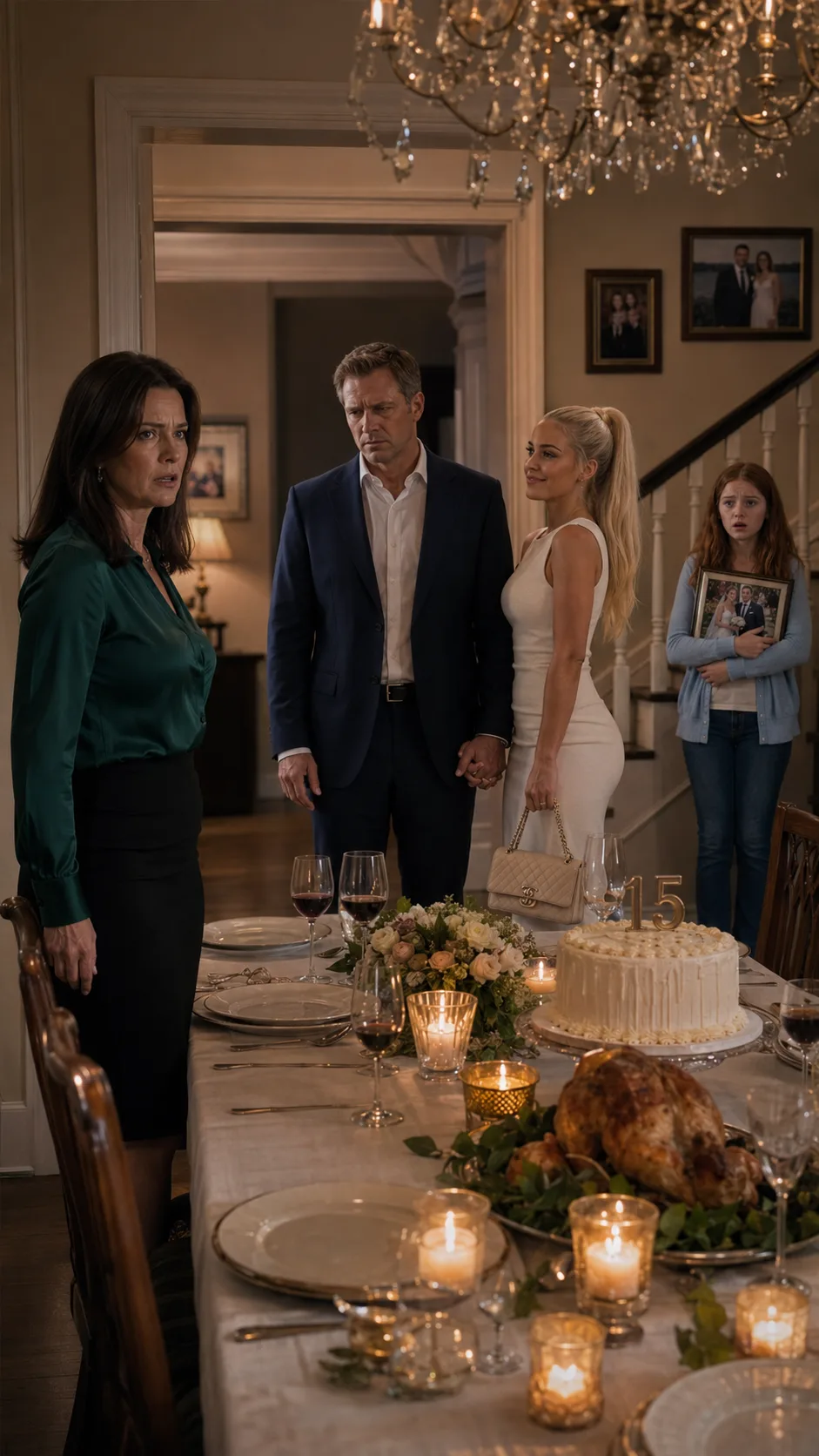
When I opened the front door, Nathan did not ask why Emma was crying. He did not ask why Chloe was standing in my dining room holding a cream handbag like it had become evidence. He did not ask why David looked like a man watching the ground split beneath him.
Nathan looked at my face once.
“So he did it tonight,” he said.
My stomach dropped.
David moved fast. “Nathan, this is family business.”
Nathan stepped inside.
“That’s funny,” he said. “You didn’t call it family business when you came to
me asking how to move money without Rachel noticing.”
The room went dead.
I turned slowly.
“What money?”
David’s face collapsed before he spoke.
Chloe whispered, “David?”
Nathan looked at me, and for the first time that night, I saw guilt on his face too.
“Rachel, I’m sorry,” he said. “I should have told you sooner. I thought he had stopped.”
My hand tightened around the velvet box.
“Stopped what?”
David raised both hands. “It wasn’t what it sounds like.”
Nathan gave a humorless laugh.
“It is exactly what it sounds like.”
He walked to the dining table and set the leather folder down beside the anniversary cake. He did not open it like a courtroom lawyer. Nathan was never theatrical. He simply removed one printed photograph and placed it on the table.
It showed David outside a small lakeside house.
A house I had never seen.
Beside him stood
Chloe.
Only she looked younger. Softer. Less polished. Her blonde hair was loose around her shoulders, and she wore jeans and a college sweatshirt.
The date printed at the bottom was four years old.
For a moment, I could not understand what I was looking at. My mind rejected it the way a body rejects poison.
Four years.
Chloe stared at the photograph.
“You said you met me last year,” she whispered.
David closed his eyes.
Nathan said, “No. He didn’t.”
Chloe’s head snapped toward David.
“What is this?”
David opened his mouth, but no words came.
I picked up the photograph. The edges bent slightly beneath my fingers.
Suddenly, Chloe was not a new mistake. Not a midlife crisis. Not some sudden storm that had blown through my door.
She had been weather inside my marriage for four years.
Emma whispered, “Four years?”
David looked at our daughter, and
whatever defense he had built died there.
“I was lonely,” he said.
That was the word he chose.
Lonely.
In the house I built with him. Beside the woman who sold her inheritance to keep him standing. Across from the child who had believed he hung the moon until less than an hour ago.
Nathan’s voice was quiet.
“There’s more.”
I almost told him to stop.
There are moments when truth does not feel like freedom. It feels like a second house collapsing while you are still trapped inside the first.
But Emma stepped beside me and took my hand.
So I nodded.
Nathan pulled out another photograph.
This one struck me before I understood it.
A scholarship banquet. A hotel ballroom. A blue banner behind a podium.
The Morgan Foundation.
My foundation.
The small education fund I started after my mother died, using part of her inheritance to help girls from struggling families finish college. I had named it after her maiden name because I wanted some part of her kindness to keep moving in the world after she was gone.
In the photo, I was younger. Smiling. Holding a certificate.
Beside me stood a blonde girl in a navy dress.
Chloe.
My breath left me.
Chloe covered her mouth.
“No,” she whispered.
I looked at her.
“You were one of my students.”
She shook her head, tears gathering fast. “I didn’t know it was you.”
“You knew the foundation name.”
“I knew Morgan,” she said, voice breaking. “David told me it was his family foundation.”
I turned to David.
He could not meet my eyes.
Nathan said softly, “Rachel wrote the check that paid her final year.”
Chloe sat down.
Not in my chair this time.
She sank into the chair beside it like her body had lost its bones.
For the first time all night, she looked twenty-six.
Not glamorous.
Not powerful.
Not chosen.
Just young, used, and horrified by the mirror placed in front of her.
“You told me she was cold,” Chloe said to David. “You told me she never supported you.”
David whispered, “I didn’t think it mattered.”
I laughed once, and the sound frightened me.
“You didn’t think my life mattered in my own marriage?”
He stepped toward me. “Rachel, I was ashamed.”
“Of what?”
“That I needed you!” he shouted.
Emma jumped.
David saw it and lowered his voice, but the damage had already landed.
He dragged both hands over his face.
“Every time I looked at this house, the company, the dinners, the vacations, I saw your money. Your father’s ring. Your mother’s inheritance. Your brother cleaning up my mistakes. I felt like a guest in my own life.”
I stared at him, stunned by the smallness of it.
“So you brought another woman into it,” I said, “so you could feel like the owner?”
He had no answer.
Because that was what he had done.
He had not merely betrayed me. He had rewritten me. He had taken the woman who fed his life, funded his dreams, defended his weakness, and turned her into a villain so another woman could admire him without seeing the scaffolding underneath.
Chloe stood slowly. Mascara had smudged beneath one eye.
“I’m leaving,” she said.
David turned quickly.
“Chloe, wait.”
She looked at him with open disgust.
“You let me sit in her chair.”
He swallowed.
“You let me insult the woman who helped me become anything,” Chloe said. “And you stood there.”
That, finally, broke him.
Not my pain.
Not Emma’s tears.
Not fifteen years of marriage.
Chloe’s disappointment.
I think that was the moment I stopped loving him.
Not because he failed me. He had done that already.
Because I realized he still wanted to be admired more than he wanted to be forgiven.
Chloe picked up her handbag, then paused beside me.
“I’m sorry,” she said.
I studied her face. I wanted to hate her. Part of me did. But another part of me saw the girl in the scholarship photo, standing beside me with hope in her eyes, never imagining that the man behind her would one day use her as a weapon against the woman who had opened the first door.
“You owe my daughter an apology too,” I said.
Chloe turned to Emma.
“I’m sorry,” she whispered. “I thought I was walking into a truth. I was walking into his lie.”
Emma did not answer, but after a moment, she nodded once.
Chloe left without looking back.
The front door closed softly.
David sank into the chair she had abandoned.
Not mine.
He knew better now.
“Rachel,” he said, “we can still fix this.”
I looked at the table.
The cold food. The untouched cake. The ring box. The photographs. The wedding portrait lying flat with Emma’s tears drying across the glass.
“No,” I said. “We can tell the truth. That is not the same thing as fixing it.”
He began to cry then.
Quietly at first, then harder, folding forward with his elbows on his knees. Years ago, that would have pulled me toward him. I would have sat beside him, put a hand on his back, helped him name his pain so he would not drown in it.
But that night, I stayed standing.
Emma came to my side.
Nathan gathered the photographs and slid them back into the folder, except one.
The scholarship photo.
I kept that one.
David looked up.
“What happens now?”
I held my daughter’s hand.
“Now,” I said, “you explain to Emma why you turned her home into a stage for your ego.”
He flinched.
“And tomorrow,” I continued, “you pack a bag.”
His mouth opened.
I raised one hand.
“Don’t argue. Don’t perform. Don’t make me manage your shame for one more night.”
That silenced him.
Three months later, people still asked me if I regretted not screaming.
They wanted broken plates. Slamming doors. A wife collapsing to the floor so everyone could measure the damage. They wanted pain to look the way movies promised it would look.
But I had already collapsed quietly for years.
That night, standing beside an anniversary dinner that had become a funeral for my marriage, I learned something I should have known sooner.
Peace does not always arrive gently.
Sometimes it comes wearing the face of the woman who sat in your chair and forced you to remember who built the table.
David moved into a small apartment near his office. Chloe never contacted him again. Two weeks later, she sent Emma a handwritten apology. A month after that, she sent a donation to the Morgan Foundation with a note that said, “I forgot who opened the first door for me. I will not forget again.”
I did not forgive her right away.
But I kept the note.
Emma and I stayed in the house.
For a long time, neither of us sat at the head of the dining table. The chair remained pushed in, untouched, as if it belonged to a ghost.
Then one Sunday morning, Emma made pancakes and burned half of them. She carried my coffee to the table, set it in front of that chair, and looked at me with the fierce tenderness only daughters can have.
“Sit,” she said.
I looked at the chair.
It did not look haunted anymore.
It looked empty.
So I sat down.
Emma smiled.
On the wall behind her, the cracked wedding photo had been replaced. Not with a perfect family portrait. Not with a picture meant to prove anything to guests.
Just a photo Nathan took of Emma and me in the backyard, laughing in sunlight, flour on our shirts from baking a terrible cake.
David’s ring stayed in the velvet box.
My father’s ring.
Not because I wanted to remember David.
Because I wanted to remember the promise my father made when he gave it away: a woman’s belief is a gift, not a debt.
And no man gets to keep living beautifully inside a life he was willing to betray.
So when people ask what I did when a younger woman came to my anniversary dinner and sat in my chair, I tell them the truth.
I let her sit there long enough to learn whose chair it really was.
Then I took my life back.
*** THE END.***
Chapter complete
You have reached the end of this chapter.
Continue reading
A few more worlds to get lost in after this chapter.




