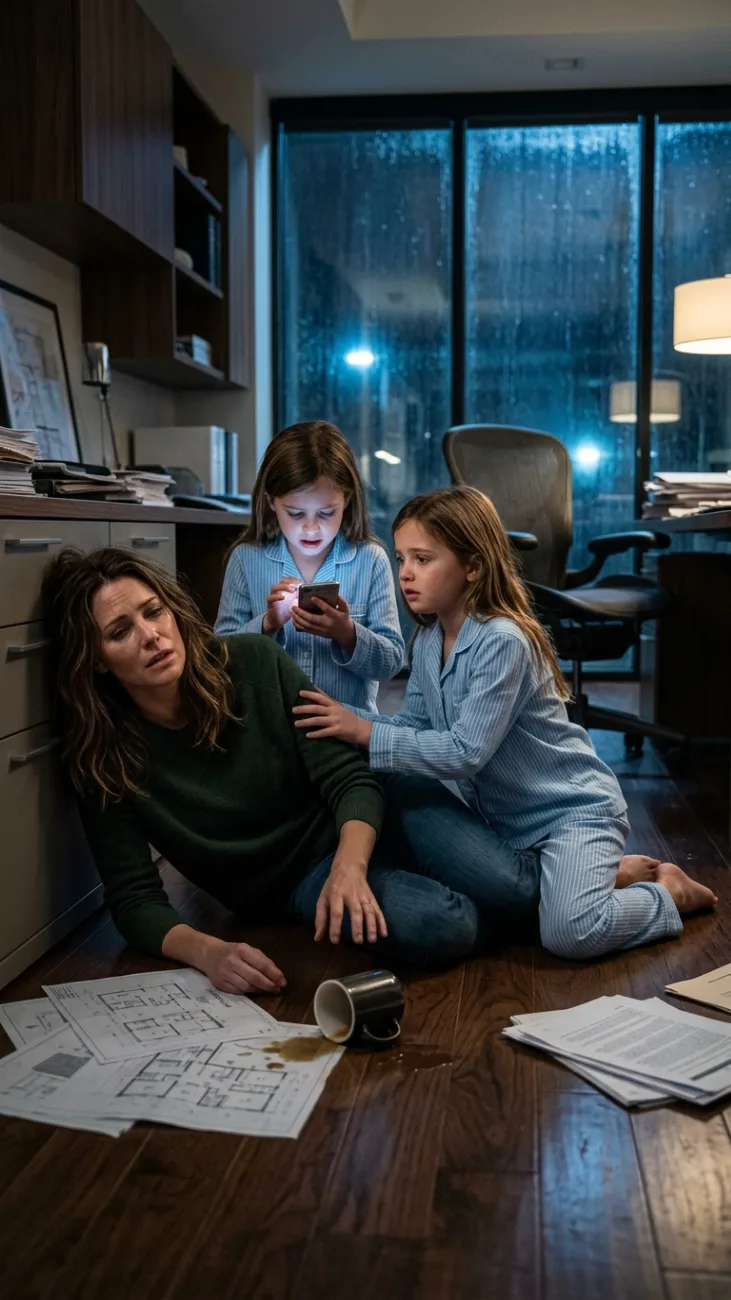
Then she found an older feature from six years earlier.
Chapter 5
Then she found an older feature from six years earlier.
Griffin Drake Funds Architecture Scholarship for First-Generation Designers.
She clicked.
The quote in the article was short but devastating.
Vision doesn’t care where you came from. Talent doesn’t ask for permission. Some of the best builders in the world just need one door held open.
Sloan stared at the screen until the words blurred.
He had done that.
For people like her.
For the girl his mother once called unsuitable.
For the version of Sloan who had believed she needed to choose between love and dignity.
Her phone rang.
It was her mother.
“Well?” her mother said without preamble. “Have you stopped being stubborn yet?”
Sloan wiped at her eyes. “That’s an aggressive opening.”
“And yet accurate. Hazel told me Griffin is teaching Iris chess strategy and took them both to a science museum. Also, apparently there’s a puppy situation.”
Sloan laughed helplessly. “There is a puppy situation.”
“Sweetheart,” her
mother said more gently, “do you love him?”
Sloan looked out the window at the patch of Seattle sky framed by the neighboring rooftops.
“I never stopped.”
“Then stop acting like your fear is wisdom.”
The words hit home because that was exactly what Sloan had been doing for ten years.
Calling fear practicality.
Calling avoidance protection.
Calling silence strength.
It had taken a brain aneurysm and two terrified little girls to rip the costume off all of it.
That evening, when Griffin brought the twins home, he stayed after they were asleep.
The kitchen was small. The overhead light warm. The kind of ordinary domestic scene Sloan used to ache for back when she and Griffin were young and broke enough emotionally, if not financially, to still believe love alone could conquer class, family, pride, and fear.
Now they were older.
More scarred.
Maybe wiser.
Maybe just more tired
of wasting time.
Griffin leaned against the counter while Sloan made tea.
“I talked to Genevieve last year,” he said suddenly.
Sloan looked up. “You did?”
“She was in Seattle for a fundraiser. She’s happily married, has a son, and still thinks my mother was terrifying.”
Despite herself, Sloan laughed. “She wasn’t wrong.”
“No. She wasn’t.” He paused. “Genevieve asked if I ever got over you.”
Sloan’s hand tightened around the mug.
“What did you say?”
He held her gaze. “I said some people are not designed to be gotten over.”
The room went very still.
Sloan set the kettle down before she dropped it.
“Griffin—”
“I’m not asking for anything tonight,” he said, and his voice was steady, almost gentle. “I know we have daughters to figure out. And trust. And ten years of wreckage. I’m just done pretending what I feel is less than it is.”
Sloan looked
at the man in her kitchen.
The billionaire the city knew as ruthless and brilliant.
The father who knelt to tie eight-year-old shoes without thinking.
The boy she had once loved enough to run from because losing him had seemed survivable, but losing him after children would have destroyed her.
Then she asked the question that had lived inside her since the hospital.
“Why didn’t you hate me more?”
A flicker crossed his face.
“I did,” he said honestly. “For about twenty minutes. Then Hazel fell asleep on my shoulder in the waiting room and Iris held my hand like she’d known me forever, and all I could think was… whatever you did wrong, you kept them safe. You loved them well. And I couldn’t hate the woman who gave me them.”
Sloan’s eyes filled.
“That’s a dangerously kind answer.”
“It’s the truth.”
She stepped closer without meaning to.
Maybe he did too.
Their bodies remembered the distance they used to erase so easily.
“I’m sorry,” she whispered. “For all of it. For not trusting you. For making fear the loudest voice in the room. For those years you lost.”
Griffin’s eyes shone.
“I’m sorry, too.”
She blinked. “For what?”
“For letting you believe my mother had the final word on who belonged in my life. For not finding you sooner. For respecting your goodbye when every part of me wanted to break your door down and make you look me in the eye.”
Sloan laughed wetly through tears. “That would have been illegal.”
“Probably.”
“And dramatic.”
“You always did like a little drama.”
He smiled then, really smiled, and it undid her.
So Sloan Callaway, architect, survivor, mother, champion of restraint and disastrous self-denial, did the bravest thing she had done in ten years.
She kissed him.
Not because the moment was perfect.
Because it wasn’t.
Their daughters were asleep upstairs. Her tea was going cold. The sink was full of dishes. Her head still ached sometimes where the surgeons had shaved her scalp and gone into her skull.
Life was messy.
So was love.
So was starting over.
But his mouth on hers felt like truth.
When they pulled apart, Griffin rested his forehead against hers.
“Are we doing this?” he asked, sounding almost stunned.
Sloan let out a shaky laugh. “Probably badly.”
His hands settled carefully at her waist. “I can work with badly.”
“Slowly,” she said.
“Slowly.”
“Honestly.”
“Absolutely.”
“And if you ever disappear emotionally because you think you’re protecting me, I’ll throw something at you.”
He laughed. “Fair.”
The twins found out the next morning in the least subtle way possible.
Hazel walked into the kitchen, saw the look on Sloan’s face, saw Griffin making coffee, and gasped like a witness in a courtroom drama.
“I knew it,” she breathed.
Iris appeared three seconds later, took one look around, and nodded with satisfaction. “Statistically inevitable.”
Sloan nearly choked on her toast.
Griffin, traitor that he was, grinned.
The girls launched themselves at both adults.
There were shrieks. There were demands for details. There was a deeply concerning amount of celebratory dancing before 8:00 a.m.
That night, the puppy came home.
Not to Sloan’s townhouse, because pets weren’t allowed. And not to Griffin’s penthouse long-term, because as Hazel had bluntly explained, “Dogs deserve grass, not billionaire vertical living.”
Three days later, Griffin bought a craftsman house in Fremont with a yard, a porch swing, four bedrooms, and enough light in the upstairs studio to make Hazel stare at the windows in reverent silence.
“This is excessive,” Sloan said when he showed it to her.
“I know.”
“It’s way too soon.”
“I know.”
“And yet you bought it.”
Griffin glanced toward the yard where the twins were already naming the puppy and arguing about the ethics of matching collars.
“Yes.”
Sloan crossed her arms. “Why?”
He looked at her for a long moment before answering.
“Because for the first time in ten years, I know exactly where home is. And I’m done living anywhere else.”
She had no defense against that.
Three months later, the twins chose the puppy’s name: Compass.
Because, as Hazel explained to anyone who would listen, “He helped us find our way.”
By spring, Sloan and the girls were spending more nights at the house than not.
By summer, Sloan admitted what everyone else already knew.
They had become a family in every way that mattered.
Not cleanly.
Not conventionally.
Not without scars.
But solidly.
The proposal happened at the Seattle Art Museum on a June evening wrapped in warm light.
Sloan thought they were attending a private reception celebrating the Morrison Center winning a major regional design award.
Instead, Griffin led her into a gallery hung with Hazel’s paintings and lined with display cases featuring Iris’s science medals, essays, and competition certificates.
At the center of the room stood the twins in matching blue dresses and barely contained excitement.
“What is this?” Sloan whispered, already crying.
Griffin took her hands.
“This,” he said, voice rough with emotion, “is the life you built. The family you protected. The daughters you raised. The art and intelligence and kindness that exist because of you. I wanted you to see what I see when I look at our life.”
Sloan could barely breathe.
The girls flanked her, one on each side.
Then Griffin reached into his jacket pocket and pulled out a small velvet box.
Sloan knew it before he opened it.
Chapter complete
You have reached the end of this chapter.
Continue reading
A few more worlds to get lost in after this chapter.




