He should have said no.
Chapter 3
He should have said no.
Legally, factually, officially—no.
But the girls were still looking at him like he was the answer to a question they had been carrying all their lives.
He looked at them. Then at Sloan, unconscious in the ambulance.
Then back at the paramedic.
“Yes,” he said quietly. “I am.”
At Seattle General, the waiting room lights were too bright and the coffee was undrinkable.
Griffin sat between Hazel and Iris, one small hand in each of his.
The doctor had not wasted words.
Brain aneurysm. Rupture. Emergency surgery. High risk.
Sloan had signed a standard admission form years ago naming him as her emergency contact. Since the girls’ grandmother was in California and unreachable for the first critical hour, Griffin had ended up signing the surgical consent forms himself after a frantic call with the hospital’s legal team.
It was the strangest moment of his life.
Signing papers for the woman
who had once broken his heart.
Signing papers while her daughters—his daughters—sat beside him in dinosaur pajamas.
“Is Mommy going to die?” Hazel asked.
Griffin closed his eyes for one second before opening them again.
He had lied in boardrooms. He had lied to the press. He had lied to himself.
He would not lie to them.
“She’s very sick,” he said. “But she’s in surgery now, and the doctors are doing everything they can.”
“That’s not really an answer,” Iris said, chin lifting in a way that made something in him ache. Sloan always did that when she wanted the truth straight.
“No,” he admitted. “It’s not. The real answer is… I don’t know yet.”
Iris nodded once. Hazel crawled closer, leaning against his side.
After a minute, Hazel asked, “Were you in love with our mom?”
The question landed so cleanly that he almost laughed.
Only children could
be that direct.
“Yes,” he said.
“Past tense?” Iris asked immediately.
Griffin looked at her. Really looked.
The analytical eyes. The challenge in her voice. The refusal to accept incomplete .
He almost smiled.
“No,” he said. “Not past tense.”
The girls exchanged one of those strange twin glances that seemed to contain an entire conversation.
“Mom still loves you, too,” Hazel said matter-of-factly.
Griffin’s head snapped toward her. “What?”
“She cries when she listens to your messages,” Hazel said, as if that settled it.
“And she has a box in the closet,” Iris added. “With pictures and letters and some jewelry.”
Jewelry.
Griffin’s pulse jumped.
The ring.
He had bought it in secret three weeks before Sloan disappeared. Platinum. Oval diamond. Simple, elegant, exactly her style. He had hidden it in the back of his sock drawer with a note that said: For when the moment is perfect.
He
had come home from work one evening ready to propose within the month.
Instead, he found her gone.
No fight. No goodbye. Just a voicemail saying she needed a clean break and he should not look for her.
He had obeyed the words.
But not the spirit.
He had looked.
God, he had looked.
For years.
“Why didn’t Mommy tell us about our dad?” Hazel asked.
Griffin forced himself back to the present. “I don’t know.”
“She said some people are too special to talk about,” Iris said softly. “Like if she said it out loud, it would hurt.”
That did it.
He looked away before the girls could see his face.
Hours crawled by.
At some point a nurse brought warm blankets and animal crackers. At some point Hazel fell asleep against his shoulder. At some point Iris curled up against his other side, still fighting sleep with that fierce little frown she wore when she wanted to stay in control.
Griffin sat there in the harsh hospital light with his daughters asleep on him and realized that every success of the last ten years had been hollow.
Because none of it had included this.
Not the first time they laughed.
Not the first fever.
Not their first day of kindergarten.
Not the bedtime questions, the scraped knees, the lost teeth, the birthdays, the nightmares, the ordinary miracles of fatherhood.
Sloan had lived all of it without him.
And somehow that knowledge made him furious with her and heartsick for her in the same breath.
At 6:08 a.m., the surgeon came back.
Griffin stood so fast he nearly woke both girls.
“The procedure went well,” Dr. Matthews said, exhaustion carved into his face. “We repaired the aneurysm. The next twenty-four hours are critical, but she made it through surgery.”
Griffin sank back into the chair.
Hazel jolted awake. “What happened?”
“Mommy’s alive,” he said, voice breaking.
That was all it took.
Both girls burst into tears.
A second later, Griffin did too.
And in that ugly, fluorescent waiting room, the three of them held onto each other like they had belonged together all along.
Part 2
Sloan woke up to a headache so brutal it felt personal.
Light sliced through the thin hospital curtains. Machines beeped around her. Her throat was raw. Her body felt wrecked, heavy and unfamiliar.
For one confused second, she couldn’t remember where she was.
Then memory crashed back in fragments.
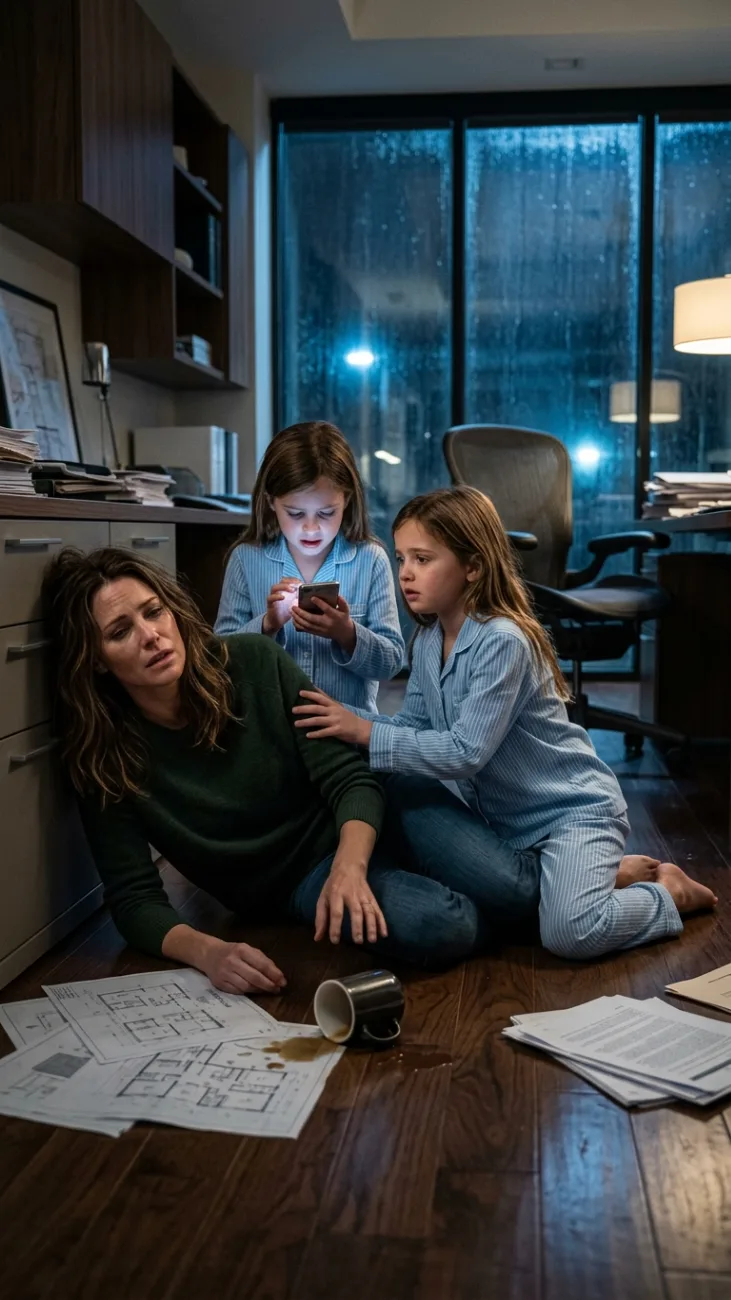
The floor.
The blueprints.
Hazel screaming.
Iris calling 911.
And beneath it all, deeper and more terrifying than the pain—
Griffin.
Her eyes flew open.
Two small faces appeared instantly over the edge of the bed.
“Mommy!”
Hazel climbed halfway onto the mattress before a nurse gently redirected her. Iris stayed pressed to the side rail, gripping Sloan’s hand so tightly it almost hurt.
“You had brain surgery,” Hazel informed her with solemn authority. “And you were really dramatic about it.”
Despite everything, Sloan laughed weakly.
Then she looked up.
And saw him.
Griffin stood in the doorway wearing yesterday’s clothes, his hair disheveled, stubble shadowing his jaw. He looked like he hadn’t slept in days.
Their eyes locked.
Ten years vanished.
Then ten years crashed down between them all at once.
“Griffin,” she whispered.
He said nothing.
He didn’t need to.
The accusation was already in the room.
The nurse checked Sloan’s monitors and quietly stepped out, closing the door behind her.
Hazel and Iris hovered beside the bed in matching hospital visitor stickers and tired little smiles.
“Mommy,” Iris said carefully, “we called your emergency contact.”
Sloan shut her eyes.
Of course they had.
Of course she had never changed it.
Even after a decade.
Even after convincing herself she had buried that part of her life for good, some weak, traitorous piece of her had left Griffin’s name there—as if she had always known that if the world ended at 2:47 in the morning, he would come.
“He came really fast,” Hazel said. “He stayed all night.”
Sloan looked at Griffin again.
He was still watching her.
Still silent.
Still devastating.
And then Hazel, because she had never once met a grenade she didn’t want to throw, said brightly, “Also, he’s our dad.”
The room went still.
Sloan’s blood turned to ice.
She looked at Griffin.
He looked back at her with a calm so cold it scared her more than shouting would have.
“Our daughters are very smart,” he said.
Our daughters.
The words cut deeper than anger.
Because they were true.
Because he deserved to say them.
Because he had been denied the right for eight years.
Sloan pushed herself up, immediately wincing as pain shot through her skull.
Griffin moved on instinct, crossing the room in two strides to steady her shoulders.
His hands were gentle. Familiar.
She hated how much her body remembered him.
“Don’t,” he said quietly. “You just had brain surgery.”
The twins, sensing a storm, exchanged a look.
“We’re going to get juice,” Iris announced.
“And not eavesdrop,” Hazel added, which meant they absolutely were going to eavesdrop.
When the door shut behind them, Sloan looked at the man she had once planned her whole life around.
He looked older, of course. Sharper around the edges. More controlled. More dangerous in the quiet way powerful men sometimes are.
But he was still Griffin.
Still the only man who had ever made her feel completely seen.
And now he knew.
“Were you ever going to tell me?” he asked.
No hello.
No how are you.
No I thought you were dead in my arms.
Just the wound, opened clean.
Sloan swallowed hard. “I don’t know.”
His laugh held no humor. “That’s unbelievable.”
“I know.”
“You knew I thought you were in Portland.”
“Yes.”
“You stayed in Seattle.”
“Yes.”
“You had my children.” His voice cracked on the last word. “My children, Sloan.”
Tears burned behind her eyes. “I know.”
“You know?” he repeated. “Do you have any idea what that sounds like to me?”
Sloan did.
It sounded like theft.
Like betrayal.
Like a man realizing that the life he should have had was lived without him while he stood outside the window, unknowingly locked out.
“I found out three weeks after I left you,” she whispered. “I had just started over. I was terrified.”
“Of me?”
“Of losing them.”
He stared at her.
“You had money,” she said, words tumbling now because if she stopped she might never start again. “Power. Lawyers. Your mother hated me. She spent months telling me I wasn’t good enough, that I’d embarrass you, that I’d ruin your future, that women like me didn’t get to keep men like you. I thought if I told you, you’d come for them. And if you came for them, I would lose.”
Griffin’s face changed.
Not softened, exactly. But the pure anger cracked enough for something else to show through.
Pain.
“My mother died six years ago,” he said quietly.
Sloan went still. “What?”
“Cancer.” His eyes never left hers. “At the end, she told me her biggest regret was driving you away.”
Sloan’s breath caught.
“I didn’t know.”
“How could you? You vanished.”
The words were flat. Exhausted.
Not cruel.
That almost hurt worse.
“I tried to find you,” he said. “For years. I hired investigators. I called every friend of yours I could track down. I drove by architecture firms like some unhinged stalker hoping I’d see you through a window. And all that time, you were here. Raising our girls a few miles from me.”
Sloan looked down at her hands.
“I’m sorry.”
He turned away, pacing once to the window and back like he needed movement to keep from breaking apart.
“Sorry doesn’t give me their first eight years.”
“No,” she said. “It doesn’t.”
The door opened then, because naturally the twins had the timing of small emotional terrorists.
“Are you fighting?” Hazel asked.
“Or fixing things?” Iris added.
Griffin and Sloan both froze.
Chapter complete
You have reached the end of this chapter.
Continue reading
A few more worlds to get lost in after this chapter.




