“I prefer silence.”
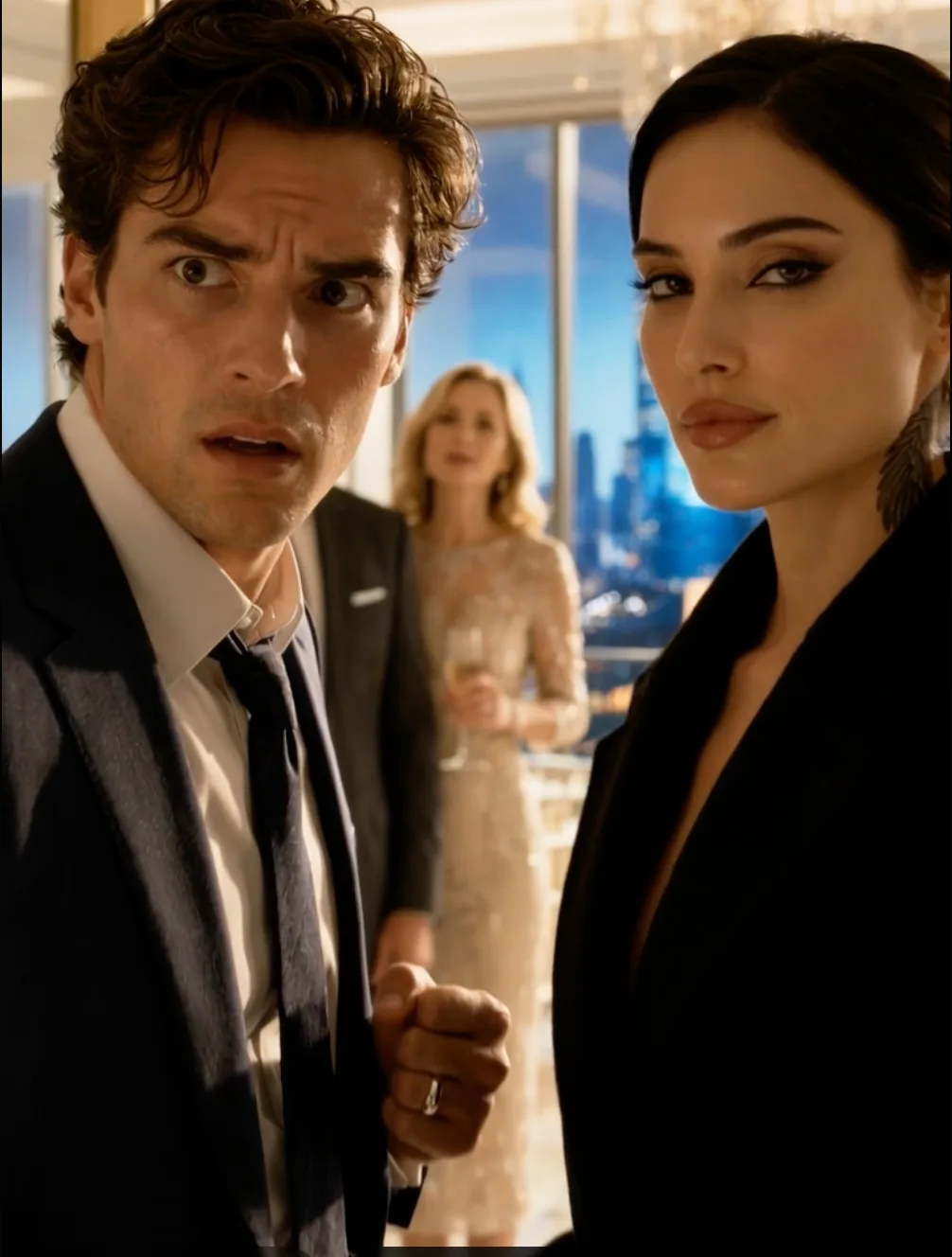
“I drive better with music.”
“It’s distracting.”
“It’s my car.”
That made her turn her head.
Chapter 3
“I prefer silence.”
“I drive better with music.”
“It’s distracting.”
“It’s my car.”
That made her turn her head.
She looked at him for a long second with that same measuring expression she had used in Manhattan.
“Is this how you treat your future wife,” she asked, “or just your unwilling passengers?”
Adrian held her gaze, then reached forward and turned the music off.
Silence returned.
It remained between them until the car lurched so violently that both of them pitched forward against their seatbelts.
The rear end of the SUV shuddered, then dragged.
Adrian cursed and pulled onto the shoulder.
He got out first. Sloane followed.
Both rear tires were destroyed.
Not punctured.
Destroyed.
He crouched, frowning. “What the hell—”
“Don’t,” Sloane said.
Something in her voice made him look up.
She was crouched a few feet away, studying the ground.
Glass.
Nails.
Small metal shards scattered in a narrow strip across the road.
Too concentrated. Too deliberate.
“This was set,” she said quietly. “Someone put it here.”
Adrian stood.
The road was empty. Trees lined both sides, dense and tall. No houses. No traffic.
“I’ll call roadside assistance.”
He turned toward the driver’s side.
Sloane caught his arm.
“Adrian.”
He followed her gaze.
A man had stepped out of the trees.
Then another.
Then four more.
Six in total, moving with the slow confidence of people who knew exactly how isolated the road was.
Adrian’s mind went cold and perfectly clear.
“Stay behind me,” he said.
The first man rushed.
Adrian moved to block him—and watched, in utter disbelief, as Sloane got there first.
She seized the man’s wrist, pivoted, and drove him face-first into the asphalt with brutal efficiency.
Another came at Adrian. Training he had not used in years took over. He struck hard, blocked low, turned, drove an elbow where it mattered. The men were not amateurs. Neither, apparently, was Sloane.
For several seconds
the world collapsed into impact, breath, movement, instinct.
Then one of the men stepped back and reached for a gun.
Sloane grabbed Adrian’s wrist.
“Forget the car. Run.”
And for the second time in one week, he obeyed her before he fully understood why.
They plunged into the trees as shouting erupted behind them, branches snapping against their clothes, dead leaves sliding underfoot.
They ran until the road disappeared.
Then until the shouting disappeared.
Then until their lungs hurt too much to keep pretending distance was optional.
When they finally stopped in a patch of thin autumn light deep in the woods, Adrian bent with his hands on his knees and drew breath the hard way.
He reached for his pocket.
No phone.
He looked up.
Sloane’s face told him hers was gone too.
For a moment, neither of them spoke.
Then Adrian gave a short, stunned laugh that had
no humor in it at all.
“Well,” he said, “this is new.”
Part 2
They found the road again an hour later.
The SUV was gone.
Of course it was.
Adrian stared at the empty shoulder and felt a strange, detached disbelief, as if he were watching someone else’s life briefly become absurd. Beside him, Sloane didn’t waste energy on surprise. She only looked once, then scanned the tree line, the road, the horizon.
“What now?” he asked.
“We stay visible until someone comes,” she said. “Or we start walking.”
They stayed.
The afternoon dragged itself over them inch by inch. No traffic passed. The road remained wide, silent, and indifferent. Every now and then Adrian caught Sloane tipping her face toward the sky, checking the light with increasing tension.
He didn’t understand it at first.
He understood it a few hours later.
The sun had dropped low enough to turn the world copper when Sloane said, “We should find somewhere to shelter before dark.”
“We’ll be harder to find if we leave the road.”
Her voice changed. Not louder. More careful.
“Adrian. Please.”
He turned.
She was hugging her arms around herself, staring at the sinking light with a tightness in her face that had nothing to do with cold.
“What’s wrong?”
She swallowed.
“I have congenital night blindness,” she said. “When it gets fully dark, I can’t see properly. Sometimes not at all.”
The words came out measured, but he heard what was under them.
Fear.
Real fear.
The kind that does not perform for witnesses because it is too old and too private for that.
“And,” she said after a moment, “I hate not being able to see.”
He nodded once. “Then we move.”
They left the road and followed a narrow dirt path he never would have noticed if she hadn’t spotted it. As the light drained away, her steps changed. Slower. More tentative. Her hand brushed tree trunks and low branches, searching. Adrian stayed close without commenting on it.
When darkness finally dropped for real, Sloane stopped altogether.
He turned back.
Her eyes were open, but they were no longer landing anywhere useful. Every muscle in her body was locked.
Adrian stepped toward her, crouched a little, and said, “Get on.”
She blinked. “What?”
“My back.”
“I’m not—”
“Sloane.”
He said her name the way she had once said his on an empty roadside: as if wasting time on pride was a luxury the situation did not permit.
After a long second, she moved closer.
Carefully, almost reluctantly, she climbed onto his back.
He stood.
She wasn’t heavy. But the tension in the arms she looped around his shoulders nearly undid him. It was the tension of someone who hated needing help and hated even more that she had none of her usual defenses left.
“I see a light,” he said after a few minutes. “Maybe five minutes.”
Her forehead touched the back of his shoulder blade.
“Okay,” she whispered.
The light belonged to a farmhouse set slightly off the tree line, old and plain and blessedly lit. A wide-shouldered man in his seventies opened the door before Adrian had finished knocking.
The man took in the scene at once: Adrian muddy and winded, Sloane on his back, one hand still gripping his shoulder like she needed proof he was there.
Without asking a single question, the man stepped aside.
“Come in.”
His name was Walter Boone.
He gave them the spare room, soup, bread, coffee, and the kind of practical kindness that asks for no gratitude because it does not view decency as extraordinary.
Adrian lowered Sloane onto the edge of the narrow bed under a warm yellow lamp.
“It’s okay,” he said softly. “There’s light.”
She opened her eyes slowly.
Relief crossed her face so nakedly that he felt it in his own chest. For the first time since Manhattan, the sharp armor around her dropped entirely. She looked younger. Tired. Human in a way that had nothing to do with fragility and everything to do with trust.
“Thank you,” she said.
He nodded because saying too much would have broken something open too soon.
Walter returned with a tray balanced in his hands.
“Folks get hit on that road sometimes,” he said as he set the tray down. “Not enough patrols. Too many men who think isolated means unaccountable.”
Adrian’s jaw tightened. “You’ve reported it?”
“Sheriff knows. Problem with roads like that is they stay empty right up until they matter.”
Over soup and bread, Walter told them their best chance of getting back toward civilization in the morning would be a produce truck that passed at dawn twice a week. He’d flag it down.
Then, as if the evening had not already stripped Sloane of enough dignity for one day, a tiny white terrier with cloudy eyes trotted into the room.
The sound Sloane made belonged somewhere between a gasp and a full-body betrayal.
Before Adrian had time to react, she grabbed his forearm with both hands and buried her face against his shoulder.
Walter laughed so hard he had to brace one hand against the doorframe.
“Mercy,” he said, scooping up the dog. “This is Daisy. She’s fourteen, half blind, and missing six teeth.”
Slowly, with visible effort, Sloane let go of Adrian and sat back.
“I wasn’t scared,” she said with enormous dignity. “I was startled.”
Adrian looked at her.
She glared.
“You were terrified.”
“I was ambushed by an unfamiliar dog in an unfamiliar environment.”
Walter grinned and carried Daisy out.
When the door shut, Adrian turned toward Sloane. “Scared of dogs?”
She lifted one pant leg just enough to show the pale crescent scar near her ankle.
“I was seven. A German shepherd chased me down a street in Boston and bit me. It bled through my sock. I’ve resented dogs ever since.”
He studied the scar, then said, “A rabbit bit me at a petting zoo when I was eight.”
Sloane stared.
He shrugged. “I was offering it a carrot. It took issue with my hand.”
For one second she just looked at him.
Then, against all probability and several well-maintained emotional walls, she laughed.
It changed her whole face.
Not prettied it. Changed it.
The air in the room shifted.
Adrian found himself smiling back before he had time to decide whether that was wise.
Later, when Walter had gone to bed and the house had gone still except for old pipes and distant wind, they sat at the small kitchen table beneath a hanging light and talked because somehow silence had become more intimate than conversation.
Sloane stirred the last of her coffee and said, “My parents probably think I’m dead.”
“They don’t,” Adrian said. “My father will have called three state troopers, two private investigators, and probably the governor by now.”
That nearly made her smile again.
The small opening encouraged honesty neither of them had planned for.
He told her about growing up in a Manhattan townhouse so pristine it felt museum-curated, about report cards that mattered because they were forecasts of worth, about a father who praised outcomes instead of effort and a mother who loved him but had learned long ago to express concern in polished, socially acceptable doses.
“I was good at things early,” he said. “People confuse that with being fine.”
Sloane looked down at her cup.
“There was a break-in when I was twelve,” she said quietly. “Our parents were in Palm Beach. I was home with our nanny. Three men came in through the back. They tied her up. I locked myself in a bathroom and called 911 from under the sink.”
Adrian stayed very still.
“They didn’t get to me,” she said. “But I heard everything. The shouting. The glass. Our nanny crying.” Her fingers tightened around the mug. “After that, I started training. Krav Maga, boxing, whatever I could learn. Everyone said I was dramatic. I wasn’t. I was building a version of myself no one would ever corner again.”
He looked at the wings on her neck.
“The tattoo?”
Her hand rose instinctively to touch it.
“I got it at nineteen,” she said. “People kept calling me resilient like it was a compliment. I didn’t feel resilient. I felt trapped in my own body, trapped in old fear, trapped in rooms where everyone told me I was okay because my family was rich enough to survive anything.” She let out a breath. “The wings were a reminder that surviving and feeling free are not the same thing.”
Adrian had no answer equal to that.
So he said the only honest thing he had.
“I’m sorry no one noticed.”
Her eyes lifted to his.
The room went quiet.
“You noticed,” she said.
He held her gaze. “I had help. You threw cash at my chest.”
That time the smile arrived fully. Briefly, but fully.
“Deserved,” she said.
“Absolutely.”
Somewhere after midnight, the conversation deepened by accident and necessity.
She admitted she had never had a serious relationship. “I never trusted dependence. It seemed like the fastest way to get hurt.”
He admitted he had dated often enough to understand the mechanics of intimacy and rarely enough to trust any of it. “Everything around me came with leverage. I got used to assuming affection was either strategic or temporary.”
She rested her cheek against her hand and studied him.
“You really were exactly as terrible as I thought at first.”
“Worse, probably.”
“And now?”
He did not answer immediately.
The lamp pooled warm light over the table. Beyond the window, the darkness pressed against the glass like a fact.
“Now,” he said, “I think you’ve been carrying everything alone for too long.”
Something in her face changed.
Not because the words were dramatic.
Because they were accurate.
“If we get married,” he said, more quietly now, “I don’t want it to be because our parents drew up paperwork and we stood still long enough to sign it.”
She looked at him then with an openness so unguarded it was almost painful to witness.
“I thought arranged marriages were the worst thing that could happen to a person,” she said.
“And now?”
Chapter complete
You have reached the end of this chapter.
Continue reading
A few more worlds to get lost in after this chapter.




