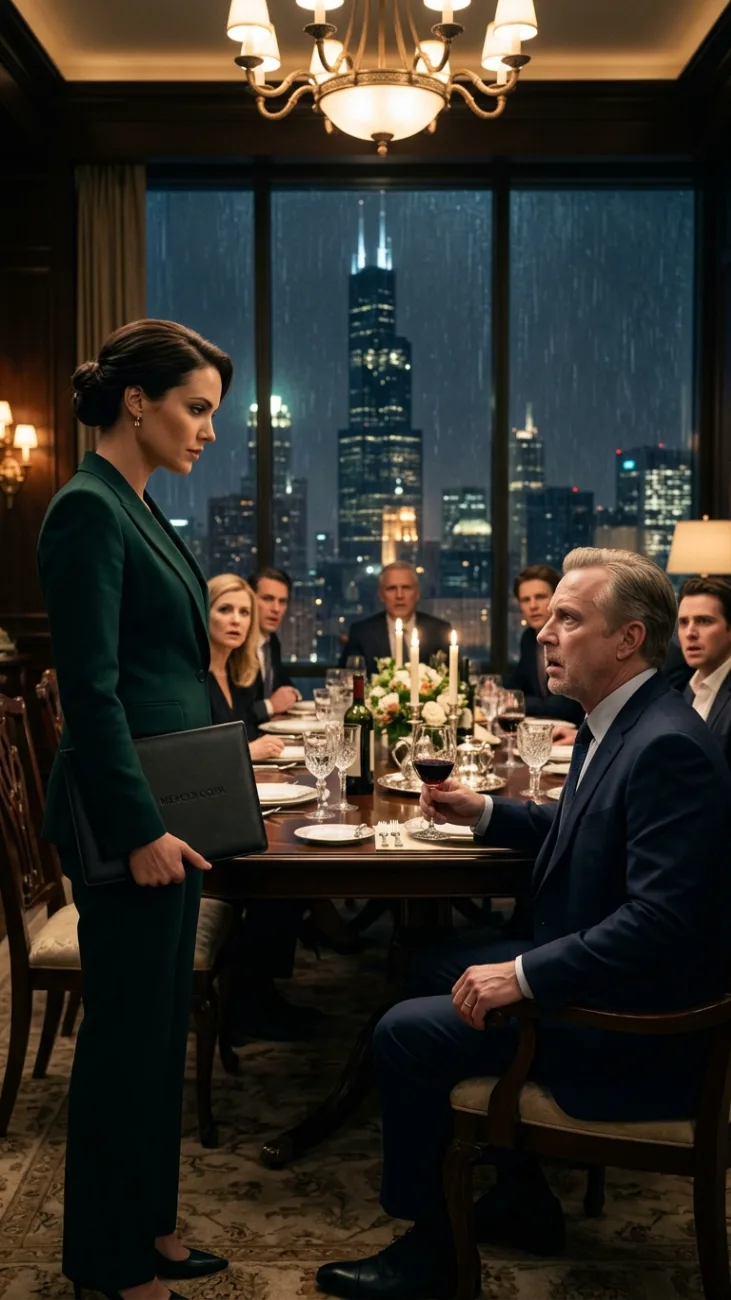
If the reunion dinner was the explosion, Sunday morning was the smoke.
Chapter 4
If the reunion dinner was the explosion, Sunday morning was the smoke.
You could feel it everywhere.
In the strained hush over breakfast.
In the way relatives suddenly found reasons to compliment my intelligence, my calm, my “impressive background” as if they were trying to retroactively buy innocence.
In the way Elaine moved through the kitchen issuing instructions to staff with brittle precision, the domestic version of a woman trying to clean blood off marble before daylight made it obvious.
Ethan found me on the back dock just after sunrise.
The lake was glassy and pale, holding the first light in long ribbons. I had a cup of coffee in one hand and the signed appointment folder on the bench beside me.
He stood there for a moment before sitting down.
“I should’ve backed you sooner,” he said.
I kept looking at the water. “Yes.”
He flinched, perhaps because he had hoped for gentleness now that the world had so visibly turned
in my favor.
“When did this start?” he asked. “With Northstone, I mean.”
“Three months ago. Katherine recruited me after the Avery Foods turnaround.”
“And you didn’t tell me.”
I turned to him then. “You want the truth?”
“Yes.”
“Because I wasn’t sure whether you would protect me or warn your brother.”
His face changed.
Not anger. Not even wounded pride.
Something worse.
Recognition.
He stared at the boards beneath our feet, his voice barely above the water. “I deserved that.”
I said nothing.
He rubbed his palms together against the morning cold. “Are we over?”
The question hung there with more honesty than almost anything he had said to me in the last year.
I could have answered quickly.
Could have given him the mercy of certainty.
But the truth was more complicated than that. Marriages do not usually die in one dramatic act. They die in a thousand
quiet submissions. In all the moments one person learns that being loved is not the same as being defended.
“I don’t know yet,” I said.
He nodded once, absorbing it without argument.
That, at least, was new.
By noon I was back in Chicago for my first restricted transition session with Northstone’s legal team. Monday morning I walked into Mercer Legacy Holdings through the executive entrance with a badge that opened doors even Gavin had once used to make people wait outside.
The receptionist stood so fast she nearly dropped her pen.
“Good morning, Ms. Mercer.”
“Good morning, Diane.”
I knew her name.
I had made it a point to know the names of assistants, analysts, schedulers, coordinators, drivers, receptionists, and interns in every company I had ever worked with. The invisible spine of businesses is almost never paid enough and rarely respected enough, but it always knows where the
rot lives.
The elevator took me to twenty-nine.
My office was larger than Gavin’s.
That had not been my request. Katherine had done it deliberately.
Symbols matter in institutions. They are the grammar of power.
The glass wall overlooked the river and most of the city beyond it. My name was already on the door.
Natalie Mercer
Chief Integration Officer
For one second, the sight of it hit something deep in me that humiliation had been trying to bury for years.
Then the door opened behind me.
Logan Pierce, the executive assistant Northstone had assigned to the integration, walked in carrying a tablet, two binders, and an expression so competent it was almost soothing.
“Welcome to the storm,” he said.
I smiled. “What’s first?”
He handed me a schedule dense enough to qualify as a threat. “Staff briefings. Legal exposure review. Vendor arbitration update. And at ten-thirty, Gavin Mercer.”
“Of course.”
By ten-twenty-eight, I had already signed six emergency authorizations, suspended two discretionary spending accounts, and discovered that Mercer Legacy had been masking cash flow instability with aggressive payment delays to smaller suppliers.
By ten-thirty, I was ready.
When Gavin entered my office, the difference between Saturday night and Monday morning was simple.
At the reunion, he had still believed he might wake up from it.
Now he knew he wouldn’t.
He wore a gray suit, immaculate on the surface. But his eyes were bloodshot, and the confidence that used to cling to him like expensive cologne had evaporated into something harsher.
He remained standing.
I remained seated.
That alone nearly broke him.
“Sit,” I said.
He didn’t move.
I looked up from the file in front of me. “That wasn’t optional.”
His jaw flexed. Then he sat.
Same chair.
Same angle.
A trembling little echo of the day he had dismissed me from his own office.
For a long moment, I let the silence do its work.
It gathered around him until even the city beyond the glass seemed to recede.
Finally I closed the file.
“Yesterday,” I said, “you told three department heads that Northstone’s restructuring would fail within six months because, and I quote, ‘Natalie has always been good at looking impressive without understanding how real business works.’”
His face hardened. “You’re monitoring private conversations?”
“No,” I said. “I’m hearing from employees who are tired of being treated like hostages.”
He leaned back. “So what is this? A public execution?”
“No,” I said calmly. “That would imply drama. This is performance management.”
He laughed bitterly. “You’ve been waiting years for this.”
“That’s true.” I met his eyes. “But not for the reason you think.”
He frowned.
I leaned forward.
“You think this is about revenge. It isn’t. Revenge is emotional. Revenge is sloppy. I am not interested in humiliating you for sport, Gavin. I’m interested in whether you are capable of functioning in a company where fear no longer counts as leadership.”
He stared at me in silence.
Then, quieter, “And if I’m not?”
“Then you’re done.”
The words landed flat and merciless between us.
I slid a document across the desk.
It was a conduct directive. Mandatory. Detailed. Reporting line changes. Behavioral expectations. Interim review schedule. Signature required.
He looked at it, then at me.
“You really expect me to sign this?”
“Yes.”
“This strips my authority.”
“No,” I said. “It defines your accountability. You never had authority. You had indulgence.”
Something flashed in his face then. Not anger exactly. Something more dangerous.
Shame.
People raised on entitlement often experience shame as a physical insult. It makes them reckless.
He stood so abruptly the chair rolled back.
“You want the truth, Natalie?” he said, voice low and shaking. “You’ve always hated this family because you could never become us.”
I stood too.
Slowly.
“No,” I said. “I hated what this family made excuses for.”
He breathed hard, hands curling at his sides. “You don’t belong here.”
I held his gaze.
“Neither do bullies.”
The silence that followed was broken only by the hum of the air system and the faint throb of traffic below.
Then Logan knocked once and stepped in.
“I’m sorry to interrupt,” he said, not sounding sorry at all. “Legal needs your review on the Mercer Freight subsidiary.”
Gavin froze.
I saw it.
A flicker. Tiny, but real.
Mercer Freight.
“Leave the file,” I told Logan.
He did and walked out.
Gavin moved toward the door too quickly.
“Sit back down.”
He stopped with his hand on the handle.
When he turned, the color had changed in his face.
Interesting.
Very interesting.
I sat first, opened the Mercer Freight file, and watched him without appearing to.
There were irregularities in the subsidiary’s vendor payments. Missing invoices. Inflated consulting charges. A logistics subcontractor in Indiana billing for routes that had never existed.
Nothing conclusive yet.
But enough to make a man like Gavin nervous if he knew where the bones were buried.
He came back to the chair slowly.
“What do you want?” he asked.
“The truth,” I said. “Which means if there’s anything in Mercer Freight I should know before the forensic team finishes their review, this is your one clean chance.”
He stared at me for a long time.
Then he smiled.
And it was the first genuinely frightening smile I had ever seen on him, because it carried no arrogance now, only hostility sharpened by desperation.
“You really think this building runs on paperwork,” he said softly. “It runs on loyalty.”
I didn’t answer.
He opened the door.
At the threshold, he looked back.
“You should be careful, Natalie. People who rise this fast in a family company usually forget how many relatives are still holding the ladder.”
Then he left.
The room seemed colder after that.
I picked up the Mercer Freight file again and began to read.
Part 5
The first real crack appeared on Thursday.
A woman named Sandra Alvarez from regional procurement requested a confidential meeting. She arrived at my office clutching a notebook so tightly her knuckles were white.
“I’m sorry,” she said before she even sat down. “I know this is risky.”
“Then it matters,” I said. “Tell me.”
What she gave me over the next forty minutes was not gossip.
It was a map.
Fake rush-order charges routed through Mercer Freight. Pressure from Gavin’s office to approve vendor contracts without competitive review. A consulting firm called Redline Advisory that billed the company hundreds of thousands of dollars for “market stabilization services,” despite having no employees beyond a registered mailbox in Naperville.
I asked, “Who owned Redline?”
Sandra swallowed. “I don’t know officially. But I was told to stop asking after I saw one invoice signed off through Lila Mercer’s trust.”
There it was.
The floor beneath the whole Mercer myth creaked.
I thanked her, assured legal protections, and called Katherine within two minutes.
By Friday afternoon Northstone’s forensic team had enough to warrant an emergency board session Monday morning.
I did not sleep much that weekend.
Not because I doubted the evidence.
Because I understood what exposure does to families like this. It does not merely reveal wrongdoing. It tears mythology. It forces everyone in the house to choose between truth and their preferred version of themselves.
Monday’s board meeting began at nine.
The same boardroom Gavin had once ruled through fear felt different now. Cleaner somehow. Less like a temple, more like a courtroom waiting for the judge.
Richard was there. Elaine too, though she no longer had a formal board vote. Katherine sat at my right. Ethan came, not as a board member, but because Richard had finally stopped pretending the company mess could be separated from family consequences.
Gavin entered last.
He looked composed.
Too composed.
He sat at the far side of the table and offered me a thin smile. “I hear you’ve been busy.”
“Yes,” I said. “Cleaning.”
Katherine began with numbers. Debt exposure. Liquidity issues. Vendor manipulation. Then legal counsel took over and laid out the Mercer Freight findings in language so plain even denial had nowhere elegant to hide.
By the time Redline Advisory appeared on the screen, Lila had started crying silently into a tissue.
Gavin did not look at her.
He looked only at me.
When counsel finished, Richard spoke.
“Is any of this inaccurate?”
The question went to Gavin.
Who folded his hands. Unfolded them. Then said, “It’s being exaggerated.”
Katherine didn’t blink. “By forensic accountants?”
“They don’t understand operational realities.”
I slid a paper across the table.
A copy of an authorization email.
His authorization email.
Billing approval. Route variance concealment. Redline sign-off.
He recognized it immediately.
He didn’t touch it.
“Operational realities,” I said, “do not include siphoning company funds through shell consulting entities tied to your household.”
Elaine inhaled sharply. “Gavin…”
He turned to his mother with a flash of fury. “Don’t.”
Richard’s face had gone the color of winter stone.
“Answer the question,” he said.
Gavin’s voice changed then. Lost polish. Lost executive rhythm. Became something rawer.
“You want the truth?” He laughed once, sharp and joyless. “Fine. The company was bleeding. Dad refused to admit it, the board wanted miracles, and everyone expected me to keep the Mercer name untarnished no matter what. Redline was temporary. A bridge.”
“A bridge to where?” Katherine asked. “Your wife’s trust?”
Lila made a broken sound.
Gavin ignored her.
“I did what I had to do,” he snapped. “Everyone in this industry moves money.”
“No,” I said. “Everyone in this industry does not steal from their own company and call it strategy.”
He finally looked at Ethan.
As if maybe, even now, his brother could rescue him from the logic of evidence.
“Say something.”
Ethan’s face was pale, but steady. “Did you take the money?”
Gavin stared.
Then he looked away.
That was answer enough.
Elaine began to cry quietly.
Richard closed his eyes for one second, not dramatically, just like a man recognizing the exact weight of his own failures as a father.
When he opened them again, he looked twenty years older.
“General counsel,” he said. “Record my motion. Immediate termination for cause. Full cooperation with forensic recovery and referral for criminal review if advised.”
The room went silent.
Even Gavin seemed stunned.
Not by the firing itself. He must have known that was coming.
By who had said it.
“Dad,” he whispered.
Richard did not raise his voice.
“You thought the company was your inheritance,” he said. “It was my life’s work. And you robbed it while wearing my name.”
Gavin stood so abruptly his chair struck the wall.
“This is because of her,” he said, pointing at me with a shaking hand. “You’re all letting her do this because she walks in wearing competence like a costume and suddenly everybody forgets who built this place.”
I rose too.
“No,” I said. “We remember exactly who built it. That’s why what you did is so disgusting.”
He laughed, cracked straight through the middle. “You think you’ve won?”
I held his stare.
“No. I think the truth finally did.”
Security entered then. Quiet, professional, almost apologetic in the way good security personnel often are when escorting disgraced executives who still cannot believe the building no longer belongs to them.
For a second I thought Gavin might fight.
Instead he looked at Ethan one last time.
Then at Richard.
Then at me.
And what I saw in his face was not just rage.
It was emptiness.
The terrifying kind that comes when a man built his entire identity on status and finds there is no self underneath it.
When he was gone, the boardroom stayed silent for a long moment.
Then Richard turned to me.
“What do you need to stabilize this company?”
It was not sentimental.
Not praise.
Not apology.
In some ways, it was better.
A real question. Asked of the person actually holding the line.
I answered with a restructuring plan, vendor triage, and an internal culture audit.
Everyone listened.
Nobody interrupted.
When the meeting ended, Ethan waited in the hallway outside my office.
I closed the door behind me and stood facing him under the muted light of the corridor.
He looked exhausted.
Not from medicine. From seeing illusions die.
“I filed for leave this morning,” he said. “From the hospital. I need time to figure out what kind of man I’ve been.”
I folded my arms.
He swallowed. “I also spoke to a lawyer.”
That surprised me. “For Gavin?”
“For us.”
I said nothing.
He took a breath. “Not to fight you. To make this easier if… if divorce is what you want.”
The word didn’t shatter me.
That told me more than grief would have.
I looked at this man I had loved. This man who had held me through funerals and flu seasons and mortgage closings and Sunday grocery runs. This man who had been gentle, intelligent, decent in a hundred private ways.
And still not brave enough.
“I loved you,” I said softly.
His eyes reddened. “I know.”
“But love that keeps asking one person to swallow themselves isn’t love I can live inside anymore.”
He closed his eyes once.
When he opened them, he nodded.
Not arguing now. Not pleading.
Just accepting the verdict he had helped write.
“I’m sorry,” he whispered.
I believed him.
And because I believed him, it hurt less and more at the same time.
Part 6
Six months later, the city looked different from my office window.
Not because Chicago had changed.
Because I had.
Mercer Legacy Holdings was no longer gasping behind glossy quarterly reports and family mythology. The Ohio losses were contained. Mercer Freight had been restructured and partially sold. Vendor lawsuits were settling. Redline funds had been traced, frozen, and folded into ongoing legal recovery.
The culture changed more slowly, but it changed.
People laughed in hallways now.
Interns spoke up in meetings.
Receptionists no longer lowered their voices when executives passed.
Managers learned, some awkwardly and some with grace, that authority did not require theater.
On the first Monday of October, I stood in the atrium before an all-staff town hall and looked out over a crowd that no longer seemed afraid of its own future.
Sunlight poured through the glass wall behind them, turning the polished floor into a sheet of gold.
Logan handed me the mic.
“You good?” he murmured.
I smiled. “Better than good.”
I stepped up to the small stage.
The room quieted.
For half a second I saw myself as I had been the day Gavin threw me out of his office. A woman standing alone in the rain with humiliation burning under her skin, trying not to let a building full of strangers see her shake.
Then the image passed.
“This company,” I began, “spent a long time confusing fear with discipline and silence with loyalty.”
A few heads lowered. Many more stayed lifted.
“We are not doing that anymore.”
The applause started early, but I lifted a hand gently and the room settled again.
“I’m not interested in building a company where people survive by shrinking. I’m interested in building one where the best idea wins, where accountability is real, and where nobody gets dismissed because someone powerful thinks respect is optional.”
That line got them.
Not because it was dramatic.
Because it was true.
After the town hall, a line of employees formed near the coffee station. Not to flatter me. To talk. To suggest new training tracks, supply improvements, mentorship programs, hiring pipelines. Hope is noisy once people stop punishing it.
Late that afternoon Richard Mercer came to my office.
He did not visit often.
He preferred phone calls, formal memos, strategic brevity. Perhaps that was for the best. Some relationships survive only after being stripped to their useful bones.
He stood by the window for a moment, taking in the city.
“You were right about Gavin,” he said.
It was not the sentence I expected.
“About what?”
“That nobody stopped him because cruelty was useful until it wasn’t.” Richard kept his eyes on the skyline. “Families like mine mistake tolerance for love. We indulge weakness when it wears the face we prefer.”
I let the silence sit.
Then he turned.
There was no grandeur left in him now. Just age, intelligence, and regret learning how to coexist.
“I should have seen you more clearly earlier,” he said.
It was the closest thing to an apology I would ever get.
And strangely, it was enough.
“Maybe,” I said. “But you see me now.”
He nodded once. “I do.”
He left a folder on my desk before he went.
Inside was the revised ownership structure from Northstone’s final stabilization agreement.
My performance equity had vested early.
Not symbolic equity. Real equity.
Enough to make me one of the most influential people in the company on paper, not just in practice.
At the bottom, in Richard’s blunt handwriting, were six words:
Earned. Not gifted. Don’t waste it.
I almost laughed.
It was such a Mercer way of expressing respect. Half compliment, half commandment.
That night, I went home to the condo that would soon no longer be mine.
The divorce with Ethan had been strangely civil. No scorched earth. No melodrama. Just two adults finally honest enough to stop pretending affection could compensate for repeated abandonment.
Some endings are not loud.
Some are the sound of a key left on a kitchen counter.
We met one last time to sign the final papers at a small law office near the river.
Afterward, we walked outside together.
The wind off the water was sharp. Cars moved below the bridge in steady streams of light.
Ethan shoved his hands into his coat pockets. “For what it’s worth,” he said, “I’m proud of you.”
I looked at him.
This man I had loved. This man who had failed me. This man who, maybe because of losing me, had finally started telling the truth about himself.
“I know,” I said.
He nodded. “I wish I’d been the kind of husband who deserved to say that sooner.”
I could have let the moment turn sentimental.
Instead I said the truest thing I had.
“I wish that too.”
Then we stood there for one quiet second, honoring what had existed and what had broken.
He kissed my forehead gently.
I got in my car and drove away.
In November, Mercer Legacy held its first employee recognition gala in more than a decade.
Not for executives.
For everyone.
Warehouse crews, dispatch coordinators, schedulers, assistant controllers, analysts, drivers, maintenance supervisors, procurement staff, and the reception team that kept the front doors from becoming chaos every morning.
The event was held at the Art Institute ballroom downtown. Warm lights. Jazz trio. No absurd speeches from men who confused bonus size with character.
I wore black.
Simple. Sharp. Nothing that needed to beg for attention.
As I moved through the room, people stopped me to tell me what had changed for them.
A young analyst said she finally spoke in meetings without rehearsing apologies first.
A warehouse manager said turnover was down because supervisors had stopped ruling by intimidation.
Diane, the receptionist from the twenty-ninth floor, hugged me and whispered, “The building feels lighter now.”
And that, more than the financial turnaround, more than the board votes or the articles in business magazines, felt like the real win.
Near the end of the night, Logan found me by the balcony doors.
“You know,” he said, handing me a glass of sparkling water, “half the city’s executive class thought you’d flame out in ninety days.”
“Only half?”
He grinned. “The optimistic half.”
I looked out over Michigan Avenue, the lights stretching into the dark like someone had stitched fire into the streets.
“Do you ever think about that first week?” he asked. “How close this whole place came to collapsing?”
“All the time.”
He tilted his head. “And Gavin?”
I thought about the last update I’d received through legal. Probation agreement. Asset scrutiny. Marriage in ruins. The long, humiliating administrative aftermath reserved for men who once believed charm was a substitute for consequences.
“I think about what happens,” I said, “when a person mistakes access for worth.”
Logan lifted his glass in a tiny toast. “To never making that mistake.”
“To never needing a family dynasty to know who I am,” I said.
At ten-thirty, Richard tapped the mic and invited me to speak.
The room hushed.
I walked to the stage.
For a moment, under the lights, I saw not strangers or staff or shareholders.
I saw every version of myself that had walked into rooms asking for permission to exist.
The younger woman swallowing insults at holidays.
The daughter sitting beside a hospital bed learning how little time changes what matters.
The wife trying to convince herself that patience would eventually be rewarded.
The candidate standing in a glass office while a man told her she was a loser.
I looked out at the crowd.
Then I smiled.
“This company,” I said, “used to belong to a story about one family.”
Heads lifted. The room stilled deeper.
“It doesn’t anymore.”
A ripple went through them.
“It belongs to the people who show up, do the work, tell the truth, and build something stronger than ego. It belongs to every person here who kept going when easier people would have folded. And if anyone ever tells you that your value depends on their approval, let me save you some time.”
I paused.
Because timing matters.
Because some lines deserve space before they land.
“They don’t get to decide your worth. You do.”
The applause hit like weather.
Real, full, loud enough to shake something loose in my chest that had been locked there for years.
Not vengeance.
Not triumph exactly.
Relief.
Afterward, as the room dissolved into music and conversation, I stepped onto the balcony alone.
The city glittered below, hard and beautiful and alive.
My phone buzzed.
A message from Katherine.
Board confirmed. Permanent CEO. Congratulations.
I stared at the screen.
Then laughed softly into the cold night.
Permanent.
Not provisional. Not temporary. Not tolerated.
Mine.
Inside, through the ballroom glass, I could see the company I had helped rebuild moving under gold light. People talking. Smiling. Planning tomorrow as if it were something worth meeting head-on.
I slipped the phone into my clutch and looked out over Chicago one more time.
Gavin had once tried to reduce me to whatever made him feel larger.
My husband had once mistaken love without courage for enough.
An entire family had once looked at me and seen someone adjacent to power, never the woman who could hold it cleanly.
They were all wrong.
And the sweetest part was that I did not need any of them to admit it anymore.
By the time I went back inside, the future was no longer something I was asking to enter.
It was something waiting for my next decision.
THE END
Chapter complete
You have reached the end of this chapter.
Continue reading
A few more worlds to get lost in after this chapter.




