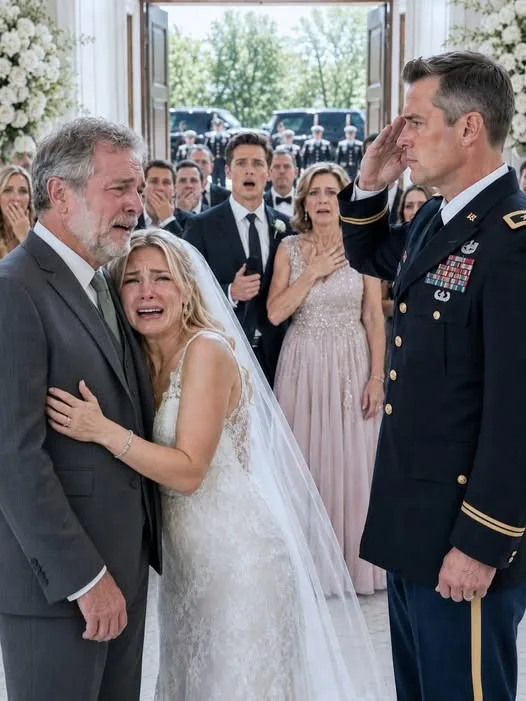
My mother’s voice sounded younger than I remembered.
Chapter 4
My mother’s voice sounded younger than I remembered.
That was the first thing that destroyed me.
Not the words.
Not Victor Vale’s name.
Not the evidence.
Her voice.
For seventeen years, I had been afraid I was forgetting it. I remembered fragments—the melody of a lullaby, the way she called me sweetheart, the laugh that came before she sneezed—but memory had slowly softened the edges.
Now she was speaking again from a cheap cassette recorder found beneath the staircase of the Vale family’s lake house.
“My name is Elena Evans,” the recording began. “If James is hearing this, I’m sorry I didn’t tell you everything.”
Dad covered his face.
The investigators had warned us the recording could be difficult. General Cole sat beside him while I held his hand.
Mom explained that she had discovered years of fraudulent materials purchases involving Richard Vale, Victor Vale, and two inspectors working on government construction projects.
She had copied invoices and
mailed duplicates to a federal oversight office.
Then someone searched her desk.
Two nights later, a vehicle followed her home.
“I don’t know whether they intend to hurt me,” she said on the recording. “But I know they are frightened. And frightened men with money can become dangerous.”
She described meeting Richard Vale in a parking lot.
He told her she had a daughter and should think carefully about what mattered.
She refused to surrender the documents.
Near the end of the tape, she said something that made my father bend forward as if he had been struck.
“James will blame himself if anything happens to me. Please tell him he was the best decision I ever made. And tell Maisie that her father is a hero even if he never tells her why.”
Dad began sobbing.
I had seen him cry at my wedding.
This was different.
These were
seventeen years of guilt leaving his body all at once.
He had spent nearly half my life believing he failed my mother.
She had spent one of her final hours trying to make sure he never believed exactly that.
The cassette did not contain a confession to murder.
But the documents beside it were devastating.
One ledger showed payments from a Vale-controlled shell company to a mechanic named Samuel Orr two days before my mother’s crash.
Orr had died nine years earlier, but investigators located his widow in Arizona.
She still had a box of her husband’s belongings.
Inside it was a handwritten notebook.
One entry included my mother’s license plate number.
Another read: V paid cash. Brake line. No questions.
The old accident file was reopened immediately.
Modern forensic specialists reviewed photographs of my mother’s vehicle and found damage inconsistent with ordinary mechanical failure. A retired investigator who had
handled the original crash admitted that a supervisor had pressured him to close the case quickly.
That supervisor had later received consulting payments from a company linked to the Vales.
The evidence did not arrive in one dramatic moment.
It accumulated over weeks.
Email by email.
Bank transfer by bank transfer.
Witness by witness.
And the truth was uglier than any secret General Cole could have announced at our wedding.
Richard Vale had arranged the sabotage.
Victor had financed it and helped bury the investigation afterward.
Years later, when Richard died, Victor inherited both the company and the secret.
He built Vale Development into a regional powerhouse using some of the same methods—cheap materials, bought inspectors, political favors, and intimidation.
Tristan had grown up inside that system.
He was not charged in connection with my mother’s death because there was no evidence he knew about it.
But the Fort Barrington investigation was different.
His signatures appeared on multiple falsified documents. Former employees testified that Tristan personally ordered them to substitute lower-grade materials to protect profit margins.
One project manager produced text messages in which Tristan wrote that inspectors could be “managed.”
The eighty-million-dollar contract was terminated.
Vale Development was barred from new federal work pending prosecution.
Banks froze several credit lines.
Within three months, projects across the state were suspended.
Tristan, Victor, and two senior executives were indicted on charges related to fraud, bribery, conspiracy, and false statements involving federal contracts.
Victor also faced prosecution stemming from the reopened investigation into my mother’s death.
Mara sold the house she had once bragged was worth more than my entire neighborhood.
I heard through mutual friends that she blamed me.
That almost made me smile.
People like Mara always needed someone beneath them.
When the world finally stopped cooperating, they called accountability cruelty.
Tristan came to see me once before his trial.
We met in the lobby of my attorney’s office.
He looked older.
Not wiser necessarily.
Just smaller.
“I loved you,” he told me.
I believed that he believed it.
Maybe he had loved the version of me he could display beside him.
Maybe he loved me until loving me required respecting where I came from.
“That morning,” he said, “I thought walking away from that wedding would prove I wasn’t weak.”
I said nothing.
“I wanted people to know I had standards.”
“You showed them.”
He lowered his eyes.
“I didn’t know your father was a decorated soldier.”
There it was.
The lesson he still had not completely learned.
I leaned forward.
“Tristan, my father did not become worthy of your respect when a general saluted him.”
He looked at me.
“He was worthy when you thought he was only a gardener.”
Tristan never answered.
There was nothing left to say.
My father eventually accepted the military recognition he had refused three decades earlier.
General Cole arranged a ceremony at Fort Barrington.
This time, Dad agreed on one condition.
“No television circus,” he said. “And my daughter sits in the front row.”
I did.
Soldiers he had rescued stood beside younger service members who had only recently learned his name.
When the citation was read, it described courage under fire, extraordinary leadership, and sacrifice beyond duty.
But the moment I remember most happened afterward.
A young private approached Dad and asked whether he had missed the military during all those years working as a gardener.
Dad smiled.
“I never stopped serving,” he said. “I just started growing things instead of protecting them.”
That sentence stayed with me.
For most of his life, James Evans had been surrounded by people who measured men through titles.
Captain.
General.
Contractor.
Business owner.
Gardener.
My father understood something they did not.
A title tells people what you do.
It does not tell them who you are.
A year after the wedding that never happened, Dad and I returned to the Oakridge Community Center.
The same folding tables were there. The same old stage. Some of the same strings of lights were hanging from the ceiling.
But this time, nobody was getting married.
We had established the Elena Evans Foundation using compensation Dad finally accepted from the government and money recovered through a victims’ settlement.
The foundation provided scholarships for children of injured veterans and grants for families of construction workers hurt because companies ignored safety standards.
Dad insisted on keeping his gardening business.
General Cole tried to convince him to retire.
I tried too.
Dad refused us both.
“I spent thirty years learning which roses survive Silver City summers,” he said. “You think I’m throwing away expertise like that?”
So every morning, the decorated Captain James Evans climbed into the same repaired Ford pickup and drove through Oakridge with rakes, hedge clippers, and bags of fertilizer in the back.
People treated him differently now.
That bothered him more than the disrespect ever had.
One afternoon, I asked why.
He wiped soil from his hands and looked toward a row of newly planted roses.
“Because they shouldn’t have needed a medal to see me.”
I thought about Tristan standing at the altar.
I thought about Mara saying every family should know its place.
I thought about my mother risking her life because strangers would eventually live inside buildings constructed with materials she knew were unsafe.
And finally, I understood what my parents had spent their lives teaching me.
Dignity is not something wealthy people give you.
It is not created by uniforms, property, contracts, applause, or the approval of people who believe money makes them important.
It belongs to you before anyone recognizes it.
On the anniversary of Mom’s death, Dad and I visited her grave together.
He placed a small bouquet of yellow roses beside the stone.
“I found out what happened, Ellie,” he whispered. “Took me too damn long.”
Then he laughed softly through his tears.
“But Maisie turned out all right.”
I slipped my arm through his.
“She had a pretty good gardener raising her.”
Dad looked at me sideways.
“Gardener?”
“Yes.”
I smiled.
“The best one I know.”
He squeezed my hand.
And as we walked back toward his old truck, I realized Tristan had accidentally given me the greatest wedding gift possible.
He had shown me exactly who he was before I signed my life away to him.
And when he tried to shame my father for the work that had fed me, educated me, and raised me, he exposed something far more important than the truth about James Evans.
He exposed the truth about himself.
My father never needed Tristan Vale’s respect.
Neither did I.
THE END.
Chapter complete
You have reached the end of this chapter.
Continue reading
A few more worlds to get lost in after this chapter.




