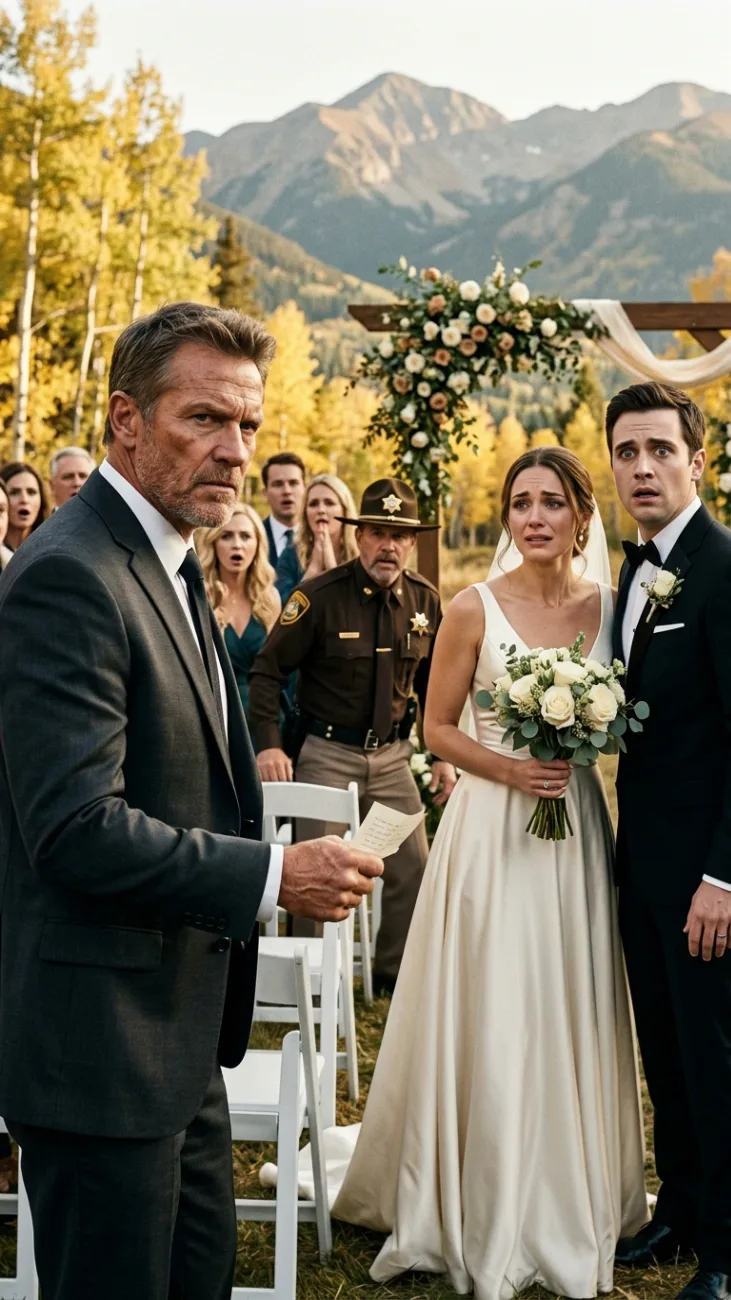
“Money doesn’t impress me,” I said simply.
Chapter 4
“Money doesn’t impress me,” I said simply.
“Land impresses me. Good people impress me. Your mother and I grew up poor. We knew what money could do to families. We decided to live modestly, enjoy what we had, and not make wealth our identity.”
I looked out over the fields, the fences, the distant shimmer of the creek.
“I wanted you to grow up normal,” I added. “Not as some rich kid who thought she was better than everyone else. I figured if you learned how to be kind, responsible, and resilient, the money would be a bonus someday—not a crutch.”
“And my inheritance?” she asked tentatively.
“Is in a trust,” I said. “Has been for years. It takes effect when I die. You’ll be comfortable. But it’s structured so no spouse can touch it without your explicit consent. I set that up after watching your aunt Linda’s divorce turn into a feeding frenzy. I wanted to
protect you.”
She sat with that for a long time, chewing on her bottom lip the way she had as a child.
“I wish Mom were here,” she said finally, voice small.
“Me too,” I said. “Every day.”
Three months later, Tyler and Marcus stood before a judge in a beige courtroom that smelled faintly of dust and nerves.
I wasn’t there—I let Margaret attend on my behalf—but I read the reports, saw the news clip that ran on the local channel. Tyler looked smaller in the footage, his suit hanging a little looser, his hair less perfectly styled. Marcus looked angry, then resigned.
They were charged with conspiracy to commit fraud, attempted financial exploitation of an at-risk adult, and a handful of related offenses. Tyler took a plea deal—five years probation, full restitution of our investigation costs, and a permanent ban on working in financial services. Marcus got two
years in prison.
Claire gave her statement via video. When she came home that night, she was quiet, drained.
“You okay?” I asked, handing her a mug of tea.
She took it, wrapped her hands around it.
“I told the truth,” she said. “That has to be enough.”
It was.
She moved back to the ranch for a while after the wedding-that-wasn’t. At first, she stayed in her childhood room, the one with the faded posters and the glow-in-the-dark stars still stuck to the ceiling. Gradually, she claimed more space—turned the spare room into a home office, fixed up the porch swing with new chains, planted her own row of herbs in the garden.
She started therapy. At first, she hated it. “I don’t want to sit in a room and talk about my feelings,” she grumbled after the first session. “I already know my feelings. They’re awful.”
But she
kept going. Slowly, the sharp edges of her anger and shame softened. She stopped calling herself stupid every time Tyler’s name came up. She started saying things like, “He exploited my blind spots,” and “I ignored red flags because I wanted the story, not the reality.”
She began dating again eventually. Carefully. No more whirlwind romances, no more men who looked perfect on paper. The first time she brought someone new to the ranch—a schoolteacher named Josh with kind eyes and a perpetually ink-stained thumb—I watched them from the kitchen window the same way I’d watched her and Tyler.
Josh never once asked about the property line.
As for me, my life changed less on the surface but more underneath.
I still woke early, made coffee in the same pot Linda had chosen, stood at the same kitchen window watching the same meadow. I still drove my ten-year-old truck into town once a week for groceries and hardware store odds and ends. I still wore flannel and jeans and fixed things myself when I could.
But I made one significant change.
I expanded Linda’s garden.
Where there had been six raised beds, I added four more. I hired a couple local kids to help haul compost and lumber, listening to them complain good-naturedly about sore backs and “boomer hobbies.” I planted more roses along the fence, not the fancy new hybrids but the old-fashioned varieties Linda had loved—cabbage roses heavy with scent, climbers that wanted to take over everything.
Near the center of the garden, I placed a stone bench. Simple gray granite, smooth and solid. On the back, I had her name carved:
LINDA CALDWELL
1959–2019
SHE PLANTED MORE THAN SEEDS
Sometimes, in the evenings, Claire and I sit there together as the sun sinks behind the mountains. The garden around us hums with bees and crickets; the air smells of tomatoes, basil, and earth. We talk about small things—her work, my latest attempt at fixing the tractor, the antics of the neighbor’s dog. Sometimes we talk about big things—trust, forgiveness, what it means to rebuild after your world breaks.
One evening, maybe a year after the aborted wedding, we sat there as the sky turned that extraordinary Colorado shade of purple that looks almost unreal.
“Dad,” Claire said, tracing the carved letters of Linda’s name with her fingertip. “Do you ever regret not telling me about the money earlier?”
I thought about it.
“If I’d known,” she continued, “maybe I would’ve been more suspicious when Tyler asked so many questions about the ranch. Maybe I wouldn’t have dismissed it as him just… being into real estate.”
“Maybe,” I said. “Or maybe, knowing you had a rich dad, you’d have spent your twenties wondering if every person who liked you liked you… or your inheritance.”
She opened her mouth, then closed it. Considered. Nodded slowly.
“The way we did it,” I went on, “you got to grow up as yourself. You got to make friends who liked you for you. You got to learn what it feels like to earn your own money and pay your own bills. Yes, it meant you were vulnerable to someone like Tyler. But when it mattered… you listened to that small voice inside that said, ‘Something’s wrong.’ You asked for help.”
She leaned her head against my shoulder.
“I wish I had listened sooner,” she said.
“So do I,” I admitted. “But you listened before it was too late. That’s what counts.”
We sat in comfortable silence for a while. Fireflies—late for the season—winked in the tall grass by the fence. A hawk circled high above, scanning for something only it could see.
“I’ve been thinking a lot about what you said that day,” Claire said eventually. “About money not impressing you. About it being more about what it protects than what it can buy.”
I watched a bee crawl sleepily into the center of a sunflower, burying itself in gold.
“Money can buy a fancy car,” I said. “But that car won’t sit with you on a porch when your life falls apart. It can buy you a big house, but if no one laughs in it, it might as well be a warehouse. What good money can do—real good—is give you enough safety that you can enjoy the things that actually matter.”
“Like sunsets,” she said.
“Like sunsets,” I agreed. “And gardens. And the freedom to walk away from a man like Tyler without worrying if you’ll end up on the street.”
She sighed, a sound somewhere between contentment and lingering sadness.
“I’m glad you protected me,” she said softly. “Even before I knew I needed it.”
“Always,” I said. “That’s the job. Your mom and I didn’t scrape and save and invest and worry just so we could die with a big number on a spreadsheet. We did it so when life threw something like this at you, you had a soft place to land.”
She was quiet for a moment.
“I think,” she said finally, “that’s the kind of rich I want to be. Not the flashy kind. The… protected kind. The kind where if my kid ever writes me a ‘Help me’ note, I have the strength and the resources to do something about it.”
I smiled, feeling that familiar ache of pride in my chest.
“I think your mother would approve,” I said.
The sun dropped the last inch behind the ridge, and the sky exploded in color—orange bleeding into pink, pink into deep blue. The ranch lay around us like a sleeping animal, peaceful and solid.
Money hadn’t bought this moment. It hadn’t bought Claire’s courage, or my stubbornness, or Linda’s insistence on planting roses in a place where late frosts could kill them. It hadn’t bought Patricia’s tenacity, or Margaret’s sharp mind, or Ray’s steady hand on Tyler’s arm.
But money had quietly been there in the background all along, like a strong foundation under a house. It had paid for the land Linda fell in love with, the education that had given me a career, the legal expertise that kept Tyler from turning our lives into one of his “plays.” It would ensure that when I was gone, Claire wouldn’t have to choose between grief and paying the electric bill.
That, I realized, was the real value of wealth.
Not in what it displayed, but in what it allowed you to say no to. No to exploitation. No to staying with the wrong person because you couldn’t afford to leave. No to selling your home just to cover medical bills.
I’d protect my daughter with every dollar I had, every acre of land, every ounce of stubborn old-man willpower, for as long as I lived.
And if I’d learned anything from the whole twisted saga of Tyler Hutchinson, it was that sometimes the most loving thing you can do for someone you care about is to quietly build a life that gives them room to make mistakes—and a way to climb out of them.
Claire slipped her arm through mine as the first stars blinked into view overhead.
“I love you, Dad,” she said.
“I love you too, sweetheart,” I replied.
And for once, with the garden blooming wild around us and Linda’s name solid behind our backs, love felt not like a risk, but like the safest investment I’d ever made.
THE END
Chapter complete
You have reached the end of this chapter.
Continue reading
A few more worlds to get lost in after this chapter.




