and longer. Time plays tricks when you’re lonely.
I remember the day clearly, the way you remember the first tremor before an earthquake.
The house smelled like turkey and sage and the yeast rolls I’d been making from the same hand-written recipe card for thirty years. Linda’s handwriting, looping and neat, stared up at me from the counter, smudged with old grease stains. Her voice lived in that kitchen—the way she’d tap the back of my hand with a wooden spoon when I tried to steal a taste, the way she’d hum without realizing it.
Linda had been gone three years by then. Cancer had taken her fast—faster than I’d been ready for, if there is such a thing as being ready to lose half your heart. One spring she was planting tomatoes, laughing at a stupid joke I made. By fall, I was signing hospice papers and learning how quiet a house could become.
The ranch had been our dream. We bought it in ’94 when Claire was eight, when this side of Colorado was still mostly scrubland and old ranchers who thought Denver was a different planet. Two hundred fifteen acres of rough grassland and gnarled trees, an old farmhouse that leaned a little too much in the wind, a barn that needed more work than we had money. We signed the papers with our hands shaking, terrified and thrilled.
People thought we were crazy.
“You’re going to drive forty minutes to the nearest decent grocery store?” Linda’s sister had said, horrified. “What about schools? What about culture?”
“We’ll plant our own culture,” Linda had joked. “And potatoes.”
We did. We planted a garden that first spring—crooked rows of carrots and too-many zucchini, roses along the front fence, lilacs by the porch. Claire ran wild with the neighbor kids, learned the names of birds before she knew the names of luxury brands. Out here, we could breathe.
After Linda died, the ranch changed shape in my mind. It became less a dream and more a promise I wasn’t sure I could keep. The house felt too big for one man, the land too vast for one heartbeat. Sometimes I’d hear Linda in the creak of the stairs or the slam of the screen door that nobody could close gently. Sometimes I’d look out at the meadow and feel swallowed by the emptiness.
Claire worried I was getting lonely. She called every night for the first month, then every other night, then weekends. She’d drive down from Denver with bags of groceries I didn’t need and ask if I was eating enough.
“Dad, you need to get out more,” she’d say, clearing my dishes like she used to when she was in high school. “Maybe join a club. Or—God forbid—start dating.”
“At my age?” I’d snort. “Sweetheart, I’m more likely to start a book club with the cattle.”
She’d smile, but I could see the worry in the tightness around her eyes. So when she met Tyler at some networking event—a cocktail thing, some mutual friend’s launch party, I never quite understood—and they started dating, I was genuinely happy for her. She’d had one serious boyfriend before, a quiet young man named Ethan who turned out to be less quiet and more controlling. That had ended badly enough that she called me in tears at one in the morning, asking if she could come home.
So when she said, “Dad, there’s someone I want you to meet,” a year or so later, I braced myself. But the light in her eyes… I hadn’t seen that since Linda’s last good days.
“His name is Tyler,” she said. “He’s an investment adviser. And before you make a joke about Wall Street, he’s actually really sweet.”
I promised to behave.
“Wow,” he said, turning in a slow circle to take in the fields, the barn, the distant mountain ridge. “Claire undersold this place.”
He was thirty-three, clean-cut, the kind of handsome that photographs well—strong jaw, too-white teeth, hair styled in that deliberate way that’s meant to look effortless. Gray sweater over a collared shirt, nice jeans, boots that looked like they’d only ever walked on polished floors.
He shook my hand firmly.
“Mr. Caldwell,” he said. “Thank you for having me. Claire’s told me so much about you.”
“Robert,” I corrected him. “Mr. Caldwell makes me feel like I should be grading your homework.”
He laughed, easy and charming, and I watched the way Claire’s shoulders relaxed at the sound. She’d been nervously watching our interaction, her eyes jumping between us like she was waiting for an explosion.
Inside, he complimented Linda’s old decor—the framed cross-stitch sayings, the landscape paintings she’d found at thrift stores and fallen in love with, the slightly faded floral curtains she never got around to replacing.
“This house has soul,” he said, and Claire shot me a see-I-told-you look.
At dinner, he praised everything my wife had ever taught me how to cook.
“Best turkey I’ve ever had,” he declared, raising his fork. “Sorry, Mom.”
He asked thoughtful questions about ranch life, about my career.
“Industrial refrigeration,” I explained, passing him the mashed potatoes.
He blinked, then grinned.
“So you’re the reason my favorite ice cream doesn’t melt in the supermarket?”
“In a roundabout way,” I said. “You’re welcome.”
He laughed. He was good at laughing.
By the end of the evening, I could see why Claire liked him. He was attentive, polite, quick humored. He helped clear the table without being asked, loaded the dishwasher like he’d done it a thousand times. When he and Claire stepped out onto the porch after dessert, I watched them through the kitchen window for a moment. Her head tilted up as she spoke; his hand rested lightly on the small of her back. She looked happy. That mattered more to me than anything.
Then, as they came back in, Tyler paused at the very same kitchen window, coffee mug in hand. Outside, the sky had gone black velvet, the only visible line the pale ribbon of the gravel driveway against the darker field.
“This land just keeps going,” he said, almost to himself. Then, louder: “How far does your property go, Robert?”
I told him. He whistled low.
“Man,” he said with a smile. “That’s something else.”
I thought nothing of it.
Claire and Tyler’s relationship moved quickly after that. Too quickly, if you asked the cautious, widowed father who’d learned to see structural failure before it happened. But I kept my reservations to myself.
He started visiting the ranch regularly, sometimes with Claire, sometimes alone “to help out with projects.” We fixed fence posts, repaired a leak in the barn roof, cleared dead branches from the creek. He tried, I’ll give him that. His hands were soft, but he was willing to learn. He blistered, swore quietly, then laughed at himself.
“This is good for me,” he’d say, flexing sore fingers at the end of the day. “Desk jobs aren’t meant for humans.”
On one of those afternoons, we took a break and stood side by side at the kitchen sink. The light was slanting golden across the fields.
“So, your land ends at that tree line?” he asked.
“Yep.”
“And all of this”—he gestured to the meadow, the barn, the distant hill—“that’s included? One parcel?”
“That’s right.”
He nodded thoughtfully.
“Must be worth a pretty penny by now, with Denver expanding.”
“You’d know more about that than I would,” I said lightly.
He smiled. “I might have to run some comps just for fun.”
Third time he asked, I felt the first little tickle of unease.
By the time Claire called me four months into their relationship, breathless and laughing, to say, “Dad, he proposed!” that tickle had become a steady itch in the back of my mind.
“He took me to this restaurant in Denver, Dad. Candlelight, live jazz, the whole cliché. But it was… perfect.” She laughed again, higher and more nervous this time. “I said yes. Of course I said yes.”
“Congratulations, sweetheart,” I said, because that’s what a father is supposed to say. “I’m happy for you. He seems like a great guy.”
After we hung up, I sat there in my quiet kitchen, phone still in my hand, listening to the refrigerator hum and the wind scratch at the windows. The ranch, the land, the life Linda and I had built suddenly felt like a set of numbers on a ledger in someone else’s hands.
So I did something I hadn’t done in a long time. I pulled out the property deed.
The paper was yellowed at the edges, the ink slightly faded but still clear. Two hundred fifteen acres. Purchase price: $80,000. I remembered signing it at a cramped desk in a lawyer’s office downtown while Claire played with a plastic horse on the floor and Linda squeezed my hand so hard my fingers ached.
Back then, it had felt like an insane risk. We’d scraped every spare penny, taken on a mortgage that made my stomach flip, eaten rice and beans and discount meat for months. We drove older cars than our neighbors, skipped vacations, fixed everything ourselves. But we had land. Linda used to stand at the fence line in the evenings, watching the sun drop behind the hills, and say, “They’re not making any more of this, you know.”
She was right.
Now, according to the most recent appraisals I’d half-heartedly filed away, the land alone was worth at least four million. Maybe more, with development rights. Denver’s sprawl had crept closer every year, bringing widened roads and new subdivisions with names like “Aspen Ridge Estates” and “The Meadows at Front Range.” Developers had started circling with their glossy brochures and too-friendly offers.
“I can get you five million,” one had told me over coffee two years earlier. “You could retire in Florida, Mr. Caldwell. Play golf all day.”
“I don’t play golf,” I’d replied. “And I already retired.”
He’d stared at me like I’d declined immortality.
What he didn’t know, what almost nobody knew, was that the ranch wasn’t my only asset. Not by a long shot.
During my years as an engineer, I’d invented a small component used in industrial refrigeration systems as part of a project for my company. Nothing earth-shattering, just a little piece that made the whole system more efficient. The company didn’t see much value in patenting it, so they let me file the patent in my own name in exchange for a licensing agreement. At the time, it felt like a minor victory, a neat little footnote in my career.
The thing took off.
Quietly. No headlines, no fame. But the royalties had trickled in steadily for twenty-five years, underlying more and more of the big systems used in warehouses and cold storage facilities. Coupled with some careful investing—slow, boring, index-fund kind of investing—I’d built up a nest egg that now sat at just over eight million.
I lived on maybe forty thousand a year. The rest accumulated, quiet and unassuming, like snowdrifts behind a windbreak.
I’d never told Claire the numbers. She knew we owned the ranch free and clear, knew I had a “comfortable retirement,” but that was it. She grew up thinking we were ordinary middle class with a slightly eccentric love of land. She wore hand-me-down clothes and drove a used car in college. When her friends flashed designer handbags and spring break photos from Cancun, she shrugged and went hiking.
Linda and I had decided early: money would not be the center of our family. We’d both seen what it did to people. Linda’s cousins had torn each other apart over their parents’ estate—screaming fights, lawsuits, siblings who never spoke again. All over money they didn’t even need.
“Money changes people,” Linda had said, sitting at this same kitchen table years ago, newspaper spread out between us. “Or maybe it just shows who they were all along.”
Either way, we chose modesty. Old truck, worn jeans, vacations that involved camping instead of cruises. It worked for us.
Now, though, looking at the deed and hearing Tyler’s voice in my head asking, “How far does your land go?” I felt exposed. Like I’d been walking around with my wallet sticking out of my back pocket in a crowded bus station.
The next morning, I called Margaret.
Margaret had been our attorney since we bought the ranch. Sharp as barbed wire, patient as a saint, she’d guided us through wills, health directives, property disputes, and the complicated paperwork that comes with patents and royalties. She was also, as it happened, one of the few people who knew the full scope of my finances.
“Robert,” she said, when she picked up. “To what do I owe the pleasure on a Saturday morning?”
“I need you to look into someone for me,” I said.
“Someone, or something?”
“Someone. Tyler Hutchinson. Says he’s an investment adviser in Denver. He’s engaged to Claire.”
There was a brief pause. “Is this about the fiancé?”
“Just a precaution,” I said. “Call it an old man’s paranoia.”
“Old men don’t usually request background checks on their future sons-in-law,” she said dryly. “At least not the ones I know.”
“Then I’m breaking new ground,” I replied. “Can you do it?”
She sighed softly. “I’ll have someone run a background check. But Robert, if you have concerns, you should talk to Claire.”
“Not yet. I might be wrong.”
I’d trusted my gut most of my life. It had kept me from bad investments, bad partnerships, bad decisions. But the idea of accusing my daughter’s fiancé of… something, when all I had was a pattern of questions, felt like stepping into a minefield.
Margaret didn’t argue. “I’ll call you when I know something.”
Three days later, my phone rang.
“Robert,” she said, voice different now—more formal. “We need to meet. Not on the phone.”
That alone told me enough to make my stomach sink.
I drove to her office in Boulder, the foothills rising on my left, the flat sprawl of the city on my right. It was a gorgeous day—one of those high-blue-sky mornings Colorado does so well—but I didn’t enjoy it. My hands gripped the steering wheel tighter than necessary.
Margaret’s office was in one of those downtown buildings that tried to look older than they were—exposed brick, big windows, reclaimed wood furniture. She closed the door behind me, gestured for me to sit, and then slid a manila folder across the desk.
“Tyler Hutchinson,” she said. “Born in Kansas, moved to Colorado for college, degree in finance, works for Cordell Financial Group. Licensed investment adviser. Clean record. No criminal history.”
“So he’s exactly who he says he is,” I said, swallowing both relief and something sour. Maybe I was wrong. Maybe I’d been judging him unfairly, reading too much into innocent questions.
“But…” she said.
“But,” I repeated, the word heavy.
She pulled out another document and laid it on top of the first. “I had our investigator dig a little deeper. Public records, social media, old engagement announcements, that sort of thing. Tyler’s been engaged twice before.”
I blinked. “Twice?”
She nodded.
“First to Rebecca Thornton, daughter of a tech CEO. Engagement lasted five months. Ended two weeks after Tyler attended a family meeting about the Thornton estate. Second to Sarah Mitchell, daughter of a real estate developer. Engagement lasted four months. Ended right after Sarah’s father revised his will.”
I stared at the names and dates, the photos clipped from online announcements—smiling couples, happy captions, the kind of staged bliss that fills social media feeds.
“Were there… allegations?” I asked. “Charges?”
Margaret shook her head. “No lawsuits. No restraining orders. Nothing official. Just… coincidental timing.”
She looked at me over the rim of her glasses.
“These families don’t sue, Robert,” she said quietly. “They make problems disappear. But I made some calls.”
She pulled out a handwritten note.
“Rebecca’s father told me, off the record, that Tyler had asked very specific questions about property transfers and inheritance structures after that family meeting. He suspected Tyler was planning something but couldn’t prove it. So he did what rich men do—called off the engagement and tightened his estate planning.”
A cold, heavy feeling settled in my chest.
“And Sarah?” I asked.
“Similar story,” Margaret said. “Tyler ingratiated himself, attended a couple meetings with the family lawyer, asked about wills and trusts. Shortly after Sarah’s father revised his will to make sure everything was locked down, the engagement ended. Mutual decision, officially.”
I closed my eyes for a moment. The pictures in front of me blurred into one generic image: smiling woman, handsome man, the promise of a future that never materialized.
“What about Claire?” I asked.
“Claire has no significant assets of her own,” Margaret said bluntly. “She does well at her marketing job, but she’s not… a target. Not like these women were. However…”
She hesitated, and I looked up.
“If Tyler believes she’ll inherit this ranch,” she said slowly, “and he has any inkling of your actual net worth, he might be taking a longer-term gamble.”
“Or,” I said, the word tasting bitter, “he’s already researched me and knows more than he’s letting on.”
Margaret nodded.
“I’d recommend having a serious conversation with Claire,” she said. “Show her this. She deserves to know.”
I stared down at the folder. At Tyler’s neat résumé, his smiling LinkedIn profile picture. At the engagement photos with other women whose fathers also owned more land and stocks than they knew what to do with.
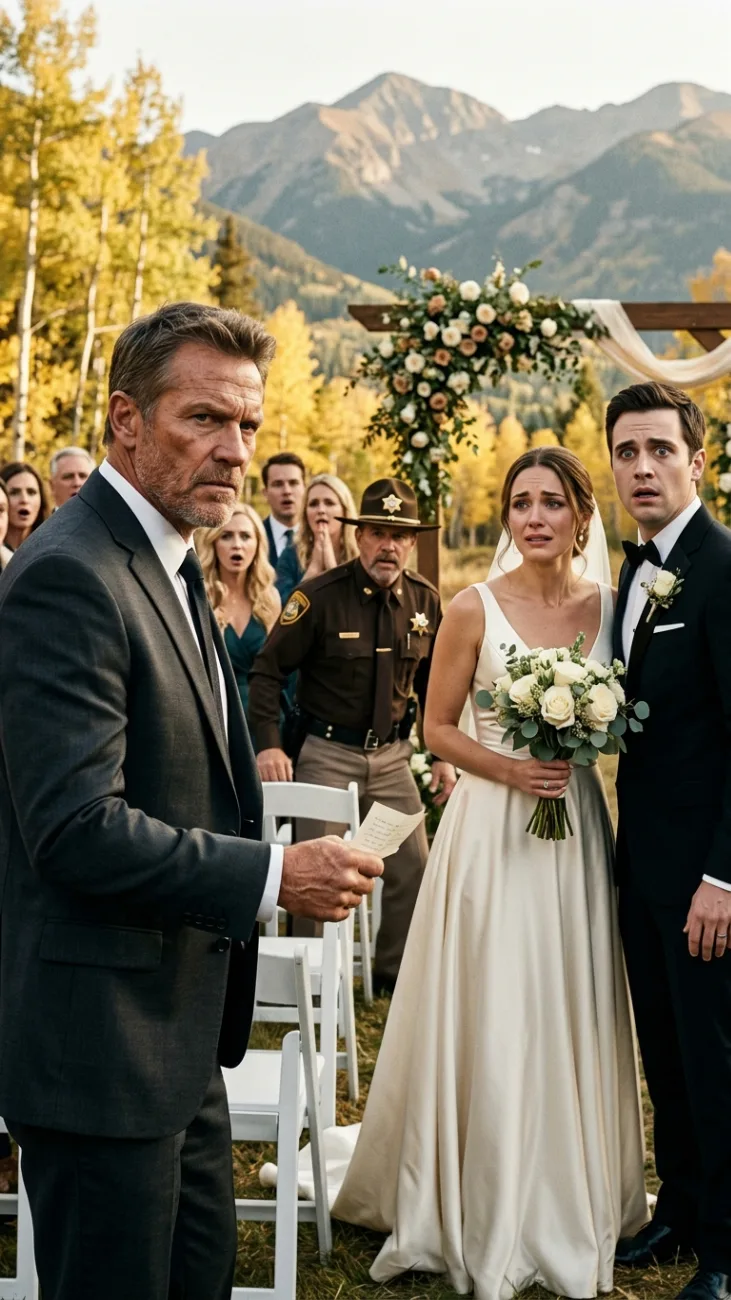
If I took this to Claire three weeks before her wedding, what would she think? That I was protecting her? Or that I was trying to control her life, just like Tyler had accused her last boyfriend’s father of doing? She was in love. She’d already picked a dress, chosen flowers, sent out invitations. Two hundred guests were planning their September weekend around watching my daughter walk down an aisle made of hay bales and plywood.
My heart knew what I should do. My head wanted more proof.
“I need to be sure,” I said quietly. “I need more than patterns and coincidences. If I blow up her wedding over this and I’m wrong…”
“You’re not wrong,” Margaret said. “Your instincts are rarely wrong.”
“But if I’m early,” I said, “if I move before she’s ready to see him clearly, she’ll only cling to him harder.”
I thought of Claire as a toddler, stubbornly clutching a broken toy while Linda gently tried to take it away before she cut herself. “Let me take it, honey,” Linda had said. “I’ll fix it.” And Claire had screamed, “No! Mine!”
Margaret leaned back in her chair.
“What do you propose?” she asked.
“I need to know what he’s actually planning,” I said. “Not just what he’s done before. If he’s targeting us… I want to hear it from his own mouth.”
The opportunity came sooner than I expected.