I sent three thousand dollars.
Chapter 2
I sent three thousand dollars.
Three weeks later, one of my soldiers lost both legs to an IED.
Caroline never asked about him.
She never asked about me either.
After my second deployment, I stopped confusing being needed with being loved.
But by then, my father had already done the thing that changed my life.
I was thirty-five when the first collection notice arrived at my apartment outside Fort Meade. I thought it was a mistake. Then came another. Then another.
Loans I had never taken.
Credit lines I had never opened.
Signatures that looked almost like mine, if someone had practiced them badly.
The accounts led to my father’s company.
Whitlock Development Group.
I drove five hours to confront him in his office. He cried. Real tears. Shaking hands. Broken voice.
“I was desperate,” he said. “Caroline needed help. The business was under pressure. I was going to fix it before you ever knew.”
“You used my Social Security number.”
“You are my daughter.”
He said it like ownership.
I remember staring at him across his mahogany desk, realizing the man I had spent my entire life trying to impress had never seen me as a person. I was an extension. A resource. A signature he could borrow. A life he could damage because he assumed I would remain loyal.
I told him he had thirty days to fix it.
Instead, he told the family I was unstable.
Deployment had changed Ava.
Ava was paranoid.
Ava was making accusations.
Ava needed boundaries.
That was my father’s genius. He did not simply lie. He prepared the room so truth would sound like madness when it arrived.
So I learned patience.
I documented everything.
Bank records. Emails. Loan forms. Transfer histories. Property filings. Insurance distributions. Trust documents. Tax inconsistencies. Hidden accounts.
I sent copies to an
attorney in Boston named Marcus Bell.
Then I waited.
Not because I was weak.
Because I wanted the truth to survive court.
Part 3
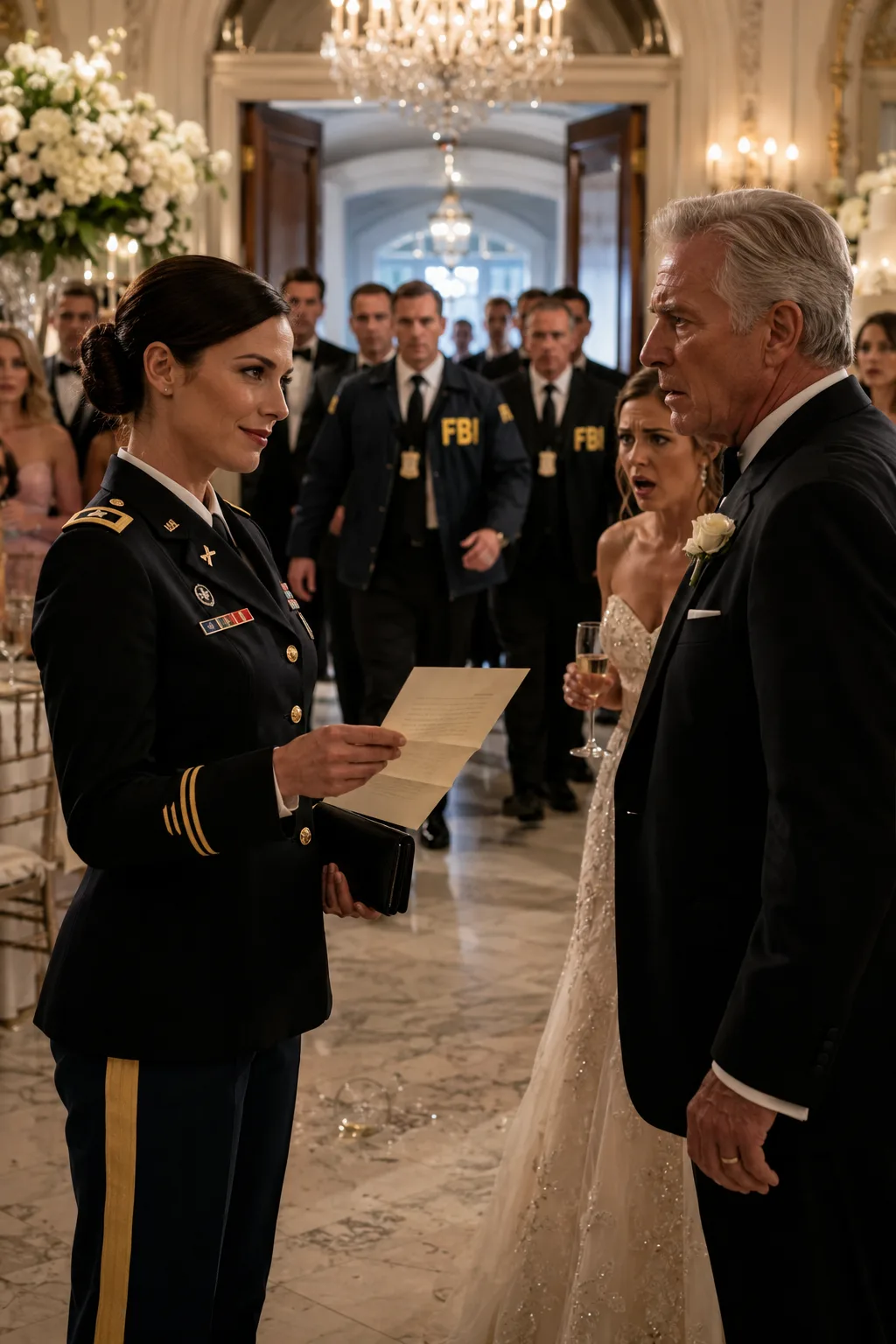
When my father gave me the disownment letter, he thought he was ending the story.
I could see it in his face.
He expected me to become the version of myself he had sold to everyone else: emotional, unstable, desperate for approval.
The ballroom waited.
Caroline lifted her chin. Her new husband, Nathan Price, stood beside her looking confused. That interested me. Nathan was a clean-cut Boston surgeon with kind eyes and the innocent exhaustion of a man who had just married into a family he did not understand.
He looked from Caroline to my father, then to me.
“What is that?” he asked quietly.
Caroline ignored him.
I stood.
The room shifted with me. Chairs creaked. Forks paused. The videographer adjusted his angle.
My father’s
eyes narrowed. “Ava.”
I took the microphone from the stand near the band.
Caroline laughed nervously. “Oh my God, please don’t do a speech.”
“You wanted this public,” I said. “I think public honesty is fair.”
Her smile hardened. “This is my wedding.”
“Yes,” I said. “And during dessert, you handed your sister a formal exile letter.”
Someone gasped near the back.
Nathan turned fully toward Caroline. “You did what?”
She whispered, “It’s complicated.”
“No,” I said softly. “It’s really not.”
The ballroom became so quiet that I could hear rain against the tall windows overlooking Newport Harbor.
“I was not planning to speak tonight,” I began. “I came here because my mother loved family. She loved tradition. She believed people could disappoint each other and still come back to the table.”
My father’s jaw tightened.
“After she died, people were told I abandoned this family. That I ran off to the Army because I wanted attention. The truth is our house was falling apart, our bills were overdue, and I had no way to pay for college.”
Caroline folded her arms. “Ava, don’t.”
“I sent money home for years,” I continued. “For bills. For Caroline’s tuition. For my father’s company. For emergencies that were never mine but always became mine.”
Nathan looked at Caroline.
She shook her head quickly. “She exaggerates everything.”
“I kept receipts.”
That was when the atmosphere changed.
Not dramatically. Not loudly. But something moved through the room. Doubt. It traveled from table to table, touching every guest who had accepted the family version because it had been convenient.
My father stepped closer. “You are embarrassing yourself.”
I smiled at him. “No, Dad. For once, I’m not.”
I opened my clutch and removed a slim folder.
His face changed.
Only for a second.
But I saw it.
Fear.
“I discovered loans under my name seven years ago,” I said. “Loans I never signed. Credit lines I never opened. Accounts tied to Whitlock Development Group.”
Nathan whispered, “What?”
Caroline’s face went pale beneath her makeup.
My father’s voice dropped. “Put that away.”
“No.”
The word was quiet, but it landed harder than shouting.
“I confronted my father privately. He promised to fix it. Instead, he told relatives I was unstable from deployment.”
Aunt Patricia, seated near the front, covered her mouth.
I looked at her. “You believed him.”
Her eyes filled with shame.
My father said, “Enough.”
But enough had been years ago. Enough had been the first forged signature. Enough had been every holiday where I was treated like a threat because I knew too much.
“I documented everything,” I said. “The loans. The forged signatures. The missing insurance money. The transfers from my mother’s estate. The tax filings. The shell accounts.”
Caroline grabbed Nathan’s arm. “She’s lying.”
He pulled away.
That small movement destroyed her more completely than any accusation I could have made.
Then I looked at my father.
“Before I came here tonight, my attorney sent complete copies to the IRS, the U.S. Attorney’s Office, and federal investigators.”
The room erupted in whispers.
My father looked old.
Not powerful. Not untouchable. Just old.
I placed the folder back inside my clutch and said the sentence I had waited seven years to say.
“The letter you gave me tonight was helpful. My attorney received a copy this morning. It proves formal separation. It also proves motive.”
The ballroom doors opened behind me.
Two men in dark suits stepped inside.
One of them scanned the room once and said, “Richard Whitlock?”
Part 4
Federal agents do not need to shout.
That is what people misunderstand.
They do not need drama, because authority already changes the air.
The older agent stepped forward with a calm expression. “Mr. Whitlock, we need to speak with you.”
My father adjusted his jacket. It was almost impressive, how instinctively he reached for dignity even while his empire was cracking under the chandeliers.
“There must be some mistake,” he said.
The agent did not blink. “We can discuss that privately.”
Caroline stepped toward me, her voice sharp and low. “You planned this.”
“No,” I said. “I prepared for it.”
“There’s no difference.”
“There is. Planning comes from revenge. Preparation comes from survival.”
Nathan stared at her. “You knew?”
Caroline’s eyes flashed. “She hates us. She has always hated us.”
“That is not what I asked.”
The room froze.
Caroline’s mouth opened, then closed. The wrong pause can destroy a lie faster than any confession.
My father tried to regain control. “This is a family matter.”
The younger agent said, “Financial fraud is not a family matter, sir.”
A sound moved through the ballroom. Not a gasp exactly. Something uglier. The sound of social certainty collapsing.
My grandmother began to cry softly at her table. Aunt Patricia stood, trembling.
“Richard,” she whispered, “tell me this isn’t true.”
My father turned on her. “Sit down.”
That answered enough.
For most of my life, people obeyed him because he sounded certain. That was his real talent. He could make cruelty sound responsible. He could make theft sound temporary. He could make abandonment sound like boundaries.
But certainty has a shelf life.
Evidence lasts longer.
Caroline suddenly raised her voice. “You ruined my wedding.”
There it was.
Not “Is this true?”
Not “What did Dad do?”
Not “I’m sorry.”
Only the wedding.
I looked at my sister in her perfect white gown, surrounded by melting candles and wilting roses, and for the first time I felt no envy, no anger, no longing.
Only pity.
“No,” I said. “Your lies ruined your wedding.”
Her face twisted. “You always thought you were better than me because you wore that uniform.”
I looked down at the medals over my chest.
“No. The uniform taught me something you never learned.”
“What?”
“That survival does not require permission.”
Nathan closed his eyes as though something inside him had finally broken.
My father said, “Ava, if you walk this road, there is no coming back.”
The sentence was so familiar that I almost smiled. He had been saying it in different forms all my life.
If you enlist, don’t expect help.
If you accuse me, don’t expect family.
If you speak, don’t expect love.
I stepped closer to him. “You handed me a disownment letter in front of two hundred people.”
His mouth tightened.
“I’m not walking away from anything,” I said. “You pushed me out and called it order.”
The agent gestured toward the side corridor.
My father hesitated. For the first time, he looked at the guests. Really looked. Business partners. Donors. Old friends. Caroline’s in-laws. People whose admiration had fed him for decades.
Nobody came to help.
Power is lonely when fear leaves the room.
He turned back to me, and in his eyes I saw hatred, humiliation, and one small shard of regret.
Not regret for hurting me.
Regret for underestimating me.
As the agents escorted him toward the corridor, Caroline broke.
She screamed his name. Then mine. Then Nathan’s.
But Nathan did not move toward her.
He removed his wedding ring slowly.
Caroline stared at him. “Don’t you dare.”
His voice was hollow. “I need the truth.”
“You have me.”
“No,” he said. “I have a stranger in a wedding dress.”
The sentence cut through the room.
I did not stay to watch the rest.
I picked up my clutch, turned away from the cameras, and walked out through the ballroom doors into the rain.
Part 5
Newport smelled like salt, wet stone, and expensive regret.
I stood beneath the hotel awning while rain fell over the harbor. Behind me, the wedding continued to collapse in muffled fragments: raised voices, hurried footsteps, the low panic of staff trying to manage a scandal too large for a seating chart.
My phone vibrated.
Marcus Bell.
I answered. “This is not a good time.”
“You need to hear this now,” he said.
Something in his voice made me step away from the doors.
“What happened?”
“I received confirmation from the probate attorney in Vermont. Your mother created a secondary trust eight months before she died.”
For a moment, the rain seemed to stop making sound.
“My mother?”
“Yes.”
“That’s impossible. Dad handled her estate.”
“He handled the estate he wanted everyone to know about.”
I pressed my free hand against a stone column.
Marcus continued carefully. “Margaret Whitlock created a conditional trust through a private attorney in Burlington. It remained sealed until specific conditions were met.”
“What conditions?”
A pause.
“Formal separation from the Whitlock family.”
I closed my eyes.
The disownment letter.
My father, in his cruelty, had signed the key to a door my mother had hidden for me.
Marcus said, “Ava, the letter activates the release clause.”
I could not speak.
All those years, I had thought my mother left me nothing but memories and grief. I had believed my father when he said everything had been necessary, complicated, already spent.
But she had known.
Somehow, before she died, she had known what kind of family I would be left with.
“What’s in it?” I asked.
“A lake house in Vermont. Investment accounts. Some jewelry. Personal items. And letters addressed to you.”
The last part broke me.
Not the money. Not the house.
Letters.
My mother’s handwriting. Her careful loops. Her left-leaning slant. The way she used to write recipes on index cards and leave notes in my lunchbox when I was little.
Tears came then, quiet and sudden. I had not cried in the ballroom. Not when my father rejected me. Not when my sister called me a liar. Not when the agents walked in.
But my mother loving me from beyond the grave was more than I could defend against.
“She protected me,” I whispered.
“Yes,” Marcus said softly. “I believe she did.”
The hotel doors opened behind me.
Nathan stepped outside. His bow tie hung loose. His tuxedo jacket was unbuttoned. He looked like a man who had aged ten years in one hour.
“I’m sorry,” he said.
I wiped my face quickly. “You don’t owe me an apology.”
“Someone should have apologized to you a long time ago.”
That hurt more than the letter.
Maybe because it was kind.
Maybe because kindness from strangers can expose just how long you have lived without it.
Nathan looked back toward the ballroom. “They’re already trying to control the story.”
“Of course they are.”
“Caroline says you set everyone up.”
I almost laughed. “I let them reveal themselves.”
He nodded slowly.
Then he looked down at his ring, still in his palm.
“I don’t think I’m married anymore,” he said.
Legally, he was wrong.
Emotionally, he was not.
He walked into the rain without another word.
I stayed beneath the awning until the agents brought my father through a side exit. His hands were not cuffed. Not yet. But two agents walked close enough to make the meaning clear.
He saw me.
For one brief second, I thought he might speak.
Maybe apologize. Maybe threaten me. Maybe say my name like a father instead of a judge.
He said nothing.
The black federal sedan pulled away from the hotel.
And just like that, the man who had controlled my life for decades disappeared into the rain.
Part 6
By morning, the videos were everywhere.
Decorated Army officer disowned at sister’s wedding.
Federal agents interrupt Newport reception.
Prominent developer questioned in fraud investigation.
Caroline deleted her social media accounts within forty-eight hours.
Nathan filed for annulment within two weeks.
My father’s company closed within three months.
The investigations took longer. They always do. Paperwork is patient. Justice is slower than pain, but it moves if fed properly.
My father’s attorneys tried every strategy.
Family misunderstanding.
Administrative error.
Emotional dispute.
Military daughter with unresolved trauma.
But evidence does not care about tone.
The signatures were there. The accounts were there. The transfers were there. The tax filings did not match the statements. The shell companies connected back to properties he had sworn were unrelated.
Caroline was questioned too.
At first, she denied everything.
Then Nathan turned over documents from their shared apartment. Emails. Wedding budget spreadsheets. Messages where she complained that “Ava’s money” should have been used before anyone touched her bridal fund.
That was Caroline’s tragedy. She never understood that writing something down made it real to people outside our family.
Aunt Patricia called me three times.
I answered on the fourth.
“I didn’t know,” she said through tears.
“I believe you didn’t know all of it.”
That was the most forgiveness I could offer.
My grandmother sent a letter in shaky handwriting. She apologized for signing the disownment letter. She said my father told her I had become dangerous. She said she thought she was protecting the family.
I read it twice.
Then I placed it in a drawer.
Not every apology deserves immediate entry back into your life. Some apologies are only acknowledgments of damage. They do not rebuild the house.
Caroline left me one voicemail.
It began with crying. Then blame. Then accusation. Then bargaining.
“You destroyed Dad. You destroyed my marriage. You destroyed everything.”
She never said she was sorry.
I deleted it.
People think closure arrives as a grand emotional moment. A slammed door. A final argument. A courthouse victory.
Sometimes closure is simply pressing delete and feeling nothing dramatic afterward.
Six weeks after the wedding, Marcus called to say the trust was ready.
I drove to Vermont alone.
The lake house stood outside Stowe, down a narrow road lined with sugar maples. Autumn had already begun burning through the hills. Gold leaves drifted across the windshield. The air smelled like woodsmoke, cold water, and clean endings.
The house was small and white, with dark green shutters and a dock stretching into a quiet lake.
It was nothing like my father’s taste.
That told me it had been truly hers.
Inside, the rooms smelled faintly of cedar and old books. Sunlight fell across braided rugs. There were quilts folded over chairs, framed black-and-white photographs on the mantel, and a blue ceramic mug beside the kitchen sink as though my mother had only stepped into another room.
On the kitchen table sat five envelopes.
Ava, age 25.
Ava, age 35.
Ava, when you need courage.
Ava, when you know the truth.
Ava, after you are free.
My hands shook so badly I had to sit down.
I opened the last one first.
My dearest Ava,
If you are reading this, then something has happened that I hoped would never come, but feared might. I know your father. I know his pride. I know how easily strong daughters become targets in weak families.
I stopped reading because tears had blurred the page.
Outside, the lake moved softly under the wind.
I tried again.
You may believe you were abandoned. You were not. I loved you from the first breath you took, and I have loved you through every silence that came after me.
One day, they may mistake your restraint for weakness.
Let them.
Silence is not surrender when you are gathering strength.
I folded over the letter and pressed it against my chest.
For years, I had survived by becoming hard. Efficient. Controlled. A woman who could stand in war rooms, hospital corridors, funeral chapels, and wedding ballrooms without falling apart.
But there, in my mother’s kitchen, I let myself break.
Not because I was defeated.
Because I was finally safe.
Part 7
My father pleaded guilty the following spring.
The final charges were less dramatic than the truth, because legal systems prefer narrow doors. Fraud. False statements. Tax violations. Identity theft connected to financial instruments.
It was enough.
At sentencing, I sat in the back row of the courtroom wearing a navy suit instead of a uniform. Caroline sat on the opposite side, thinner than before, her hair cut short, her face pale and polished.
She did not look at me.
My father did.
When given the chance to speak, he stood slowly.
His attorney had prepared something for him. I could tell. Richard Whitlock did not apologize without rehearsal.
“My actions were mistakes made under pressure,” he began.
The judge watched him without expression.
“I loved my family and wanted to preserve what my wife and I built.”
That was when I stood.
My attorney touched my wrist, but I shook my head.
The judge allowed me to read a victim statement.
I had written three versions. Angry. Polite. Devastating.
In the end, I read none of them.
I walked to the podium with one page in my hand: my mother’s letter.
“My father stole from me,” I said. “But before that, he taught me to doubt my own pain. He used family as a word for ownership. He used loyalty as a leash. He used grief as camouflage.”
The courtroom was silent.
“He told people I was unstable because I had served in war. But the truth is, service taught me what he never could. It taught me discipline. Patience. Courage. It taught me that fear is not a command.”
My father looked down.
“I do not ask this court for revenge. I ask for recognition. Not only of the money, but of the years. The reputation. The isolation. The way a person can be erased inside her own family while still being expected to pay the bills.”
My voice trembled once.
Only once.
“My mother wrote that silence is not surrender. Today, my silence ends.”
When I returned to my seat, Caroline was crying.
I did not know whether the tears were for me, for herself, or for the life she had lost.
It no longer mattered.
My father was sentenced. Not for as long as some people wanted. Longer than he expected.
As deputies led him away, he turned.
“Ava,” he said.
It was the first time in years he had said my name without contempt.
I looked at him.
There were a hundred things I could have said.
I could have told him he destroyed his own life. I could have told him my mother had outsmarted him. I could have told him that the daughter he tried to exile had become the only person in the family strong enough to tell the truth.
Instead, I said, “Goodbye, Dad.”
And I meant it.
Part 8
One year after Caroline’s wedding, I returned to the lake house permanently.
I retired from active service that summer and accepted a civilian advisory role in Washington that allowed remote work. For the first time since I was eighteen, I chose where to live because I wanted peace, not because duty ordered me there.
The lake was quiet in the mornings.
Mist rose off the water. Loons called from somewhere beyond the pines. In winter, snow softened the roof and turned the woods silver. In spring, wildflowers appeared near the dock my mother must have loved.
I kept her letters in a wooden box beside the fireplace.
I read them on difficult days.
Not because I was stuck in the past, but because love, when real, continues to give instructions.
Caroline wrote once.
A real letter this time. No performance. No perfume. No dramatic loops.
She said she had started therapy. She said Nathan had moved to Seattle. She said she did not expect forgiveness but wanted to admit that she knew more than she had claimed. Not everything, but enough. Enough to stay quiet. Enough to benefit. Enough to become cruel.
At the end, she wrote, I thought love was something you won. I am beginning to understand that means I never really had it.
I sat with that sentence for a long time.
Then I wrote back.
I hope you become someone honest.
That was all.
It was not forgiveness.
It was not punishment.
It was a door left closed but not locked forever.
My grandmother died the next winter. I went to the funeral. I stood in the back, signed the guest book, and left before anyone could turn grief into a reunion.
Some relatives watched me with guilt.
Others with resentment.
I understood both.
Families built on silence do not thank the person who finally speaks. They blame her for the noise.
But I no longer needed them to understand.
On the second anniversary of the wedding, I sat on the dock at sunset with my mother’s final letter open beside me.
The sky burned orange over the lake. The water held the light like a secret. For a while, I listened to the wind move through the trees.
The envelope my father had given me was stored in the same wooden box as my mother’s letters. I kept it not because it hurt me, but because it reminded me of the strangest truth I had ever lived.
Sometimes the thing meant to destroy you becomes the document that sets you free.
My father thought disowning me would erase me.
Instead, it gave me my name back.
My sister thought humiliation would make me small.
Instead, it made the truth visible.
My relatives thought silence meant guilt.
Instead, silence had been preparation.
I watched the sun disappear behind the Vermont hills and felt no triumph, no bitterness, no ache for a family that had only loved me when I was useful.
What I felt was peace.
Real peace.
The kind that does not need witnesses.
The kind that does not ask permission.
The kind my mother had hidden for me in a house by a lake, waiting patiently until I was ready to come home.
Chapter complete
You have reached the end of this chapter.
Continue reading
A few more worlds to get lost in after this chapter.




