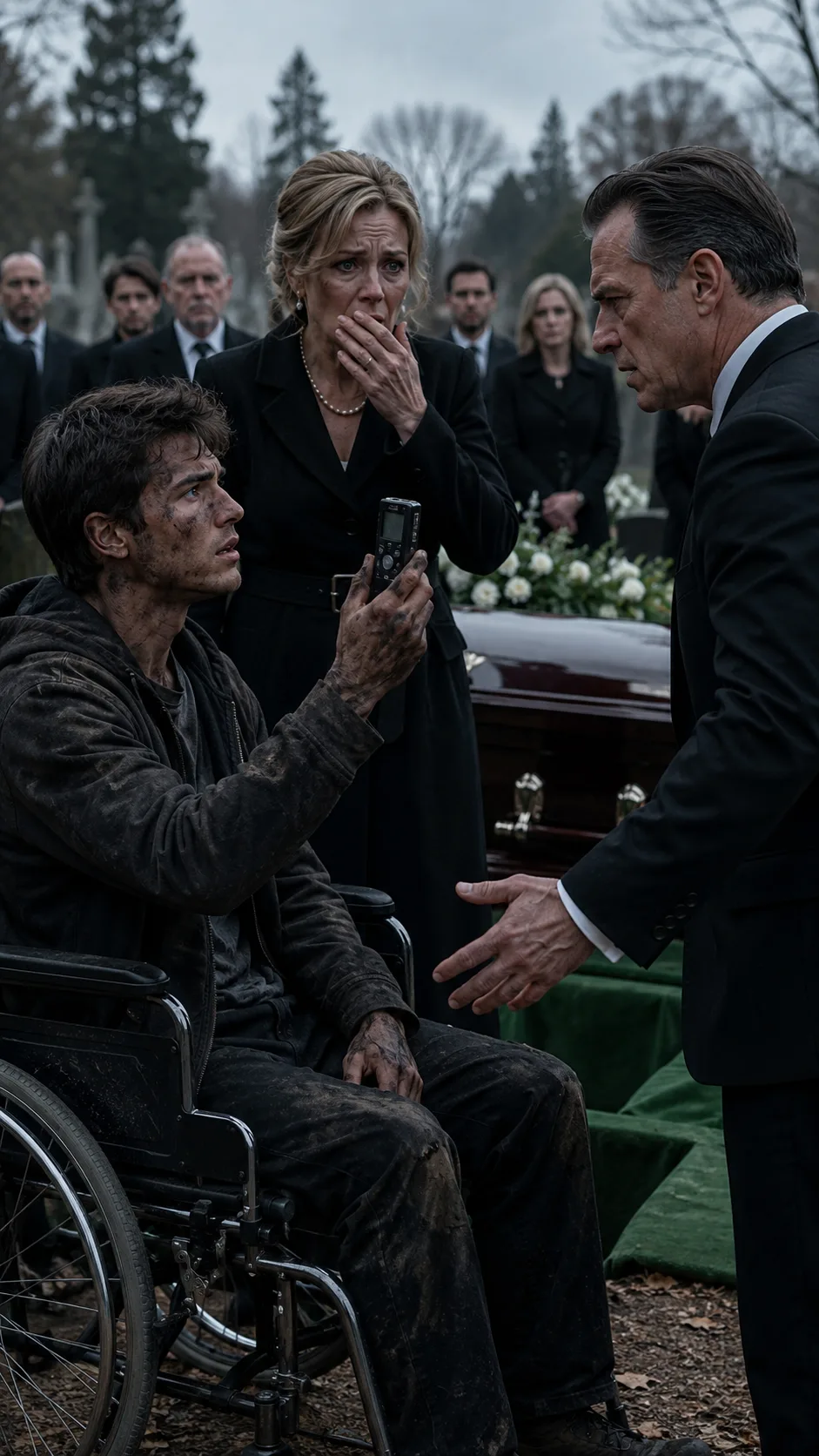
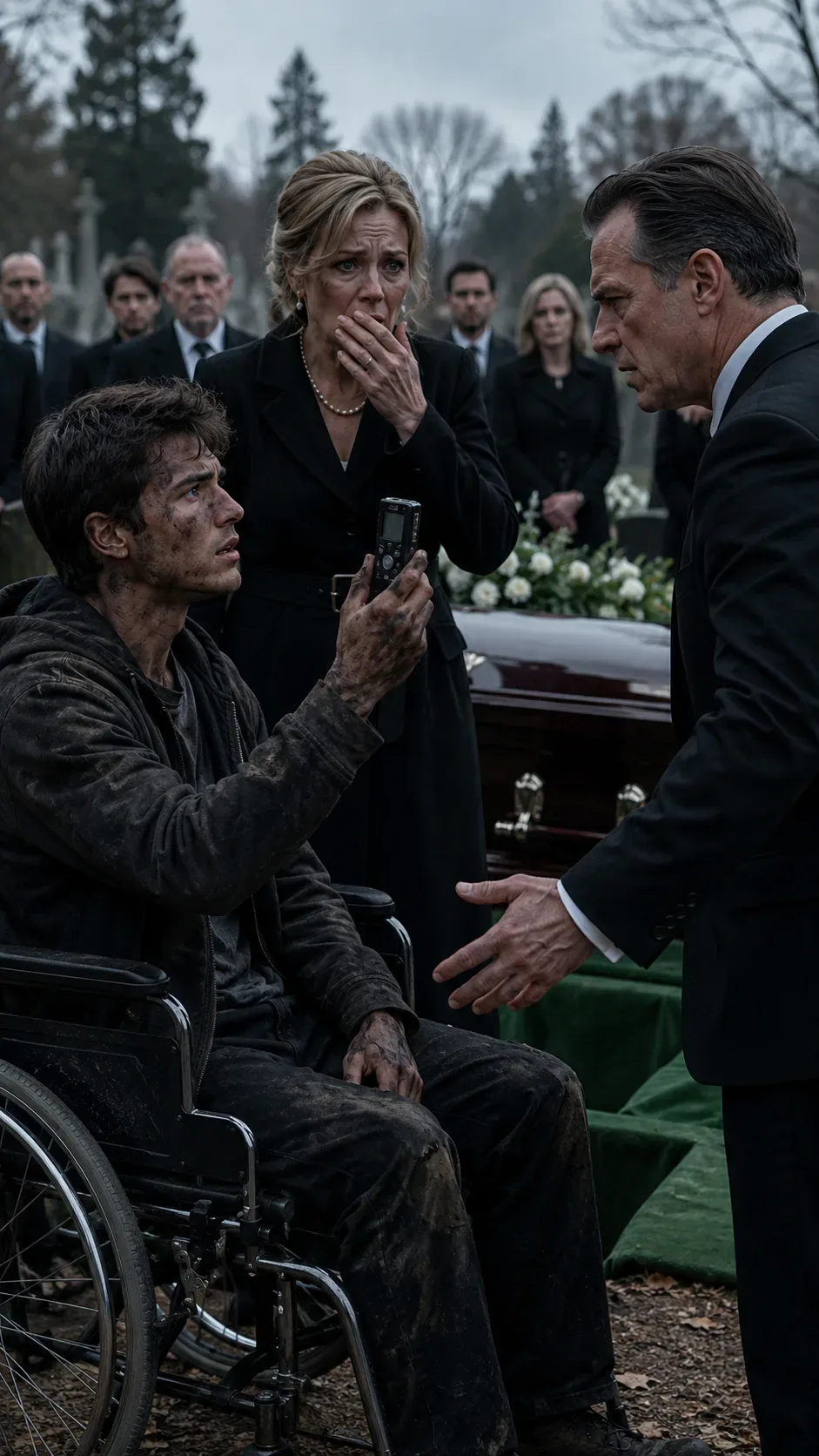
At the funeral, a dirty young man in a wheelchair suddenly rolled toward the grave and screamed for them to stop the burial, terrifying the guests who believed he was insane.
Chapter 1
At the funeral, a dirty young man in a wheelchair suddenly rolled toward the grave and screamed for them to stop the burial, terrifying the guests who believed he was insane.
But when he looked at a pale woman in the crowd and whispered, “Mom… it’s me,” the entire cemetery fell silent, because her son had supposedly died in a fire twenty years earlier. Then, with trembling fingers, he raised his burned hand and revealed the small childhood ring engraved with their family name — the same ring that vanished with the missing boy on the night of the tragedy.
Eleanor staggered backward. The world tilted beneath her feet. Her husband, Arthur, caught her arm, his grip tightening until it hurt.
“Get him out of here!” Arthur shouted, his voice shaking. “Call the police!”
Two men in dark suits stepped forward. They reached for the wheelchair.
“Don’t touch me!” the young man screamed. He thrashed, gripping the wheels. “Look at it, Mom! Look at the crest!”
Eleanor pushed Arthur away. Her eyes were locked on the small, tarnished silver band. It
was scratched. It was worn. But the engraved initials were unmistakable.
“Arthur, wait,” she whispered.
“Eleanor, no,” Arthur hissed, pulling her back. “It’s a sick trick. Julian died. We buried his memory twenty years ago.”
The stranger looked directly at Eleanor. Tears cut clean paths through the grime on his face.
“The blue bedroom,” the young man said, his voice dropping to a raw whisper. “You used to sing the song about the paper moon when the thunderstorms came.”
Eleanor froze. The air left her lungs. No one else knew that. It wasn’t in the news reports. It wasn’t in the old case files.
“Who are you?” she gasped, taking a trembling step toward him.
“It’s me, Mom. I survived. I’ve been trying to get back to you for so long.”
“This is madness,” Arthur yelled, stepping between them. “Julian died in the flames! The police found the remains!”
The
young man stared bitterly at Arthur. His scarred fingers tightened around the armrests of his wheelchair.
“They found a body, Arthur,” the young man whispered. “But it wasn’t mine.”
Eleanor gripped her throat, looking from the stranger to her husband. A terrifying realization began to take root in her mind.
“What do you mean?” Eleanor cried. “Then whose body was in the house?”
The young man looked around the cemetery, his eyes narrowing as he fixed his gaze on someone standing at the back of the crowd.
“Ask the person who set the fire,” he said.
A silence fell so violently that even the wind seemed to stop moving through the black coats and gray veils.
Everyone turned.
At the far edge of the cemetery, beneath the crooked shadow of an old cypress tree, stood a woman in a dark green dress. She had been quiet the entire service. Too
quiet. Her gloved hands were folded at her waist, her lips pressed into a thin line.
Margaret Vale.
Arthur’s younger sister.
Eleanor saw her and frowned through her tears. “Margaret?”
Margaret did not move.
Not at first.
Then her right hand twitched.
Arthur’s head snapped toward the young man. “You filthy liar.”
The young man laughed once, but there was no humor in it. “You still say that the same way.”
Arthur stepped closer. “I don’t know who paid you, but this ends now.”
“No,” Eleanor said.
Her voice was weak, but everyone heard it.
Arthur turned slowly. “Eleanor.”
“No,” she repeated, stronger this time. “Let him speak.”
The priest stood beside the open grave, frozen with the prayer book still in his hands. The coffin waited above the earth, polished mahogany shining beneath the pale morning light.
It was Arthur’s funeral.
Or it was supposed to be.
That was the cruelest part. Arthur Whitmore, powerful patriarch, respected philanthropist, beloved husband, had collapsed three days earlier in his private study. The family said it was his heart. The newspapers called it peaceful.
But Arthur was standing beside Eleanor.
Alive.
Breathing.
Commanding.
The man inside the coffin was not Arthur.
The man inside the coffin was Arthur’s older brother, Edmund, the one everyone had gathered to mourn.
And Edmund had died with one secret still locked inside him.
The young man slowly reached into the torn inner pocket of his coat.
Arthur lunged forward. “Stop him!”
But Eleanor moved first. She stepped between Arthur and the wheelchair.
Her hands were shaking, but she did not move aside.
The young man pulled out a folded piece of oil-stained paper. It had been protected beneath layers of plastic, tape, and thread. He unfolded it carefully, as if one wrong movement might turn it to dust.
“This was hidden inside the back of my chair,” he said. “The man who raised me sewed it there before he died.”
Eleanor stared at the paper.
“What is it?”
“A letter,” he said. “From Edmund.”
The name struck the crowd like a bell.
Arthur’s jaw tightened.
Margaret’s eyes finally lifted.
The young man looked down and read.
“Eleanor, if this ever reaches you, then the boy is alive. I could not save the other child, but I saved yours.”
Eleanor covered her mouth.
The young man kept reading, his voice breaking over each word.
“I was too late to stop the fire. I saw Margaret leaving the east wing with the lamp oil. I saw Arthur standing in the garden, watching the windows burn. I carried Julian out through the servants’ passage. His legs were badly injured. His hand was burned. I could not bring him back to the house because Arthur saw me. He told me if the boy lived, everything we had built would collapse.”
A murmur spread through the mourners.
Arthur’s face turned colorless.
“That is forged,” he said.
The young man looked up. “You said the same thing when Edmund confronted you.”
Eleanor slowly turned toward her husband.
“Arthur,” she whispered.
He did not look at her.
The young man continued.
“Edmund took me to a doctor outside the city. He paid a nurse to hide me. But Arthur found out. I remember the shouting. I remember Edmund telling him he would go to the police. The next morning, Edmund disappeared for three months.”
Margaret’s breathing changed.
Only slightly.
But Eleanor heard it.
The young man pointed toward the coffin. “He spent the rest of his life trying to find me again. When he finally did, he was already dying. He told me the truth. He told me to come here today, because this would be the only place where all of you had to listen.”
Arthur looked at the crowd.
For the first time that morning, he looked afraid.
“Enough,” he said. “This family has suffered enough.”
Eleanor stared at him as if she were seeing a stranger wearing her husband’s face.
“Did you know?” she asked.
Arthur swallowed. “I protected you.”
Her knees almost failed.
“No.”
“I protected you,” Arthur said again, louder now. “Do you have any idea what losing him did to you? You stopped eating. You stopped speaking. You were a ghost in that house. I buried the truth because the truth would have destroyed you.”
“My son was alive.”
Arthur’s mouth opened, but nothing came out.
“My son was alive,” Eleanor said again. “And you let me mourn him for twenty years.”
The cemetery shifted around them. Guests lowered their eyes. Some stepped back as if guilt itself had spread across the grass.
Margaret suddenly turned to leave.
The young man saw her.
“So you’re running again?”
Margaret froze.
Her shoulders lifted once.
Then she slowly faced him.
“You don’t know what happened that night,” she said.
The young man rolled his chair forward. The wheels pressed through the wet grass. “Then tell her.”
Margaret looked at Eleanor.
For a moment, she looked almost young again. Not the elegant widow with diamonds at her collar. Not the quiet sister-in-law who had spent twenty years lighting candles on Julian’s birthday. Just a woman cornered by a memory she had rehearsed too many times.
“I didn’t mean for the fire to spread,” Margaret said.
Eleanor’s face went still.
Arthur hissed, “Margaret, shut your mouth.”
But Margaret was already unraveling.
“I only wanted smoke,” she said. “Enough smoke to scare Edmund. Enough to force Father to change the will.”
“The will?” Eleanor whispered.
Margaret laughed, but it cracked halfway through. “You never knew, did you? Julian was going to inherit everything through your side of the trust. The estate, the company shares, the coastal land. Father changed it after Julian was born. Not Arthur. Not Edmund. Julian.”
Eleanor looked down at the young man in the wheelchair.
His burned hand rested on his lap, the silver ring dull beneath the cloudy sky.
Margaret’s voice thinned. “Arthur said if the boy was gone, the trust would return to the brothers. Edmund would get half. Arthur would get half. He promised me a place in the company. A real place. Not charity. Not pity.”
Arthur stepped toward her. “Stop talking.”
“No,” Margaret said, and now she was looking at him with twenty years of poison in her eyes. “You don’t get to bury Edmund and bury me with him.”
The crowd turned toward Arthur.
Eleanor did not blink.
Margaret raised her trembling hand and pointed at him.
“He locked the nursery door.”
The words fell into the cemetery like a stone dropped into dark water.
Eleanor made a sound so small it barely sounded human.
The young man closed his eyes.
Arthur stood perfectly still.
Then he said, “That is not true.”
Margaret shook her head. “You locked it because Julian woke up. He was crying. He saw me with the lamp. He would have told Eleanor.”
Arthur’s voice dropped. “Careful.”
Margaret took one step forward. “Edmund broke the servants’ door to get him out. That’s why you hated him. That’s why you kept him silent with money, doctors, threats, everything. But he saved the boy. He saved what was left of him.”
Eleanor walked toward Arthur.
Not fast.
Not dramatically.
Just one step.
Then another.
The guests moved aside.
For twenty years, she had slept beside this man. She had leaned on his arm at memorial dinners. She had let him hold her hand at the grave of a child who had never been buried there. She had thanked him for surviving grief with her.
Now she stood in front of him and looked into his eyes.
“Tell me she’s lying,” Eleanor said.
Arthur’s throat moved.
“Tell me,” she said again.
Arthur looked at the young man. Then at Margaret. Then at the coffin waiting beside the grave.
Something cold passed across his face.
“I did what had to be done.”
A woman in the crowd gasped.
Eleanor stepped back as if he had struck her.
Arthur turned toward the mourners. “All of you stand here judging me because you have the luxury of pretending families are built on love. They are not. Families are built on names, land, power, bloodlines. That boy was going to inherit everything before he could even write his own name.”
“That boy was your son,” Eleanor said.
Arthur snapped his head toward her. “He was your son.”
The words silenced even Margaret.
Eleanor stared at him.
Arthur seemed to realize what he had said only after it had already left his mouth.
The young man looked between them.
“What does that mean?” he asked.
Arthur’s face hardened. “It means nothing.”
But Eleanor was no longer looking at Arthur.
She was looking at the coffin.
At Edmund’s coffin.
“No,” she whispered.
Margaret covered her mouth.
Eleanor turned slowly toward the young man. Her voice trembled. “Julian…”
The young man’s eyes searched hers. “Mom?”
Eleanor’s lips parted, but she could barely breathe.
Arthur spoke first.
“He was Edmund’s.”
The cemetery broke into whispers.
Eleanor’s hand flew to her chest.
Arthur’s smile was bitter now. Empty. Ruined.
“You want the whole truth? Fine. There it is. Edmund loved you before I married you. You loved him too. Don’t pretend you didn’t. Father knew. Everyone knew. Then you chose me because I was the one with the name, the house, the future.”
“That is not true,” Eleanor said.
Arthur ignored her.
“When Julian was born, Father saw Edmund’s face in him. He knew. That old fool changed the trust to protect Edmund’s child. My wife’s child. My brother’s son.”
Julian gripped the wheels of his chair.
Eleanor looked as if the ground had opened beneath her, but she did not deny it.
Arthur leaned closer. “I raised another man’s heir in my house. I watched everyone celebrate him. I watched Father put my inheritance into his crib.”
Margaret whispered, “Arthur…”
He swung toward her. “You lit the match. Don’t look innocent now.”
“But you locked the door,” Margaret said.
“And Edmund opened it.”
Arthur’s voice cracked on his brother’s name.
That small crack told Eleanor everything.
Arthur had not hated Edmund because of the estate.
Not only that.
He had hated him because Edmund had done the one thing Arthur had never been able to do.
He had saved Julian.
A police siren sounded far beyond the cemetery gates.
Someone had called.
Arthur heard it too.
He looked around the crowd and saw that the fear had changed direction. No one was afraid of the young man in the wheelchair anymore.
They were afraid of him.
Arthur stepped back.
“Eleanor,” he said, changing his voice now. Softening it. “Listen to me. Whatever happened, I stayed. Edmund ran. Margaret lied. I stayed with you through every year of grief.”
“You created the grief,” Eleanor said.
Arthur reached for her.
Julian moved before anyone else.
He pushed his wheelchair between them, his scarred hand raised.
“Don’t touch her.”
Arthur looked down at him.
For one second, the past and present stood face-to-face: the man who locked the door, and the boy who should have died behind it.
Arthur bent slightly, his voice low enough that only those closest could hear.
“You should have stayed buried.”
Julian did not flinch.
“I tried,” he said. “For twenty years, I lived like a ghost because of you. But ghosts remember.”
The police cars reached the cemetery gates.
Margaret sank onto a stone bench, shaking as two officers hurried across the grass.
Arthur straightened his coat as if dignity could still save him.
Eleanor turned to the officers and pointed at her husband.
“This man murdered my son’s childhood,” she said. “And he tried to bury the truth with his brother.”
Arthur laughed once. “That’s not a charge.”
“No,” Julian said.
He reached into his coat again and pulled out a small black recorder.
Arthur stopped laughing.
Julian held it up.
“Edmund knew you’d deny everything,” Julian said. “So before he died, he recorded his last conversation with you.”
Arthur’s face changed.
Not much.
But enough.
The officer took the recorder from Julian’s hand and pressed play.
At first, there was only static.
Then Edmund’s old, fragile voice came through.
“Tell me where the boy is, Arthur.”
Then Arthur’s voice, younger but unmistakable.
“The boy is gone.”
“You saw him alive.”
“I saw a problem.”
Eleanor covered her mouth.
The recording crackled.
Edmund coughed, then said, “You locked that door.”
Arthur’s recorded voice replied, “And you should have left it locked.”
No one moved.
No one breathed.
Arthur stared at the recorder as if it had risen from the grave itself.
The officers stepped toward him.
Arthur backed away. “That is not admissible. That is nothing. You can’t—”
One officer took his arm.
Arthur jerked violently. “Do you know who I am?”
Eleanor looked at him for a long time.
Then she said, “Yes.”
Arthur turned to her.
Her voice was calm now. Terribly calm.
“You are the man I buried my son beside while he was still alive.”
Arthur’s body seemed to fold around the sentence.
They led him away across the wet cemetery grass.
Margaret did not resist when the second officer approached her. She only looked at Julian.
“I didn’t know you survived,” she whispered.
Julian stared at her. “That doesn’t make me less burned.”
Margaret lowered her head.
The officers took her too.
The crowd remained silent as the police cars pulled away from the cemetery gates.
For the first time, Eleanor and Julian were left facing each other without Arthur between them.
The coffin still waited beside the grave.
Edmund’s coffin.
Julian turned toward it.
“He found me in a hospital outside the city,” he said. “I didn’t know who I was. Not really. I remembered smoke. A song. A woman crying my name. Edmund came every month after that. He paid for my care. He told me stories about you.”
Eleanor’s hands trembled at her sides.
“Why didn’t he bring you home?”
Julian looked at the coffin. “He said Arthur would kill me before he let the truth come out.”
Eleanor shut her eyes.
“He was right,” Julian said.
The priest lowered his prayer book.
“What would you like to do?” he asked gently.
Eleanor looked at Edmund’s coffin.
Then at Julian.
Then at the empty grave beside it — the grave where her son’s name had stood for twenty years on a stone that had lied to her every morning.
“Bury Edmund,” she said. “But not beside Julian.”
The priest nodded.
Eleanor walked toward the old headstone at the far end of the family plot. It was covered in moss, carved with the name JULIAN WHITMORE and the dates of a life that had never ended.
She knelt before it.
Julian rolled his chair beside her.
For a while, neither of them spoke.
Eleanor reached out and touched the carved letters.
“I came here every week,” she said. “I brought white roses. Sometimes I talked until my voice gave out.”
Julian looked at the stone.
“I heard you,” he said.
Eleanor turned to him.
He gave a small, broken smile. “Not really. But I used to dream about a woman singing during storms. I didn’t know if she was real.”
Eleanor reached for his burned hand.
He hesitated.
Then he let her take it.
She touched the ring, the scars, the fingers that had survived what her own house had done to him.
“I should have known,” she whispered.
“You were lied to.”
“I am still your mother.”
Julian’s face tightened. For a moment, he looked less like a broken young man and more like a child standing in a blue bedroom, waiting for thunder to pass.
“I don’t know how to come home,” he said.
Eleanor held his hand tighter.
“Then we won’t start with home.”
He looked at her.
“We’ll start with lunch,” she said. “Then a doctor. Then the truth. One piece at a time.”
Behind them, the mourners began to leave in clusters, whispering into phones, carrying the scandal out into the world. By nightfall, the Whitmore name would be everywhere. The fire. The false burial. The hidden heir. The brother who saved him. The husband who betrayed them all.
But Eleanor did not care.
Not anymore.
The family name had taken her son once.
It would not take him again.
The priest began the final prayer over Edmund’s grave. Eleanor listened with her head bowed, Julian beside her, their joined hands resting between the living and the dead.
When the prayer ended, Julian looked at the coffin.
“Was he my father?” he asked.
Eleanor did not answer quickly.
She owed him more than panic. More than shame. More than another buried truth.
“Yes,” she said at last. “Edmund was your father.”
Julian closed his eyes.
Eleanor waited for anger.
Instead, he whispered, “Then he saved me twice.”
The coffin lowered slowly into the earth.
A pale beam of sunlight slipped through the clouds and touched the silver ring on Julian’s hand.
For twenty years, that ring had been the only proof that a child had once belonged somewhere.
Now it was something else.
Not proof of a grave.
Proof of return.
Eleanor rose and stood behind Julian’s wheelchair. Her hands rested on the handles, but she did not push.
“May I?” she asked.
Julian looked back at her.
For a long second, the cemetery held its breath again.
Then he nodded.
Eleanor pushed him slowly away from the false grave, past the guests, past the black cars, past the place where Arthur had shouted for him to be removed.
No one stopped them.
At the cemetery gate, Julian looked up at the sky.
Dark clouds still hung above the city, heavy with rain.
Eleanor bent closer.
“What is it?”
Julian listened for a moment.
Then he said, “I think there’s a storm coming.”
Eleanor’s fingers tightened on the wheelchair handles.
For the first time in twenty years, she began to sing.
Quietly.
Unsteadily.
The old song about the paper moon.
Julian lowered his head as the first rain fell.
And this time, when thunder rolled across the sky, he was not alone.
Chapter complete
You have reached the end of this chapter.
Continue reading
A few more worlds to get lost in after this chapter.




