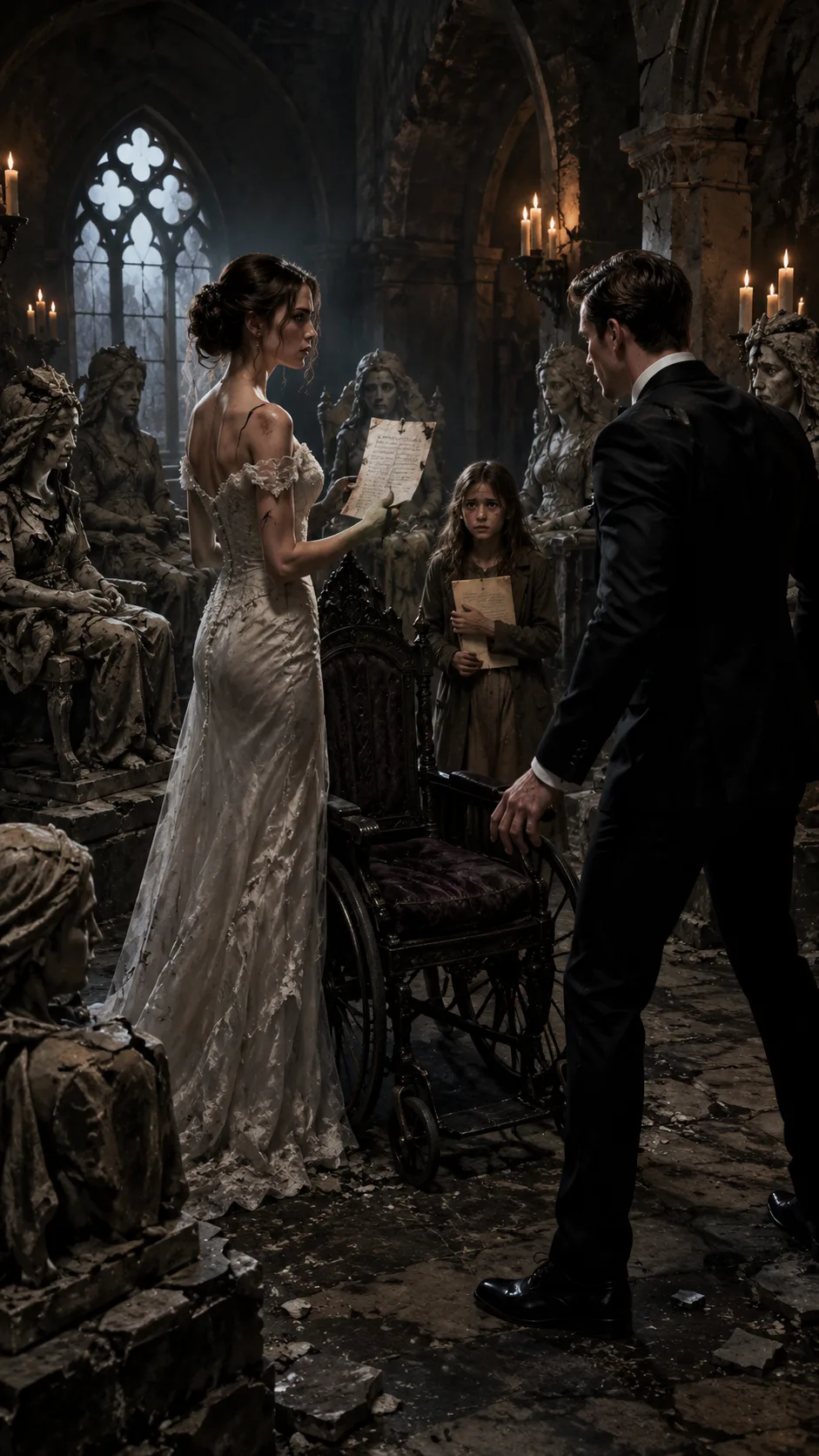
Julian stepped over the shattered glass and reached for the bride’s hand, his grip like a vice.
Chapter 1
Julian stepped over the shattered glass and reached for the bride’s hand, his grip like a vice.
“Now that you’re up,” he whispered, “we have to talk about the basement.”
Clara stared at him.
For three years, she had loved that voice.
That calm voice.
That gentle voice that had read to her on nights when her legs felt like dead weight beneath silk blankets. That voice that had promised her the doctors were still searching, still hoping, still praying. That voice that had kissed her forehead each morning before leaving her trapped beside the window like a beautiful ornament no one dared touch.
Now the same voice sounded like a locked door.
Behind him, the mother-in-law sat twisted in Clara’s abandoned wheelchair, her once-perfect posture collapsing inch by inch. Her hands clawed at the armrests. Her diamonds clicked against the polished wood.
“Don’t take her down there,” the older woman rasped.
Julian did not look back.
“She has to see it.”
Clara tried to pull her
hand away.
His fingers tightened.
A thin line of blood appeared where the glass had nicked the bottom of his polished shoe, but he did not seem to feel it. He only watched Clara’s feet, bare against the expensive rug, as if each step she had taken belonged to him.
The air in the bridal suite had changed.
Minutes ago, the room had smelled of white roses, champagne, perfume, and wealth. Now it smelled of rain through broken glass, candle smoke, and old dust dragged up from somewhere beneath the mansion.
The homeless girl outside was gone.
But Clara could still see her.
Small face behind the window. Wide eyes. Dirty fingers gripping the stone ledge. A child who had watched a powerful woman raise her hand against a bride in a wheelchair and had not looked away.
Then the vase had flown.
The glass had exploded inward.
And Clara
had stood.
She had not thought. She had not chosen. Her body had simply moved before fear could stop it.
Now her legs worked.
And her mother-in-law’s did not.
“Julian,” Clara said, keeping her voice steady. “Let go of me.”
His smile thinned.
“You have always been dramatic.”
“I said let go.”
From the wheelchair came a low sound. It might have been laughter. It might have been pain.
“She has your mother’s spine,” the older woman said.
Julian’s face changed.
For one second, the polished groom vanished. No perfect son. No elegant heir. Just a man hearing a name he had spent years burying.
“Don’t,” he said.
The mother-in-law lifted her chin. Grey had climbed from her knees to her hips now, turning the fabric of her silver gown stiff where it touched her body.
“You think I started this?” she said to Clara. “You think I wanted to
become this?”
“You kept me in a chair.”
“I kept myself alive.”
“You lied to me.”
“I did what every woman in this family was forced to do.”
Julian turned sharply. “Enough.”
“No,” Clara said.
The word surprised even her.
Small.
Hard.
Final.
She stepped away from him. This time, he did not hold her. Perhaps he had not expected her to move so quickly. Perhaps he had forgotten that a woman who had been trapped for years might learn exactly how to watch hands, doors, shadows, and exits.
Clara bent and picked up a long shard of broken crystal from the floor.
Julian’s eyes flicked to it.
She did not point it at him. She only held it low at her side.
“Take me to the basement,” she said. “But you don’t touch me again.”
A strange pride crossed the mother-in-law’s face.
Then it was gone.
Julian adjusted his cufflinks.
“The ceremony begins in twenty minutes,” he said. “Guests are waiting.”
Clara looked down at her wedding dress.
Ivory silk. Hand-beaded sleeves. A train long enough to sweep a cathedral floor. Julian’s family had chosen every inch of it. Even the veil had been selected by his mother, who had smiled and said, “A bride should look like she belongs to the house.”
Clara understood now.
Not the family.
The house.
“Then we shouldn’t keep them waiting,” she said.
Julian studied her carefully.
For the first time since she had met him, he looked uncertain.
The mother-in-law gripped the wheelchair harder. “Clara.”
Clara turned.
The older woman’s eyes were no longer cruel. Fear had stripped away the velvet and pearls.
“If you go below,” she said, “do not let him make you sit.”
The words landed heavier than the vase.
Julian opened the suite door.
The hallway beyond was lined with wedding flowers. White lilies. Pale roses. Silver ribbons. At the far end, music floated up from the ballroom below, an operatic voice practicing one high, trembling note again and again.
It was beautiful.
It was wrong.
Clara stepped into the corridor on legs that still felt unfamiliar. Every muscle trembled. Not from weakness. From memory returning too fast.
Servants froze when they saw her.
One maid dropped a tray of crystal flutes. Champagne spilled across the runner like pale gold blood. A footman whispered something and crossed himself.
Julian turned to them.
“Clean this,” he said.
Nobody moved until Clara passed.
She could feel their eyes on her ankles. Her knees. Her feet.
Not admiration.
Recognition.
They had known.
All of them.
The elevator stood hidden behind a panel of carved walnut near the back staircase. Julian pressed his palm to a brass plate. The wall opened without a sound.
Inside, the elevator was old. Too old for the modern mansion. Its iron gate folded back like ribs.
Clara entered first.
Julian followed.
The gate shut between them and the decorated world above.
As they descended, the music from the ballroom faded. The operatic note stretched thin, then disappeared.
“What is this?” Clara asked.
“The beginning of your real inheritance.”
“I don’t want your inheritance.”
Julian smiled.
“You already accepted it when you married me.”
“We haven’t finished the ceremony.”
“No,” he said. “But the house recognized you.”
The elevator stopped with a soft groan.
The gate opened.
Cold air touched Clara’s face.
The basement was not a basement.
It was a chapel.
A hidden chapel beneath the mansion, older than the estate itself, built from black stone and lined with statues of women. Not saints. Not angels. Wives.
Hundreds of them.
Each woman sat in a chair carved from the same pale stone. Some wore gowns from centuries past. Some wore veils. Some wore jewels still hanging from frozen throats. Their faces were calm, but their hands told the truth.
One had fingers curled like she had tried to rise.
One clutched the armrest so tightly the stone had cracked.
One leaned forward, mouth slightly open, as if her last word had been trapped forever between her teeth.
Clara could not breathe.
At the center of the chapel sat an empty pedestal.
No.
Not empty.
A chair waited there.
A wheelchair.
Older than hers, made from dark wood and silver, with straps folded neatly across the arms.
Clara took one step back.
Julian moved between her and the elevator.
“Every fortune has a cost,” he said. “Ours is simply more honest than most.”
Clara looked at the statues.
“How many?”
“Wives?”
“How many women?”
Julian glanced around as if counting paintings in a gallery.
“Enough to keep the family alive.”
Clara’s grip tightened around the glass shard.
“My legs were taken because of them?”
“Because of my mother,” Julian said. “She occupied the chair when my father died. The curse passed through her. She could walk. Every other woman who married into the bloodline paid the difference.”
“Paid with their bodies.”
“With stillness,” he corrected. “Not death. Not pain, if they obeyed.”
Clara stared at him.
There it was.
The polished cruelty beneath all his kindness.
Three years of doctors.
Three years of sympathy.
Three years of him kneeling beside her chair, pressing her hand to his lips, whispering that he would love her no matter what.
He had not loved her despite the chair.
He had chosen her for it.
“Why me?” Clara asked.
Julian’s expression softened in a way that made her stomach turn.
“Because you were alone.”
The chapel seemed to grow quieter.
“No father to question the diagnosis. No brothers to threaten lawsuits. No mother to stay past visiting hours. You had beauty, intelligence, and no army behind you.”
Clara’s lips parted.
He continued.
“And because you loved me too quickly.”
A small sound came from behind one of the pillars.
Clara turned.
The homeless girl stepped out of the shadows.
Her hair was tangled from rain. One sleeve hung torn. A cut marked her cheek from the shattered window, but it was shallow. In her hands, she held a folded page wrapped in oilcloth.
Julian went still.
“You,” he said.
The girl raised her chin.
Clara moved toward her at once, placing herself between Julian and the child.
“How did you get down here?” Clara asked.
The girl did not look away from Julian.
“The servants’ stairs,” she said. “My mother showed me before she stopped walking.”
Julian’s jaw tightened.
Clara looked back at him.
“Who is she?”
“No one.”
The girl’s voice shook, but her words did not.
“My name is Eliza Vale.”
The name moved through the chapel like a match catching old paper.
Several candles along the walls flickered.
Julian’s eyes hardened.
“That name belongs to no one in this house.”
Eliza unfolded the oilcloth.
Inside was a marriage certificate.
Old.
Creased.
Stamped with the family seal.
Clara stepped closer.
The bride’s name on the certificate was not Julian’s mother.
It was Marguerite Vale.
Eliza’s mother.
The groom’s name was Julian’s father.
Clara read it twice.
Then the truth arranged itself in front of her, piece by piece.
Julian’s father had married another woman before his society wedding. A woman hidden, erased, discarded. A woman who had borne a daughter outside the family portrait. A daughter who had spent years watching the mansion from across the street because the bloodline had locked her mother away below.
Eliza’s fingers trembled around the paper.
“My mother sat in that chair for six years,” she said. “He told her it was medicine. He told her the family would take care of me. Then one day the chair was empty and she was gone.”
Clara turned toward the statues.
One of them, near the back, wore no jewels. Her dress was simple. Her head was tilted slightly toward the chapel door, as if she had spent eternity listening for a child’s footsteps.
Eliza looked at the statue.
“That’s her.”
Clara’s throat tightened.
Julian moved fast.
He reached for the paper.
Eliza stepped back, but Clara stepped first. She swung the glass shard—not at him, but down across the back of his hand. A clean warning cut opened across his skin.
Julian hissed and recoiled.
“You’re making this ugly,” he said.
“It was ugly before I arrived.”
His eyes dropped to the blood on his hand.
For a moment, he looked more offended than hurt.
Then he laughed.
“My mother should have finished teaching you fear.”
From above came the muffled sound of applause.
The wedding guests, unaware of the chapel below, had likely seen some staged performance begin without the bride and groom. The mansion continued entertaining even while its foundation swallowed women.
Julian walked toward the ancient chair.
“You think this is about cruelty,” he said. “It’s about order. One woman walks. One woman holds the house steady. The fortune chooses balance.”
“No,” Clara said. “Men chose the rules and called it a curse.”
Julian’s smile vanished.
Clara saw it then.
The one thing he could not bear.
Not losing money.
Not exposure.
Being named plainly.
She looked at the statues. “Did any of them agree?”
Silence.
Stone silence.
But the chapel answered in another way.
A crack appeared beneath the nearest statue’s hand.
Julian heard it.
So did Eliza.
Clara raised her voice.
“Did any of them choose this?”
The chapel trembled.
Dust fell from the vaulted ceiling.
Julian lunged.
He grabbed Clara’s wrist and dragged her toward the chair.
Eliza screamed her name.
Clara twisted, but Julian was stronger. He forced her back against the ancient wood. The straps slithered across the arms as if waking.
“No,” Clara said.
Julian leaned close.
“You wanted to stand,” he said. “Stand after you sign.”
He pulled a folded contract from inside his jacket and shoved it against her lap.
The paper bore her name.
Her full married name.
Clara Ashbourne.
Beneath it, in small perfect letters, waited a line of legal surrender: all personal claim, body, estate, inheritance, and future issue bound to Ashbourne continuity.
A pen appeared in Julian’s hand.
He had brought it with him.
Of course he had.
The bride upstairs.
The chair below.
The contract ready.
Nothing had happened sooner than he expected.
He had expected all of it.
Clara looked at the pen.
Then at Eliza.
The girl stood frozen near her mother’s statue, holding the torn certificate like a shield too small for the war in front of her.
Julian pressed the pen into Clara’s fingers.
“Sign.”
Clara’s hand closed around it.
The straps tightened.
Cold rushed up her spine.
Her legs began to numb.
Julian’s breath slowed in relief.
“There,” he whispered. “See? Fighting only makes the first moment worse.”
Clara lowered her eyes to the contract.
For three years, she had learned stillness.
She had learned to smile while people talked over her. She had learned to listen when everyone thought pity made them honest. She had learned the exact weight of silence in a room full of people who believed a seated woman could not change anything.
They had mistaken stillness for obedience.
Clara pressed the pen to the page.
Julian watched the tip.
Eliza covered her mouth.
Clara wrote one word.
Not her name.
Eliza.
Julian blinked.
“What are you doing?”
Clara wrote again.
Marguerite.
Another crack split through the chapel.
Then another.
She wrote faster.
Names.
Not signatures.
Not surrender.
Every name she could read from the plaques beneath the statues. Every woman carved into stone. Every wife erased into the foundation of the Ashbourne fortune.
Julian grabbed for the contract.
Clara pulled it against her chest and shouted, “You wanted a witness?”
The chapel shook violently.
Above them, something heavy crashed.
The music stopped.
Clara looked at Eliza.
“Read your mother’s name.”
Eliza’s lips trembled.
Then she turned to the statue in the plain dress.
“Marguerite Vale.”
The statue cracked from shoulder to wrist.
A thin breath escaped the stone.
Julian staggered back.
“No.”
Clara looked to the next statue.
“Read them.”
Eliza ran to the wall and began.
“Adelaide Moreau.”
Crack.
“Beatrice Holloway.”
Crack.
“Cecily Ward.”
Crack.
With each name, another statue fractured. Not exploding. Not collapsing into horror. Simply opening, as if the stone had never been part of them, only a shell forced around women who had waited too long to be remembered.
The chapel filled with whispers.
Soft.
Layered.
Unmistakably alive.
Julian stumbled toward the elevator.
The gate slammed shut by itself.
Clara felt the straps loosen.
Warmth rushed into her legs again.
She stood from the chair.
This time, not by accident.
By choice.
Julian turned.
For the first time, he looked afraid.
“You don’t understand what you’re breaking,” he said.
Clara held up the contract covered in names.
“No,” she said. “I understand exactly what I’m ending.”
The mother-in-law’s voice came from the elevator shaft above them.
Weak.
Desperate.
“Clara!”
The gate above rattled. Then the old woman appeared in the descending elevator, still trapped in Clara’s wheelchair, stone climbing now toward her ribs. Two servants stood behind her, pale and silent, as if they had finally decided which side of the house they feared less.
The elevator opened.
Julian stared at his mother.
“You told her?”
The older woman laughed once. It broke in the middle.
“I told her less than you deserved.”
Clara turned to her. “How do we end it?”
The mother-in-law looked at the chair.
Then at the contract.
Then at her son.
“The fortune must sit somewhere.”
Julian backed away.
“No.”
A strange calm settled over the chapel.
Clara understood.
So did he.
For generations, women had been forced to hold the curse because men had written the rules and hidden the chairs. But the curse did not love men. It loved ownership. It followed the signature. The surrender. The one who claimed the house as a right.
Julian had claimed everything.
Every room.
Every wife.
Every secret.
The mother-in-law lifted one trembling hand and pointed at the contract.
“Make him sign what he built.”
Julian moved toward Clara.
Eliza stepped in front of her, small body shaking but planted firmly.
Julian stopped.
Not because of the child.
Because behind her, the statues were moving.
Dozens of stone women turned their cracked faces toward him.
The chapel did not roar.
It watched.
That was worse.
Clara walked to Julian and held out the pen.
His eyes flicked around, calculating exits that no longer existed.
“You can’t do this to me,” he said.
Clara looked at the chair.
“I heard those words upstairs.”
He swallowed.
The mother-in-law closed her eyes.
For one second, Clara saw the woman she might have been before fear sharpened her into something cruel. A young bride brought into a house that taught her survival meant passing pain to someone else before it swallowed her whole.
Clara did not forgive her.
But she understood the shape of the cage.
Julian’s hand shook as the pen entered his fingers.
The contract lay on the chair.
He signed.
Julian Ashbourne.
The moment the final letter touched the page, every candle in the chapel went out.
Darkness hit.
Then the operatic note returned.
Not from above.
From the walls.
From the statues.
From every woman who had ever been told to be silent so the family could remain rich.
The chair beneath the contract groaned.
Julian tried to run, but his knees locked.
His perfect tuxedo stiffened at the edges. His shoes rooted to the stone floor. He looked down, breathing fast, as pale grey crept over the polished leather.
“No,” he said. “No, no, no.”
Clara stepped back.
The curse did not turn him into a statue at once.
It made him sit first.
The chair dragged itself backward with a slow scrape. Julian fell into it as if invisible hands had pulled him down. The straps folded over his wrists, not violently, not wildly, but with the quiet confidence of something old completing paperwork.
His mother watched.
A tear slid down her cheek and stopped where stone had reached her jaw.
“I raised you to inherit the house,” she whispered. “Not to become it.”
Julian stared at Clara.
For the first time, his voice lost its polish.
“Please.”
Clara looked at the word on the contract.
His name.
Alone.
“No woman walks for your comfort anymore,” she said.
The chapel answered.
The statues cracked fully open.
Not bodies stepping out. Not ghosts with faces. Something gentler. Dust, light, breath, and the faint sound of skirts moving through air. The women dissolved from stone into brightness that rose toward the ceiling like a dawn the mansion had buried.
Eliza ran to her mother’s statue.
“Mom?”
The plain stone figure split down the center.
A warm hand emerged.
Then another.
Marguerite Vale stepped forward as if waking from a long winter. Thin. Tired. Still young in the way grief sometimes preserves and steals at the same time. Her eyes found Eliza.
The girl broke.
She ran into her mother’s arms.
No one spoke.
Not Clara.
Not the servants.
Not even the old woman in the wheelchair.
Above them, the wedding guests began shouting. The mansion groaned as hidden doors opened all over the house. Portraits cracked. Locked rooms unsealed. Bank ledgers burst from safes. A fortune built on silence began giving up its records.
Julian sat in the ancient chair, stone climbing over his chest.
His eyes stayed human longest.
Clara wished that gave her satisfaction.
It did not.
It only made the room feel colder.
When the last grey line reached his throat, he tried to speak again. No word came out.
The chair became still.
The contract turned to ash.
And Clara’s wedding ring split in half on her finger.
She removed it and let it fall.
It struck the floor with the smallest sound in the chapel.
But everyone heard it.
Hours later, police filled the mansion. Guests stood outside in rain-soaked gowns and tuxedos, whispering beneath flashing lights. Reporters shouted questions through the iron gates. Servants carried boxes of ledgers from the walls. Doctors examined Clara and found no medical explanation for three years of paralysis.
They found other things.
A hidden chapel.
A registry of wives.
Bank accounts under false names.
Medical records forged by private physicians paid through family trusts.
The world would call it scandal.
Clara knew better.
It was excavation.
By dawn, the bridal suite had been stripped of flowers. The broken window remained open. White curtains moved in the morning wind.
Clara stood there alone, barefoot on the same rug where she had first felt the floor.
Behind her, the wheelchair sat empty.
She touched its handle once.
Then she pushed it toward the window.
Not out.
Not broken.
Just away from the center of the room.
Eliza appeared at the doorway, holding Marguerite’s hand.
“You’re leaving?” the girl asked.
Clara looked around the suite. The silk dress. The spilled champagne. The shattered glass. The place where a woman had tried to keep her seated because she had once been seated too.
“Yes,” Clara said.
Marguerite stepped forward. Her voice was rough from disuse.
“What will you do with the house?”
Clara looked out over the estate.
For generations, it had been a monument to men who called possession legacy. It did not deserve to stand untouched.
But not every stone was guilty.
Some stones had only listened.
“First,” Clara said, “we open every locked room.”
Eliza’s fingers tightened around her mother’s.
“And then?”
Clara turned from the window.
“Then we make sure no girl ever has to watch from outside again.”
Six months later, the Ashbourne mansion reopened under a different name.
The Vale House.
No portraits of patriarchs hung in the entrance hall. No private chapel remained beneath the floor. The basement became an archive, then a shelter, then a legal foundation for women who had been trapped by families with money, signatures, and quiet threats.
Clara never sat for the unveiling.
She stood at the podium in a simple blue dress, one hand resting on the lectern, the other holding a list of names.
Not donors.
Not board members.
The women from the chapel.
She read every one aloud.
When she reached Marguerite Vale, Eliza squeezed her mother’s hand in the front row.
When she reached Clara Ashbourne, she paused.
Then she crossed out the last name with a black pen.
The audience went silent.
Clara looked up.
“My name is Clara Vale now,” she said. “Not by blood. By choice.”
No applause came at first.
Then Eliza stood.
Then Marguerite.
Then the servants who had once been too afraid to move.
Then the room rose with them.
Outside, beyond the restored windows, sunlight covered the front steps.
A young bride in a wheelchair waited near the entrance with her mother, afraid to come inside until Clara walked down to meet her.
Clara knelt—not because she had to, but because she wanted their eyes level.
The young woman whispered, “They said you would understand.”
Clara looked back at the house.
At the open doors.
At the windows no one would ever need to break again.
“I do,” she said.
The girl glanced at Clara’s legs.
“Do you ever fear losing it again?”
Clara stood slowly.
The old fear still lived somewhere inside her. It probably always would. But fear was not a chair. Fear did not get to decide where she belonged.
She offered the girl her hand.
“Every morning,” Clara said. “Then I walk anyway.”
And from somewhere deep below the house, where the chapel had once held its breath, a single operatic note rose through the walls.
This time, it did not haunt.
It sang.
Chapter complete
You have reached the end of this chapter.
Continue reading
A few more worlds to get lost in after this chapter.




