Diego Navarro had not returned to the Alvarez ranch because he missed it.
Chapter 1
Diego Navarro had not returned to the Alvarez ranch because he missed it.
He returned because Esteban was dying.
That was what the lawyer had said over the phone two nights earlier, in a voice too clean and careful to belong anywhere near grief.
“Mr. Navarro,” the man had told him, “Esteban Alvarez has asked for you by name. He says there is something he must tell you before the end.”
Diego had almost laughed.
Not because it was funny.
Because Esteban Alvarez had spent twenty years making sure Diego knew he was not wanted on that land, in that house, or anywhere near the family name.
Esteban had taken him in when he was sixteen, fed him, worked him, and reminded him every day that gratitude was the only inheritance a boy like him deserved. Diego had slept in the room above the tack shed, eaten at the kitchen table only after everyone else had finished, and learned early that silence was
safer than questions.
Then, at twenty-two, Diego had fallen in love with Marisol.
Esteban’s daughter.
Beautiful Marisol with dark eyes, a sharper mouth, and a laugh that could make even the driest summer afternoon feel less cruel. She had met Diego behind the horse stalls, passed him notes under the feed sacks, and sworn she was not afraid of her father.
“I choose my own life,” she used to whisper.
But the night Diego planned to leave with her, Marisol never came.
Esteban did.
The old man had found Diego waiting by the old bridge with a duffel bag, two bus tickets, and the kind of hope that made a man stupid.
“She changed her mind,” Esteban had said.
Diego had not believed him.
Then Esteban handed him Marisol’s necklace.
The little silver cross she never removed.
“She said to give you this. She said she was ashamed.”
Diego had
stared at that cross until his vision blurred. Then he had left before sunrise and never came back.
For twelve years, he told himself that was the end.
But endings, he had learned, were usually lies people told themselves so they could keep walking.
Now the ranch stood ahead of him beneath a white, merciless sun.
The Alvarez house sat low and wide beyond the dry fields, its yellow paint peeling from the porch posts, its windows half-covered by dust. The roof sagged on one side. The windmill behind the barn turned slowly, whining every few seconds like something old trying to breathe.
Diego parked his truck near the gate.
For a moment, he did not get out.
The place looked smaller than his memory.
Meaner, somehow.
As if it had been waiting.
He stepped down into the dirt, boots sinking slightly into the powdery ground. The air smelled of
hay, rust, and approaching rain, though the sky was clear. Cicadas screamed from the mesquite trees. Somewhere inside the house, a screen door slammed.
Then a woman appeared on the porch.
Marisol.
Diego stopped walking.
Twelve years changed a person in quiet ways. It had pulled some softness from her face and replaced it with angles. Her black hair was pinned at the back of her neck. She wore a pale blouse, jeans, and no jewelry that he could see.
Not the cross.
Never the cross.
For a few seconds, neither of them spoke.
Marisol gripped the porch railing with one hand.
“You came,” she said.
Diego looked past her toward the house. “Your father asked for me.”
Her mouth moved as if she wanted to say something else. Instead, she looked toward the barn.
“He’s not in the house.”
“Why?”
“He wanted to be there.”
Diego followed her gaze.
The barn stood behind the main house, larger than everything else, its red paint faded into the color of dried blood. One side leaned slightly, though the frame still held. The double doors were open just enough to show darkness inside.
Diego remembered that barn.
He remembered Esteban’s rule.
No one went into the back room.
No one touched the hatch.
No one asked why the cellar door was chained.
“Of course he did,” Diego muttered.
Marisol flinched at the edge in his voice.
A small movement stirred behind her.
Diego noticed it then.
A boy stood inside the doorway of the house, half-hidden behind the screen.
Eight, maybe nine years old.
Thin shoulders. Dark hair. Brown eyes too serious for his face.
Diego stared.
The boy stared back.
Something strange passed through Diego’s chest. Not pain. Not recognition. Something quieter and more dangerous.
The boy stepped backward into the shadow.
Marisol quickly turned.
“Mateo,” she said. “Go inside.”
The child did not move.
Diego’s eyes shifted from the boy to Marisol.
“Who is he?”
Her fingers tightened around the railing.
“My son.”
The answer came too fast.
Diego knew that tone. He had heard it from men in bars, from debtors, from people who had practiced a truth until it sounded almost real.
“Your son,” Diego repeated.
Marisol looked away.
From somewhere behind the barn came a low coughing sound.
Marisol descended the porch steps.
“He doesn’t have much time.”
Diego almost asked again.
He almost demanded what she had spent twelve years hiding.
But the boy was still watching from the doorway.
So Diego followed her.
The barn swallowed the sunlight the moment they stepped inside.
Dust floated through the air in thin gold sheets. Old tools hung from hooks along the walls. Saddles cracked with age lay over wooden beams. In the far corner, a single lantern burned on a crate, though it was the middle of the afternoon.
Esteban Alvarez lay on a pile of folded blankets near the back.
He looked smaller than Diego remembered.
That was the first thing that unsettled him.
Esteban had once seemed carved from oak and iron. Broad shoulders. Thick hands. A voice that could turn a room quiet before he finished a sentence.
Now his body looked thin beneath a wool blanket. His gray hair stuck to his forehead. His breathing came rough and uneven, each inhale dragging through him like a door scraping across stone.
But his eyes were still Esteban’s.
Dark.
Hard.
Waiting.
Marisol stopped several steps away.
“I brought him,” she said.
Esteban turned his head slowly.
When he saw Diego, his cracked lips parted.
“You look like your father,” he whispered.
Diego stiffened.
“My father was a drunk who disappeared before I could remember his face.”
Esteban’s mouth twisted.
“No.”
Diego felt Marisol go still beside him.
The old man lifted one trembling hand and pointed toward a wooden box near the lantern.
“Inside.”
Diego did not move.
Esteban’s fingers curled weakly.
“Open it.”
The command should not have worked anymore.
Somehow it did.
Diego stepped to the crate and lifted the lid.
Inside were old papers, a rosary, a bundle of letters tied with twine, and a photograph.
He picked up the photograph first.
The picture was faded at the edges, worn from being handled too often. It showed Esteban standing in front of the same ranch house decades earlier, one hand resting on the shoulder of a little boy.
The boy could not have been more than six.
Dark hair. Narrow chin. Serious eyes.
Diego stared at the child.
His own childhood face stared back.
The barn seemed to tilt.
“What is this?” he asked.
Esteban closed his eyes.
“Your mother brought you here.”
Diego shook his head once. “No.”
“She was sick. Alone. She begged me to take you.”
“No.”
“She died three months later.”
Diego looked at Marisol.
Her face had gone pale.
“You knew?”
Marisol did not answer.
Diego turned back to Esteban. The photograph shook slightly in his hand.
“You told me I was nothing.”
Esteban swallowed with difficulty.
“I told you what I had to.”
“No,” Diego said. “You told me what made you feel clean.”
A sound came from the barn entrance.
Diego turned.
Mateo stood in the doorway.
Sunlight burned white behind him, turning his small body into a dark outline.
Marisol spun around. “Mateo, I told you to stay inside.”
But the boy’s eyes were fixed on Esteban.
The old man saw him.
Something changed in Esteban’s face then. Not fear exactly. Recognition. Regret. A thing too late to matter and too heavy to hide.
With a shaking hand, Esteban pointed toward the boy.
Then toward Diego.
His voice came out thin as thread.
“That’s… your son.”
Silence dropped into the barn.
Not quiet.
Silence.
Diego forgot how to breathe.
The photograph in his hand felt suddenly heavier than metal.
He looked at Mateo, then Marisol, then back to Mateo.
The boy slowly backed away, tears filling his eyes.
“Mom said if Grandpa dies…” Mateo whispered, “you’ll disappear like the last dad…”
Diego froze.
The child’s words cut deeper than Esteban’s final confession.
“Wait,” Diego said, his voice cracking. “What did she mean by that?”
Mateo took another step back into the blinding sunlight.
“She said the barn takes them.”
Diego stared at him.
“Who, kid? Who did it take?”
“The others,” the boy whispered, wiping his nose with a dusty sleeve. “Before you.”
Diego stood up slowly.
His heart hammered against his ribs.
He looked from Esteban’s lifeless eyes to the terrified face of the boy. The photograph in his hand felt like a lead weight. He knew his own past, but he knew nothing of this place.
“Listen to me,” Diego said, stepping forward. “I didn’t know. I swear I didn’t know about you.”
“That’s what the last one said,” the boy sobbed. “Right before he went into the cellar.”
Diego stopped.
A cold dread moved through him.
He turned his head slowly toward the back of the barn.
There, half-hidden under loose straw, a heavy iron ring protruded from the floorboards.
Esteban had kept that hatch chained for as long as Diego could remember.
“Your mother told you about the cellar?” Diego asked.
Mateo nodded quickly, pointing a trembling finger past Diego’s shoulder.
“She said Grandpa kept the key in his pocket. She said if you find it, I have to run.”
Diego’s hand slid automatically toward Esteban’s vest.
His fingers brushed against cold metal.
He pulled out a heavy brass key, followed by a folded scrap of paper covered in frantic handwriting. He unfolded the note.
The words were uneven, written by a dying hand.
Diego read them once.
Then again.
Marisol took one step toward him.
“Diego.”
He moved the paper away from her reach.
The note was short.
Not a confession.
A warning.
Diego, if you are reading this, do not trust what she tells you. I buried my sins under this barn, but not all of them are mine. The men did not leave. She made them vanish. I helped hide the truth because I was afraid of losing the ranch, the name, and the child. Mateo is yours. I lied about Marisol leaving you. I lied about everything. The proof is below.
Diego looked up.
Marisol was staring at the paper.
Not confused.
Not surprised.
Only cornered.
That was worse.
“What is below?” Diego asked.
Her expression changed so quickly that for a second he saw the girl he had once loved, the one who smiled under moonlight and promised freedom.
Then she was gone.
“Nothing you need to see,” she said.
Mateo stepped behind the barn door, one hand pressed against the wood.
Diego folded the note carefully and put it in his pocket.
“You told him to run if I found the key.”
“I was protecting him.”
“From me?”
“From this family.”
Diego took a slow step toward the hatch.
Marisol blocked his path.
“Don’t.”
One word.
Sharp.
Not a plea.
Diego looked down at her.
“Move.”
“You don’t understand what my father did.”
“I’m starting to.”
“No,” she said. “You are starting exactly where he wanted you to start. With me looking guilty and him looking sorry.”
Diego’s jaw tightened.
“Then explain the last dad.”
Marisol’s eyes flicked toward Mateo.
The boy shrank farther into the doorway.
Diego noticed.
Marisol noticed that he noticed.
“Mateo gets confused,” she said.
“He said others.”
“He hears stories.”
“What stories?”
Her lips pressed together.
Diego turned away from her and strode toward the hatch.
Marisol grabbed his arm.
“Diego.”
He pulled free.
“Don’t touch me.”
For the first time, something like panic broke through her controlled face.
“You open that door, and you don’t get to close it again.”
He looked at her.
“Good.”
Diego kicked straw away from the floorboards. The iron ring sat in the center of a square outline, dark from years of dust and oil. A thick chain looped through two brackets, fastened with an old brass lock.
He crouched.
The key fit.
Marisol made a small sound behind him.
Not fear.
Defeat.
The lock opened with a hard metallic click that echoed through the barn.
Mateo covered his ears.
Diego removed the chain and pulled the ring.
The hatch resisted at first, swollen from age. Then it lifted with a groan, releasing a breath of cold air from below.
No rotten smell.
No horror.
Just earth, stone, and something dry, like old paper.
Wooden steps descended into darkness.
Diego picked up the lantern.
Marisol stepped forward.
“You shouldn’t take the boy down there.”
“I’m not.”
He turned to Mateo.
“Stay by the door.”
Mateo shook his head. “No.”
Diego softened his voice.
“I’m not leaving.”
The boy looked at him like he wanted badly to believe it and had learned never to do that too quickly.
“I’ll stand where you can see me,” Diego said.
Mateo nodded once.
Barely.
Diego descended the steps.
The cellar was colder than it should have been.
The lantern light spread across stone walls, wooden shelves, old wine barrels, broken crates, and stacks of canvas sacks long emptied of grain. At first, it looked like storage.
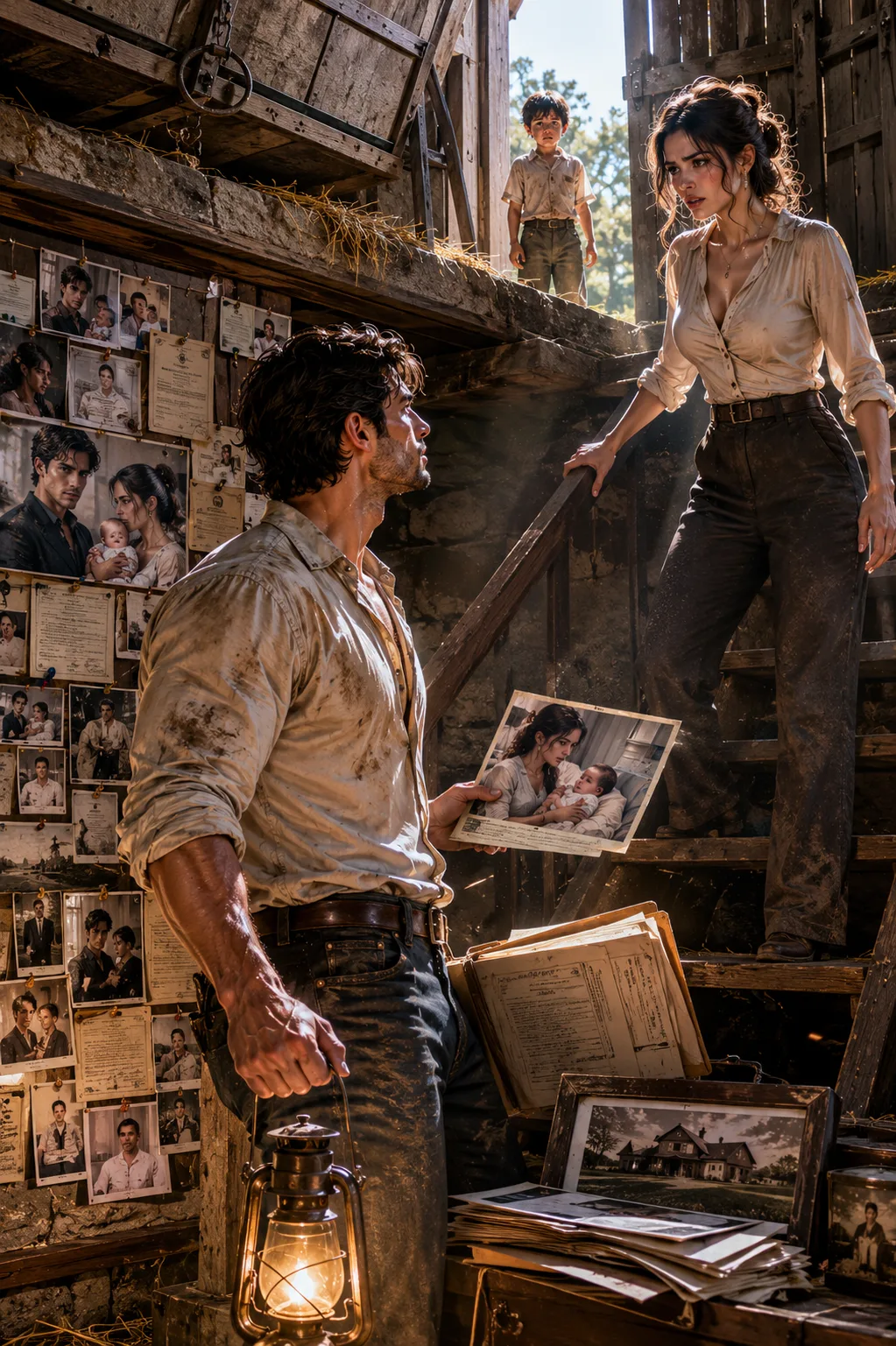
Then Diego saw the photographs.
They covered one wall.
Pinned in rows.
Some old. Some newer.
Men.
Women.
Children.
Workers.
Family.
A history of the ranch that no one had ever displayed upstairs.
Diego stepped closer.
His own face was there.
A photograph of him at seventeen, standing beside a horse, unaware someone had been watching from the shade.
Beside it was Marisol at eighteen.
Then Marisol holding a newborn baby in a hospital bed.
Diego’s hand went still.
He lifted the lantern.
The baby had dark hair.
Mateo.
The next row held documents.
Birth certificate copies. Land transfer forms. Letters. Medical papers. Bank records.
Diego scanned them quickly.
His name appeared again and again.
Not as a hired hand.
As Esteban Alvarez’s legal ward.
Then another document.
A sealed acknowledgment of inheritance.
Esteban had intended to leave part of the ranch to Diego years ago.
The date was the same week Diego had left.
Diego turned the page.
A letter from Marisol.
No.
Not Marisol.
A letter signed with her name, but the handwriting was Esteban’s.
He left me. Do not look for him.
Diego closed his eyes for one second.
The silver cross had been a lie.
The shame had been a lie.
His entire life after that night had been built on a lie old enough to grow roots.
Then he saw the last section of the wall.
Three photographs.
Three men.
Each one standing with Marisol in different years.
One held a baby toy.
One stood near the porch with a forced smile.
One carried a suitcase.
Beneath each photograph was a name.
Luis Ortega.
Samuel Pike.
Adrian Velez.
And under the names, Esteban had written dates.
Arrival.
Departure.
Except the departure dates were marked with question marks.
Diego heard the floor creak above him.
Marisol’s voice came from the hatch.
“Do you see now?”
Diego turned slowly.
She stood at the top of the stairs, sunlight behind her.
Mateo stood several feet away, still near the barn door.
Diego lifted one of the documents.
“I see my son.”
“You see what he wanted you to see.”
“I see three men who disappeared after coming here.”
“They left.”
“Mateo said they went into the cellar.”
“Mateo was five when Adrian left. He remembers shadows and stories.”
Diego climbed two steps.
“Then why was he afraid I would disappear?”
Marisol’s face hardened.
“Because I taught him to be afraid of men who arrive late and ask to be called father.”
The words landed between them.
Diego stopped.
Above them, thunder rolled faintly over the distant hills.
The first dark clouds had gathered beyond the open barn doors.
Marisol came down three steps.
“My father didn’t just lie to you,” she said. “He lied to everyone. He brought those men here because he wanted one of them to replace you. He told Mateo each one was his father. He made me stand there while strangers tried to win my child with candy and promises.”
Diego stared at her.
“No.”
“Yes.”
She pointed toward the wall.
“Luis was a ranch broker. Samuel was a lawyer. Adrian was married to my cousin. My father paid them, threatened them, used them. Every time I refused, he told Mateo another man had left because he was unwanted.”
Diego’s hand tightened around the lantern.
“And the cellar?”
Marisol looked toward the pinned photographs.
“This was his shrine. His records. His control room. He brought them down here to show them what he owned. Papers. Secrets. Debts. He didn’t bury bodies, Diego. He buried leverage.”
Diego wanted to believe her.
He also wanted to believe the note in his pocket.
Two truths stood in front of him, both wearing familiar faces.
Then Mateo spoke from above.
“Mom.”
His small voice trembled.
Marisol turned.
The boy was pointing toward Esteban’s body.
Something had fallen from the old man’s hand.
A second key.
Smaller.
Diego climbed out of the cellar and crossed the barn.
The key lay beside Esteban’s fingers, tied to a red string.
Under the string was another folded paper, tucked beneath the blanket.
Diego picked it up.
Marisol went very still.
“Don’t,” she said.
Diego unfolded it.
This writing was steadier.
Older.
It was not a note meant for him.
It was addressed to Mateo.
My boy, if your mother ever tells you the barn takes fathers, know this: the barn only keeps what cowards hide. Your father did not leave you. I drove him away before you were born. I told your mother he had abandoned her. I told Diego she was ashamed of him. I chose pride over blood. I chose land over truth. If there are other men in your memory, they were my doing. Your mother fought me until I broke her life into pieces. Do not hate her for the lies I taught her to live inside.
Diego lowered the letter.
The barn had gone silent again.
Only rain began ticking softly on the roof.
Mateo looked from Diego to Marisol.
“Mom?” he whispered.
Marisol did not move.
Her face had no defense left.
Diego turned to her.
“You told him the barn takes fathers.”
Her mouth opened.
Nothing came out.
“Why?”
Marisol looked at Mateo then, and whatever answer she had planned died before it reached her tongue.
Finally, she said, “Because I thought it was kinder than telling him they kept leaving after Grandpa ruined them.”
Diego’s voice dropped.
“But I didn’t leave him.”
Marisol looked at him.
“No.”
One word.
Small.
Ruined.
Diego glanced toward the cellar hatch.
“All these years.”
Marisol swallowed.
“I wrote to you.”
Diego’s eyes snapped back to her.
“What?”
“I wrote five letters. Then seven. Then I stopped counting. I sent them to the garage in Tucson where you worked after you left.”
“I never got them.”
“I know that now.” Her eyes shifted toward Esteban. “He paid someone to send them back before they reached you.”
Diego took a step away as if the floor under him had shifted.
Marisol continued, each word careful.
“When Mateo was born, I tried to leave. My father threatened to take him. He had papers, lawyers, doctors willing to say I was unstable. He told me if I ran, he would make sure Mateo grew up believing I abandoned him too.”
Mateo’s lower lip trembled.
Marisol crouched, but did not reach for him.
“I was wrong to scare you,” she said to the boy. “I was wrong every time I let Grandpa’s stories become mine.”
Mateo stared at her.
“Is he my dad?”
The question was so quiet that the rain almost swallowed it.
Diego could not move.
For years, he had imagined fatherhood as something belonging to other men. Men with framed photos on desks. Men who came home before dinner. Men who knew how to fix bicycles and speak gently when children cried.
He had never imagined it standing in a barn doorway, covered in dust, asking whether he was real.
Diego knelt.
Not too close.
Not yet.
“Yes,” he said. “I think I am.”
Mateo wiped his face with his sleeve.
“You think?”
Diego almost smiled. It hurt too much.
“I don’t want to lie to you. We’ll prove it properly. But I knew something when I saw you on that porch.”
“What?”
Diego looked at the old photograph in his hand.
“That I had seen your eyes before.”
Mateo did not come closer.
But he stopped backing away.
That was enough.
Then a sound came from outside.
Engines.
More than one.
Marisol stood quickly.
Diego turned toward the barn entrance.
Two black SUVs rolled up beside the house. Men stepped out in dark rain jackets. Behind them came an older man in a gray suit carrying a leather folder above his head to shield it from the rain.
Marisol’s face changed.
“The lawyer.”
Diego frowned. “What lawyer?”
“Not the one who called you.”
The suited man entered the barn without knocking mud from his shoes. He glanced once at Esteban’s body, then at Diego, then at Marisol.
“Mrs. Alvarez,” he said.
Marisol’s mouth tightened. “I’m not Mrs. Alvarez.”
“You are the sole executor until the revised papers are processed.”
Diego looked at her. “Revised papers?”
The lawyer opened his folder.
“Esteban Alvarez filed a new estate instruction three weeks ago. Unfortunately, given his condition, there will likely be questions regarding capacity. Until the court confirms legitimacy, the ranch remains under existing control.”
Marisol said nothing.
Diego noticed her hands curl.
The lawyer continued.
“The existing control belongs to the Alvarez Family Trust.”
“And who controls that?” Diego asked.
The lawyer looked at him for the first time with mild annoyance.
“At present, Mr. Navarro, you are not a party to this matter.”
Marisol stepped forward.
“He is now.”
The lawyer’s eyes narrowed.
“Marisol.”
She walked to the cellar hatch and pointed down.
“My father’s records are below. Birth documents. Trust documents. Letters. Proof of coercion. Proof of fraud.”
The lawyer’s face hardened.
“I would advise you not to disturb private estate materials.”
Diego moved between him and the hatch.
“That sounded like fear.”
The men in rain jackets stepped forward.
Mateo grabbed the edge of the barn door.
Marisol saw him and lifted one hand.
“Stay there.”
The lawyer closed his folder.
“Mr. Navarro, this is a private family matter.”
Diego looked at Mateo.
Then at the photograph of himself as a child in Esteban’s hand.
Then at Marisol, standing in the place where fear had kept her for twelve years.
“No,” Diego said. “That’s what made this place rot.”
He took the folded letter from his pocket. Then the second one. Then the photograph.
He set them on the crate beside the lantern.
“My name is Diego Navarro,” he said. “If there’s a court, I’ll be there. If there’s a test, I’ll take it. If there are records, I’ll sign for them. But nobody is locking that hatch again.”
The lawyer stared at him.
“You have no idea what you are interfering with.”
Diego stepped closer.
“I grew up here. I know exactly what men like you call interference.”
The barn doors rattled in the wind.
Rain swept across the threshold.
For a long moment, no one moved.
Then Mateo walked forward.
Small steps.
Careful.
He crossed the dirt floor, passed his mother, and stopped beside Diego.
He did not touch him.
He only stood there.
But the message was clear enough.
The lawyer looked at the boy.
Something in his calculation changed.
Marisol noticed.
So did Diego.
The lawyer adjusted his grip on the folder.
“This is not over.”
Diego held his gaze.
“It is for today.”
The suited man looked toward Esteban one last time, then turned and left the barn. The men followed him into the rain.
The SUVs pulled away minutes later, leaving tire tracks in the mud.
No one spoke until the sound disappeared.
Marisol sank onto a hay bale, both hands pressed together.
Diego stood beside Mateo, unsure what to do with his own arms, his own voice, his own life.
Esteban lay still beneath the blanket.
The old man had spent his final hours opening the door he had spent decades locking.
It did not absolve him.
Diego knew that.
Some damage did not become holy just because guilt arrived late.
But truth, even late truth, could still cut chains.
Mateo looked up at Diego.
“Are you going to leave?”
Diego crouched again.
“No.”
“For how long?”
Diego glanced at Marisol.
She was watching him, waiting for an answer she did not deserve but needed anyway.
He looked back at his son.
“I don’t know how to be a father yet,” he said. “But I know how to stay.”
Mateo studied him.
The rain softened.
Somewhere outside, water dripped steadily from the broken gutter.
“Grandpa said people say that,” Mateo murmured.
Diego nodded.
“He taught you not to trust words.”
Mateo looked at the open cellar hatch.
“Then what do I trust?”
Diego picked up the heavy chain from the floor.
He carried it to the barn doors and dropped it into the mud outside.
The iron struck the ground with a dull, final sound.
Then he came back and placed the brass key in Mateo’s small hand.
“Start with what people do.”
Mateo looked down at the key.
His fingers closed around it.
Marisol covered her mouth but made no sound.
That evening, they carried Esteban into the house.
Not as a saint.
Not as a monster.
As a man whose lies had outlived his strength and nearly outlived everyone else.
The next morning, Diego called the sheriff, then a family attorney from the next county, then the hospital to arrange a paternity test. He did not ask Marisol for permission. She did not try to stop him.
For three days, the ranch filled with people who had once been kept away.
A judge’s clerk came.
Two former workers came.
Luis Ortega came, older and heavier, with a scar near his chin and a file of documents Esteban had used to ruin his business. Samuel Pike sent a sworn statement from Oregon. Adrian Velez appeared with his wife and admitted he had been paid to pose as a possible father when Mateo was a toddler.
Each story was different.
Each story led back to the same barn.
Mateo listened from the porch steps, saying little.
Sometimes Diego sat beside him.
Sometimes Marisol did.
They did not pretend healing was happening just because truth had arrived.
That would have been another lie.
On the seventh day, the test results came.
Diego did not open the envelope alone.
He carried it to the barn, where Marisol and Mateo were waiting under the open doors. The hatch remained uncovered. The cellar below had been emptied of documents and photographed for court.
Rain had washed the dust from the yard.
The air smelled of wet earth.
Diego handed the envelope to Mateo.
“You should open it.”
Mateo looked startled.
“Me?”
“It’s your life too.”
The boy tore the paper carefully.
His lips moved as he read words too official for a child.
Then he looked up.
“Well?” Marisol asked.
Mateo did not answer her.
He walked to Diego.
This time, he touched him.
One small hand around two of Diego’s fingers.
“You’re my dad,” he said.
Diego looked down at their hands.
For a second, he was twenty-two again, standing by a bridge with two bus tickets and no idea that his future had already begun without him.
Then he closed his fingers gently around Mateo’s hand.
“Yes,” he said.
Marisol turned away, but not before Diego saw her shoulders bend.
He did not comfort her.
Not yet.
Maybe someday.
Maybe not.
Forgiveness was not a door that opened just because someone knocked.
But later, when the sun began lowering behind the windmill, Mateo carried the brass key to the cellar hatch.
Diego followed him.
Marisol stayed near the doorway.
Mateo looked at the dark square in the floor.
“What do we do with it now?”
Diego considered the question.
They could seal it. Burn the barn. Sell the ranch. Walk away from every beam, every nail, every ghost.
Part of him wanted to.
But Mateo kept looking at the hatch like a child trying to decide whether darkness was stronger than daylight.
So Diego took the lantern and set it on the first step.
“We clean it,” he said.
Mateo frowned.
“Why?”
“Because it doesn’t get to be scary forever.”
The boy thought about that.
Then he nodded.
Together, father and son descended into the cellar.
Not to disappear.
Not to hide.
To bring everything left into the light.
And above them, for the first time in twelve years, the barn door stayed wide open.
Chapter complete
You have reached the end of this chapter.
Continue reading
A few more worlds to get lost in after this chapter.




