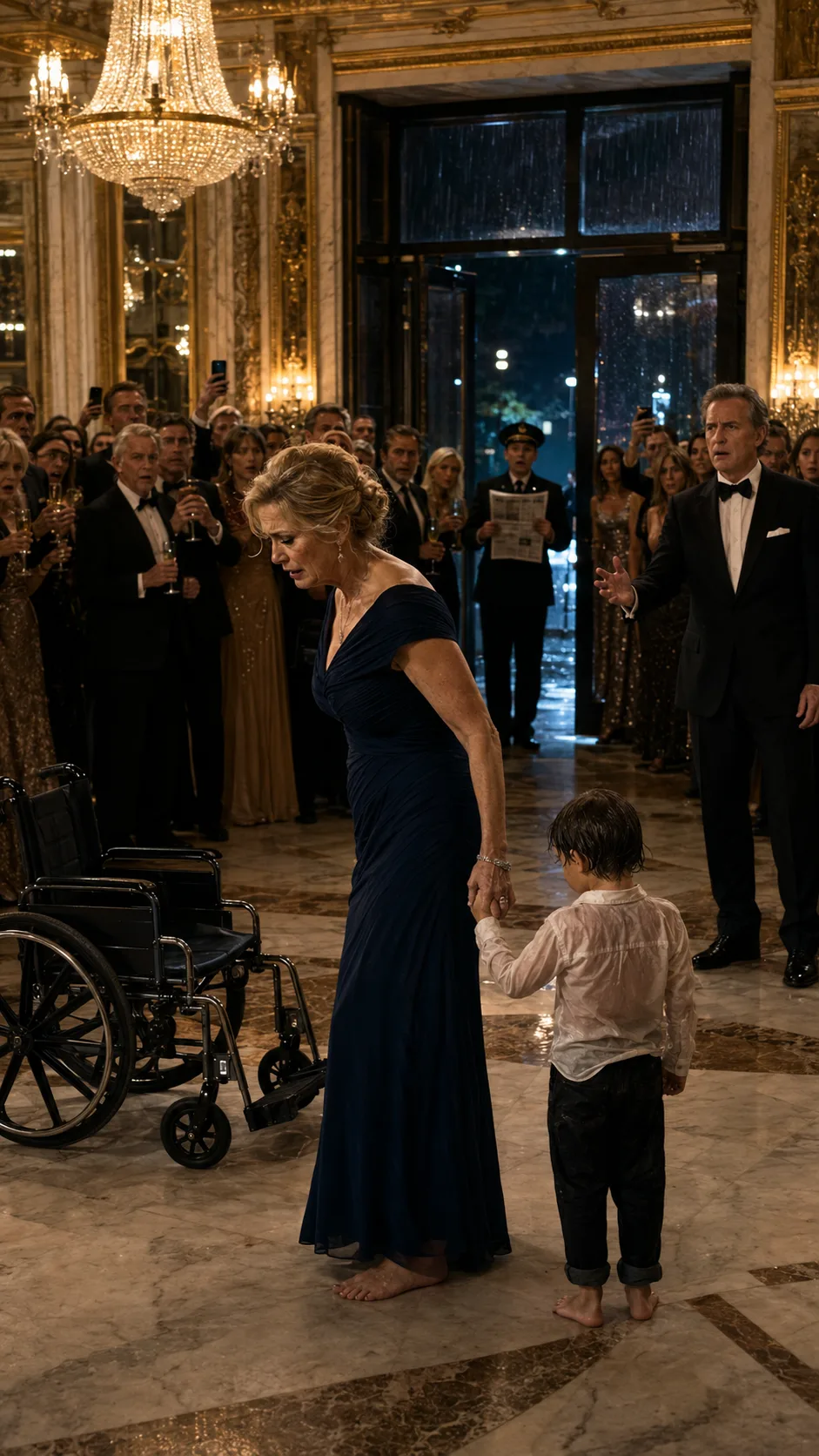
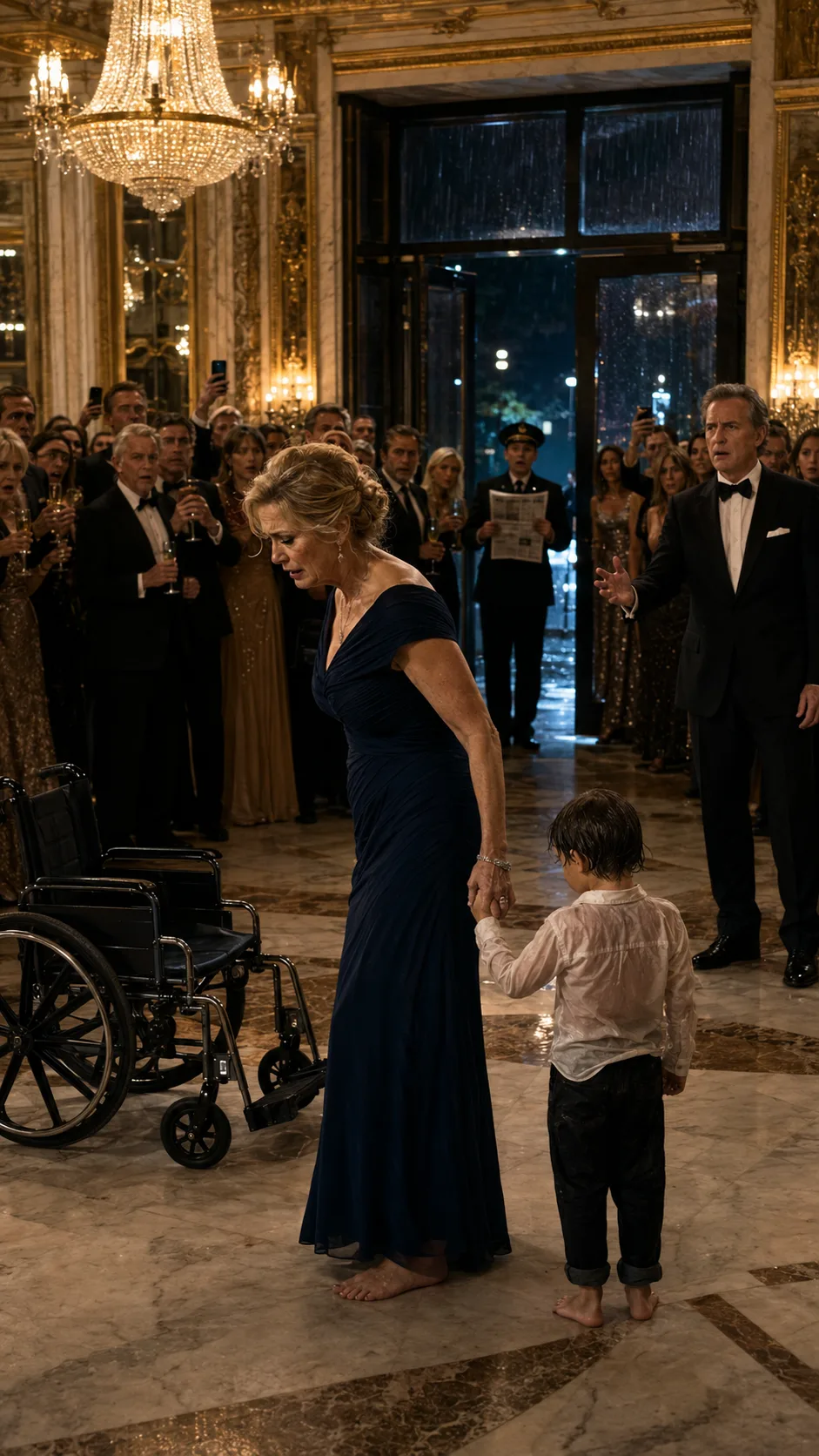
The ballroom glittered as if it had been built to make people forget the outside world existed.
Chapter 1
The ballroom glittered as if it had been built to make people forget the outside world existed.
Gold light poured from crystal chandeliers. Champagne glasses caught the shine and scattered it across polished marble floors. A string quartet played near the fountain at the center of the hall, their music smooth enough to hide the sound of expensive whispers.
Everyone at the Aurelia Foundation Gala had come dressed like a secret.
Men in tailored black suits stood in clusters beneath white roses hanging from the ceiling. Women in silk gowns laughed behind diamond bracelets and red lipstick. Waiters moved silently through the crowd with silver trays, carrying drinks no one finished and smiles no one trusted.
At the edge of the dance floor, beside a column wrapped in ivy and soft white lights, sat Evelyn Hart.
Nobody looked at her for long.
That was how it had been for years.
They glanced once, recognized the wheelchair, remembered the story, then looked away with the same careful politeness
people used around broken glass.
Evelyn had once been the woman everyone watched.
Before the accident, she had danced at every gala, every charity dinner, every opening night. Not because she needed attention, but because movement had been the only language that ever felt honest to her. She had glided across rooms with her head high and her laughter bright enough to make strangers turn.
Then one rainy night changed the shape of her life.
A black car. Wet pavement. Screeching brakes. A hospital room filled with flowers she could not smell over the antiseptic.
Doctors had told her she might walk again.
Then they said maybe.
Then they said it would take time.
Then they stopped saying anything at all.
Evelyn stopped asking.
Five years passed.
Her husband, Adrian, stopped touching the handles of her wheelchair after the second year. At first, he pushed her gently and leaned down
to ask if she needed anything. Then his hands became impatient. Then embarrassed. Then absent.
By the fifth year, he had learned to stand beside her in public without really standing with her.
That night, he stood near the champagne tower speaking to donors, one hand in his pocket, the other resting lightly on the back of a young woman in a silver dress.
Evelyn watched them from across the ballroom.
The woman laughed at something Adrian said.
He smiled back.
It was the smile he no longer gave his wife.
Evelyn lowered her gaze to her hands resting in her lap. She had chosen a navy-blue gown with long sleeves and a high collar. Elegant. Safe. A dress that did not invite questions.
“Mrs. Hart?”
A waiter had stopped beside her.
“Would you like another glass?”
She looked at the untouched champagne on the small table beside her.
“No,
thank you.”
The waiter nodded and left.
Across the room, a man she vaguely recognized from the board leaned toward another guest and murmured something. Both of them looked in her direction.
Then they looked away.
Evelyn had grown used to being a story people thought they understood.
The poor wife in the wheelchair.
The tragic heiress.
The woman who survived, but never returned.
She told herself she did not care.
But when the orchestra shifted into a waltz, her fingers curled against her palm.
The dance floor opened.
Couples stepped forward one by one. Shoes brushed marble. Dresses whispered. Laughter rose.
Adrian did not look at her.
He guided the young woman in silver onto the floor.
Evelyn sat very still.
A woman beside her cleared her throat and said, “You’re so brave for coming tonight.”
Evelyn smiled because she knew how to do that.
“Thank you.”
The woman patted her shoulder like she was a child and drifted away.
Brave.
People always called her brave when they had nothing else to say.
The music swelled.
Adrian spun the young woman once. She laughed, tipping her head back beneath the chandelier light.
Something inside Evelyn tightened.
She remembered Adrian years ago, stepping on her toes during their first dance in this very ballroom.
“You’re terrible,” she had whispered.
“I’m rich,” he had whispered back. “I can afford lessons.”
She had laughed so hard she nearly ruined the dance.
That memory felt like a room she had been locked out of.
Evelyn turned her wheelchair slightly, enough to face away from the dance floor.
Then the music stopped.
Not faded.
Stopped.
The violin cut off mid-note.
A murmur rippled through the ballroom.
Evelyn lifted her head.
At the center of the dance floor stood a little boy.
He could not have been more than seven.
Barefoot.
Small.
Soaked from the rain.
His brown hair clung to his forehead. His white shirt was damp, wrinkled, and too thin for the cold outside. His trousers were rolled unevenly at the ankles, as if someone had dressed him in a hurry or he had dressed himself.
Nobody moved.
The boy stood beneath the chandeliers with tears on his cheeks, looking around the grand ballroom as if he had walked into the wrong world.
A security guard near the entrance took one cautious step forward.
“Hey, kid,” he called. “Where are your parents?”
The boy did not answer.
His gaze moved across the crowd.
Past the guests.
Past the donors.
Past Adrian, who had stopped dancing with one hand still at the young woman’s waist.
Then the boy looked directly at Evelyn.
The room seemed to narrow.
Evelyn felt it in her chest before she understood it.
Recognition.
Not of his face.
Of his sadness.
The boy began walking toward her.
His bare feet made faint prints on the polished floor.
A few guests stepped back, pulling their gowns away as if grief might stain the fabric.
The boy stopped in front of Evelyn’s wheelchair.
He held out one trembling hand.
“Dance with me,” he whispered.
A nervous laugh moved through the room.
Someone muttered, “Is this part of the program?”
Another person said, “Poor thing.”
Evelyn looked down at the child’s hand.
Small fingers.
Cold.
Open.
Waiting.
Her throat tightened.
“I can’t dance,” she said.
The boy stepped closer.
“You don’t need that chair anymore.”
The ballroom fell silent.
Not quiet.
Silent.
Even the fountain at the center seemed too loud.
Evelyn stared at him.
“What did you say?”
Before he could answer, Adrian stormed forward.
His shoes struck the marble sharply.
“That’s enough,” he snapped. “Kid, this isn’t funny.”
The boy did not look at him.
Adrian reached toward the boy’s shoulder.
“Don’t touch me.”
The words were small.
But something in the boy’s voice made Adrian stop.
His hand hovered in the air.
Then slowly lowered.
The young woman in silver stared at Adrian, confused.
Evelyn watched her husband’s face. For the first time that night, his expression had cracked.
Not anger.
Fear.
The boy kept looking at Evelyn.
“I haven’t walked since the accident,” she whispered.
“I know.”
Her breath caught.
“You know?”
The boy nodded.
His eyes were too old for his face.
“My mom used to tell me something before she died,” he said. “She said sometimes people become prisoners of fear… not pain.”
A low murmur passed through the ballroom.
Evelyn’s fingers dug into the armrest.
“Who are you?”
The boy did not answer.
He knelt beside her chair, careful and gentle, as if approaching a frightened animal.
“My mom was scared too,” he said. “After the crash, she didn’t want to leave her room. She said the world was too loud.”
Evelyn could barely breathe.
The word crash moved through her like a cold hand.
Adrian stepped closer again.
“Security,” he called. “Remove him.”
No one moved.
The first guard near the door looked uncertain.
The boy reached out his hand again.
Evelyn looked at it.
Her mind filled with every voice she had collected over five years.
Be careful.
Don’t strain yourself.
You’re not ready.
What if you fall?
What if you make it worse?
What if everyone sees?
The boy’s hand remained steady.
“I’m scared,” Evelyn said.
“I know.”
His voice did not shake now.
“But I won’t let you fall.”
The ballroom held its breath.
Evelyn slowly placed her hand into his.
His fingers were cold.
Too cold.
The moment she touched him, a strange stillness passed through her, not warmth, not magic, not pain.
Memory.
Rain against a windshield.
A child laughing from the backseat of another car beside hers at a red light.
A woman singing softly.
Then white headlights.
Evelyn gasped and pulled back.
The boy looked up at her.
“Don’t stop.”
Adrian moved toward her.
“Evelyn, don’t be ridiculous.”
She turned to him.
For five years, his voice had made decisions sound like protection.
Stay seated.
Rest.
Let me handle it.
Don’t embarrass yourself.
Tonight, beneath the chandeliers, those words finally sounded like walls.
Evelyn gripped the boy’s hand again.
The wheelchair creaked as she leaned forward.
A woman in the crowd covered her mouth.
Adrian’s face hardened.
“Evelyn,” he warned.
She ignored him.
Her feet touched the floor.
The marble was cold through the thin soles of her shoes.
Her legs trembled immediately.
Pain flashed through her knees and hips, sharp enough to make her inhale through her teeth.
“I can’t,” she gasped.
“Yes, you can,” the boy said.
His small hand tightened around hers.
Evelyn leaned forward another inch.
Her body shook.
The crowd blurred.
Every eye in the room fixed on her.
She hated that part most.
Not the pain.
The watching.
For five years, people had watched her suffer politely. They had watched her enter rooms through side doors. Watched her pretend not to notice stairs. Watched Adrian speak for her. Watched her disappear while still sitting among them.
Now they watched her try.
That was worse.
Because trying could fail.
Trying could become a spectacle.
Trying could prove everyone right.
The boy stood in front of her, his other hand lifted, palm open.
“Look at me,” he said.
Evelyn did.
“Not them.”
Her breathing shook.
Slowly, she pushed down on the armrests.
Her shoulders rose.
Her legs trembled harder.
The chair shifted backward.
A gasp spread through the ballroom.
Adrian’s face went pale.
“Evelyn, sit down.”
She did not.
One inch.
Then another.
Her body lifted.
For the first time in five years, Evelyn Hart stood above her wheelchair.
Not straight.
Not graceful.
Not like before.
But standing.
The sound that came from the guests was not applause at first.
It was a collective breath.
A hundred people seeing something they did not know how to explain.
Evelyn stared down at her own feet.
Her knees shook violently.
Tears slipped down her cheeks, but she did not wipe them away.
The boy smiled.
“See?”
She laughed once, broken and breathless.
“I’m standing.”
“You were never broken,” he whispered.
The words struck something deep inside her.
Adrian took another step forward.
“Enough. She’ll hurt herself.”
The boy turned his head slightly.
“No,” he said. “You’re afraid she won’t need you anymore.”
The entire ballroom froze.
Adrian’s jaw tightened.
The young woman in silver slowly removed her hand from his arm.
Evelyn looked at her husband.
For years, she had thought he resented the chair because it reminded him of the accident.
Now she understood.
The chair had become convenient.
A quiet throne for his control.
A reason to answer for her.
A reason to decide where she went, who she saw, what she tried, what she feared.
The boy tugged gently on her hand.
“One step.”
Evelyn swallowed.
Her right foot moved.
Barely.
A scrape across marble.
But it moved.
Someone cried out, “She moved!”
Phones rose from every corner of the ballroom.
Evelyn barely heard them.
She took another step.
Her left leg buckled.
The boy stepped closer instantly, bracing both hands against hers.
“I’ve got you.”
She almost fell.
Almost.
But she did not.
The room erupted into whispers.
Then the orchestra, unsure and trembling, began to play again.
Not the waltz from before.
Something softer.
A single violin.
The boy guided her slowly.
Not a dance.
Not really.
More like a woman learning the shape of the earth beneath her again.
Step.
Pause.
Breath.
Step.
Her hands shook. Her shoulders shook. Her whole body seemed built from fear and stubbornness.
But she moved.
Across the dance floor, Adrian stood frozen.
For once, no one was looking at him.
They were looking at Evelyn.
Not with pity.
With wonder.
The boy smiled up at her.
“My mom would have liked you.”
Evelyn looked down.
“What was her name?”
His smile faded a little.
“Clara.”
The name struck the ballroom before Evelyn could react.
A security guard near the back suddenly made a sound.
Not a word.
A broken breath.
Everyone turned.
The guard was older, with gray at his temples and a radio trembling in one hand. His face had lost all color. In his other hand, he held a folded newspaper taken from beneath the front desk, old and yellowed at the edges.
He stared at the boy.
Then at the newspaper.
Then back again.
“No,” he whispered.
Adrian snapped, “What is it?”
The guard did not answer him.
He walked forward slowly, as if each step might make the truth worse.
The guests parted.
The violin stopped again.
Evelyn stood in the center of the ballroom, gripping the boy’s hand.
The guard unfolded the newspaper.
His hands shook so badly the paper rattled.
On the front page was a photograph.
A woman.
A crushed car.
A small boy with brown hair, smiling in a school uniform.
The same eyes.
The same face.
The guard lifted the paper higher.
His voice cracked across the silence.
“Wait…”
Nobody moved.
“That boy is dead.”
The ballroom went still.
The guard turned the newspaper outward.
The headline was old, faded, but clear enough for the nearest guests to read.
Child Dies Saving Mother In Car Crash — 5 Years Ago
Evelyn’s body turned cold.
Her fingers tightened around the boy’s hand.
But there was nothing there.
She looked down.
Her hand was empty.
The boy was gone.
A sound moved through the ballroom, half gasp, half prayer.
Evelyn spun too quickly and nearly lost her balance. Several people rushed forward, but she lifted one hand sharply.
“No.”
Her voice was weak, but it stopped them.
She stood alone.
The wheelchair sat several feet behind her.
Empty.
Adrian stared at it as if it had betrayed him.
Evelyn looked across the dance floor.
No boy.
No wet footprints.
No small hand.
Only a faint trail of water glistening on the marble, leading toward the center of the room and disappearing beneath the chandelier light.
The guard approached her carefully and handed her the newspaper.
Evelyn took it with shaking hands.
The article was dated five years earlier.
The accident had happened on the same night as hers.
Same road.
Same storm.
Same pileup.
Clara Wells, a single mother, had been trapped in her car after shielding her son from broken glass. Her son, Noah, had managed to crawl free and call for help before collapsing near the roadside. Witnesses said he had refused to leave his mother until help arrived.
He died before dawn.
His mother survived.
Evelyn pressed one hand to her mouth.
“Noah,” she whispered.
The name seemed to settle into the ballroom like a candle being lit.
The old guard nodded.
“I remember him,” he said. “My brother was one of the paramedics that night. The boy kept saying, ‘Don’t let her fall asleep.’ Over and over.”
Evelyn’s knees trembled.
This time, the trembling was different.
Not weakness.
Truth.
She looked at the newspaper again.
The boy had not saved only his mother.
That night, on the same road, emergency crews had found Evelyn’s car because the first responders had followed the call from Noah’s location. Without that call, she might not have survived long enough to reach the hospital.
Evelyn stared at the empty space where he had stood.
Adrian stepped toward her.
“Evelyn,” he said, softer now. “Come sit down.”
She looked at him.
For five years, those words had sounded like safety.
Now they sounded like a cage closing.
“No.”
His expression flickered.
“You need help.”
“I needed help,” she said. “You gave me fear.”
The young woman in silver looked at the floor.
Guests shifted, uncomfortable now, not with Evelyn, but with Adrian.
He lowered his voice.
“Don’t do this here.”
Evelyn gave a small, tired smile.
“Where would you prefer I stand for the first time in five years?”
No one spoke.
Adrian’s mouth opened, then closed.
Evelyn turned to the crowd.
Her legs were still shaking.
Her body still hurt.
She was not healed. Not completely. Not magically. Not perfectly.
But she was upright.
And that changed everything.
The chairman of the Aurelia Foundation, an elderly man named Mr. Bellamy, stepped forward and removed his glasses.
“Mrs. Hart,” he said quietly, “would you like assistance?”
Evelyn looked at the wheelchair.
Then at the dance floor.
Then at the newspaper in her hand.
“Yes,” she said. “But not back to the chair.”
Two women rushed forward. The waiter who had offered champagne earlier came too. Together, they supported her gently, not pushing, not deciding, just steadying.
Evelyn took one careful step.
Then another.
The crowd did not applaud this time.
They understood somehow that applause was too small for what was happening.
They simply made room.
Adrian stood near the edge of the dance floor, stranded among all the people who had once admired him.
“Evelyn,” he said again.
She did not turn.
At the ballroom entrance, rain tapped against the glass doors.
Beyond them, the night shimmered in silver.
Evelyn walked toward the doors with the newspaper pressed to her chest.
Each step hurt.
Each step frightened her.
Each step belonged to her.
When she reached the entrance, the older security guard opened the door.
Cold air rushed in, carrying the smell of rain.
Outside, beneath the awning, a woman stood alone.
Middle-aged. Thin. Wearing a dark coat. One hand at her mouth.
Her eyes were fixed on the newspaper.
Evelyn knew before the woman spoke.
“Clara?” Evelyn asked.
The woman nodded once.
Her gaze dropped to Evelyn’s feet.
Then back to her face.
“I saw him,” Clara whispered. “Through the window. I thought…”
Her voice broke, but she forced herself to continue.
“I thought grief had finally made me see things.”
Evelyn stepped closer with help from the waiter and the two women.
“Your son saved me,” she said.
Clara shook her head.
“He saved everyone he could.”
Evelyn held out the newspaper.
Clara did not take it at first.
Her eyes remained on the ballroom behind Evelyn.
“Did he say anything?”
Evelyn looked back at the empty dance floor.
The chandelier light shone on the faint water marks that were already fading.
“He said I was never broken.”
Clara covered her mouth.
For a long moment, the two women stood beneath the sound of rain, connected by a boy who had appeared in a room full of people and left behind proof only the wounded could understand.
Then Clara reached into her coat pocket and removed a small object.
A blue ribbon.
Worn at the edges.
“He wore this the day before the accident,” she said. “He told me he wanted to learn to dance because heroes should know how.”
Evelyn took the ribbon carefully.
Her fingers closed around it.
Behind her, Adrian tried to approach the doorway, but Mr. Bellamy blocked him with one calm step.
“Not tonight,” the old man said.
Adrian looked around for support.
He found none.
The young woman in silver had already left the dance floor. Guests avoided his eyes. The world he had controlled so smoothly had shifted while he stood still.
Evelyn did not watch him fall apart.
She had spent enough years facing backward.
Three months later, the ballroom opened again.
Not for a gala.
Not for donors.
For a new wing of the Aurelia Rehabilitation Center.
On the wall near the entrance hung a small bronze plaque.
The Noah Wells Hope Studio
Below it, smaller letters read:
For those learning to stand again.
Evelyn arrived using a cane.
Not because she never needed the chair.
Some days she still did.
Some days pain returned with teeth. Some days fear waited beside her bed before her feet touched the floor.
But the chair no longer owned her.
Adrian was gone from her life by then. Quietly at first, then legally. Papers signed. Accounts separated. Names removed. His absence felt less like loss and more like a door finally opened.
Clara came to the dedication wearing the same dark coat, though the weather had turned warm.
When she saw the studio, she placed her hand over Noah’s name and closed her eyes.
Evelyn stood beside her.
Neither woman spoke for a while.
Children from the rehabilitation program gathered inside the studio. Some used braces. Some used walkers. Some stood with help. Some sat and watched, not ready yet.
A music teacher placed her hands over the piano keys.
The first notes rose.
Soft.
Simple.
Evelyn looked at Clara.
“Would you like to dance?”
Clara laughed once through her tears.
“I don’t know how.”
Evelyn held out her hand.
“Neither do I anymore.”
Clara looked at the hand.
Then she took it.
Together, they stepped into the studio.
Not perfectly.
Not gracefully.
But together.
As they moved beneath the morning light, Evelyn felt something cool brush against her fingers.
She looked down.
For one impossible second, a small barefoot shadow stood between them.
A boy with brown hair.
A blue ribbon tied around his wrist.
He smiled.
Then the sunlight shifted.
And he was gone.
Clara squeezed Evelyn’s hand.
“You saw him too?”
Evelyn nodded.
Across the studio, a little girl in leg braces took her first step between two parallel bars.
Everyone turned toward her.
Her mother covered her mouth.
The child looked frightened, then determined, then proud.
Evelyn watched her move.
One step.
Then another.
And somewhere in the bright room, beneath the piano music and the quiet sound of people holding their breath, Evelyn thought she heard a boy’s voice whisper:
“I won’t let you fall.”
So she smiled.
And this time, when the music played, she did not look for the chair.
She looked for the next step.
Chapter complete
You have reached the end of this chapter.
Continue reading
A few more worlds to get lost in after this chapter.




