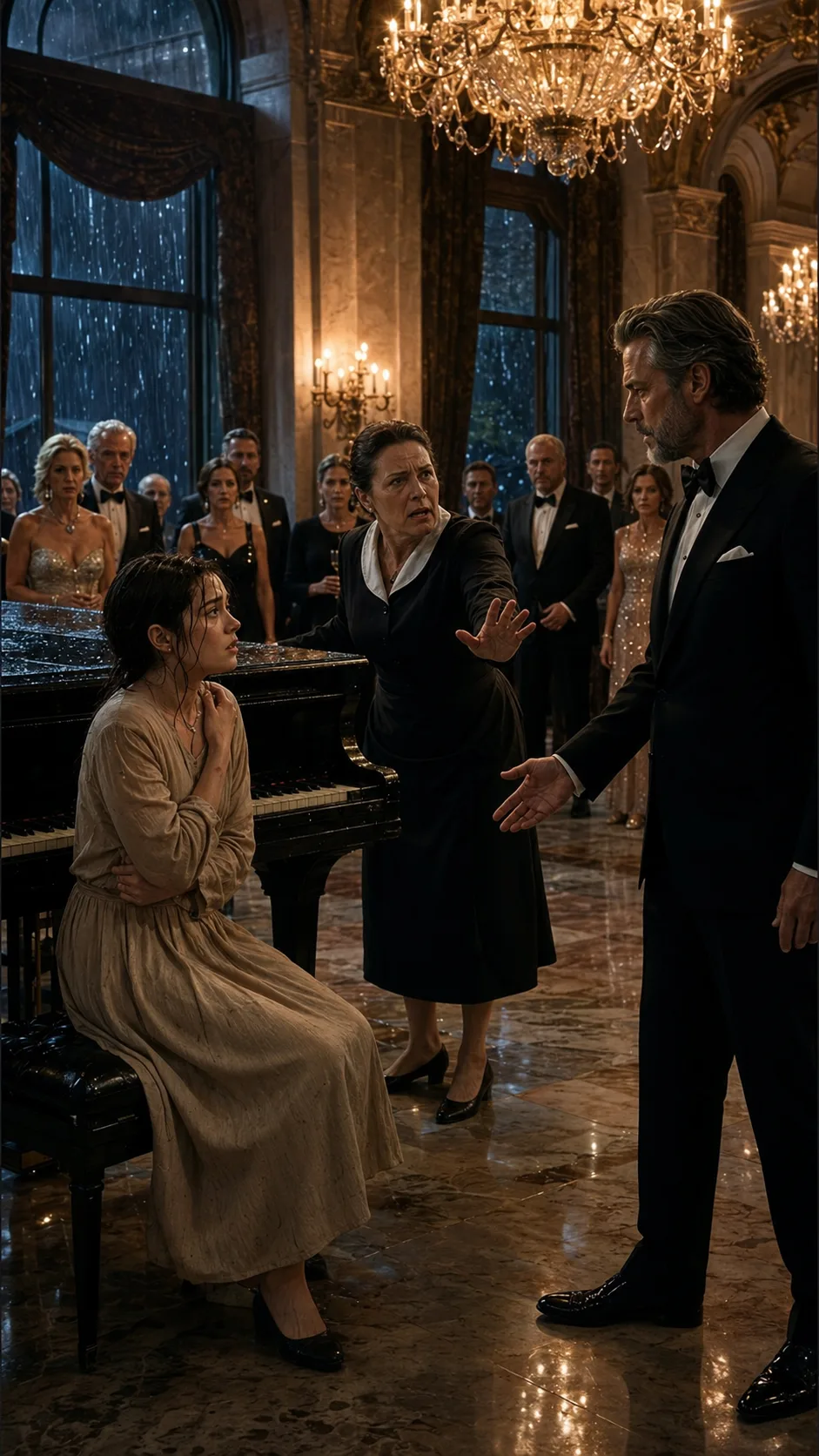
Rain hammered against the tall ballroom windows while the city’s richest people laughed beneath golden chandeliers.
Chapter 1
Rain hammered against the tall ballroom windows while the city’s richest people laughed beneath golden chandeliers.
Music played softly.
Champagne sparkled.
Diamonds flashed under warm light.
Outside, the storm bent the trees along Fifth Avenue until their black branches scratched against the glass like fingers asking to be let in. Inside the Vale Foundation Gala, nobody cared. The city’s wealthiest guests stood under painted ceilings and talked about donations, art auctions, summer villas, and the kind of suffering they could mention without ever standing too close to it.
Then the doors opened.
A little barefoot girl stepped inside.
Her beige dress was dirty and oversized, hanging from her thin shoulders. Her dark hair was wet from the storm outside, and her small hands trembled from cold and hunger. Mud marked her legs up to the knees. One of her feet left a faint print on the marble floor.
The entire ballroom went silent.
A waiter immediately moved toward her.
“You can’t be in here.”
But the
girl looked past him.
At the black grand piano standing in the center of the room.
She swallowed nervously.
“May I play for food?” she asked quietly.
For one second, nobody reacted.
Then the laughter exploded.
A glamorous woman in gold shook her head with disgust. Her name was Vivienne Vale, and she wore her late sister’s diamonds around her throat as if mourning could be polished and displayed.
“This is a private event, sweetheart,” Vivienne said.
Several guests smirked.
One man whispered, “She probably learned this scam on the street.”
The girl lowered her eyes.
For a moment, it looked like she might run away.
But instead, she walked to the piano.
The crowd watched, amused.
“She’ll embarrass herself.”
“Someone stop her.”
The little girl climbed onto the piano bench. Her tiny fingers hovered above the keys.
Then—
she played.
The first note hit the ballroom like a knife
through glass.
Soft.
Beautiful.
Heartbreaking.
The laughter vanished instantly.
People slowly turned toward the piano in disbelief. The melody did not sound like something a hungry child should know. It moved through the ballroom with the tenderness of a lullaby and the pain of a goodbye. The girl played with her shoulders tight and her chin lowered, but her fingers knew the song like they had been born remembering it.
The woman in gold slowly lowered her champagne glass.
At the back of the ballroom, billionaire host Alexander Vale stood completely still.
His face lost all color.
“That melody…” he whispered.
No one near him spoke.
The girl continued playing, unaware that every eye in the room was now filled with shock. Rain streaked the windows behind her. The chandeliers swayed faintly from the thunder outside, scattering broken gold across her wet hair.
Then her torn sleeve slipped down slightly.
A faded birthmark appeared on her wrist.
Alexander suddenly rushed forward.
His hands began shaking.
“No…” he whispered. “No, that’s impossible…”
The girl looked up in confusion.
Alexander’s voice cracked.
“That mark… my daughter had the same one before she disappeared ten years ago.”
The ballroom gasped.
And then—
a woman near the back screamed:
“DON’T LET HIM TOUCH HER!”
The scream cut through the room harder than the thunder.
Two hundred guests turned.
Near the far wall, beside the table of silent auction gifts, stood a woman in a dark servant’s uniform. Her hair was streaked with gray and pinned carelessly behind her neck. She held a tray with both hands, but the crystal glasses on it were shaking so badly that champagne trembled at the rims.
Alexander froze.
The little girl pulled her hands away from the piano keys.
The final note faded into the ballroom, thin and unfinished.
Vivienne’s face changed first. Not much. Just enough.
Her mouth tightened.
Her eyes moved toward the woman in the servant’s uniform, and for one quick second, something sharp passed between them.
Alexander turned slowly.
“Grace?”
The woman lowered the tray onto the nearest table before it could fall. Her breathing was uneven, but she stepped forward anyway.
“Don’t go near her,” Grace said.
Alexander stared at her like she had climbed out of a grave.
For ten years, Grace March had been a name buried under police reports, accusations, and the worst night of Alexander Vale’s life. She had been his daughter’s nanny. She had vanished the same night little Amara Vale disappeared from the family’s summer estate after a fire broke out in the east wing.
Everyone believed Grace had taken the child.
Everyone believed Alexander had trusted the wrong woman.
Everyone believed Amara had died somewhere far away, nameless and lost, because the searches had never found her.
But now Grace stood in his ballroom, older, thinner, wearing a uniform and staring at the barefoot girl like she would throw herself in front of a train to keep her safe.
Alexander’s voice dropped.
“You were alive.”
Grace’s eyes did not move from the child.
“Yes.”
“You took my daughter.”
Grace flinched, but she did not step back.
“I saved her.”
The ballroom erupted in whispers.
Vivienne placed her champagne glass on a nearby table with careful fingers.
“This is absurd,” she said. “Security, remove that woman.”
Nobody moved.
Alexander lifted one hand without looking away from Grace.
“No one touches her.”
The command settled over the room.
The little girl sat frozen on the piano bench. Her wet feet dangled above the floor. Her eyes moved from Alexander to Grace, then back again.
“Miss Grace?” she whispered.
Grace’s face changed. The hardness cracked. She took a step toward the girl.
“It’s all right, Lily.”
Alexander’s breath caught.
“Lily?”
Grace nodded once. “That’s what I called her.”
“That is not her name,” Alexander said.
His voice was low, but everyone heard it.
Grace swallowed.
“I know.”
Alexander took one step closer to the piano. The girl shrank back, not because he had moved fast, but because rich rooms had never been safe places for her.
He saw it.
The fear.
Not of him as a man, but of everything he represented. Polished shoes. Clean hands. Locked doors. People who could throw a child back into the rain because she did not look expensive enough to exist near them.
Alexander stopped.
He lowered himself slowly to one knee, several feet from the piano bench. A billionaire in a black tuxedo kneeling on marble before a barefoot child.
The ballroom went utterly still.
“What is your name?” he asked.
The girl gripped the edge of the bench.
“Lily.”
“Do you know who taught you that song?”
She shook her head.
“Miss Grace said my mother sang it.”
Alexander closed his eyes.
The room blurred for him, not because of tears, but because memory had struck too quickly.
His wife, Elena, sitting beside the nursery window with newborn Amara in her arms. Rain on the glass. A candle on the piano. Elena humming that same melody because the baby would not sleep unless she heard it.
Nobody outside the family knew that song.
Elena had written it.
Elena had died believing her daughter was asleep in the next room.
Alexander opened his eyes.
“Your mother’s name was Elena,” he said.
The girl stared at him.
Grace covered her mouth with one hand.
Alexander reached inside his jacket and pulled out a folded photograph. The edges were worn soft from years of being opened and closed. He carried it everywhere, though no one knew.
He unfolded it.
A young woman smiled in the picture, seated at the same black grand piano, a baby wrapped in cream-colored cloth in her arms. Beside her stood Alexander, younger, laughing at something beyond the camera.
The girl did not take the photograph at first.
Then she leaned forward.
Her eyes moved over the woman’s face.
The room watched her small fingers lift toward the image.
Grace whispered, “Lily…”
But the girl was already touching the photograph.
“She has my eyes,” the girl said.
Alexander’s face tightened.
“Yes.”
Vivienne suddenly laughed.
It was not loud, but it was wrong.
People turned toward her.
“This is madness,” she said. “A dirty child walks in, plays a song someone taught her, and now everyone is ready to believe she’s a lost heiress?”
Grace turned on her.
“You knew.”
Vivienne’s expression sharpened.
“Careful.”
Grace’s voice grew stronger.
“You knew that child was alive.”
The ballroom shifted. Guests stepped back from Vivienne as if accusation itself could stain their gowns.
Alexander stood.
“What is she talking about?”
Vivienne lifted her chin.
“She’s desperate. She stole your child, Alexander. She disappeared for ten years. Now she crawls back with a street girl because she heard there was money in this room.”
Grace shook her head.
“No. I came back because Lily was hungry. Because the shelter closed. Because the woman who hid us died last winter. Because I had nowhere else to go.”
Alexander looked at Grace.
“Then why didn’t you come to me?”
Grace laughed once. It broke before it became sound.
“Because the last time I tried, your sister’s men found me first.”
Vivienne’s gold dress caught the chandelier light as she stepped forward.
“That is a filthy lie.”
Grace reached into the pocket of her uniform.
Vivienne’s face went pale.
“Don’t,” she said.
One word.
Too quick.
Alexander noticed.
So did everyone else.
Grace pulled out a small plastic pouch wrapped in brown paper. Inside were old items protected from rain and time. A hospital bracelet. A tiny silver anklet. A torn corner of a blanket embroidered with the letter A. And a cassette tape with a peeling white label.
Alexander stared at the anklet.
His lips parted.
Amara.
It was the anklet he had placed on his daughter himself, three days after she was born. A silver moon and two tiny stars. Custom made. One of a kind.
Vivienne stepped back.
Grace held the pouch toward Alexander.
“I kept them because I knew one day I would need proof.”
Alexander took the pouch with both hands.
The ballroom had become silent in a way no music could fill.
Grace pointed toward the tape.
“Elena recorded that melody. She gave it to me in case Amara missed her while you traveled. The night of the fire, I was told to bring the baby to the east nursery. But when I reached the hallway, I heard Vivienne arguing with someone.”
Vivienne’s voice cut through the room.
“Enough.”
Grace did not stop.
“She said the trust would never pass to her as long as Elena’s child lived.”
The guests recoiled.
Alexander turned toward his sister.
Vivienne’s beauty did not vanish, but it hardened into something older and colder.
“You expect him to believe a servant?”
Grace looked at Alexander.
“I ran because when I opened the nursery door, Amara was gone from her crib, and smoke was already coming through the vents. I found her outside in the service garden with a man I had never seen before. He was carrying her wrapped in a blanket.”
Alexander’s jaw tightened.
“What man?”
Grace looked at Vivienne.
“Ask her.”
Vivienne smiled.
It was small.
Controlled.
“You’ve rehearsed this.”
Grace’s hand shook as she pointed at the cassette tape.
“So did you.”
Alexander looked down.
“What’s on it?”
Grace’s voice lowered.
“Not the song.”
Vivienne moved suddenly.
Not toward Alexander.
Toward the pouch.
But Alexander closed his hand around it before she could reach him.
The entire ballroom seemed to inhale.
Vivienne stopped inches away from him.
For the first time that night, she looked afraid.
Alexander stared at her.
“What’s on the tape?”
Vivienne did not answer.
A security guard stepped closer, but Alexander raised his hand.
“No.”
He walked to the piano.
On the side table beside it, the gala technicians had set a small vintage cassette player for one of the evening’s charity performances. Alexander placed the tape inside.
Grace closed her eyes.
The little girl slid off the piano bench and ran to Grace, pressing herself against the woman’s side.
Alexander pressed play.
For a second, only static filled the ballroom.
Then a voice emerged.
Young.
Clear.
Vivienne’s voice.
“By morning, everyone will believe Grace took the child. The fire will destroy enough. Alexander will be too broken to question anything.”
A man’s voice answered, muffled.
“And the nanny?”
“Let her run. If she returns, she becomes the villain twice.”
Gasps spread through the room.
Vivienne stood perfectly still.
The tape continued.
“And the baby?” the man asked.
A pause.
Then Vivienne’s voice again.
“Far away. Alive, if possible. I’m not a monster.”
Grace made a sound and pulled the girl closer.
The little girl looked up at her.
Alexander stopped the tape.
The silence after it was worse than the recording.
Vivienne slowly turned toward the guests. Her smile returned, but it no longer fit her face.
“You don’t understand,” she said. “None of you understand what it was like.”
Alexander looked at her as if he had never seen her before.
“Elena trusted you.”
Vivienne’s eyes flashed.
“Elena got everything.”
“She was my wife.”
“She was chosen,” Vivienne said. “By Father. By the board. By you. And then she had the child, and suddenly every door closed.”
Alexander’s voice was almost calm.
“So you took my daughter.”
Vivienne looked at the girl.
The child stepped behind Grace.
Vivienne’s mouth twisted.
“I spared her.”
Alexander took one step toward his sister.
Grace immediately placed herself in front of the child.
“Don’t,” she said, but this time she was not speaking to Alexander.
He stopped.
Not because Grace had ordered him.
Because Amara—Lily—was watching.
He looked at his daughter.
Her hair was dripping onto the floor. Her dress was too thin. Her feet were bare in a room where women wore diamonds worth more than buildings. She had asked to play for food in her own father’s house.
Alexander’s anger folded inward and became something heavier.
He turned to the head of security.
“Call the police.”
Vivienne’s face changed.
“Alexander.”
He did not look at her.
“And my attorney.”
“Alexander, please.”
He finally turned.
For a moment, the ballroom saw not a billionaire, not a host, not a man made powerful by money, but a father who had spent ten years grieving a child who had been breathing somewhere without him.
“You let me bury an empty coffin,” he said.
Vivienne’s lips parted, but no words came.
“You let Elena die thinking her baby was gone.”
Vivienne looked away.
That was the only confession she had left.
Police arrived within twelve minutes.
Nobody laughed when they entered.
The woman in gold did not scream when they took her away. She walked with her head high, but when she passed the piano, the little girl stepped closer to Grace.
Vivienne saw it.
Something in her face cracked.
Then she was gone.
The ballroom remained full, but no one seemed to know what to do with their hands. Some guests stared at their shoes. Some quietly left. Others stood near the walls, suddenly aware of the marble, the chandeliers, the tables of untouched food.
Alexander removed his tuxedo jacket and walked toward the girl.
He stopped far enough away that she could choose.
“May I?” he asked.
She looked at the jacket, then at Grace.
Grace nodded.
The girl took one small step forward.
Alexander wrapped the jacket around her shoulders.
It swallowed her.
For a moment, neither of them spoke.
Then she asked, “Are you really my father?”
Alexander knelt again.
“Yes.”
“Why didn’t you find me?”
The question moved through him like a blade, but he did not defend himself. He did not explain the investigators, the false leads, the ransom calls, the years of searching countries where she had never been.
He only said, “I should have.”
Grace looked down.
“No,” she whispered. “You looked. They made sure you looked in the wrong places.”
Alexander’s eyes stayed on his daughter.
“I still should have.”
The girl studied his face carefully, as if trying to decide whether a person could be both a stranger and family.
“My name is Lily,” she said.
Alexander nodded.
“Then you are Lily.”
Grace blinked.
He continued, “And you are Amara. You don’t have to choose tonight.”
The girl’s fingers tightened around his jacket.
“My mother sang that song?”
“Yes.”
“Did she love me?”
Alexander’s face changed in a way the entire room felt.
“She loved you before she ever saw your face.”
The girl looked toward the piano.
“Can you play it?”
Alexander gave a small shake of his head.
“No. Your mother tried to teach me. I was terrible.”
For the first time, the girl almost smiled.
“Miss Grace says I’m not terrible.”
“No,” Alexander said. “You are not.”
A doctor was called. A child services officer arrived, then another attorney, then a police detective who spoke gently and asked very few questions. Alexander refused to let anyone rush the child. He ordered the kitchens opened and every guest still present watched as the barefoot girl sat at a small table near the piano and ate warm soup, bread, and strawberries from a silver-rimmed plate.
She did not eat like a child at a gala.
She ate like someone afraid the food might disappear.
Alexander sat across from her and said nothing about it.
Grace stood nearby, twisting a napkin between her hands.
When the room had nearly emptied, Alexander approached her.
“You kept her alive,” he said.
Grace lowered her eyes.
“I kept her hidden. There’s a difference.”
“You were alone.”
“Not always. Some people helped. Quiet people. Poor people. People nobody at events like this ever notices.”
Alexander looked around the ballroom.
The flowers.
The orchestra.
The gold.
The wasted food.
Then he looked back at Grace.
“I noticed too late.”
Grace did not comfort him.
He was grateful for that.
The police asked Grace to come to the station to give her statement. Lily refused to let go of her sleeve.
Alexander watched the child’s small fist gripping the black fabric.
“She stays with her until Lily says otherwise,” he told the officers.
The detective hesitated.
Alexander’s attorney cleared his throat.
The detective nodded.
That night, Alexander did not take Lily to the Vale mansion.
He took her, Grace, a doctor, and two trusted staff members to the private family residence above the old music conservatory Elena had loved. It was smaller than the mansion, warmer, and far from the cameras already gathering outside the hotel.
Lily fell asleep on a sofa with Alexander’s jacket still around her shoulders.
Grace sat in a chair nearby and did not close her eyes.
Alexander stood in the doorway for a long time.
At dawn, the rain stopped.
The city outside looked washed clean, though nothing inside him did.
News of Vivienne’s arrest filled every screen by morning. Old evidence reopened. Former employees came forward. A retired driver admitted he had been paid to burn documents. A doctor from a private clinic identified the man on the tape. The trial that followed lasted seven months.
Vivienne never wore gold to court.
Lily testified only once, behind closed doors, with Grace beside her and Alexander waiting outside. She did not need to describe pain in order for people to understand it. She only told them about moving from shelter to shelter, about Grace selling her wedding ring for medicine, about learning piano on broken church instruments, about being told never to speak her real birthday aloud.
When Vivienne was sentenced, Alexander did not celebrate.
He went home.
Lily was in the music room, sitting at Elena’s piano. For months, she had refused to touch the black grand piano from the gala. So Alexander had moved Elena’s old upright into the conservatory residence, scratches and all.
Grace sat by the window knitting something small and uneven.
Lily looked up when Alexander entered.
“Did they send her away?” she asked.
“Yes.”
“For a long time?”
“Yes.”
She nodded and looked back at the keys.
Then she moved slightly on the bench.
“Sit.”
Alexander obeyed.
She placed his hand over the middle keys.
“You’re doing it wrong already,” she said.
“I haven’t played anything.”
“Your fingers look scared.”
Grace made a small sound by the window. Almost a laugh.
Alexander looked at Lily.
For ten years, he had imagined finding his daughter in a thousand ways. He had imagined running toward her, lifting her into his arms, hearing her call him Dad as if time could be repaired by wanting it badly enough.
Reality was quieter.
She did not call him Dad at first.
She called him Mr. Vale.
Then Alexander.
Then, one evening, when she was half-asleep and asking for water, she said, “Papa,” and both of them pretended not to notice because the word was too fragile to touch.
Grace stayed.
Not as a servant.
Not as a nanny.
As family.
The Vale Foundation changed its mission within the year. No more galas where suffering was polished into speeches. Alexander funded shelters with music rooms, legal clinics for missing children, emergency housing for women and children fleeing danger, and a program named after Elena that placed pianos in community centers across the city.
At the first opening ceremony, reporters waited for Lily to play.
She was eleven by then.
Her hair was neatly brushed, her dress clean, her shoes polished. But when she stepped onto the small stage, she was not smiling for the cameras. She looked once at Grace, once at Alexander, then at the crowd of children seated on folding chairs in front of her.
Some wore donated coats.
Some held paper cups of soup.
Some looked ready to run if anyone spoke too loudly.
Lily sat at the piano.
Alexander stood near the back, away from the spotlight.
Grace stood beside him.
The room became quiet.
Lily lifted her hands.
The first note was the same.
Soft.
Beautiful.
No longer broken.
Alexander closed his eyes as Elena’s melody filled the room, but this time it did not sound like loss.
It sounded like a door opening.
And when Lily finished, nobody laughed.
Nobody whispered.
Nobody asked who had let her in.
The children clapped first.
Then Grace.
Then Alexander.
Then the whole room rose to its feet.
Lily turned on the bench and found Alexander in the back.
This time, she smiled.
Not for the cameras.
For him.
Alexander pressed one hand over his heart.
And for the first time in ten years, the song did not end with silence.
Chapter complete
You have reached the end of this chapter.
Continue reading
A few more worlds to get lost in after this chapter.




