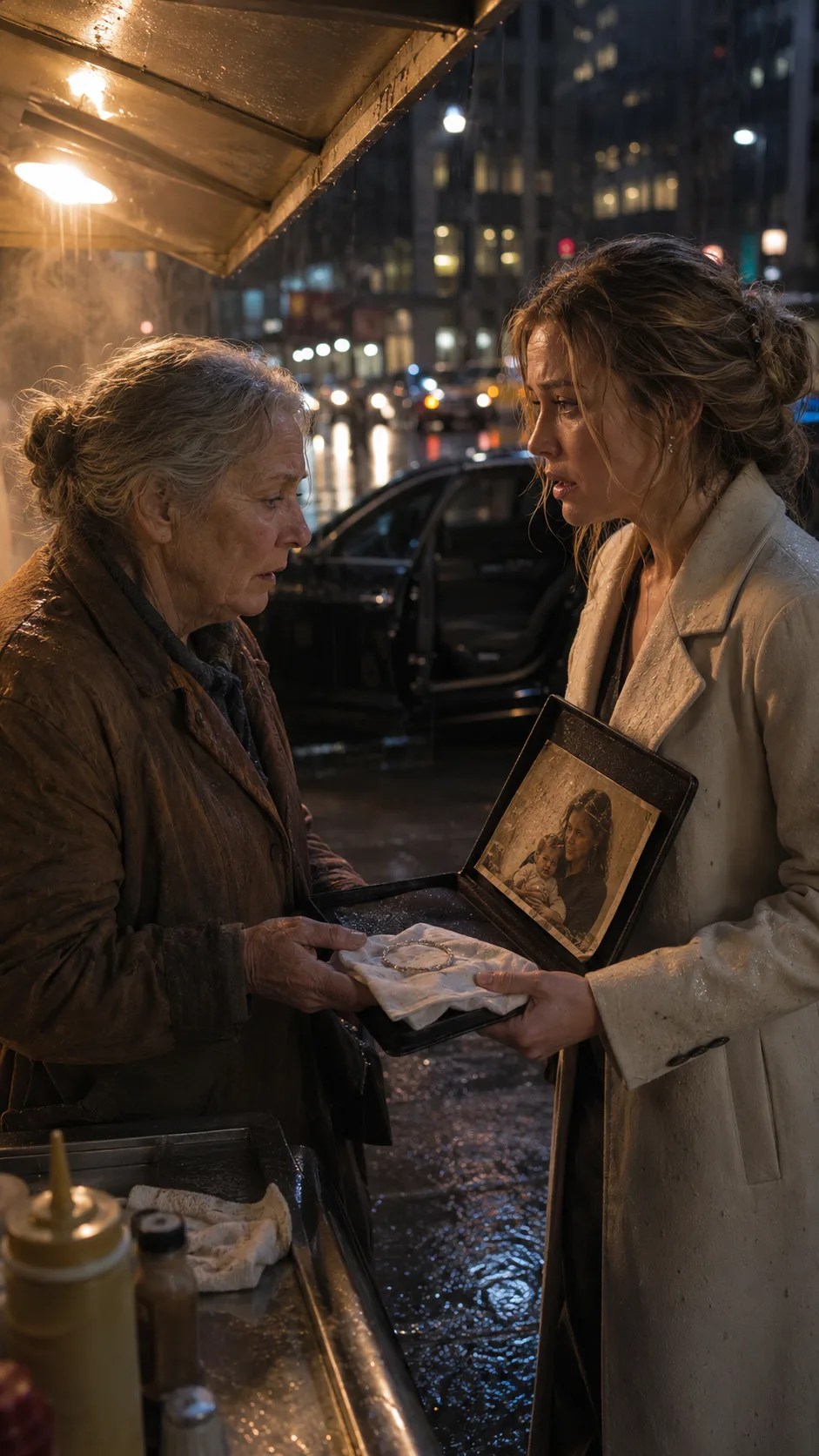
The summer rain fell over Manhattan like silver sheets torn open across the sky.
Chapter 1
The summer rain fell over Manhattan like silver sheets torn open across the sky.
Neon signs from bars, corner stores, taxis, and hotel lobbies shimmered across the wet pavement, turning the sidewalks into rivers of broken light. People hurried past one another with umbrellas tilted low, collars pulled up, eyes fixed ahead, as if slowing down for even a second might let the city swallow them whole.
On the corner of 52nd Street, between the steam rising from a manhole cover and the impatient blare of car horns, Margaret Sullivan stood behind her tiny hot dog cart.
The cart was so small that most people barely noticed it anymore. Its red awning had faded from years of sun. The laminated price sign had curled at the edges from rain. The metal frame carried dents from decades of being pushed, pulled, bumped, and repaired.
But everything inside was always clean.
The napkins were stacked neatly.
The mustard sat on the left.
The ketchup sat on
the right.
The tongs hung exactly where Margaret’s hand expected them to be.
She had worked that same corner for thirty-two years.
Thirty-two years of watching Manhattan change its skin.
Small bakeries became glass offices. Old movie theaters disappeared beneath luxury hotels. Regular customers grew older, moved away, or turned into names Margaret only saw in newspaper headlines.
And still, she remained.
A woman in her sixties with silver hair pinned behind her neck, a worn brown raincoat, and hands roughened by steam, winter, and work. She was not rich. She was not famous. No one waited for her at home except a tiny fourth-floor apartment where the pipes groaned at night and the heater worked only when it felt like it.
But Margaret still knew how to smile at strangers.
In Manhattan, that had become a rare skill.
That night, the rain came down harder than usual.
Margaret pulled
the side tarp lower and wiped water from the metal counter with an old towel. Her last customer had just walked away, leaving three coins behind and tossing out, “Keep the change,” as though it were a grand favor.
She was about to close the lid over the sausages when she saw the little girl.
The child stood near the crosswalk beneath the red traffic light.
No umbrella.
No adult beside her.
Her hoodie was too large, swallowing most of her small face. Her sneakers were soaked through, one lace loose and dragging across the pavement. Her tiny hands were pressed together in front of her chest, shaking from the cold.
Margaret looked around.
No one stopped.
No one asked.
The city kept moving around the little girl as if she were nothing more than rainwater on the curb.
Margaret leaned out from behind the cart.
“Hey, sweetheart…” she called
gently. “Are you okay?”
The girl flinched.
Pale blue eyes lifted from beneath the edge of the hood. They were the eyes of a child who had learned fear before trust.
She hesitated for several seconds before stepping closer.
“If you stand out there much longer,” Margaret said, “you’re going to turn into a little duck.”
The girl did not laugh. But something in her gaze loosened.
“What’s your name?”
A pause.
“Emma,” the girl whispered.
Margaret nodded as if she had just been given the name of a tiny queen.
“All right, Emma. I’m Margaret.”
She took a warm bun, placed a sausage inside, added a little ketchup, wrapped it carefully in foil, and held it out.
Emma stepped back at once.
“I don’t have money.”
She said it quickly, like she was used to being chased away the moment she told the truth.
Margaret looked at her.
Then she placed the hot dog on the edge of the counter.
“You don’t need money tonight.”
Emma stared at the food.
Then at Margaret.
Then back at the food.
Her lips trembled. She did not cry immediately. She stood there stiffly, as though she were trying to keep some door inside her from breaking open.
Then the tears came.
Not loud tears.
Not the kind meant to get attention.
They were small, silent tears from a child who had carried too much inside a body far too young.
Margaret stepped out from behind the cart and shielded the girl from the rain with her own body.
“When did you last eat?”
Emma wiped her face with her wet sleeve.
“Yesterday.”
Margaret’s hand tightened around the towel.
“And your mother?”
The child lowered her head.
“She’s sick. I had a sandwich… but I gave it to her.”
No thunder cracked above them.
Only rain.
But something inside Margaret broke quietly.
She did not ask the girl to explain. She did not make her feel ashamed with pity. She simply turned back to the cart and began packing everything she could.
Two hot dogs.
A small bag of pretzels.
Two bananas.
A bottle of water.
A carton of orange juice.
And the last slice of pie Margaret had saved for herself after closing.
She placed everything into a thick paper bag, folded the top carefully, and handed it to Emma.
The girl held the bag with both hands, as if it were treasure.
“That’s too much,” Emma whispered.
Margaret shook her head.
“No. It’s enough.”
For the first time that night, Emma smiled.
It was tiny.
But under the rain, it lit up her whole face.
Then she looked at Margaret with a seriousness that did not belong to a six-year-old.
“One day,” Emma said, “a black car will come for you.”
Margaret laughed softly.
“Oh, really?”
Emma nodded.
“And when it does… I’ll give you back something important.”
Margaret tilted her head.
“You sound like a little fairy godmother.”
Emma clutched the paper bag tighter.
“I promise.”
Before Margaret could ask where she lived, how sick her mother was, or whether she could call someone, Emma turned and ran into the rain.
“Emma!”
The child disappeared into the crowd near the corner, her oversized hoodie swaying until the yellow light of a passing taxi swallowed her completely.
Margaret stood in the rain for a long time.
That night, she searched two blocks. She asked a security guard. She asked a doorman. She asked a homeless man who often slept near the subway entrance.
No one had seen a little girl named Emma.
No one knew anything about a sick mother.
The next morning, Margaret returned to 52nd Street.
Then the next day.
Then the day after that.
Emma never appeared.
After one month, Margaret still saved a small bag of food every night. After three months, she still looked toward the crosswalk whenever it rained. After one year, her chest still tightened whenever she saw a child wearing an oversized hoodie.
But Manhattan did not keep answers for poor people.
The city took what it wanted.
Then it kept shining.
Fourteen years passed.
Margaret grew older beside the same hot dog cart.
Her hair turned fully white. Her fingers stiffened in winter. Her back ached every time she pushed the cart back to storage. Old customers vanished. New customers rarely looked at her for more than three seconds.
They paid with phones.
They complained if they had to wait.
They photographed their food and threw half of it away.
Rent rose.
Permit fees rose.
New city regulations required upgraded equipment, a replacement gas system, new heat storage, and multiple inspections.
All of it cost money.
Margaret did not have much left.
One late August afternoon, she received a final letter from the city office.
If she did not pay the renewal fees and complete the required repairs within ten days, her vending permit would be revoked.
Margaret read the letter three times.
Each time, the words blurred a little more.
She had no children.
Her husband, Thomas, had died twenty years earlier from a heart attack in their tiny kitchen.
They had once had a daughter.
Lily.
But Lily vanished when she was two years old on a chaotic afternoon in Bryant Park.
That wound was something Margaret never spoke about to customers.
Not because it had healed.
Because some pain, if named too often, could make it impossible to stand up and work the next morning.
The day Lily disappeared, Margaret had turned away for less than a minute to pick up a fallen bottle from beneath the stroller.
When she turned back, the stroller was empty.
The police searched.
Lily’s photo appeared on local news.
Thomas walked through neighborhoods putting up flyers until his hands bled.
Someone claimed they had seen a girl like Lily in Queens.
Someone else said Newark.
Another person said they saw a woman carrying a child onto a bus.
None of it led anywhere.
A month later, the police said Lily may have been taken out of state.
A year later, the case grew cold.
Three years later, Thomas stopped sleeping.
Ten years later, Margaret still kept Lily’s yellow sweater inside a tin box beneath her bed.
And now, fourteen years after the night she met Emma, Margaret sat behind her hot dog cart holding the city’s final notice, unsure whether she still belonged on that corner at all.
That evening, it rained again.
Not as fiercely as the night Emma appeared, but enough to turn the pavement into twisted ribbons of light. Margaret closed the lid, lowered the price sign, locked the cash drawer, and moved slowly, as if stretching the minutes could delay the ending.
When the small metal door finally shut, she sat on the folding chair behind the cart.
Then she covered her face with both hands.
“I can’t do this anymore, Tom,” she whispered.
No one answered.
Only rain tapped against the awning.
Then white headlights swept across the sidewalk.
Margaret looked up.
A black car stopped in front of the cart.
Not a taxi.
Not a police car.
A sleek luxury vehicle, its polished body reflecting the streetlights like dark water. The engine ran so quietly it was almost silent.
Margaret stood, one hand gripping the edge of the counter.
The back door opened.
A young woman stepped out.
She was tall and elegant, wearing a cream-colored coat with clean, expensive lines. Rain glistened on her dark blonde hair, tucked neatly behind one ear. She carried a leather designer bag, but the way she stood there was not like the rich customers who sometimes stopped at Margaret’s cart.
She did not look down.
She looked directly at Margaret.
Those pale blue eyes.
Margaret’s throat tightened.
“You’re closing soon, right?” the woman asked.
Her voice was gentle, with the faintest tremor at the end.
Margaret nodded slowly.
“I’m sorry… do I know you?”
The woman smiled.
A small smile, nearly breaking under the rain.
“You once told me I didn’t need money.”
Margaret froze.
The noise of Manhattan seemed to fall away.
Rain.
The crosswalk.
The oversized hoodie.
The shaking hands.
“Emma?” she breathed.
The woman lifted a hand to her mouth, trying to hold herself together.
“I told you I’d come back.”
Margaret stepped around the cart.
Emma stepped forward.
They embraced in the rain while traffic rushed past and pedestrians moved around them with annoyed glances. Margaret heard none of it. She held the young woman as if holding a piece of memory the city had once stolen from her.
“You’re alive,” Margaret said. “Oh God… you’re alive.”
Emma nodded against her shoulder.
“Because of you, my mother made it through that night.”
Margaret pulled back, both hands still holding Emma’s arms.
“How is your mother? What happened after that? I looked for you. I did.”
“I know,” Emma said, looking at the old cart. “I came back years later and asked around. Someone told me you were still here. But I wasn’t ready.”
“Ready for what?”
Emma fell silent.
Her face changed.
The smile vanished. A seriousness settled over her expression, and Margaret felt a chill move through her.
“I didn’t come only to thank you.”
Emma opened her leather bag and removed a thick velvet folder.
Margaret stared at it.
“What is that?”
“The truth about that night,” Emma said. “And about another night, long before I met you.”
Margaret frowned.
“I don’t understand.”
Emma opened the folder.
The first page was an old photograph.
The colors had faded. The edges were slightly bent.
Margaret took it.
Her entire body went still.
In the photo, she was younger. Brown-haired, bright-eyed, wearing the blue sweater Thomas had loved. She stood in Bryant Park, holding a baby girl in a yellow sweater.
Lily.
Margaret felt her knees weaken.
“Where did you get this?” she asked.
Emma placed a hand on her arm.
“My mother kept it.”
Margaret looked up sharply.
“Your mother?”
Emma swallowed.
“Her real name was Grace Alden. But for years, she used another name. She was the woman who took the baby from the park.”
Margaret stepped back.
Not from fear.
Because the ground seemed to disappear beneath her.
“No.”
“Margaret—”
“No.” She shook her head. “Don’t say that unless you’re certain.”
Emma turned another page.
A birth certificate.
Child’s name: Emily Grace Alden.
The date had been altered with dark ink.
Below it was a copy of an old hospital record, then a handwritten note, then more photographs.
A little blonde girl around four years old standing beside a thin woman.
A six-year-old in an oversized hoodie.
A girl with pale blue eyes.
Margaret looked at Emma.
This time, she did not only see the child from the rain fourteen years ago.
She saw Thomas in the shape of her jaw.
She saw herself in the eyes.
She saw Lily in the half-smile that never dared to fully bloom.
“You…” Margaret said, but the word broke in her throat.
Emma reached into her bag and took out something small wrapped in a white cloth.
She opened it.
A tiny silver baby bracelet.
Inside it were engraved two letters:
L.S.
Lily Sullivan.
Margaret touched the bracelet with shaking fingers.
She remembered the day Thomas bought it. He said a two-year-old did not need silver jewelry, but Margaret had insisted because Lily had laughed so beautifully in the sun that morning.
Margaret had fastened that bracelet around her daughter’s wrist on the day Lily disappeared.
She sank onto the folding chair.
“My baby didn’t die,” she whispered.
Emma knelt before her, not caring that her expensive coat touched the wet sidewalk.
“No.”
“Grace… that woman… why?”
Emma looked down at the bracelet.
“She lost her own baby one week before. Her husband left. Her family turned away from her. She was falling apart. When she saw Lily in the park… she said she stopped thinking. She picked her up. At first, she meant to take her to the police. Then she ran.”
Margaret closed her eyes.
Rain slid down her face.
Maybe tears did too.
“She raised me as her daughter,” Emma continued. “It wasn’t always good. But she loved me in her broken way. When I was six, she became very sick. The night I met you, we were living in a rented room in Brooklyn. She had no money. I was hungry. So was she.”
Margaret opened her eyes.
“Then why did you disappear?”
“I brought the food back. She ate a little and drank the water. Then she called someone she used to know. That person helped us leave the city the next morning to escape the landlord and the debts. After that, we moved from place to place.”
“And Grace?”
Emma stared at the bracelet.
“She died two years ago.”
Margaret stayed silent for a long time.
Part of her wanted to hate Grace with every stolen year in her bones. She wanted to shout. She wanted to ask how someone could take another woman’s child and continue breathing afterward.
But Grace was not standing in front of her.
Emma was.
The little girl who once stood in the rain with shaking hands and promised a black car would come.
“She told me before she died,” Emma said. “I didn’t believe her at first. I hired investigators. I took a DNA test. I found the old police records. The hospital papers. The photos. It took almost two years before I was sure.”
Margaret looked at her.
“How sure?”
Emma pulled a white envelope from the folder.
“Ninety-nine point nine percent.”
Margaret let out a small, wounded laugh.
“Lily.”
Emma stopped breathing for a second.
Margaret reached out and touched her cheek.
“You are Lily.”
Emma’s lips trembled.
“I don’t know if I have the right to that name.”
Margaret held Emma’s face in both of her aged hands.
“That name has been waiting for you for thirty years.”
Emma collapsed into her arms.
This time, her crying was not quiet.
Margaret held her daughter on 52nd Street, beside the old hot dog cart, in the city that had taken her child and returned her in the most impossible way.
But the story did not end there.
The next day, Emma brought Margaret to her lawyer’s office.
Margaret sat in a room on the forty-second floor, looking out at Manhattan through a wall of glass. She felt out of place in her old coat, her hands folded neatly in her lap.
Emma sat beside her.
Her lawyer, Richard Hale, placed a folder on the table.
“Mrs. Sullivan,” he said, “there are a few things Emma would like to do immediately.”
Margaret turned to the young woman.
“Lily,” she said softly. “May I call you Lily?”
Emma looked at her.
“I want you to call me that.”
The word “you” nearly undid Margaret.
Richard gave them a moment before continuing.
“First, your business permit has been renewed. All fees, penalties, and required cart upgrades have been paid.”
Margaret opened her mouth.
“No. I can’t accept—”
Emma took her hand.
“You fed me when you barely had anything to give. Let me do this.”
Richard pushed another document forward.
“Second, Emma has secured a long-term lease for your corner on 52nd Street. No one can push you out.”
Margaret stared.
“What are you doing?”
Emma smiled through red eyes.
“I’m giving back something important.”
Margaret shook her head.
“You came home. That’s enough.”
“No,” Emma said. “It isn’t.”
She unfolded a design plan.
On the paper was a small glass-and-metal food kiosk at the corner of 52nd Street. Above it, a sign read:
SULLIVAN’S CORNER
Margaret read the words silently.
“I want to build you a proper place,” Emma said. “Not to replace the old cart if you don’t want to. But to make sure the city can’t erase you.”
Margaret covered her mouth with one hand.
Richard added, “Emma has also created a small fund. Every night, Sullivan’s Corner will provide free meals for children and homeless people in the area. The fund is called Lily’s Promise.”
Margaret turned to her daughter.
“Lily’s Promise,” she whispered.
Emma nodded.
“A hungry child was once saved by a hot dog in the rain. I want that to continue.”
Margaret could not speak.
But not everyone welcomed Emma’s return.
When Emma filed to restore her birth name, Lily Sullivan, the story spread quickly. Local newspapers reopened the old Bryant Park disappearance. Photos of young Margaret and Thomas appeared online. People commented. People sympathized. People wanted details.
Then a man appeared.
His name was Victor Alden.
Grace’s former husband.
The same man who had abandoned Grace years before, yet suddenly claimed in front of reporters that he had “always loved Emma like a daughter” and deserved involvement in the life Grace had left behind.
Grace had not left much.
But Emma had built her own success. She had become a respected financial lawyer. She had money, status, and access to rooms that men like Victor spent their lives trying to enter.
One morning, Victor came to Sullivan’s Corner while the new kiosk was still under construction.
He wore an expensive suit that looked too desperate to impress. His hair was slicked back. His smile was too wide. Two freelance reporters followed behind him, cameras raised.
Margaret stood beside Emma, watching workers lift the new sign into place.
Victor walked toward them.
“Emma,” he called. “Or should I say Lily now?”
Emma turned.
Her face closed.
“You shouldn’t be here.”
Victor placed a hand against his chest.
“I’m family.”
Margaret stepped forward half a pace.
“Family doesn’t show up only after everything has been paid for.”
Victor looked at her, his smile thinning.
“You’re the hot dog woman, aren’t you? I understand this is emotional for you. But this is more complicated than a street-corner fairy tale.”
Emma moved in front of Margaret.
“Don’t speak to my mother that way.”
The words my mother made Victor pause.
The cameras kept rolling.
Victor recovered quickly, putting on a look of wounded concern.
“She’s confused,” he said to the reporters. “She’s dealing with a painful identity shock. I only want to protect her from people who might take advantage—”
“Enough,” Emma said.
Her voice was not loud.
But everyone nearby heard it.
Victor tilted his head.
“You’re making a mistake. Grace raised you. I’m the only one left from that life.”
Emma stared at him for a long moment.
Then she opened her leather briefcase and pulled out an envelope.
Margaret recognized it.
It had come from the velvet folder.
Emma did not hand it to Victor. She placed it on the folding table beside the kiosk.
“You want to talk about Grace?”
Victor’s eyes flicked to the envelope.
“What is that?”
“A notarized copy of her statement before she died.”
Victor’s expression shifted.
Emma continued.
“In it, Grace named the people who knew the truth. The people who helped her leave New York. The people who used the secret to take money from her for years.”
Victor went still.
The workers stopped moving.
The reporters stepped closer.
Margaret looked at Victor and saw, for the first time, the man behind the polished suit calculating his escape.
Emma took out another document.
“You were never protecting me. You knew I was the child taken from Bryant Park, and you never called the police. You accepted money every month to keep quiet.”
Victor gave a dry laugh.
“You can’t prove—”
Emma placed her phone on the table.
A recording began to play.
Grace’s weak voice filled the rainy morning.
“Victor knew. He knew from the first year. He said if I didn’t pay, he would take the girl away. He didn’t want the child. He wanted whatever he could get from her.”
Victor lunged for the phone.
Margaret moved faster than he expected.
She slammed her metal hot dog tongs down onto the table.
A sharp clang cut through the air.
“Don’t.”
One word.
Victor stopped.
Not because of the tongs.
Because of the woman holding them.
A mother who had lost her child for thirty years was not someone he could push aside anymore.
Emma looked directly at the cameras.
“I’m not making this public for revenge. I’m making it public because silence stole thirty years from my mother. It stole my real name. It turned a child into a secret adults could profit from.”
Victor stepped back.
One reporter asked, “Do you plan to sue Mr. Alden?”
Emma turned to Victor.
“Yes.”
Victor pointed at her.
“You’ll regret this.”
Margaret stepped beside her daughter.
“No,” she said. “You will.”
The video spread across the internet that day.
Not because anyone screamed.
Because a white-haired hot dog vendor stood in the rain beside her lost daughter and faced the man who had helped keep them apart for three decades.
Victor was investigated for extortion, concealing information related to a child abduction, and several financial crimes. Grace was gone and could not be put on trial. But her statement, old transactions, and Emma’s evidence were enough to pull the living into the light.
Margaret did not celebrate.
She did not know how to celebrate a truth that hurt that much.
Some nights, she still woke at three in the morning, pulled the tin box from beneath her bed, and unfolded Lily’s yellow sweater. Her daughter had returned, but the stolen years could not grow back.
Emma understood that too.
She carried two names inside her.
Emma, the girl raised by a lie.
Lily, the child who had finally come home.
Some evenings, she sat in Margaret’s apartment and looked through old photos of Thomas, asking about the father she never got to know.
Margaret told her everything.
Thomas sang badly but sang lullabies anyway.
He hated mustard but always gave customers extra because “people have the right to like strange things.”
After Lily disappeared, he never changed their phone number because he was afraid someone might call one day and say they had found her.
Emma listened.
She did not cry much.
She simply gathered each piece of her life as if retrieving it from her mother’s hands.
Three months later, Sullivan’s Corner officially opened.
It was no longer an old cart tucked between tall buildings.
It was a warm little kiosk with a sturdy awning, soft golden lights, a few wooden stools along the side, and a small framed sign that read:
If you are hungry and have no money, tell us. You don’t need money tonight.
Margaret had written the words by hand.
Emma had framed them.
On opening day, people came from everywhere. Old neighbors. Regular customers. Reporters. People who had watched the story online. Some came out of curiosity, but they left with food in their hands and something quieter on their faces.
Margaret stood behind the counter.
Only this time, she did not stand alone.
Emma stood beside her, wearing a white apron over an expensive blouse, awkwardly learning how to place a sausage into a bun without dropping the onions.
Margaret watched her and laughed.
“You’re holding those tongs like you’re signing a contract.”
Emma frowned at the hot dog.
“I’m better with contracts.”
“You’ll learn.”
A boy around seven stopped in front of the counter, holding his little sister’s hand. Both children were wet from the rain. The boy looked at the prices, then stepped back.
Emma noticed first.
She leaned down.
“Have you two eaten?”
The boy shook his head.
“We don’t have money.”
Margaret and Emma looked at each other.
One small moment.
Enough for both of them to understand.
Margaret placed two hot dogs onto foil wrappers.
Emma added two cartons of orange juice.
“You don’t need money tonight,” Emma said.
The boy looked at her.
Then at Margaret.
“Really?”
Margaret smiled.
“Really.”
The boy took the food with both hands. His little sister hugged the orange juice like treasure.
Emma stood still as they ran beneath the awning.
Margaret placed a hand on her daughter’s back.
“You all right?”
Emma nodded.
Then she looked out at 52nd Street, where the rain turned the road into glass.
“That night,” she said, “if you hadn’t given me that food…”
Margaret interrupted her.
“Don’t live inside if.”
Emma turned to her.
Margaret looked at her daughter, her old eyes steady.
“I lived inside if for thirty years. If I had turned around sooner. If I had held your hand tighter. If I had not dropped the bottle. If I had run after that woman. If I had searched one more street.”
She took Emma’s hand.
“If gives nothing back. You came home. Now we live from there.”
Emma squeezed her hand.
“Are you angry at Grace?”
Margaret looked out at the rain.
“Yes.”
Emma lowered her head.
“I am too.”
“But I also know,” Margaret said, “that if she had not raised you, I might have lost you another way. That doesn’t make what she did right. But life doesn’t always give us clean answers.”
Emma was quiet.
Margaret stroked her hand.
“You don’t have to choose between two mothers. You only have to know your way home.”
Emma looked at her.
Then she rested her head on Margaret’s shoulder.
Outside, the city kept moving.
People hurried past.
Some stopped to buy hot dogs.
Some accepted free meals.
Some only read the sign and walked a little slower.
Night deepened. Manhattan remained loud, cold, and fast, as if it had never lost anyone. But on the corner of 52nd Street, there was now a small place glowing in the rain.
A place that had once been an old cart no one noticed.
A place where a hungry little girl had once been fed without being asked for money.
A place where a black car had finally arrived after fourteen years.
Near closing time, Emma took the tiny silver bracelet from her pocket. She had attached it to a delicate chain and now wore it around her neck.
Margaret touched it gently.
“L.S.,” she whispered.
Emma smiled.
“Lily Sullivan.”
Margaret looked at her for a long time.
“Do you want to keep the name Emma?”
Emma thought for a moment.
“Emma is the one who survived,” she said. “Lily is the one who came home.”
Margaret nodded.
“Then keep both.”
Emma looked out at the shining street.
“My full name will be Lily Emma Sullivan.”
Margaret smiled.
Not loudly.
Not dramatically.
Just enough for the tired lines of her face to soften.
At that moment, a taxi passed through a puddle and sent a silver splash against the curb. Emma pulled Margaret back, and both women laughed when a few drops landed on their aprons.
Margaret wiped the water from her daughter’s sleeve.
A small gesture.
Thirty years late.
Still the gesture of a mother.
Emma looked down at her hand.
“Mom?”
“Yes?”
“Can I come early tomorrow and learn how to make pie?”
Margaret pretended to consider it.
“Pie isn’t easy.”
“I’ve handled million-dollar merger contracts.”
“Pie is harder.”
Emma laughed.
So did Margaret.
Outside, the rain kept falling.
But for the first time in many years, Margaret no longer heard it as something washing people away.
It sounded like music.
Soft.
Long.
Gentle.
The next morning, the people around 52nd Street saw something unusual.
A white-haired woman stood beside a younger woman in an apron as they opened Sullivan’s Corner together. On the counter were fresh pies, hot coffee, and a row of hot dogs ready for the first customers of the day.
Margaret hung the small sign out front.
Emma stood beside her.
A man hurried past, then turned back.
“One hot dog,” he said. “Extra mustard.”
Margaret raised an eyebrow at Emma.
Emma picked up the tongs.
This time, she held them firmly.
“Coming right up.”
Margaret watched her daughter prepare the first hot dog of the morning. The bun sat a little crooked. The mustard was slightly too much. But Emma handed it over with a smile that made time fold in on itself.
The customer paid and walked away.
Emma placed the first bill into the cash box.
Margaret looked at the money, then at her daughter.
“Welcome home, Lily Emma Sullivan.”
Emma turned to her.
In the weak sunlight after the rain, her blue eyes brightened.
“I’m home, Mom.”
And this time, the city did not take her away.
Chapter complete
You have reached the end of this chapter.
Continue reading
A few more worlds to get lost in after this chapter.




