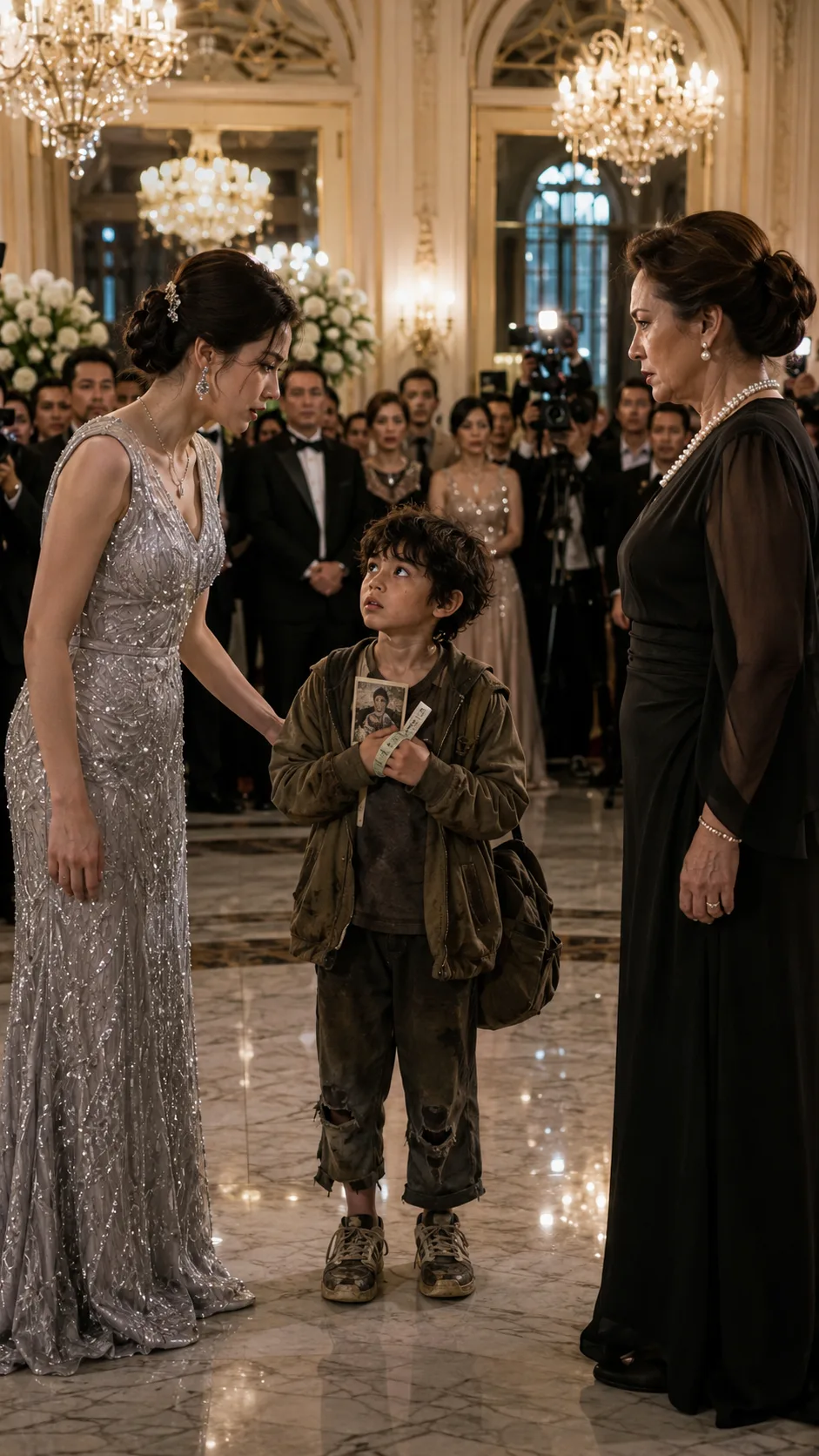
The crystal chandeliers inside the Grand Crown Hotel reflected across polished marble floors like frozen stars.
Chapter 1
The crystal chandeliers inside the Grand Crown Hotel reflected across polished marble floors like frozen stars.
Everything in that ballroom had been polished, arranged, and rehearsed.
The white roses on each table had been flown in that morning. The champagne glasses stood in perfect pyramids beside silver trays of smoked salmon and gold-dusted desserts. Cameras flashed near the entrance, where a velvet backdrop displayed the name of the evening’s charity gala in elegant black lettering:
THE ELEANOR VALE FOUNDATION — ANNUAL WINTER BENEFIT
Wealthy guests laughed.
Glasses clinked.
Reporters whispered into their microphones, describing the gowns, the jewelry, the politicians, the CEOs, the heirs of families whose names were carved onto buildings across the city.
At the center of it all stood Eleanor Vale.
Thirty-four years old. Perfectly dressed. Perfectly composed.
Her silver dress caught the chandelier light every time she turned, and the diamond pins in her dark hair glittered like tiny pieces of ice. She smiled for photographs, shook hands with donors, and thanked
people for supporting “children who had nowhere else to go.”
That was the phrase printed on the banners.
Children who had nowhere else to go.
Eleanor had approved it herself.
She had approved every detail of the evening: the menu, the music, the guest list, the speech, the placement of each camera. Nothing happened inside the Grand Crown Hotel without someone checking with her first.
At least, that was what she believed.
Then suddenly—
A woman screamed.
“Oh my God... THAT’S HIM!”
The sound cracked through the ballroom so sharply that the string quartet stopped mid-note.
Conversations died instantly.
Forks froze above plates. A champagne glass tilted in someone’s hand but did not spill. Every head turned toward the grand entrance.
Near the doorway stood a small boy.
Around eight years old.
Messy curls.
Dirty shoes.
A ripped backpack hanging from one shoulder.
His name was Noah.
He looked painfully
out of place beneath the golden ceiling, standing on marble so shiny it reflected the holes in his sneakers.
In both hands, he held one old photograph.
Folded.
Worn.
Protected like treasure.
For several seconds, nobody moved.
Some guests stared as if a stray animal had wandered into the ballroom.
Some whispered behind jeweled hands.
Some looked away, embarrassed not for him, but because poverty had stepped too close to their evening.
“Who let him in here?” one guest muttered.
A security guard near the entrance straightened.
Another reached for his earpiece.
Noah saw them.
His little fingers tightened around the photograph.
He took half a step back.
That was when a little girl in a bright yellow coat slipped away from her mother’s side and walked toward him. She was no older than six, with a pastry box held carefully in both hands.
The ballroom watched her cross the
marble.
She stopped in front of Noah and opened the box.
Inside was a small chocolate tart, untouched.
“Did you eat today?” she asked.
Noah looked at the floor.
“No…”
His voice barely came out.
The girl placed the pastry box into his hands as if she were giving him something far more important than dessert.
Noah stared at it.
He did not eat.
He looked past her, into the crowd of strangers, searching every face with a kind of desperate patience that made the silence feel heavier.
Then, slowly, he opened the photograph.
A shopping bag slipped from a woman’s hand and crashed onto the floor.
The sound echoed.
The woman who dropped it stood near the second row of tables.
Her name was Vivian Hart.
She was fifty-two, wealthy, elegant, and known throughout the city for never losing control in public. Her pearls were real, her posture was flawless, and her face had the careful stillness of someone who had spent years pretending the past could not reach her.
But now she froze.
Her eyes widened.
Her body stopped moving.
Because the photograph in Noah’s hands showed a younger version of her daughter, Eleanor.
Holding a baby.
The baby was wrapped in a blue blanket.
On the back of the photo, written in faded ink, were three words:
Eleanor and Noah.
“No...” Vivian whispered.
Her hand rose to her mouth.
“No... that’s impossible.”
Eleanor, who had been speaking to a senator near the stage, turned at the sound of her mother’s voice.
At first, she only saw the crowd parting.
Then she saw the boy.
Then she saw the photograph.
The smile left her face so completely that one reporter lowered his camera.
The ballroom became still in a way no one could have rehearsed.
Eleanor walked closer.
One step.
Then another.
The long silver fabric of her dress brushed against the marble, whispering beneath the chandeliers.
Noah did not run.
He looked up at her, and for a moment, something passed across his face that was not fear.
It was recognition.
Not of a memory.
Of a hope.
Eleanor stopped a few feet away from him.
Her eyes dropped to the photograph.
The color drained from her face.
“Where did you get that picture?” she asked.
Noah swallowed.
His hands shook, but he did not let go of it.
Then quietly, he said:
“Mom...?”
The word did not sound loud.
It did not need to.
It traveled through the ballroom like a crack through glass.
Every camera turned.
Vivian moved first.
“No.” Her voice came sharp now. Too sharp. “No, absolutely not.”
Eleanor didn’t look at her.
Her eyes stayed on the boy.
Noah reached into his ripped backpack and pulled out a small cloth pouch. It was faded blue, with one broken button. He opened it with careful fingers and took out a hospital bracelet, yellowed with age.
The name printed on it was nearly faded.
But not completely.
BABY BOY VALE
A murmur rippled through the room.
Eleanor’s lips parted.
Vivian stepped forward and grabbed Eleanor’s arm.
“Don’t,” she said.
Eleanor finally turned to her.
“Don’t what?”
Vivian’s jaw tightened.
The senator beside the stage quietly stepped away. A reporter raised his phone higher. The little girl in the yellow coat clutched her mother’s skirt, still watching Noah.
Vivian lowered her voice, but everyone nearby heard her.
“He’s confused. Someone put him up to this.”
Noah flinched at the words.
Eleanor saw it.
She gently pulled her arm from her mother’s grip.
“Who are you?” she asked the boy.
Noah took a breath.
“My name is Noah Reed. The lady who raised me was Mrs. Clara Reed. She died two weeks ago.”
The ballroom shifted.
Not loudly.
Just enough for shoes to scrape against marble.
Noah continued, each word small but clear.
“She told me before she died that if I ever got hungry, or if the house people came again, I should find the woman in the picture.”
Eleanor stared at him.
“What house people?”
Noah looked down.
“The men from the children’s home.”
A waiter near the buffet quietly set down his tray.
Eleanor’s foundation supported three children’s homes across the city.
Including Reed House.
Including the one she had visited for cameras every December.
Vivian’s face hardened.
“This is ridiculous,” she said. “Security, remove him.”
The guards stepped forward.
Eleanor lifted one hand.
They stopped.
It was the first time that night the room understood who truly held power.
“No one touches him,” she said.
The words were calm.
But they landed.
Noah stared at her as if he had just been given shelter by the sound of her voice.
Vivian’s eyes flashed.
“Eleanor, you are embarrassing yourself.”
Eleanor turned slowly toward her mother.
“Why does he have a photograph of me holding him?”
Vivian did not answer.
The silence grew teeth.
Eleanor looked again at the photo. Her fingers trembled as she reached for it, but Noah held it close to his chest.
“Mrs. Reed said not to give it away,” he said quickly. “She said people with money can make things disappear.”
The room went even quieter.
Eleanor’s hand dropped.
Vivian laughed once.
It was not a real laugh.
It was a small, dry sound meant to cover panic.
“This child is repeating nonsense.”
Noah shook his head.
“I’m not lying.”
Vivian looked down at him.
Her voice turned cold.
“Do you even understand where you are?”
Noah held the photo tighter.
Eleanor stepped between them.
“He understands enough.”
Vivian’s expression changed then.
For the first time that evening, the perfect mask slipped. Not completely. Just enough.
“Eleanor,” she said, “you were twenty-six. Your career was beginning. You had just lost Daniel. You were in no condition to make decisions.”
The name struck Eleanor like a hand across the chest.
Daniel.
No one in the ballroom spoke.
No one even pretended to be busy.
Daniel Grant had been Eleanor’s fiancé eight years ago. A young architect from a family without status, without wealth, without approval from Vivian Hart. He died in a car accident before the wedding.
At least, that was what the public knew.
Eleanor’s gaze sharpened.
“What decision?”
Vivian said nothing.
Eleanor took one step closer.
“What decision, Mother?”
Vivian’s fingers tightened around her clutch.
“You were grieving.”
Eleanor’s voice dropped.
“What did you do?”
Noah watched them both, not understanding everything, but understanding enough to know that the ground beneath him was changing.
Vivian looked around at the cameras.
Then at the donors.
Then at the foundation banner behind the stage.
Children who had nowhere else to go.
Her face went pale.
Eleanor saw it.
And suddenly, a memory flickered.
A hospital room.
White curtains.
Her mother beside the bed.
Medication thick in her veins.
Someone saying the baby had not survived.
Someone holding her hand too tightly.
Someone telling her not to ask questions because grief would destroy her.
Eleanor pressed one hand against the back of a chair.
“No,” she whispered.
Vivian stepped closer.
“This is not the place.”
Eleanor’s eyes lifted.
“This is exactly the place.”
A ripple moved through the guests.
The reporters were recording openly now.
Vivian’s voice became a warning.
“You do not want to do this in public.”
Eleanor looked at Noah.
His cheeks were hollow. His coat sleeves were too short. There was a bruise-colored smudge of dirt along his jaw. He stood in a room full of adults who could buy anything they wanted, and he looked as if he expected to be thrown back into the rain.
Something inside Eleanor became very still.
She knelt in front of him, ignoring the silver dress pooling across the marble.
“Noah,” she said, careful with his name. “Who gave you my picture?”
“Mrs. Reed,” he said. “She said she was paid to take me when I was a baby. She said she was sorry.”
Vivian inhaled sharply.
Eleanor did not move.
“She said she tried to bring me back once,” Noah continued. “But the woman with the pearls told her if she came near you again, she’d lose everything.”
Every eye turned to Vivian’s pearl necklace.
Vivian’s mouth opened.
No sound came out.
Eleanor stood.
Slowly.
The kind of slow that makes people afraid to breathe.
“Is he my son?”
Vivian looked away.
That was the answer.
Eleanor staggered one step back, but she did not fall.
A man near the stage whispered, “Oh my God.”
Noah’s eyes filled, but he did not cry. He just stared at Eleanor like his whole life depended on the next sentence.
Eleanor turned back to him.
Her hand lifted, then stopped in the air. She seemed afraid to touch him too quickly, afraid he might vanish.
“May I?” she asked.
Noah nodded once.
She reached out and brushed one curl away from his forehead.
A tiny scar sat near his hairline.
Eleanor’s knees weakened.
Daniel had the same scar.
A childhood fall, he used to say, laughing whenever she touched it.
Noah had Daniel’s eyes.
And her mouth.
And the small crease between his brows when he tried not to break.
Eleanor covered her own mouth with one shaking hand.
Vivian snapped.
“This is emotional manipulation. We need lawyers. We need tests. We need—”
“We need the truth,” Eleanor said.
Her voice cut through the ballroom.
Vivian froze.
Eleanor turned to the event director near the stage.
“Call my attorney.”
“Eleanor—”
“Now.”
The director hurried away.
Vivian grabbed Eleanor’s wrist.
“You will destroy everything I built for you.”
Eleanor looked down at her mother’s hand.
Then back at her face.
“You mean everything you stole from me.”
Vivian released her as if burned.
The room shifted again.
No one laughed now.
No one whispered behind hands.
They watched Vivian Hart, the woman who had funded schools, hospitals, and public campaigns about family values, stand beneath chandeliers while a hungry child held proof she could not explain.
Noah suddenly swayed.
The little girl in the yellow coat gasped.
“He needs food,” she said.
Eleanor turned instantly.
She took the pastry box from Noah’s hands, opened it, and knelt again.
“Eat,” she said.
Noah looked unsure.
Like permission was not something he trusted.
Eleanor broke a small piece from the tart and placed it carefully into his palm.
He ate it slowly.
The ballroom watched a millionaire kneel on marble in a designer gown while a child in dirty shoes ate dessert like it might be his last meal.
And for the first time all evening, the cameras did not feel important.
Only the boy did.
A few minutes later, Eleanor’s attorney arrived with two hotel security officers and a police liaison who had been assigned to the gala. Vivian tried to speak first, but Eleanor held up a hand.
“No.”
One word.
Vivian stopped.
The attorney, Martin Hale, was a serious man with silver hair and a face that rarely changed. But when he saw the photograph, the hospital bracelet, and the name on the cloth pouch, even he looked shaken.
“We’ll need a DNA test,” he said.
Eleanor nodded.
“Tonight.”
Vivian’s eyes widened.
“You can’t possibly—”
“I can.”
Martin glanced at Vivian.
“There may also be legal exposure here.”
Vivian’s face turned rigid.
Eleanor looked at Noah.
“Do you have anywhere safe to sleep tonight?”
Noah shook his head.
“The lady at the shelter said I could stay until morning. But the boys there take things.”
Eleanor closed her eyes for half a second.
Then opened them.
“You’re not going back there.”
Vivian stepped forward again.
“You cannot bring an unknown child into your home.”
Eleanor turned on her.
“He is not unknown.”
Vivian’s mouth tightened.
“You don’t know that yet.”
Eleanor held out the photograph.
“I knew it before he said Mom.”
The room went silent again.
Noah looked up.
For the first time, his face changed.
Not into a smile.
Something smaller.
Something fragile.
Something almost too scared to exist.
Eleanor crouched in front of him.
“I don’t remember holding you,” she said. “But I believe I did.”
Noah blinked fast.
“Mrs. Reed said you sang to me.”
Eleanor stopped breathing.
There had been a song.
A lullaby Daniel used to hum off-key while painting the nursery yellow. Eleanor had sung it once in the hospital before sleep swallowed her again.
No one knew that.
No one except Daniel.
No one except the baby.
Eleanor’s hand covered her mouth.
Noah whispered the first line.
Not perfectly.
But enough.
The sound broke something inside the room.
A donor near the front wiped his eyes. The little girl in the yellow coat stepped closer to her mother. One reporter lowered his phone, unable to keep filming.
Eleanor reached for Noah.
This time, he stepped into her arms.
Not quickly.
Not dramatically.
Just one small step.
Then another.
And when she wrapped her arms around him, he stood stiff for one second, as if waiting for someone to pull him away.
No one did.
So he leaned in.
His face pressed against her shoulder.
His hands gripped the silver fabric of her dress.
Eleanor held him like the world had narrowed to the weight of that child in her arms.
Vivian stood alone beneath the chandeliers.
For years, she had controlled invitations, headlines, bank accounts, silence.
But she could not control this.
Not the photograph.
Not the bracelet.
Not the song.
Not the boy who had walked through the front doors with dirty shoes and a truth folded in his hands.
The next morning, the story covered every screen in the city.
FOUNDATION HEIRESS REUNITED WITH SON AFTER EIGHT YEARS
CHARITY GALA TURNS INTO FAMILY SCANDAL
VIVIAN HART UNDER INVESTIGATION
By noon, Reed House was sealed for inspection.
By evening, former employees began calling Martin Hale.
By the end of the week, the truth had teeth.
Clara Reed had not stolen Noah.
She had been paid.
The payment came from an account controlled by Vivian.
Hospital records had been altered.
A nurse had signed a statement under pressure.
A doctor had retired early with a settlement that now looked less like retirement and more like hush money.
And Eleanor learned the part that hurt most:
Daniel had never known.
He died believing the baby was gone.
Eleanor sat in her private study when Martin placed the documents in front of her.
Noah was asleep upstairs in the yellow bedroom Daniel had painted years earlier.
The paint was faded now.
The crib was gone.
But the small wooden airplane Daniel built still hung from the ceiling, turning slowly whenever the heater clicked on.
Eleanor looked at the documents.
Then at the window.
Rain tapped against the glass.
“She let me bury my son,” Eleanor said, “while he was alive.”
Martin did not answer.
There was no answer large enough.
Vivian was arrested three days later.
She wore sunglasses when officers escorted her from her townhouse, but cameras caught her hands shaking.
Reporters shouted questions.
She said nothing.
Eleanor did not watch the footage.
She was in the kitchen with Noah, teaching him how to make pancakes.
He spilled flour across the counter.
Then froze, waiting to be scolded.
Eleanor looked at the mess.
Then at him.
Then she dipped one finger into the flour and drew a crooked smiley face on the counter.
Noah stared.
Then he laughed.
It was small at first.
Uncertain.
Then real.
The sound filled the kitchen better than music.
That winter, Eleanor closed two of the foundation’s old programs and rebuilt them from the ground up. No cameras. No staged visits. No polished banners with perfect phrases.
She hired investigators.
Real ones.
She visited children’s homes without warning.
She listened to children without handlers standing nearby.
And every night, she came home before dinner.
Noah still kept the photograph.
But he no longer slept with it under his pillow.
One evening, months later, he stood in the doorway of Eleanor’s study wearing new pajamas with little blue airplanes printed on them.
“Can I ask something?” he said.
Eleanor closed her laptop.
“Always.”
He looked down at his bare feet.
“Do I have to call you Mom?”
Eleanor’s throat tightened, but she kept her voice steady.
“No,” she said. “You can call me whatever feels right.”
Noah nodded.
He thought about it.
Then he walked across the room and climbed carefully onto the sofa beside her.
“Okay,” he said.
A quiet minute passed.
Then he rested his head against her arm.
“Mom?”
Eleanor closed her eyes.
“Yes?”
“Did you look for me?”
The question landed softly.
That made it hurt more.
Eleanor turned toward him.
“I didn’t know you were alive,” she said. “But something in me looked for you every day.”
Noah considered this.
“Like when you lose something but still check the same place?”
Eleanor nodded.
“Yes. Exactly like that.”
He leaned closer.
“I checked every rich lady in every newspaper,” he said. “Mrs. Reed said maybe one day I’d find the right one.”
Eleanor wrapped her arm around him.
“And you did.”
Noah looked up.
“Are you going to disappear?”
“No.”
“Even if I mess up?”
“No.”
“Even if I get scared and hide food?”
Eleanor went still.
Then she kissed the top of his head.
“Even then.”
He nodded once, as if filing the answer somewhere important.
After a while, he whispered, “The hotel was scary.”
“I know.”
“But the girl gave me cake.”
Eleanor smiled faintly.
“She did.”
“Can we invite her someday?”
“Yes.”
Noah relaxed against her.
Outside, the rain softened.
Inside, the old photograph sat framed on the mantle.
Not hidden.
Not folded.
Not protected like a secret anymore.
Beside it was a newer photograph: Eleanor and Noah standing in the kitchen, both covered in flour, laughing at something no one else could see.
The city would remember the scandal.
The newspapers would remember the gala.
The wealthy guests would remember the moment a boy in dirty shoes stopped an entire ballroom with one word.
But Eleanor remembered something else.
She remembered the weight of him in her arms.
She remembered the first bite of chocolate tart in his palm.
She remembered the way his voice trembled when he asked if she would disappear.
And every night after that, when Noah slept beneath the little wooden airplanes, Eleanor would pause at his door for one extra second.
Not because she feared he was gone.
But because after eight stolen years, she needed to see him there.
Breathing.
Safe.
Home.
Chapter complete
You have reached the end of this chapter.
Continue reading
A few more worlds to get lost in after this chapter.




