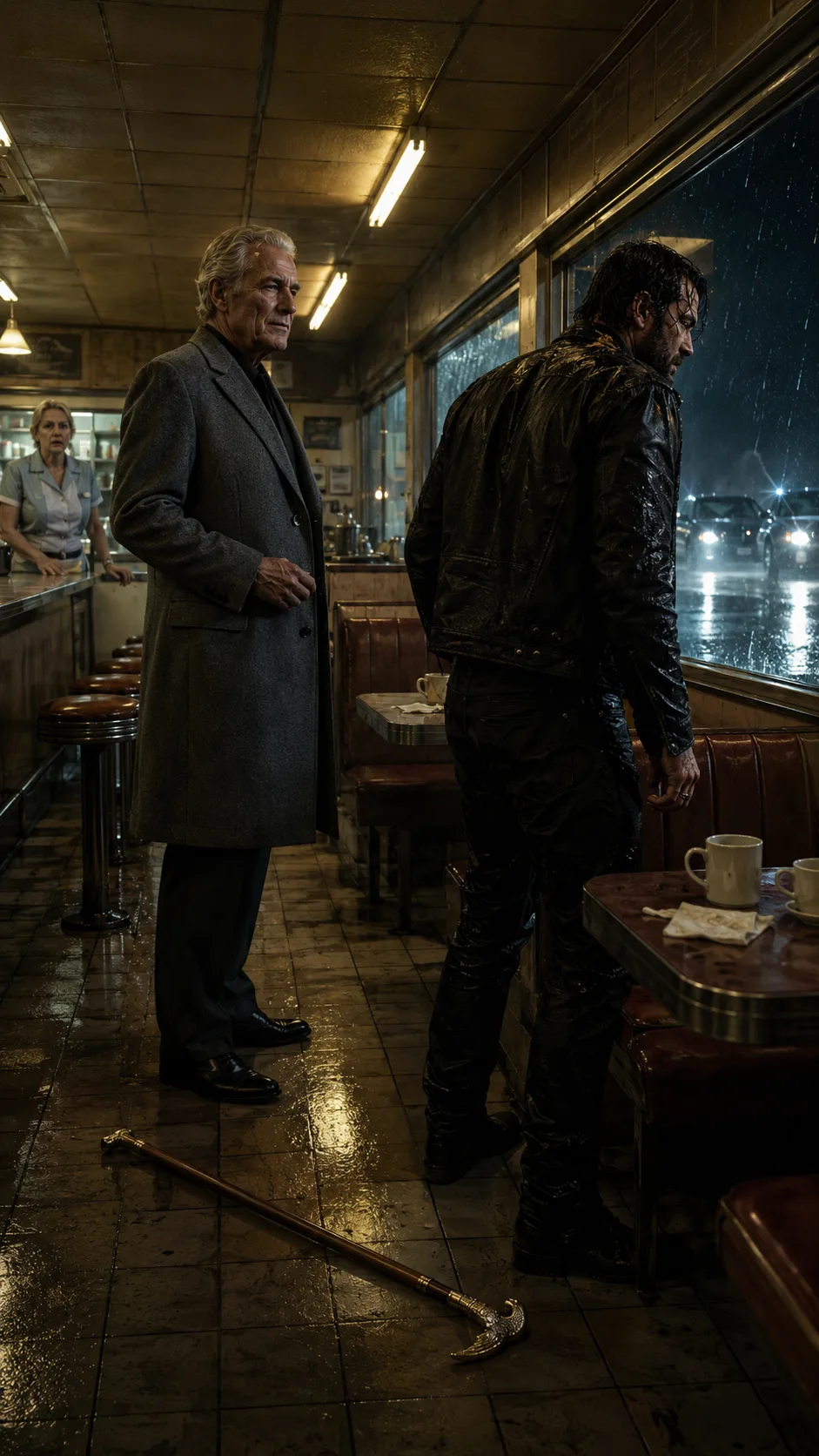
The diner had always been the kind of place people forgot the moment they left.
Chapter 1
The diner had always been the kind of place people forgot the moment they left.
It sat at the edge of a two-lane road outside Briar Creek, pressed between an abandoned gas station and a field of weeds that turned silver whenever headlights passed. The sign above the roof still said MABEL’S in faded red letters, though Mabel herself had been gone for almost twelve years. Nobody had the heart to change it. Nobody had the money either.
Most nights, the diner was just a place for coffee, pie, and silence.
Truck drivers stopped there when they were too tired to keep going. Nurses came after late shifts with dark circles under their eyes. Lonely men sat at the counter and stirred sugar into coffee they never finished. People came in, warmed their hands around chipped mugs, said too little, paid in crumpled bills, and disappeared back into the dark.
But that night was different.
Rain hammered the windows so hard it sounded like the
world was trying to get in.
The storm had rolled down from the north just after sunset, turning the road outside into a black ribbon of water. The neon sign buzzed and flickered in the rain. Every few minutes, thunder rolled over the flat land, deep enough to rattle the silverware in its tray.
Inside, Mabel’s Diner glowed yellow and tired.
There were only seven people there.
Ruth Bell, the waitress, stood behind the counter refilling ketchup bottles with the careful patience of a woman who had survived too much to be rushed by anything. At sixty-two, Ruth had a face lined more by work than age, and hair she kept pinned up with a pencil because hair clips always disappeared when she needed them.
Behind the grill, her nephew Miles flipped burgers and pretended not to watch the clock. He was nineteen, thin, nervous, and always convinced the world
was about to ask something from him he didn’t know how to give.
At the counter sat a retired school bus driver named Mr. Hollis, reading yesterday’s newspaper because he liked pretending the world could wait twenty-four hours before reaching him.
A young couple sat near the window, arguing in whispers over a phone neither of them wanted to look at.
And in the far corner booth sat the old man.
He had come in at 8:17 p.m.
Ruth remembered because the clock above the pie case had stopped at 8:17 years ago, and whenever someone walked in around that time, she noticed.
He wore a gray wool coat buttoned neatly to the throat. His posture was straight, almost formal. He had a clean white beard, trimmed close, and eyes that did not wander. His hands rested on top of a wooden cane laid across his lap.
The cane was
the first thing Ruth noticed.
It was old wood, polished so deeply that the diner lights moved across it like water. The handle was carved into the shape of an eagle’s head, but not in a decorative way. It looked worn by use. Earned. Near the silver collar below the handle, there were three tiny marks cut into the wood.
Ruth could not read them from the counter.
But she could tell they meant something.
The old man ordered black coffee and a slice of apple pie.
Nothing else.
When Ruth set it down, he thanked her by name.
That made her pause.
“You’ve been here before?” she asked.
“A long time ago,” he said.
His voice was low, steady, and rough around the edges, like gravel under snow.
Ruth glanced at him again. “I usually remember faces.”
“I had a different face then.”
She almost smiled, because it sounded like a joke.
But he did not smile.
So she left him alone.
For half an hour, he sat there without touching the pie. He drank his coffee slowly, looking out through the rain as if he were waiting for something that had taken years to arrive. Once, he checked an old silver watch. Once, he placed his palm over the cane’s handle and kept it there.
Miles leaned through the kitchen window and whispered, “You know him?”
“No,” Ruth said.
“He looks like somebody important.”
Ruth looked over again.
The old man sat still in the corner booth, gray coat unwrinkled, cane across his lap, face turned toward the storm.
“No,” she said. “He looks like somebody who stopped being important on purpose.”
Miles did not understand that.
Ruth did.
At 9:03 p.m., the front door opened.
The bell above it gave one weak jingle before the wind swallowed the sound.
The bikers did not enter so much as take over.
There were five of them.
They came in soaked with rain, leather jackets shining under the fluorescent lights, boots leaving dark prints across the old tile floor. The first one through the door was broad-shouldered, with a shaved head and a chain wallet hanging from his belt. He looked around the diner with the lazy smile of a man who had already decided nobody inside mattered.
Behind him came two younger men, both laughing too loudly at something that had stopped being funny before they opened the door. Another biker dragged a chair back with a screech just because he could. The last one, taller and quiet, stood near the entrance for a moment, scanning the room like he was measuring exits.
Ruth had seen men like them before.
Not exactly them.
But the type.
Men who entered a room looking for the weakest thing in it.
The leader slapped both hands on the counter.
“Coffee,” he said.
Ruth looked at the wet floor behind him. “You want menus?”
“I said coffee.”
Miles froze behind the grill.
Ruth picked up the pot.
“Five?”
The leader smiled. “You count good.”
The two younger bikers laughed.
Ruth poured the coffee without answering. There were times in life when silence was not fear. It was maintenance. You kept things from catching fire by not handing fools a match.
The bikers spread out across the diner.
They took two booths and three counter seats, though there were only five of them. One of them turned the napkin dispenser upside down and shook it until napkins scattered across the table. Another leaned back and placed wet boots on the booth seat across from him.
The young couple near the window stopped whispering.
Mr. Hollis lowered his newspaper by an inch.
In the corner booth, the old man did not move.
The leader noticed him after the first cup of coffee.
It happened slowly.
His eyes slid across the room, bored and searching. They passed over Ruth, Miles, the couple, the newspaper, the pie case. Then they landed on the old man’s cane.
Something in his face changed.
Not interest.
Ownership.
“Well, now,” he said, loud enough for the room to hear. “Look at that.”
Nobody answered.
He pushed away from the counter and walked toward the corner booth.
Ruth set the coffee pot down.
The old man’s hand rested on the cane.
The biker stopped beside the table and tilted his head.
“That yours?”
The old man looked up at him.
“Yes.”
“Looks expensive.”
“It is not for sale.”
The biker’s smile widened.
“I didn’t ask if it was for sale.”
The diner shrank around those words.
Ruth felt Miles watching from the kitchen window. She gave the smallest shake of her head without turning. Stay back.
The biker reached out and tapped the eagle head with one finger.
The old man’s hand tightened slightly.
Only slightly.
“Don’t touch it,” the old man said.
The biker looked back at his friends.
They grinned.
One of the younger men called out, “Careful, Jace. Grandpa might curse you.”
More laughter.
Jace.
Ruth filed the name away because some part of her believed names mattered when trouble came.
Jace leaned closer to the old man.
“You hear that? They think you’re magic.”
The old man did not blink.
“No,” he said. “They think you’re foolish.”
The laughter stopped for half a breath.
Jace’s smile remained, but the skin around it tightened.
“What did you say?”
The old man picked up his coffee cup with one steady hand.
“I said they think you’re foolish.”
Ruth saw it then.
The room had divided.
On one side, noise and wet leather and men needing attention.
On the other, one old man with a cane across his lap.
And somehow the old man made the larger side look small.
Jace moved fast.
In one sudden motion, he grabbed the cane.
The crack of it leaving the old man’s hand echoed through the diner like a gunshot.
A glass tipped over at the young couple’s table. Coffee sloshed across the counter. Mr. Hollis stopped breathing behind his newspaper. Even the neon sign outside seemed to flicker quieter.
Jace stepped back, holding the cane in both hands like a prize.
The old man’s fingers remained curved around empty air.
For one second, nobody moved.
Then Jace laughed.
“Seriously?” he said. “This is what you’re holding onto?”
The others joined in.
The sound grew uglier as it spread.
One biker slapped the table. Another whistled. The youngest one said, “Check if there’s money inside.”
Ruth came around the counter.
“That’s enough,” she said.
Jace spun the cane once.
Ruth stopped.
The old man lifted his eyes to her. Not warning. Not pleading. Just a look that said she did not need to step closer.
Jace noticed.
“Oh,” he said. “You got a girlfriend here, old man?”
The old man looked at the empty space where the cane had been.
Not angry.
Not scared.
Observing.
That calmness made the room feel smaller.
Jace’s laughter faded first.
He seemed to dislike the old man’s silence more than he would have disliked shouting. Anger would have given him something to push against. Fear would have given him something to enjoy. But the old man gave him nothing.
So Jace tried harder.
He held the cane out sideways.
“Tell me something,” he said. “Why’s a stick like this matter so much?”
The old man looked at him.
“Because it was given to me by men who are no longer here.”
The words fell flat and heavy.
For a moment, even the bikers did not know what to do with them.
Then one of them snorted.
“Dead guys gave him a stick.”
Jace smiled again, relieved to have cruelty back in his hands.
“You hear that?” he said. “Sentimental.”
The old man’s gaze moved from Jace’s face to the cane.
“Put it on the table.”
Jace leaned in.
“Say please.”
The old man did not.
Ruth’s fingers tightened around the edge of her apron.
Miles whispered from behind her, “Should I call somebody?”
Ruth did not look away from the corner booth.
“Not yet.”
Because something had shifted.
It was not visible exactly. The door had not opened. No siren sounded. No weapon appeared. But the air in the diner had changed texture, like the last second before lightning strikes.
Jace spun the cane again.
Then, with a sharp little toss, he threw it onto the floor.
CLACK.
The sound did not fit the moment.
It felt final.
The cane rolled once, twice, and stopped near the old man’s boot.
Silence started spreading.
Not sudden.
Not forced.
Like something in the room had remembered a truth nobody else knew.
The old man looked down at the cane.
He did not reach for it.
Instead, he slowly placed both palms on the table and stood.
He was taller than Ruth expected.
Not tall in the way young men were tall, all shoulders and challenge. He stood with the controlled balance of someone whose body had once been trained to obey under pressure. His gray coat hung clean and straight. The rain tapped the windows behind him.
Jace stepped closer, chin lifted.
“What?” he said. “You got a problem, old man?”
The old man reached into his coat.
The quiet biker by the door shifted.
Jace’s smirk sharpened.
“Careful,” he said. “Wouldn’t want you hurting yourself.”
The old man pulled out a small black key fob.
Jace blinked.
The old man pressed a single button.
CLICK.
That sound did not belong in a diner.
It belonged somewhere else.
Outside, through the rain, one pair of headlights appeared at the far end of the lot.
Then another.
Then three more.
The bikers stopped laughing.
One by one.
The first vehicle rolled in slowly. Black SUV. No markings. Headlights low and bright against the rain. It stopped beside the gas pumps that had not worked in years.
Then a second SUV pulled in.
Then a third.
A long dark sedan followed.
Then two more vehicles swung into the lot from the road, tires hissing over wet pavement.
No one got out at first.
That was worse.
Inside the diner, the only sound was the storm and the soft buzz of the neon sign.
Jace turned toward the window.
“What is this?”
The old man looked at him.
“Consequence.”
The word did not come loud.
It did not need to.
The front door opened.
The bell gave one tiny jingle.
A man in a dark suit stepped in, rain on his shoulders, one hand holding an umbrella he did not bother to close. He was maybe forty, clean-cut, with the kind of face that did not waste movement. Behind him came two more men in dark coats. Then a woman with silver hair pulled tight at the back of her head.
None of them looked at the bikers first.
They looked at the old man.
The man in the suit lowered his chin.
“Sir.”
Ruth heard Miles inhale sharply behind her.
Sir.
Not buddy.
Not mister.
Sir.
Jace looked from the newcomers to the old man.
“What the hell is going on?”
The woman with silver hair glanced at the cane on the floor.
Her expression changed almost imperceptibly.
The man in the suit saw it too.
His jaw tightened.
The old man stepped out from the booth and bent slowly to pick up the cane. His hand closed around the carved eagle head. He inspected the silver collar, then the polished wood.
There was a small scratch near the base.
Fresh.
Ruth saw his thumb pause over it.
Only then did his face change.
Not much.
But enough.
The man in the suit turned toward Jace.
“You touched it?”
Jace scoffed, but the sound came out thinner than before.
“It’s a cane.”
The woman with silver hair took one step forward.
“That cane was presented to Colonel Elias Varrick by the surviving members of the 71st after he carried their commander out of a burning transport under fire.”
Nobody spoke.
Even the rain seemed to soften against the glass.
Ruth looked at the old man again.
Colonel.
Elias Varrick.
She knew the name.
Not from the town. Not from gossip. From newspapers years ago. From a photograph taped inside the county courthouse. From a memorial wall outside the veterans’ hall that Miles passed every week without reading.
The quiet biker near the door suddenly looked down.
Jace did not.
He held on to arrogance because it was the only thing left in his hands.
“So?” he said. “Am I supposed to clap?”
The man in the suit moved before anyone expected him to.
Not toward Jace.
Toward the door.
He opened it wider.
Outside, more headlights waited in the rain.
Men and women stepped from the vehicles. Not police. Not soldiers in uniform. But they carried themselves with the same still discipline. Some were old. Some were young. One walked with a limp. Another had an empty sleeve pinned neatly to his coat. They formed a line outside the diner window, standing in the storm without speaking.
Jace looked out.
For the first time, his face lost its shape.
The old man walked past him.
Slowly.
Each tap of the cane against the tile landed clean.
Tap.
Tap.
Tap.
He stopped in the center of the diner, between the bikers and the door.
“I came here tonight,” he said, “because this was the last place my son ate before he left for his final deployment.”
Ruth’s hand went to her mouth.
The old man continued.
“He sat in that booth. Ordered apple pie. Wrote a letter on a napkin because he had forgotten paper.” He looked toward the corner booth. “Mabel kept it for me after he did not come home.”
No one moved.
The young woman by the window lowered her phone to the table.
Mr. Hollis folded his newspaper with both hands.
Jace’s eyes flicked toward his friends, but none of them were smiling now.
The old man lifted the cane slightly.
“The men who gave me this were not honoring me. They were honoring him. And every other son and daughter who did not return to sit in places like this again.”
The words settled over the diner, heavy but calm.
Then the youngest biker muttered, “Man, we didn’t know.”
The old man looked at him.
“No,” he said. “You did not care.”
That landed harder.
Jace’s mouth opened.
Nothing came out.
The man in the suit stepped closer. “Colonel, say the word.”
Ruth did not know what that meant.
Jace clearly thought he did.
His hands lifted slightly.
“Hey. Look. It was a joke.”
The old man turned back to him.
“A joke requires someone to laugh without being smaller afterward.”
Jace swallowed.
Rainwater dripped from his jacket onto the floor.
The old man studied him for a long moment.
Then he looked past him to the other bikers.
“You came in here to frighten people who were tired, hungry, and trying to stay dry. You saw age and thought it meant weakness. You saw silence and thought it meant permission.”
No one interrupted him.
“You were wrong.”
Outside, the line of people remained in the rain.
The woman with the silver hair moved to the counter and took a folded cloth from her coat pocket. She held it out to Ruth.
“May I?”
Ruth nodded without understanding.
The woman walked to the old man and gently wiped rain and dust from the cane’s silver collar. Her fingers moved with care. Like she was touching more than wood.
Jace watched.
Something in his face shifted then.
Not enough to redeem him.
But enough to show he understood the room no longer belonged to him.
The old man turned to Ruth.
“I apologize for the disturbance.”
Ruth shook her head. “You didn’t cause it.”
“No,” he said. “But I brought old ghosts into your diner.”
Ruth looked toward the window, at the people standing in the rain.
“Looks to me like they brought themselves.”
For the first time that night, the old man almost smiled.
Then he faced Jace again.
“You will pay for the damages.”
Jace nodded too quickly. “Yeah. Sure. Whatever.”
“And you will apologize.”
Jace’s eyes hardened.
There it was.
The last bit of pride, cornered and hissing.
“To who?” he asked.
The old man pointed with the cane.
“To her.”
Ruth stiffened.
Jace looked at Ruth as if seeing her for the first time.
The old man continued.
“To the cook you frightened. To the couple by the window. To the man at the counter. To every person in this room you treated like furniture.”
Jace’s jaw worked.
His friends looked away.
The man in the suit took one step forward.
The old man lifted one hand, stopping him.
“No,” he said. “Let him decide what kind of man he wants to leave as.”
That silence was worse than any threat.
Jace stood there, soaked and exposed under the diner lights, surrounded by people who no longer feared his noise.
At last, he turned toward Ruth.
His mouth twisted around the words.
“I’m sorry.”
Ruth held his gaze.
“For?”
Jace blinked.
Ruth did not move.
“For how we came in,” he said. “For the mess. For running my mouth.”
Ruth waited.
Jace looked down.
“For touching what wasn’t mine.”
The old man nodded once.
Then Jace turned to Miles.
“Sorry.”
Miles did not answer.
But he stopped gripping the edge of the kitchen window.
One by one, Jace apologized to everyone in the diner. The words were stiff at first. Forced. Then smaller. By the time he reached Mr. Hollis at the counter, he could barely lift his eyes.
Mr. Hollis folded his newspaper under one arm.
“My brother was 71st,” he said.
Jace went still.
Mr. Hollis reached into his shirt pocket and pulled out a worn photograph. He did not show it. He only held it.
“He didn’t come home either.”
Nobody breathed for a moment.
Jace looked at the photograph, then at the old man’s cane.
Whatever answer he had ready died before it reached his mouth.
The old man turned toward the man in the suit.
“Have their license plates recorded. Make sure Ruth receives payment before noon tomorrow.”
“Yes, sir.”
Jace looked startled. “You know her name?”
The old man looked back at the counter.
“Mabel’s sister sent me her Christmas cards for twenty years,” he said. “Ruth kept this place open after Mabel passed. My son wrote once that this diner made him feel like he was leaving from home, not from nowhere.”
Ruth looked down quickly.
This time, nobody commented.
The old man walked back to the corner booth and picked up the untouched slice of apple pie. He carried it to the counter and placed it in front of Mr. Hollis.
“For your brother,” he said.
Mr. Hollis stared at the plate.
Then he nodded once.
The bikers paid their bill in cash. Too much cash. None of them asked for change.
They left quietly.
The bell above the door jingled when they went out, softer than before.
Through the window, Ruth watched them stand in the rain for a moment before heading to their motorcycles. They did not laugh. They did not rev their engines. They moved like men trying not to be noticed.
Outside, the people who had arrived in the black vehicles parted to let them pass.
No one touched them.
No one needed to.
When the motorcycles finally disappeared down the wet road, the old man stood near the door with his cane in one hand.
The man in the suit held the umbrella open for him.
But the old man did not leave.
He turned back to Ruth.
“Does the jukebox still work?”
Ruth glanced at the old machine in the corner, half-hidden beside the coat rack.
“Depends on the song.”
The old man reached into his pocket and placed a quarter on the counter.
“Mabel used to keep one song ready.”
Ruth knew which one before he said it.
She walked to the jukebox, pressed the glass panel with her palm, and pushed B-12.
For a second, nothing happened.
Then the machine clicked.
An old, soft melody filled the diner, cracked by age and dust.
Outside, the rain kept falling.
Inside, everyone stayed quiet.
The old man stood beside the corner booth, one hand resting on the cane, looking at the empty seat across from him.
Not like he was alone.
Like someone had finally arrived.
Ruth poured him a fresh cup of coffee.
This time, he drank it.
Miles came out from behind the grill and cleaned the muddy footprints from the floor without being asked. The young couple by the window stopped arguing and sat close enough for their shoulders to touch. Mr. Hollis ate the apple pie slowly, one careful bite at a time.
The old man finished his coffee near midnight.
Before leaving, he placed a folded bill under the cup and a smaller folded paper beside it.
Ruth waited until the black vehicles were gone, until the headlights faded through the rain and the road returned to darkness.
Then she picked up the paper.
It was a copy of an old napkin, protected in plastic.
The handwriting was young and uneven.
Best pie in the county. Tell Dad I’ll bring him here when I get back.
Ruth stood behind the counter for a long time.
Miles came up beside her.
“Who was he really?” he asked.
Ruth looked at the empty corner booth.
She thought about the cane. The headlights. The line of people standing in the rain. The way silence had moved through the diner before anyone understood why.
Then she folded the paper carefully and placed it under the glass beside the register, where regulars kept photos, thank-you notes, and things too important to throw away.
“He was a father,” Ruth said.
Miles waited for more.
But there was nothing more important than that.
By morning, the storm had passed.
Sunlight slid weakly through the diner windows, catching on the wet pavement outside. A repairman came before noon and fixed the booth seat the bikers had damaged. An envelope arrived with more money than the repairs required. No name on it. Just a small stamped eagle in the corner.
And from that day on, people still came to Mabel’s Diner for coffee, pie, and silence.
But they did not forget it when they left.
Because near the register, beneath the old photograph of Mabel and the county fair ribbon for best apple pie, Ruth placed a small brass sign.
It read:
Be careful what you touch. Some things carry names.
And in the far corner booth, where the old man had sat alone in the storm, Ruth always kept one seat clean.
Not reserved.
Remembered.
Chapter complete
You have reached the end of this chapter.
Continue reading
A few more worlds to get lost in after this chapter.




