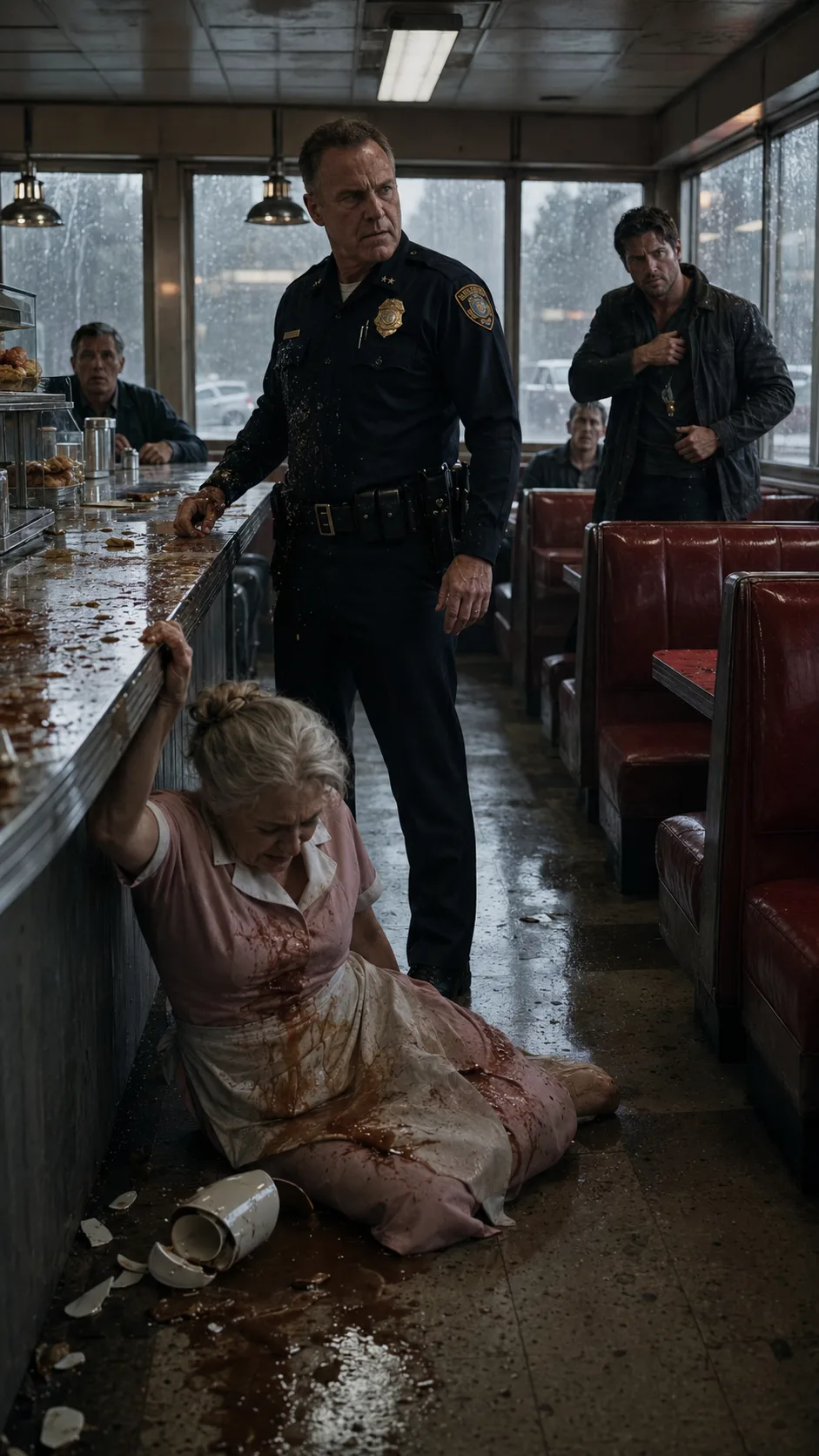
Evelyn Parker had learned one rule in forty years of waiting tables:
People didn’t come to Miller’s Diner for food.
Chapter 1
Evelyn Parker had learned one rule in forty years of waiting tables:
People didn’t come to Miller’s Diner for food.
They came to bury things.
They came after funerals, pretending they only wanted meatloaf and black coffee while they stared at the same untouched plate for an hour. They came after court hearings, after bankruptcies, after affairs, after fights that left wedding rings turned inward on tired fingers. They sat under the faded neon sign and spoke in low voices, believing the old booths swallowed secrets.
They were wrong.
Secrets didn’t disappear at Miller’s.
They seeped into the cracked red vinyl. They hid under sugar dispensers. They clung to the smell of frying oil and old coffee. Evelyn had carried them for decades, not because she wanted to, but because nobody noticed a waitress who refilled cups and kept her head down.
That was how she survived.
That was also how her husband died.
The rain came hard that Thursday afternoon, pressing against the diner windows until the whole town
outside looked smeared and gray. Water ran down the glass in crooked lines. The sign over the counter flickered every few seconds, buzzing like an insect trapped behind plastic.
Miller’s Diner was too quiet.
Usually, the place had noise. Forks against plates. Truckers laughing too loudly. Teenagers whispering over fries. Old men arguing about baseball as if the outcome mattered to God.
But that afternoon, every sound felt borrowed.
A spoon tapped a cup once, then stopped.
The radio above the pie case played an old country song so softly Evelyn could barely hear the words.
She wiped the counter slowly, even though it was already clean.
At sixty-eight, Evelyn moved with the careful patience of someone who had learned exactly how much pain her bones would allow. Her silver hair was pinned at the back of her neck. Her apron had a coffee stain near the pocket that no
amount of washing ever fully removed.
On the register sat a small framed photograph of her late husband, Harold Parker.
He was smiling in the picture, one hand lifted like he was halfway through telling a joke. Evelyn never moved it. Not even after people told her it might be healthier to put it away.
Harold had been dead six months.
Officially, his death was an accident.
A late-night drive. Wet pavement. A guardrail. A truck driver who claimed he saw nothing until the headlights vanished.
That was the story written in the report.
Evelyn knew reports could lie.
Harold had spent the last year of his life asking questions about Officer Daniel Cross. He asked about missing evidence. About old arrest records that didn’t match court files. About people who disappeared after filing complaints.
Then he came home one night with mud on his shoes and fear in his
eyes.
“I found something,” he told Evelyn.
He never told her everything. Not at once. Harold had always been careful that way. But he gave her a brown folder wrapped in plastic and said, “If anything happens to me, don’t take this to the station.”
Three days later, he was dead.
And Evelyn kept the folder.
She kept it through the funeral.
She kept it when Cross stood by Harold’s casket in his pressed uniform, head bowed, one hand resting respectfully over his belt.
She kept it when neighbors brought casseroles.
She kept it when the sheriff told her grief could make people suspicious.
She kept it when a patrol car began passing her little house every night at 2:13 a.m.
She kept it because Harold had asked her to.
That afternoon, booth seven was occupied by a man Evelyn had never seen before.
He had come in twenty minutes earlier, soaked from the rain but not in a hurry. Mid-thirties, dark jacket, rough hands, quiet eyes. He ordered eggs over easy, toast, and coffee. He paid cash before the food arrived.
People who paid before eating were either polite or planning to leave quickly.
Evelyn had noticed that too.
“More coffee?” she had asked him.
The man looked up, and for one second she saw something guarded behind his expression.
“No, ma’am. Thank you.”
Ma’am.
Not many men said that anymore.
His receipt said Jax Ryder, though Evelyn knew better than to trust the name on a credit slip. He sat with his back angled toward the wall, facing the entrance. He ate slowly but watched everything.
A man like that either had enemies or had been one.
Then the bell over the front door rang.
No one looked up at first.
Then the room changed.
Evelyn felt it before she saw him.
Trouble always had a temperature.
Officer Daniel Cross stepped inside and brought the cold with him.
He was a tall man with a clean-shaven face, polished boots, and a uniform that looked too neat for a rainy afternoon. His dark hair was combed back. Water gleamed on his shoulders. His badge caught the fluorescent light as he stood just inside the doorway and let the bell finish trembling above him.
He didn’t order.
He didn’t sit.
He just stood there like the diner had been waiting for him.
A man at the corner table lowered his newspaper.
The cook stopped moving behind the pass-through window.
Evelyn kept wiping the counter.
Cross walked toward her slowly. Not because he was calm. Because he wanted everyone to feel each step.
“You still digging where you shouldn’t,” he said.
His voice was calm, but there was a blade under it.
Evelyn didn’t look up.
“My husband is dead,” she replied. “He can’t dig anything anymore.”
A pause.
Across the diner, in booth seven, Jax Ryder stopped eating.
He didn’t look up yet.
But his hand slowly left his fork.
Cross leaned closer across the counter. Evelyn could smell rain on him, and something sharper. Peppermint gum. Leather. Power worn too comfortably.
“Dead doesn’t mean finished,” he said.
Evelyn finally met his eyes.
For forty years, she had seen men like Cross sit in booths with their lies folded neatly beside them. Men who thought uniforms, money, family names, or loud voices could make truth obedient.
Cross had all of those things except patience.
“My husband asked questions,” Evelyn said. “I only kept what he found.”
Cross smiled.
Not kindly.
“You should’ve burned those papers.”
The diner seemed to inhale.
Evelyn’s fingers tightened around the wet cloth in her hand.
“So you know they exist,” she said.
The smile left Cross’s face.
For one second, Evelyn saw the mistake land.
Then he moved.
Before anyone could react, Cross grabbed the mug of coffee from the counter.
Evelyn saw the motion.
Saw the steam.
Saw his wrist turn.
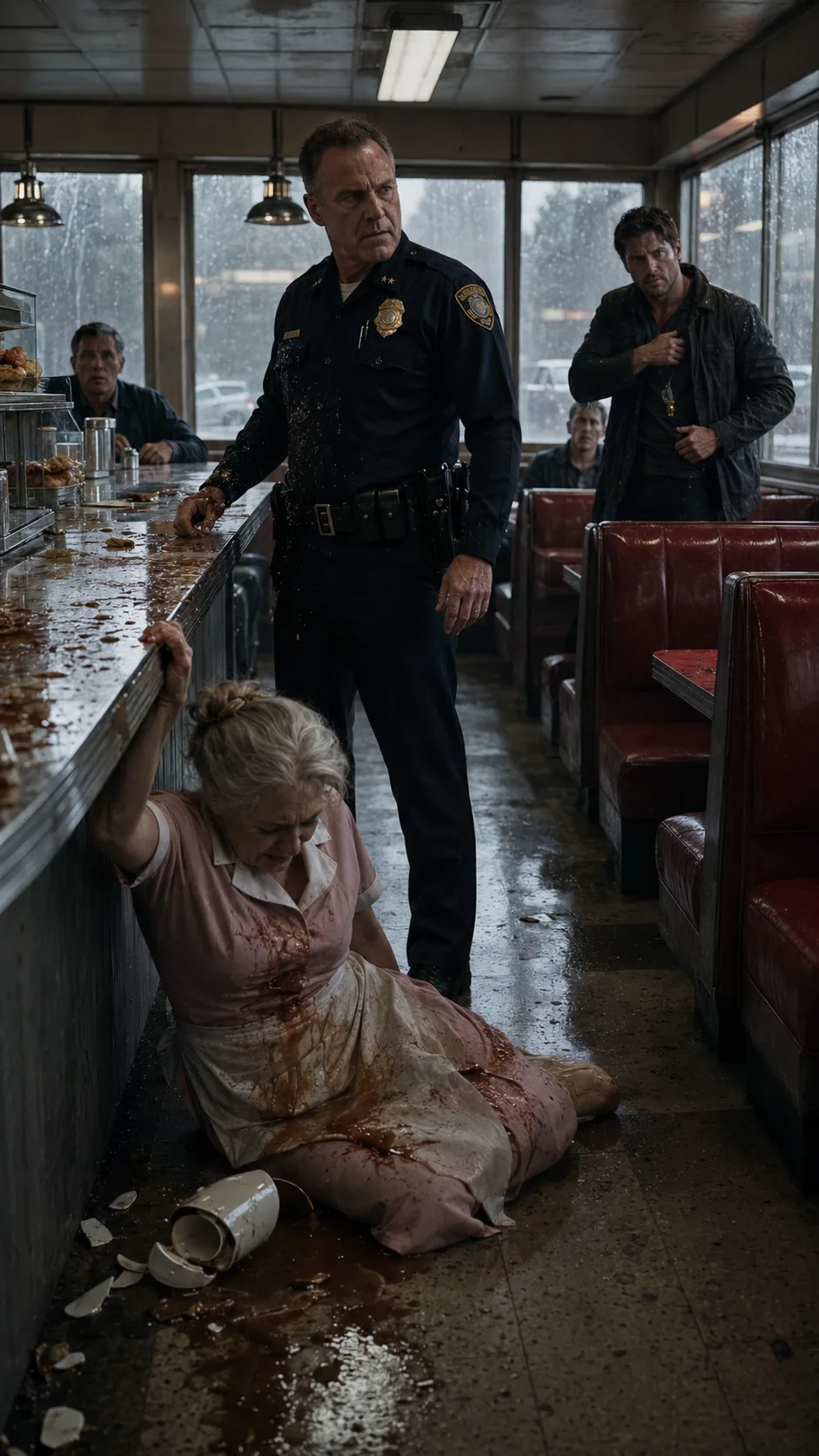
The coffee hit her face and chest in a scalding splash.
She gasped and stumbled backward. Her hip struck the lower cabinet. The rag fell from her hand. Then she went down hard behind the counter, one arm knocking against the shelf of clean cups.
A cup shattered.
The diner froze.
Forks stopped mid-air.
The old country song kept playing above the pie case.
Rain hammered the windows.
No one spoke.
Cross stood over the counter, breathing through his nose, his hand still curled as if the mug were still in it.
“Careful, Evelyn,” he said. “Accidents happen in wet weather.”
That was when booth seven moved.
The chair scraped back.
Not loudly.
Just enough.
Jax Ryder stood.
He was taller than Evelyn had realized. Broad-shouldered, still wet from the rain, his face unreadable except for a tightness along his jaw. He placed his napkin on the table with strange care.
Cross turned his head.
“Sit down,” Cross said.
Jax didn’t.
The cook, Reggie, appeared in the pass-through window holding a spatula like he had forgotten what it was for.
“Officer,” Reggie said, voice low. “You need to leave.”
Cross didn’t look at him.
His eyes stayed on Jax.
“I said sit down.”
Jax stepped out from the booth.
One step.
Then another.
He didn’t rush. He didn’t raise his voice. He walked like a man who had already decided how this ended and was only measuring the distance.
Evelyn pressed one hand to the side of her face and pushed herself up to one elbow. Pain burned across her skin, but she forced herself to breathe through it.
“Don’t,” she rasped.
Jax glanced at her.
It was quick. Almost nothing.
But his eyes changed.
Then he looked back at Cross.
“You threw coffee on a sixty-eight-year-old woman,” Jax said.
Cross gave a short laugh.
“She slipped.”
Nobody in the diner moved.
Not a soul believed him.
Cross knew it.
That made him more dangerous.
He placed one hand on his belt.
Not on his weapon.
Close enough.
Jax stopped walking.
The distance between them was six feet.
The diner’s fluorescent light flickered above them.
Cross tilted his head.
“You don’t know who you’re looking at.”
Jax’s gaze dropped briefly to the badge.
Then back to Cross’s face.
“I know exactly who I’m looking at.”
Something in the room shifted.
Cross heard it too.
His mouth tightened.
“And who are you supposed to be?”
Jax reached into his jacket.
Every person in the diner stiffened.
Cross’s hand snapped lower.
“Don’t.”
Jax froze with two fingers inside the coat pocket.
Then, slowly, he pulled out a black leather wallet.
He opened it.
Not toward Cross at first.
Toward the room.
A badge gleamed under the light.
A different badge.
Federal.
The silence became heavier than the rain.
Cross blinked once.
Jax turned the badge toward him.
“Special Agent Jaxon Ryder,” he said. “Internal Corruption Task Force.”
The cook whispered something that sounded like a prayer.
Cross’s face did not collapse.
Men like him practiced control too often for that.
But something small betrayed him.
His throat moved.
Jax put the badge away.
“I’ve been sitting here forty-three minutes,” he said. “Long enough to hear you threaten a witness. Long enough to watch you assault her. Long enough to record every word.”
Cross’s hand left his belt.
Evelyn closed her eyes for half a second.
Harold.
Cross recovered fast.
“You think this means anything?” he said. “You walked into my town and staged a little diner show. That’s all you have?”
Jax looked toward the corner of the ceiling.
The security camera above the pie case blinked red.
Cross followed his eyes and laughed.
“That thing hasn’t worked in years.”
Evelyn swallowed.
Then, despite the pain, she spoke.
“That one hasn’t.”
Cross turned.
Evelyn gripped the edge of the counter and slowly pulled herself to her feet. Her apron was wet. Her cheek was red. Her hands shook, but not from fear.
She pointed to the framed photograph of Harold beside the register.
Cross looked at it.
For the first time since he walked in, he seemed confused.
Evelyn reached behind the frame and pressed a tiny black button.
A soft beep sounded.
Jax’s mouth barely moved.
Cross stared at the photograph.
Evelyn’s voice was rough.
“Harold installed it after you came to our house.”
The color drained from Cross’s face in degrees.
Not all at once.
First his lips.
Then his cheeks.
Then the skin around his eyes.
Jax stepped closer.
“You came to her house?” he asked.
Cross said nothing.
Evelyn reached under the counter and opened the drawer where she kept extra order pads, pens, and aspirin. Beneath them was a small plastic bag. Inside was a flash drive taped to a folded note.
She placed it on the counter.
Cross looked at it like it was a snake.
“That’s not the folder,” he said.
“No,” Evelyn replied. “That’s the copy.”
The room went still again.
Cross stared at her.
Evelyn held his gaze.
“You thought Harold only trusted me because I was his wife,” she said. “He trusted me because I know where people hide things.”
Jax took the plastic bag from the counter with a napkin, careful not to touch the drive directly.
Cross suddenly smiled again, but this time it was thin.
“You have no idea what’s on that,” he said. “Neither did he.”
Evelyn reached into her apron pocket.
Her fingers closed around the folded paper Harold had left inside the brown folder.
For six months, she had read it every morning before opening the diner.
Names.
Dates.
Case numbers.
Payments.
And one line Harold had underlined three times.
If Cross feels cornered, he’ll mention the quarry.
Evelyn unfolded the paper.
“I know about the quarry,” she said.
Cross went perfectly still.
Jax turned to him.
There it was.
The thing beneath the thing.
The secret Miller’s Diner had been holding since before Evelyn’s hair went silver.
Twenty-two years earlier, a young mechanic named Luis Moreno had vanished after accusing Cross of planting evidence during a drug arrest. The official story said Luis skipped town. His mother came into Miller’s every Sunday for nine years and sat at booth three, ordering coffee she never drank.
Evelyn remembered her.
Everyone remembered her grief.
But nobody remembered Luis in public.
Not after Cross became untouchable.
Jax looked at Evelyn.
“What quarry?”
Cross moved fast.
He lunged for the plastic bag.
Jax caught his wrist before his fingers reached it.
The entire diner erupted.
A chair scraped backward. Someone shouted. Reggie came around the counter with the spatula still in his hand. The man with the newspaper stood but did not know where to go.
Cross twisted hard, trying to break free.
Jax pinned his wrist to the counter.
“Don’t make it worse,” Jax said.
Cross laughed through clenched teeth.
“You think you can take me in here? In front of these people?”
Jax leaned closer.
“I was hoping you’d ask that.”
The front door opened again.
This time, three people entered.
Two were federal agents in dark jackets.
The third was Sheriff Elaine Mercer.
Evelyn had known Elaine since she was a rookie with nervous hands and a braid down her back. Elaine had been Harold’s student once. She looked older now, her face marked by years of staying quiet in rooms where Cross spoke first.
Cross stared at her.
“Elaine,” he said.
She did not answer him.
One of the federal agents moved behind Cross and took his free arm.
Cross’s voice dropped.
“You don’t want to do this.”
Sheriff Mercer looked at Evelyn.
Then at the coffee on the floor.
Then at the flash drive in Jax’s hand.
“Yes,” she said. “I do.”
They cuffed Cross in front of the whole diner.
The sound was small.
Metal clicking once.
But to Evelyn, it felt louder than thunder.
Cross did not fight after that.
He only looked at Evelyn as if the room had betrayed him.
No.
Not the room.
The witness.
The waitress.
The old woman he thought would burn papers because he told her to.
As the agents led him toward the door, Cross stopped beside booth seven. His eyes moved from Jax to Evelyn.
“You think this ends with me?”
Evelyn picked up the wet rag from the floor.
Her hand still trembled.
But her voice did not.
“No,” she said. “I think it starts with you.”
The bell over the door rang as they took him out into the rain.
Nobody spoke for a long moment.
Then Reggie set the spatula down on the counter.
“Evelyn,” he said, “we need to get you to a doctor.”
She nodded once.
But she did not move yet.
Her eyes went to Harold’s photograph.
The tiny camera behind it looked like nothing. Just a shadow tucked under an old frame.
Harold had always been better at hiding things than people knew.
Jax came around the counter slowly.
“Mrs. Parker,” he said, “I’m sorry I didn’t step in sooner.”
Evelyn looked at him.
“You were listening.”
“Yes.”
“You needed him to say enough.”
Jax’s silence answered.
Evelyn gave a tired little nod.
“Harold would have hated that.”
“I know.”
“But he would have understood.”
Jax lowered his eyes briefly.
That was when Evelyn understood something else.
“You knew my husband,” she said.
Jax looked at the photograph.
“Not well. He contacted our office three weeks before he died. Sent a partial file. Said if anything happened, I should come here and sit in booth seven.”
Evelyn’s hand tightened around the edge of the counter.
Booth seven.
Harold’s favorite booth.
The one where he proposed to her after a double shift and a slice of cherry pie.
She looked toward it.
The plate of eggs sat cold and unfinished.
“What took you six months?” she asked.
Jax absorbed the question like he deserved it.
“The first file disappeared inside the bureau. Then the agent assigned to it retired early. Then Harold’s name got flagged as unreliable.”
“By Cross.”
“Yes.”
Evelyn laughed once, without humor.
“Dead and still inconvenient.”
Jax nodded.
“But your husband mailed one more thing. Not to the office. To me personally. It arrived two weeks ago.”
“What was it?”
“A photograph.”
Evelyn looked at Harold’s picture.
Jax reached into his inside pocket and pulled out a worn envelope. He opened it and removed a printed photograph, careful with the edges.
He set it on the counter.
Evelyn stared.
It showed Officer Cross standing near an old quarry road at night. Beside him were two men Evelyn recognized from city council campaign posters. Behind them, half-hidden by darkness, was a white pickup truck.
Harold had written on the back in blue ink:
Ask Evelyn about Luis’s mother.
Evelyn covered her mouth with one hand.
She remembered the woman. Rosa Moreno. Small, tired, always wearing a brown coat with one missing button. For nine years, Rosa came every Sunday.
Then one day, she stopped.
Evelyn thought she had moved away.
Jax spoke carefully.
“Mrs. Moreno died last year. Before she passed, she gave Harold a key.”
Evelyn’s eyes lifted.
“A key?”
“To a storage unit in Fairview.”
Evelyn looked down at her apron.
Her pocket felt suddenly heavy.
The folded paper had not been the only thing Harold left her.
Six months ago, after the funeral, Evelyn found a small brass key taped beneath the bottom drawer of Harold’s nightstand. No label. No note.
She had kept it on her key ring ever since because grief made people do strange things.
Slowly, she reached into her apron pocket and pulled out her keys.
There it was.
Small.
Brass.
Ordinary enough to be overlooked.
Jax stared at it.
Evelyn held it out.
“Fairview Storage?” she asked.
Jax nodded.
The sheriff stepped closer, rainwater still on her jacket.
“Evelyn,” Elaine said, “you don’t have to do anything else today.”
Evelyn looked at her.
For a second, she saw the young deputy Elaine used to be. The one who came into Miller’s after night shifts and asked Harold for advice. The one who used to believe good work could keep bad men small.
Then Evelyn looked at the door where Cross had disappeared.
“Yes,” Evelyn said. “I do.”
They drove to Fairview in two cars.
Evelyn rode with Sheriff Mercer, a cold towel pressed to her cheek. The rain softened to a thin mist, turning the road silver. Neither woman spoke for the first ten minutes.
Finally, Elaine said, “I should have listened to Harold sooner.”
Evelyn watched the passing trees.
“Yes.”
Elaine took the answer without flinching.
“He brought me pieces,” she said. “Nothing complete. Cross always had an explanation. Always had someone above him willing to sign off.”
“People like Cross don’t survive alone.”
“No.”
Evelyn turned the brass key in her palm.
“My husband knew that.”
Fairview Storage sat behind a tire shop, surrounded by chain-link fencing and weeds. The office was closed, but the manager had already been contacted. He met them at the gate under a yellow raincoat and kept glancing at the federal badges like he wished he had stayed home.
Unit 118 was near the back.
The metal door was rusted along the bottom.
Evelyn stood before it with the key in her hand.
Jax waited beside her.
“You don’t have to open it yourself,” he said.
Evelyn inserted the key.
“Yes,” she said. “I do.”
The lock turned.
The door rolled upward with a grinding sound that echoed across the wet pavement.
Inside were boxes.
Dozens of them.
Neatly stacked.
Labeled by year.
At the front sat a blue plastic bin with a strip of masking tape across the lid.
On it, Harold had written:
FOR EVELYN.
Her knees almost gave.
Jax reached out, but she lifted one hand.
Not yet.
She opened the bin.
Inside was Harold’s old tape recorder, three notebooks, several flash drives, and a sealed envelope with her name on it.
Evelyn took the envelope.
Her hands shook as she opened it.
The letter was short.
My Evie,
If you’re reading this, I failed to come home with the truth.
I’m sorry.
Cross is only the first door. Behind him are men who sold cases, buried bodies, stole homes, and used badges like keys. Rosa Moreno kept records after Luis disappeared. She gave them to me because she said waitresses remember who sits together.
She was right.
So were you.
I need you to trust the man in booth seven. I need you to trust Elaine if she finally finds her courage. And I need you to forgive me for leaving you with the weight of this.
You always said Miller’s Diner collects secrets.
Maybe now it can give them back.
I love you.
Harold.
Evelyn read it once.
Then again.
The rain tapped the storage roof above them.
Nobody rushed her.
When she lowered the letter, Jax had opened the first notebook. His face had gone hard.
Sheriff Mercer looked over his shoulder.
“What is it?” Evelyn asked.
Jax turned the notebook around.
Names.
Not one.
Not three.
Pages of them.
Police officers. Judges. Developers. Council members. A district attorney who had retired to Florida two years earlier. Case numbers lined up beside payment amounts. Addresses. Dates. Notes written in Rosa Moreno’s careful handwriting and Harold’s blocky script.
At the bottom of one page was a map.
The old quarry.
Evelyn looked at it, then at Jax.
“Luis is there,” she said.
Jax didn’t answer right away.
He didn’t have to.
Two days later, the quarry was sealed off.
By then, the story had spread past the town, past the county, past the state. News vans parked outside Miller’s Diner. Reporters stood under umbrellas and shouted questions through the window. Evelyn kept the blinds closed.
Cross had been charged first with assault, witness intimidation, evidence tampering, and obstruction. More charges followed after the storage unit was processed.
Then came the arrests.
One judge.
Two former deputies.
A city councilman.
A retired prosecutor.
A real estate developer who had built half the new subdivisions on land stolen through forged liens and coerced sales.
The town pretended to be shocked.
Evelyn wasn’t.
She had served coffee to most of them.
She remembered where they sat.
She remembered who paid cash.
She remembered who stopped talking when Harold walked in.
Three weeks after Cross was arrested, investigators confirmed human remains had been found near the old quarry access road. They could not release the identity immediately, but Evelyn knew before anyone said it aloud.
Rosa Moreno had waited nine years in booth three.
Now someone would finally say her son’s name in public.
The night before the official press conference, Evelyn reopened Miller’s Diner.
People thought she would retire.
Sell the place.
Leave town.
Instead, she came in at five in the morning, tied on a clean apron, and brewed the first pot of coffee herself.
By six-thirty, every booth was full.
No one knew what to say to her.
That was fine.
Evelyn had never needed people to know what to say.
Reggie moved quietly behind the grill. The bell over the door rang every few minutes. Rain had given way to a pale spring sun, and light slipped through the windows onto the counter where Harold’s photograph still sat.
The tiny camera had been removed by evidence technicians.
The frame remained.
At 7:12, Jax Ryder walked in.
This time, he wasn’t wet from rain.
He looked tired. Federal tired. The kind that came from paperwork, interviews, and knowing one arrest never cleaned a whole city.
He sat in booth seven.
Evelyn poured him coffee without asking.
“Eggs over easy?” she said.
“Yes, ma’am.”
She wrote it down.
Then she paused.
“Luis Moreno’s mother sat over there,” she said, nodding toward booth three.
Jax looked at the empty booth.
“I know.”
“Harold used to pay for her coffee after the third year.”
Jax looked back at her.
“She knew.”
Evelyn’s fingers tightened around the coffee pot.
“What?”
“She knew he paid. She told him once that if he ever stopped, she’d start tipping him.”
Evelyn laughed.
A small sound.
A real one.
Then the bell over the door rang again.
Sheriff Elaine Mercer entered without her hat, wearing plain clothes instead of uniform. Conversations quieted, but not with fear this time. With attention.
Elaine walked to the counter.
Evelyn stood across from her.
For years, there had been a wall between them built from things unsaid.
Elaine placed a folded paper on the counter.
“My resignation,” she said.
Evelyn looked at it.
Elaine continued, “Temporary. Until the state finishes the review. If they clear me, I’ll run for sheriff again properly. If they don’t, I won’t.”
Evelyn studied her face.
“And why are you showing me?”
“Because Harold deserved that kind of honesty. So do you.”
Evelyn looked at the paper for a long moment.
Then she slid a menu across the counter.
“Breakfast?”
Elaine blinked.
“That’s it?”
“That’s not forgiveness,” Evelyn said. “That’s breakfast.”
Elaine nodded once and sat at the counter.
It was enough for that morning.
Later, after the rush thinned and the sun rose higher, Evelyn stood alone by the register.
She picked up Harold’s photograph.
For six months, she had spoken to it every day in silence. She had asked him why he left her with fear, with papers, with a key she didn’t understand.
Now she had the answer.
He hadn’t left her with fear.
He had left her with proof.
A shadow fell across the counter.
Jax stood there, holding a file.
“We found something else in the storage unit,” he said.
Evelyn set the photograph down.
“What?”
Jax opened the file and removed a sealed envelope.
It was old. Yellowed at the edges. On the front was written:
MILLER’S DINER — ORIGINAL DEED
Evelyn frowned.
“The deed?”
Jax nodded.
“It was transferred thirty-one years ago from Samuel Miller to Harold Parker.”
Evelyn stared at him.
“That can’t be right. Harold and I bought the diner from Mr. Miller.”
“You paid him,” Jax said. “But according to this, he signed it over for one dollar.”
Evelyn shook her head.
“No. Harold would have told me.”
Jax hesitated.
“There’s a note attached.”
He handed it to her.
The handwriting was not Harold’s.
It belonged to Samuel Miller, the old owner who had died long before Cross became a name people feared.
Evelyn read the note.
Harold,
This place has always belonged to the people who listen when others are ignored. You and Evelyn are the only ones I trust to keep it that way.
Don’t let men with badges or money decide which stories matter.
Keep the coffee hot.
Sam.
Evelyn lowered herself onto the stool behind the counter.
For the first time in forty years, she understood the diner differently.
It had not been a business.
It had been a witness.
Harold knew.
Samuel knew.
Rosa knew.
Maybe everyone who came there carrying something too heavy had known, in some quiet way, that Miller’s was the one place in town where the forgotten did not vanish completely.
Jax closed the file.
“There will be trials,” he said. “A lot of them. They’ll come after your credibility. Harold’s too.”
Evelyn looked around the diner.
At booth seven.
At booth three.
At the cracked red vinyl.
At the counter where Cross thought pain would make her obedient.
Then she looked at Jax.
“Let them.”
That evening, after closing, Evelyn stayed behind alone.
She wiped every table. Refilled every napkin holder. Turned off the grill. Counted the drawer. Did all the things she had done for most of her life.
Then she walked to booth seven and sat down.
Harold had sat across from her there the night he proposed. He had been nervous enough to spill cream on his sleeve. She had laughed so hard the cook threatened to charge them rent for the booth.
Evelyn placed Harold’s photograph across from her.
“You were always dramatic,” she said.
The diner hummed quietly around her.
Outside, the pavement still shone from old rain. Cars passed now and then, their headlights sliding across the windows. The neon sign buzzed, flickered, then steadied.
Evelyn reached into her apron pocket and pulled out Harold’s letter.
She folded it carefully and placed it behind the photograph.
Tomorrow, reporters would come again.
Next week, lawyers would call.
Next month, the town would choose sides.
But tonight, Miller’s Diner was quiet.
Not empty.
Never empty.
It was full of every word finally ready to be spoken.
Evelyn stood, turned off the last light, and walked to the door.
Before leaving, she looked back once at the booths.
People didn’t come to Miller’s Diner for food.
They came to bury things.
But from that night on, Evelyn Parker made sure nothing stayed buried forever.
Chapter complete
You have reached the end of this chapter.
Continue reading
A few more worlds to get lost in after this chapter.




