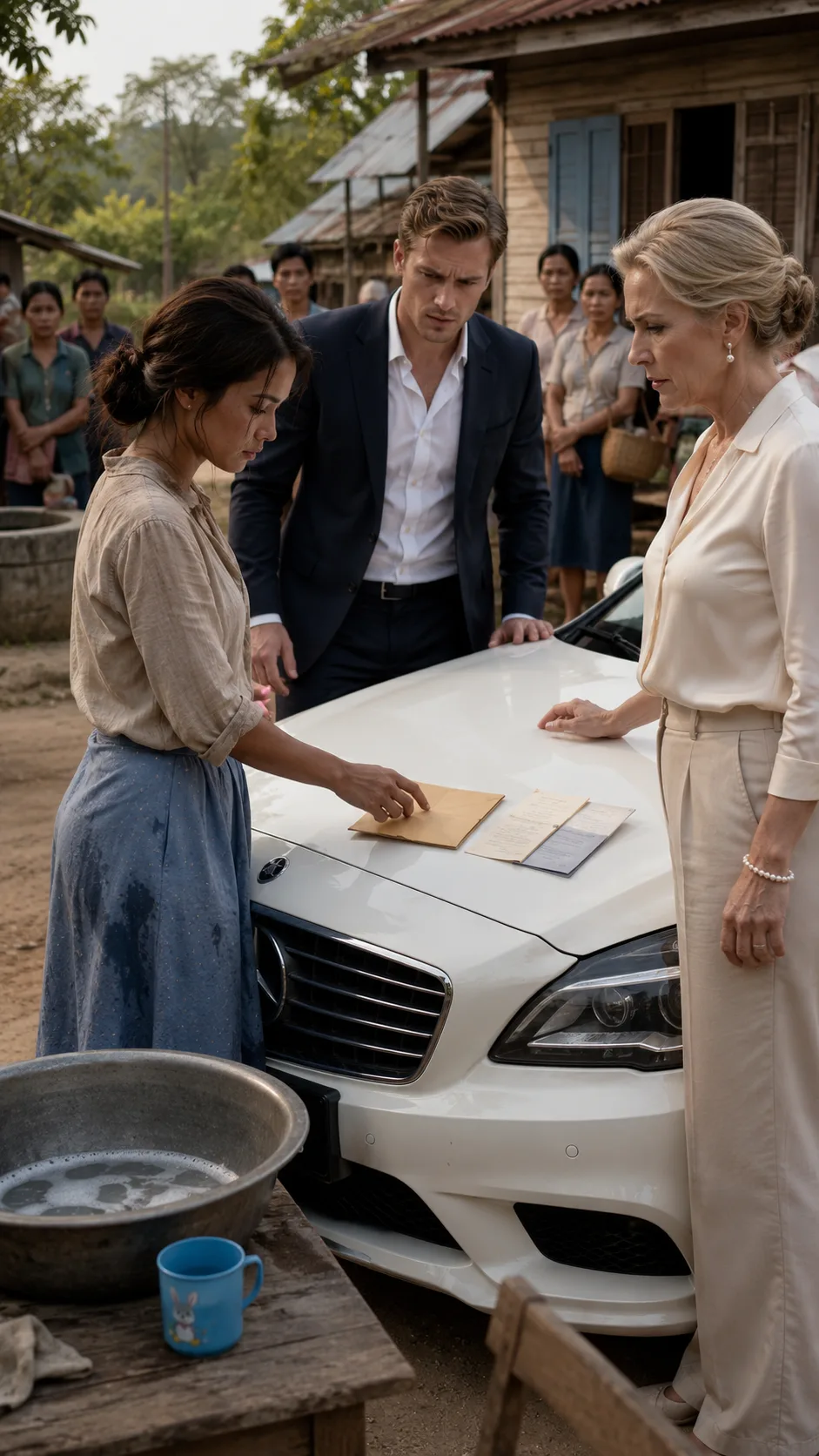
The metal basin hit the wooden table hard enough to make the chickens scatter.
Chapter 1
The metal basin hit the wooden table hard enough to make the chickens scatter.
Soapy water jumped over the rim and splashed across Mara Voss’s skirt, leaving dark patches on the faded cotton she had been wearing since dawn. One of the neighbor boys laughed until his grandmother slapped the back of his head with a folded newspaper.
Mara didn’t move.
Across the dirt road, beside a black luxury car too polished for their village, stood Adrian Vale.
Seven years had thinned his face in a way money could not fix. His suit looked expensive, but the cuffs were dusty now, and one sleeve had been pulled tight where his hand had closed around the fabric. He had always done that when trying not to say too much.
That was the first thing she noticed.
Not the car.
Not the driver standing beside it with both hands folded in front of him.
His sleeve.
Mara’s fingers stayed on the rim of the basin. The
water trembled around a cracked white bowl, two tin spoons, and a child’s blue cup with a rabbit painted on it. She had meant to wash everything before the afternoon heat turned the soap sour.
A fly landed on the wet table and walked in a crooked circle.
“Mara,” someone whispered behind her.
She heard sandals scrape the ground, baskets lower, doors open without anyone admitting they had opened them. The village was small enough that a cough at one end reached the other before sunset.
Adrian took one step forward.
Mara’s mouth moved before she had decided to speak.
“…it’s you.”
He looked at her the way people look at something that has been returned from a place no one survives. His eyes went from her face to her hands, then to the narrow house behind her with its blue shutters, patched roof, and laundry line tied between two
guava trees.
“I finally found you.”
The words did not land where he meant them to.
Mara wiped her wet hand down the side of her skirt. She did it once. Then again. She had always done that when she needed time, even as a girl, even before she knew some people could take your time and call it kindness.
“You came too late.”
The driver looked down at his shoes.
Adrian stopped in the middle of the road. A truck groaned somewhere beyond the bend, carrying cassava sacks toward the market, but it slowed when it reached the gathering crowd. Even the driver wanted to see.
“I looked everywhere,” Adrian said.
“Not here.”
“I didn’t know where here was.”
“You knew my mother’s name.”
“She was gone when I came.”
Mara’s throat worked once. Her mother had been gone for six years, buried under a stone that leaned after
every rainy season. She had died still angry, though not at Adrian. That had been the part Mara hated most.
Old anger was easier when it had one face.
A woman from the next house, Aunt Lidia, shifted the basket on her hip. She had come to borrow salt and had stayed for a resurrection.
Adrian’s gaze stayed on Mara.
“Why did you leave?”
A rooster crowed at the wrong time.
Someone muttered, “Lord.”
Mara almost laughed. It would have sounded ugly.
She had imagined this question too many times while sweeping, while nursing a feverish child, while counting coins beside the kerosene lamp. She had answered it in her head with shouting. With papers. With silence. Once, during a night when the rain leaked through three places in the roof, she had answered it by throwing his old postcard into the stove and then pulling it out before the corner fully burned.
Now he stood there in daylight, asking as if the road between them were only dirt.
“You came too late,” she said again.
Adrian’s jaw shifted. He looked younger for half a second, like the man who once stood barefoot in her mother’s kitchen because he had ruined his city shoes in the mud and refused to complain. Her mother had given him boiled peanuts in a chipped bowl. He had eaten every one.
That memory should have stayed dead.
Then a child’s voice cut through the road.
“Mom! Mom!”
Mara turned before anyone else did.
Theo came running from the school path with his satchel bouncing against one hip, one sock lower than the other, hair damp at his forehead from heat and play. He was six, nearly seven, though he argued about the nearly as if it were an insult.
He crashed into Mara’s side and wrapped both arms around her waist.
“I got the red mark,” he said into her skirt. “For reading. Teacher said I read the whole page.”
Mara placed one hand on the back of his head.
Only then did Theo notice the road.
The people.
The black car.
The man.
His small body went still under Mara’s palm.
Adrian’s face changed.
Not dramatically. Not like people in films. His mouth parted a little, then closed, and his hand stopped crushing the sleeve of his jacket. His eyes moved over Theo’s face in small pieces, as if the full picture would damage him.
Theo had Adrian’s eyes.
Everyone had said so without knowing who Adrian was. Aunt Lidia had called them “storm eyes” when he was a baby. The schoolteacher said they made him look serious even when he was stealing mango slices from her lunch tin.
Adrian looked from the boy to Mara.
“…is he…”
He could not finish.
Mara felt Theo’s fingers grip the cloth at her waist. She had washed that skirt so many times the seams had begun to twist.
The village waited.
Theo looked up at her.
“Mom?”
Mara bent slightly and touched his shoulder. “Go inside.”
“But—”
“Inside.”
He did not move.
Adrian took another step. Dust rose around his shoe.
“What’s his name?”
Mara kept her hand on Theo’s shoulder. “Don’t.”
“Mara.”
She had not heard him say her name in seven years. It used to soften at the end when he was tired. Now it came out scraped raw.
Aunt Lidia set her basket down.
Theo stared at Adrian with a child’s open suspicion. “I’m Theo.”
Adrian swallowed.
Mara felt it before she saw it. The shift in the crowd. The quick little intake from someone near the well. The knowledge passing from one person to another without needing a full sentence.
Same eyes.
Same mouth.
Same face.
Adrian looked like a man who had walked into a room and found his own childhood sitting there.
A second car arrived before anyone could speak again.
White.
Low.
Too clean.
Mara knew that kind of arrival. Wealth did not only enter a place; it arranged the air around itself and expected people to stand straighter.
The white car door opened.
Helena Vale stepped out.
She had not aged as much as Mara wanted her to. Her hair was silver now instead of pale gold, pinned neatly at the back of her head. Her cream blouse had no wrinkles. A pearl bracelet sat on her wrist like a small row of teeth.
Behind her came a man with a leather folder tucked under one arm.
A lawyer, Mara guessed.
Of course.
Helena took in the village first. The road. The cracked basins. The children barefoot near the ditch. She looked at Mara last, as if saving the worst for when she had proper time.
“Mara Voss.”
No surprise.
No apology.
Adrian turned toward his mother. “You knew?”
Helena’s eyes flicked to him. “Get in the car.”
The driver from the black car looked at the lawyer. The lawyer looked at nothing.
“I asked you a question,” Adrian said.
Aunt Lidia made the sign of the cross with two fingers and then pretended she had been scratching her collarbone.
Helena walked forward until her shoes reached the edge of the wet patch from Mara’s basin. She stopped just before the mud could touch her.
“This is not a conversation for the road.”
Mara almost smiled. The road had heard worse. Births, debts, proposals, accusations, drunken songs at midnight, a goat theft that had split two families for nine months. The road could handle Helena Vale.
Theo pressed closer.
Helena saw him then.
For one brief, ugly second, her composure slipped. Not much. Her eyes sharpened. Her fingers curled once around the handle of her handbag.
Then she put herself back together.
“Take the child inside,” she said.
Mara did not answer.
Adrian moved between them without seeming to realize he had done it. “Mother.”
Helena kept looking at Mara. “How much?”
The village inhaled.
Mara’s wet hand tightened on Theo’s shoulder.
Adrian’s head turned.
“What did you say?”
Helena opened her handbag. “Let us stop pretending. She has waited years for this scene. Fine. She has it. Ask for what you want, Miss Voss, but do not use the boy as theater.”
Theo whispered, “Mom?”
Mara crouched in front of him. She fixed the loose sock first. It was ridiculous. Everyone was watching, Adrian was standing there with his face broken open, Helena Vale had returned to the same road where she had ruined Mara’s life, and Mara was fixing a sock.
The heel had twisted under Theo’s foot.
She smoothed it.
“Go to Aunt Lidia,” she said.
Theo looked at Adrian again.
Then he went, slowly, to the older woman. Aunt Lidia put one hand on his satchel and the other on her basket, as if both might run.
Mara stood.
Her knees did not feel like hers.
“I don’t want your money.”
Helena gave a small breath through her nose. “That is not what you said seven years ago.”
Mara did not move.
Adrian looked at her. “What does that mean?”
Mara reached back toward the table, not for a weapon, not for anything dramatic. Her fingers found the edge of a dish towel. She folded it once, corner to corner. Then again.
She had done that with every paper she was afraid to read.
The lawyer shifted his folder from one hand to the other.
Helena noticed.
Good.
“You should leave,” Mara said.
“To protect your version?” Helena asked.
“To protect your son.”
That was the first time Helena looked wounded.
Only for a moment.
Adrian stared at his mother now. His whole body had gone still. He had inherited that from her, the ability to turn into marble when cornered.
The man with the folder cleared his throat. He seemed to regret it immediately.
Helena turned to him. “Mr. Calder, please prepare the statement.”
“The statement?” Adrian said.
Helena lifted her chin. “If this woman is claiming that child belongs to our family, she can say so properly in front of witnesses. Or she can sign that she has no claim. Either way, we end this today.”
A murmur moved through the villagers.
Mara looked at Theo. He had both hands wrapped around Aunt Lidia’s skirt, but he was watching everything. Children always watched the wrong parts. Not the insult. Not the threat. The small things. The way adults’ hands moved when they lied.
The lawyer opened his folder.
The fluorescent panel above the doorway of the tiny repair shop blinked once, even though it was daylight.
Mara saw it and hated herself for noticing.
Adrian stepped closer to the lawyer. “Put that away.”
Helena did not look at him. “You are emotional.”
“I have a son standing ten feet away.”
“You have an accusation standing ten feet away.”
The sentence hit the road harder than the basin had.
Aunt Lidia pulled Theo closer. The boy’s face had gone flat in the way children’s faces do when they know something adult and awful has entered their name.
Mara walked to him.
Not fast.
Not slow.
Just enough to place her body where Theo could see only the side of her skirt and the blue shutters behind her.
“Do not call him that.”
Helena’s smile came without warmth. “Then prove he is not being used.”
Adrian said, “Enough.”
“No.” Helena turned on him. “You do not get to appear here after years of searching like a tragic hero and forget why this family had to survive your father’s collapse, your grandfather’s debts, and every woman who thought loving you meant owning a piece of us.”
Adrian flinched at the word father.
Mara saw it. She had not known his father was dead until two years after the funeral, when a newspaper used to wrap dried fish carried a photograph of Vale Industries’ memorial scholarship ceremony. Adrian had been in the picture beside Helena, both dressed in black. Mara had pressed the paper flat on her kitchen table and stared until the fish smell made her sick.
Helena had done one kind thing once.
That was the part Mara still hated.
The day Mara first came to the Vale house, soaked from rain and too proud to say she was cold, Helena had sent a maid with a wool cardigan. “No guest freezes under my roof,” she had said from the far end of the room, not smiling, not welcoming, but not cruel either.
Mara kept that cardigan for three months after she left.
Then Theo was born and spit milk on it.
She cut it into cleaning cloths.
“Your family survived by erasing us,” Mara said.
Helena’s eyes narrowed.
Adrian looked at Mara. “Us.”
The word stayed there.
Theo shifted behind her. A chicken pecked at the wet ground near the table until someone hissed it away.
Mr. Calder removed two pages from the folder and placed them on the hood of the white car because there was no table clean enough for him, apparently. He uncapped a pen.
Mara stared at the pen.
Seven years earlier, Helena had used a fountain pen.
Black with a gold clip.
Mara remembered because the nib had scratched the paper when Helena signed the bank slip. She remembered the sound better than the amount written beside it. Money had a way of making noise before it touched your hand.
Fifty thousand dollars.
To disappear.
Mara had not taken it.
But Helena had signed anyway.
“Miss Voss,” Mr. Calder said, “this is a simple acknowledgment that no legal paternity claim is currently being pursued and that no financial demand will be made against Mr. Adrian Vale or the Vale estate.”
Adrian reached for the paper.
Helena stopped him with one look. “Let her read it.”
Mara did not move toward the car.
“I read slowly,” she said.
Helena’s mouth tightened. “Then take your time.”
That almost broke Mara.
Not because of the insult. Insults were small when you had lived through hunger and fever and a landlord who stood too close when asking for rent.
It was the tone.
The same polished patience Helena had used in the Vale drawing room when she told Mara that Adrian had chosen someone else. That he had accepted his future. That Mara could keep her dignity if she left before the engagement announcement.
Mara had believed the part about dignity.
She had been twenty-two.
A fool in a borrowed dress.
“Mom,” Theo called.
Mara looked at him.
He held up the red mark on his school paper. The paper had bent in his fist, but the mark was there, bright and crooked. He wanted her to see. He wanted the day to go back to being about reading.
Her mouth opened.
Nothing came out.
The road tilted slightly in the heat.
She walked into the house.
Behind her, people spoke at once. Adrian called her name, but she did not stop. Inside, the air smelled of soap, rice, and the medicinal oil she rubbed on Theo’s chest when his cough came back in winter. A single cup sat beside the sink. The shelf above it leaned to the left because the wall had never been straight.
Mara went to the bedroom and opened the wooden trunk under the cot.
Her hands knew where to go.
Under winter blankets.
Under a broken radio.
Under the blue cardigan pieces she had never thrown away, though they were only rags now.
The cream envelope was flat from years of being hidden.
She held it.
Then she sat on the edge of the cot because her legs had stopped agreeing with her.
No one saw that part.
She pressed the envelope to her knees and counted the cracks in the floorboards. One near the door. One under Theo’s toy truck. One shaped like a crooked river beside her left foot.
Five cracks.
She counted them twice.
Then she stood and went back outside.
Adrian was arguing with his mother now. Quietly, which was worse. Helena was speaking with her head turned slightly away from the crowd, as if privacy could still be manufactured by posture.
Mara stepped into the sunlight.
Mr. Calder saw the envelope first.
Lawyers notice paper the way priests notice candles.
Helena followed his gaze.
For the first time, she looked afraid.
Not much.
Enough.
Mara held the envelope at her side. “Where do you want me to sign?”
Adrian turned. “Mara, don’t.”
She looked at him then. Really looked.
He had been searching, he said. Maybe he had. Maybe he had hired people and made calls and followed old addresses until they went cold. Maybe he had stood in places she had once lived and felt punished by every closed door.
But Theo had learned to walk holding the leg of a table Adrian never bought.
Theo had asked why other children had fathers at the school picnic.
Theo had once drawn a man with no face and said, “That’s mine because I don’t know.”
Searching did not undo that.
Mara walked to the hood of the white car.
The paper waited there, held down by Mr. Calder’s leather folder so the breeze would not take it. The pen lay beside it, black plastic, cheap compared with the one Helena had used before.
Mara picked it up.
The crowd leaned without meaning to.
Helena’s voice lowered. “Be careful.”
Mara looked at the document.
The words blurred, not because she was crying. She was not. Her eyes had dried somewhere between the trunk and the road.
“No financial demand,” she read.
Mr. Calder nodded. “Correct.”
“No claim.”
“It states no current legal action.”
Helena cut in. “And no public statement from you after today.”
Adrian looked at his mother. “That isn’t in there.”
“It will be.”
Mr. Calder hesitated.
Helena’s face hardened. “Add it.”
The lawyer did not move fast enough.
Helena took the pen from Mara’s hand and wrote along the bottom margin herself, pressing so hard the paper dented under the nib.
Mara watched her.
The same hand.
Older.
Same pressure.
Same arrogance about paper.
Helena capped the pen and pushed it back. “There. Now sign.”
Mr. Calder’s mouth opened. Then closed.
Adrian said, “You can’t just—”
“I can protect my family.”
“You mean yourself.”
Helena ignored him. She turned toward the villagers, toward the open doors, the watching faces, the children half-hidden behind adults.
“Let everyone hear me clearly,” she said. “This woman left with money from my family. She hid for years. Now that Adrian has found her, she wants a name, a fortune, and sympathy.”
The road did not move.
No one came to Mara’s side.
That was not cruelty. That was how poor people survived powerful people: by making their bodies small until danger chose someone else.
Helena pointed at the document.
“Sign it.”
Mara placed the old cream envelope on the hood of the car.
The paper made almost no sound.
Still, everyone heard it.
A dull, dry tap against polished metal.
She did not open it right away.
Helena stared.
Adrian stared.
Theo tried to move forward, but Aunt Lidia held him by the strap of his satchel.
Mara slid one finger under the flap. The glue had died years ago. Inside were two things: a bank transfer slip and a folded letter on Vale stationery.
The letter still smelled faintly of dust and old perfume.
Mara placed both beside Helena’s altered statement.
Then she stepped back.
Helena’s voice came out thin. “What is this?”
Mara looked at Adrian, then at Mr. Calder, then at the villagers who had learned not to expect justice unless it arrived by accident.
“Read your signature.”
No one spoke.
Mr. Calder reached for the transfer slip before Helena could stop him. His eyes moved across the page. Once. Then again.
Adrian leaned over his shoulder.
The lawyer’s face changed first.
Not fear.
Recognition.
Professional dread.
“Mrs. Vale,” he said.
Helena did not answer.
Adrian took the paper from him. His fingers touched the corner as if it might burn. He read the date.
Seven years ago.
Three weeks before Theo was born.
The amount.
Fifty thousand dollars.
Recipient: Mara Voss.
Status: rejected.
Reason: beneficiary refused.
Below that, in black ink, was Helena’s signature.
Adrian lifted the folded letter next.
Mara did not stop him.
He opened it.
The letter had only twelve lines. Mara knew because she had counted them many times when anger needed a shape.
Adrian read in silence.
His face emptied by degrees.
Helena reached for it.
He moved it out of her reach.
“Adrian,” she said.
He read the last line again. Mara saw his lips shape the words without sound.
Leave before he knows.
A baby deserves a clean name.
The breeze shifted the top page of Helena’s fresh statement. Mr. Calder put one hand over it before it slid away.
Aunt Lidia muttered something under her breath. This time she did not pretend it was anything else.
Adrian looked at his mother.
“You told me she left for money.”
Helena’s throat moved. “She was dangerous to your future.”
“She refused it.”
“She would have come back.”
“You made sure I never got her letters.”
Mara looked at him then.
Adrian turned to her, and the answer was already in his face.
He had not received them.
Not the one she sent after Helena’s visit.
Not the one from the clinic.
Not the one with Theo’s birth date written three times because her hand would not stop shaking.
The road became too bright.
Mara picked up Theo’s blue cup from the basin and held it because her hand needed something ordinary.
Mr. Calder straightened. “Mr. Vale, this document appears to contradict prior statements made to you and to the family office.”
Helena snapped, “You work for me.”
“I work for the estate.”
That sentence did what shouting could not.
Helena stepped back half a pace.
Her heel sank slightly into the wet dirt near the basin water.
She looked down at it as if the earth had insulted her.
Adrian held the letter in one hand and the transfer slip in the other.
“Did you know about the child?”
Helena said nothing.
Mara looked at Theo. His eyes were fixed on Adrian now, not with trust, not with fear, but with a child’s terrible need to understand why adults keep breaking the floor under him.
“Answer me,” Adrian said.
Helena’s mouth tightened. “I knew there was a possibility.”
Mara let out a breath.
One sound.
Not victory.
Not relief.
Something smaller.
Theo pulled free from Aunt Lidia and came to her side again. This time Mara did not send him away.
Adrian knelt in the dirt before anyone expected him to.
His trousers darkened at the knees.
Helena made a small sound, almost disgusted, almost wounded.
Adrian held out the red-marked school paper Theo had dropped without noticing. He must have picked it up from the ground. The page was dusty along one edge.
“You read the whole page?” he asked.
Theo looked at Mara first.
She nodded once.
Theo took the paper from him but did not step closer. “Teacher said I skipped only one word.”
“What word?”
“Harbor.”
Adrian’s face did something painful. “That is a hard word.”
Theo studied him. “Are you my dad?”
The village heard it.
The question did not belong to adults anymore.
Mara wanted to cover his ears after the words had already left. Wanted to pull him inside and make rice and wash the blue cup and tell him the world was small enough to understand.
Adrian looked at her.
He did not ask permission with words.
Mara hated that she understood.
She looked at Theo. “He is.”
Theo’s mouth opened slightly.
Then he looked at Adrian’s eyes, and some private child logic made more sense than any paper on the car hood.
“Oh,” he said.
That was all.
Oh.
Aunt Lidia wiped her nose with the back of her wrist and turned away like she had seen something rude.
Helena stood beside the white car with mud on one heel, a lawyer no longer obeying her, and a son kneeling in the road before a child she had tried to turn into a rumor.
She looked smaller.
Not sorry.
Smaller.
Adrian stood after a while. He kept the papers in his hand.
“I want the family office notified,” he told Mr. Calder. “No decisions involving my mother until the board reviews this.”
Helena laughed once. It broke in the middle. “You would humiliate me over this?”
Mara almost spoke.
Adrian answered first.
“You did it in public.”
Mr. Calder closed his folder. “I’ll make the calls.”
He walked away toward the white car, then stopped to move a small lizard off the tire with the edge of his shoe. The lizard ran under the repair shop.
No one mentioned it.
Adrian turned to Mara. “I don’t know how to fix seven years.”
“You don’t.”
The answer came too fast.
His eyes lowered.
Mara wished she had said it differently. Then she did not.
Theo tugged her skirt. “Can I keep the red mark?”
She looked down. “Of course.”
“It got dirty.”
“We can still keep it.”
Adrian folded the letter carefully along its old creases. He was not good at it. The paper resisted where Mara had folded it too many times.
Mara held out her hand.
He gave it back.
Not because she owned the pain more.
Because she had carried it longer.
Helena moved toward the car. No apology came. Not to Mara. Not to Theo. Not even to Adrian. She paused with one hand on the door and looked at the village as if memorizing witnesses she planned to hate later.
Then she got in.
The white car reversed first. It had to go slowly because three goats had wandered into the road.
The black car stayed.
Adrian did not ask to come inside. That mattered.
He stood near the basin while Mara lifted it from the table and poured the dirty water beside the guava tree. Soap ran into the dust and disappeared fast.
Theo watched Adrian watch the water.
“Do you have a house?” Theo asked.
Adrian blinked. “Yes.”
“Does it have chickens?”
“No.”
Theo considered this with visible disappointment.
Mara picked up the blue cup and rinsed it again though it was already clean.
Adrian looked at her hands. “I can stay in the village tonight.”
“There’s no hotel.”
“I saw a guest room sign near the market.”
“That room has a rooster under the window.”
“I can manage a rooster.”
Theo said, “It screams at four.”
Adrian nodded, serious. “Then I’ll be warned.”
Aunt Lidia snorted despite herself.
Mara did not smile. Not fully.
The road began to loosen around them. People remembered baskets, errands, soup left on stoves, clothes not yet taken from lines. A few looked at Mara differently now, which was another burden. Pity and respect were both heavy when offered too late.
Adrian took one step closer, then stopped.
“Mara.”
She looked at him.
“I did look.”
“I know.”
She did not know, not completely, but the papers had made room for the possibility.
He swallowed. “May I come tomorrow?”
Theo looked up at her before Adrian finished asking.
There it was.
The cost.
Not Helena. Not the village. Not the years.
The small face waiting for Mara to decide whether hope was allowed.
She folded the damp dish towel over the edge of the table. Corner to corner. Then she stopped and left it crooked.
“Tomorrow,” she said.
Adrian nodded.
Theo held his red-marked paper flat against his chest.
The black car eventually turned around near the well and drove back the way it had come, slower than it arrived. Dust rose behind it and settled on the same road, the same cracked table, the same basin now empty in Mara’s hands.
That evening, Mara put Theo’s school paper on the shelf above the sink.
The red mark had smeared.
She left it there anyway.
Chapter complete
You have reached the end of this chapter.
Continue reading
A few more worlds to get lost in after this chapter.




