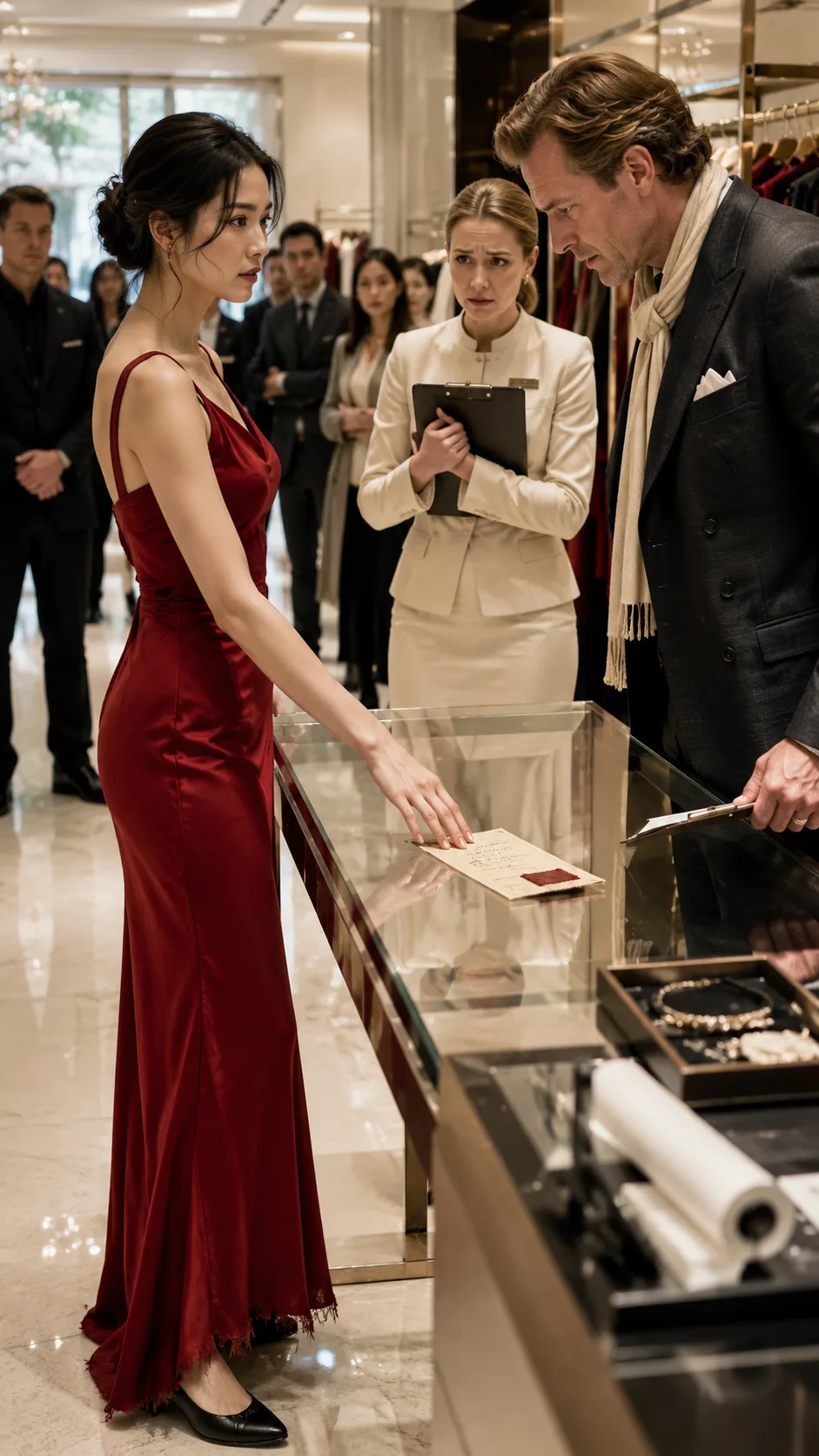
The red dress stood behind glass like it had been waiting for someone to breathe near it.
Chapter 1
The red dress stood behind glass like it had been waiting for someone to breathe near it.
Lina Park noticed the hem first. Not the price tag, which was turned toward the marble floor like a secret. Not the gold plaque under the mannequin. Not the woman behind the counter who looked up once and then looked back down, already finished with Lina before Lina had taken three steps inside. The hem. One stitch near the left side sat slightly higher than the rest, not enough for a customer to notice, but enough for someone who had grown up watching fabric become memory under a sewing lamp. Her mother used to fix uneven hems by holding the cloth between two fingers and humming through the pins in her mouth. Lina stopped in front of the dress. It was red silk. Not bright red. Deeper. The color of a cherry left too long in wine. The bodice was cut with restraint, the waist shaped by invisible seams, the
skirt falling in a way that made the mannequin look almost alive. A dress like that did not beg for attention. It expected the room to give it. She put one hand inside the pocket of her plain beige coat. Her thumb found the folded corner of the envelope she had carried for six months. Then she reached out. A hand struck the back of hers before her fingers touched the glass. “Don’t touch that.” The saleswoman stood close enough for Lina to smell her perfume, a clean expensive scent with something bitter under it. Her name tag read Marissa Lane. Her suit was ivory, the kind of ivory that made poor people nervous around coffee. “Dresses like this are not made for people like you.” Lina lowered her hand. That was all. A couple near the perfume display turned. The man pretended to study a bottle. His wife did
not pretend as well. Near the entrance, the security guard paused with one hand on his radio and the other holding half a granola bar. Lina looked down at her coat sleeve. A loose thread had come out near the cuff. She wound it once around her finger, then let it go. “I wasn’t going to damage it,” she said. Marissa smiled without letting it reach her eyes. “Of course you weren’t.” The words carried farther than they needed to. Two teenage girls near a rack of evening bags stopped whispering. A small silver bell above the entrance shook once as another customer came in, then kept moving for no reason. Lina stepped back. She had told herself the boutique would not feel familiar. Maison Aurum had been renovated twice since her mother worked there. The black awning was new. The marble floor was new. Even the air felt expensive,
chilled and filtered, nothing like the rented basement studio where her mother used to work until midnight with a bowl of rice gone cold beside the machine. But the red dress was not new. Not really. Lina had seen the first sketch folded into a biscuit tin under her mother’s bed, drawn on paper so thin the pencil had nearly cut through. The dress had been called No. 17 back then. Her mother had written one line beneath it in Korean, then crossed it out. For my daughter, when she stops apologizing. Lina had not stopped. The envelope in her pocket made a small sound when she shifted her weight. Marissa heard it. Her eyes moved to Lina’s coat. “Are you waiting for someone?” “No.” “Then I’m afraid browsing here is by appointment.” There were four customers browsing without anyone checking a calendar. A woman in a camel coat had a dog inside a leather carrier. The dog sneezed. No one asked if the dog had an appointment. Lina nodded once. She turned toward the door, already doing the thing she had done since childhood: folding herself smaller so other people would not feel cruel for pushing. “Wait.” The voice came from behind her, not loud, but the boutique reacted to it. Marissa straightened. A man stood near the central display table, one hand resting on the back of a velvet chair. He was in his early fifties, tall without showing off about it, with silver at the sides of his dark hair and a coat that looked simple until you noticed how perfectly it fit. His eyes were not kind. That was the first thing Lina noticed. They were careful. “I want you to try on this dress,” he said. Lina looked at him. “Why?” He gave a slight smirk, though it had no warmth in it. “Our model isn’t here today to advertise the dress. You try it on. I’ll even pay you for it. Don’t be afraid.” Marissa laughed once. Too fast. “Mr. Vale, that won’t be necessary. We can call Anya. She’s only—” “She’s late.” “Yes, but this young woman is not fitted for couture.” The man did not look away from Lina. “What size?” Lina’s mouth moved before she decided to answer. “Two.” Marissa’s face changed by one inch. Mr. Vale noticed. “Then the dress should fit.” “It is a heritage piece,” Marissa said. “The fabric is delicate.” “So are reputations.” The boutique went quiet enough for the sound system to become noticeable. Some slow piano track played through hidden speakers. One note repeated with a soft defect, almost a tick. Lina should have left. Her bus pass was in the side pocket of her tote. Her second job started at five. The tailor on Mercer Street would complain if she came in with red silk lint on her sweater, and Mr. Alvarez did not complain often, which made it worse when he did. She owed rent in nine days. She had thirty-seven dollars in her checking account, unless the pharmacy charge had gone through. She should have said no. Instead she looked at the dress again. The left hem still sat slightly high. “I don’t need payment,” she said. Mr. Vale’s eyebrow lifted. Marissa’s smile hardened. “How generous.” Lina untied her coat belt. Her fingers did not shake. That annoyed her, because they should have. She hung the coat over her arm and stood there in a washed gray sweater, black skirt, cheap flats polished so often the toes had gone dull. A girl near the bags whispered, “She’s actually pretty.” Her friend pressed two fingers against her mouth. Marissa removed the dress from the mannequin with the care of a priest handling something holy. She did not hand it to Lina at first. She held it in the air, waiting for Lina to understand the weight of the permission. Lina took it. The silk was cold. Her thumb found the side seam without meaning to. French seam. Hand-finished. Almost invisible. Almost. The fitting room smelled like cedar blocks and steamed fabric. Lina closed the curtain and stood with the dress over her arm. There was a three-way mirror, a velvet stool, a brass hook shaped like a branch. Someone had left a pin on the floor. She picked it up and pushed it into the cushion before taking off her sweater. That was habit. Her mother used to say loose pins were how fabric remembered carelessness. Lina slid into the dress. For a second it would not move past her ribs. She stopped. Breathed once. Then she found the inner fastening, the one hidden beneath the left panel, exactly where her mother always placed them because she hated visible hooks. The zipper moved. Outside, Marissa was talking. “Mr. Vale, we need to be careful. Social campaigns require brand alignment.” “She is wearing a dress,” he said. “She is representing a house.” “She hasn’t stepped out yet.” “She shouldn’t have stepped in.” Lina looked at herself. The dress fit. Not almost. Not close enough for photographs. It fit as if it had been waiting with her measurements written into it years before her body knew them. The waist held without squeezing. The shoulders sat flat. The skirt brushed her calves and moved when she moved, not behind her, but with her. She touched the seam near her heart. Under the lining, something small had been stitched into the inner facing. A flat square of fabric, sealed beneath a transparent panel. Lina leaned closer. Her mother’s initials were there. E.P. Eun Park. The air in the fitting room did not change. The lights stayed bright. Somewhere outside, the dog sneezed again. Lina sat on the velvet stool. One second. Then she stood. She stepped out. The boutique stopped pretending not to look. The woman with the dog lowered the carrier. The teenage girls stood with their phones at waist level but did not lift them. The security guard forgot the granola bar in his hand. Even Marissa lost the first shape of her mouth before she put it back. Mr. Vale’s expression changed the least. That made Lina look at him harder. The dress did what great clothing does when the body inside it stops apologizing. It did not make Lina beautiful. It made the room admit she had been beautiful before anyone gave her permission. Marissa crossed her arms. “It needs alterations,” she said. No one answered. A clerk at the register knocked over a roll of receipt paper. It bounced once and uncurled across the counter. She grabbed it and pretended she had meant to. Mr. Vale walked a slow circle around Lina, professional enough to be respectful and observant enough to make Marissa nervous. “What is your name?” he asked. “Lina Park.” Marissa’s eyes moved. There. Lina saw it. Just a flicker, but it was enough. Marissa knew the name. Maybe not Lina. Maybe not the daughter. But Park had landed somewhere it should not have landed. Mr. Vale turned toward the saleswoman. “And you said she was not fitted for couture.” “I said the brand must be protected.” “From whom?” Marissa’s chin lifted. “From opportunists.” The word found Lina’s cheek more cleanly than the slap to her hand had. Mr. Vale looked at Lina again. “Do you sew?” Lina did not answer right away. The old version of her would have said a little. She would have made herself harmless. She would have given people the smallest version of the truth so they would not feel challenged by the full one. “My mother did,” she said. “What was her name?” Marissa moved before Lina could answer. “This is becoming inappropriate. The launch preview begins in twenty minutes. Mr. Calder is arriving with press, and I will not have this turned into some street-casting experiment.” Mr. Vale smiled. Now there was warmth, but not kindness. “Good. Then we have witnesses.” Marissa stepped closer to him and lowered her voice. Lina still heard every word. “She came in here dressed like that. She reached for a protected piece. If anything happens to the dress, the liability is on the store.” “Then write it down.” Marissa blinked. “Excuse me?” “Write down your concern. Have her sign whatever form you use. If you are certain she is a risk, protect the store.” The trap was so neat Lina almost missed it. Marissa did not. Not fully. Her eyes narrowed, then moved toward Lina. She saw a poor girl in a borrowed dress, a boutique full of customers, a wealthy investor watching, and a chance to make the humiliation official. “I think that would be wise,” Marissa said. Lina’s thumbnail pressed into her palm. A crescent mark appeared. The clerk brought over a clipboard. Her hand hovered near the paper as if she wanted to apologize for carrying it. She had a tiny bandage around one finger with blue cartoon stars on it. Marissa took the pen and wrote across the top of the form. TEMPORARY MODEL LIABILITY ACKNOWLEDGMENT. Then, beneath it, in sharper strokes: Subject has no affiliation with Maison Aurum, the designer archive, or any authorized campaign. She turned the clipboard toward Lina. “Sign here.” Mr. Vale said nothing. The customers watched. The red dress held Lina upright in a way her own spine had not been managing. She looked at the sentence again. No affiliation. Her mother had died with the first royalty check still unpaid. Her sketches had been archived under another woman’s name. Lina had spent two years writing emails to accounts that stopped replying once she attached documents. She had stood outside this boutique once at nineteen and watched a window display of her mother’s work under a name that did not belong to it. No affiliation. Lina took the pen. Marissa’s mouth curved. Lina signed. Not her full legal signature. Just Lina Park, the way she signed delivery slips and rent checks and birthday cards she could not afford to mail on time. Marissa pulled the clipboard back. “There. Now we all understand.” The silver bell above the door rang again. A man entered with three people behind him. He was older than Marissa, younger than Mr. Vale, with a tan that looked maintained rather than earned. His scarf was tied too carefully. Behind him came a photographer, a young assistant carrying garment bags, and a woman in black who was already recording voice notes into her phone. “Julian,” the man said. “You started without me.” Mr. Vale did not move. “Victor.” Victor Calder kissed the air near Marissa’s cheek. “Where is Anya?” “Delayed,” Marissa said. “But we have it under control.” Victor’s gaze landed on Lina. For a moment, he saw the dress before he saw the person. His face opened with satisfaction. Then his eyes reached Lina’s face, and something tightened. “Who is this?” Marissa answered before Lina could. “A temporary model. Not affiliated. I had her sign.” Victor looked at the clipboard. “You had her sign what?” “A liability acknowledgment.” “Why?” “Because she walked in off the street and attempted to touch the archive piece.” Victor’s eyes moved to Lina’s cheap flats beneath the red silk. His relief returned. He smiled at the room, at the customers, at the woman recording voice notes. “Then it is settled. We appreciate your help, Miss Park. After a few photographs, you may return the dress and collect a courtesy fee.”
The woman with the dog shifted. The dog made a small tired sound. Lina did not move. Victor turned to Mr. Vale. “We should begin. Press will want the founder story.” “The founder story,” Mr. Vale said. Victor’s smile stayed. “Our creative rebirth,” he said. “A forgotten sketch from the original Aurum archives, restored under my direction. This dress represents the soul of the house.” Lina looked down at the bodice. Her mother’s initials sat against her skin beneath the lining. Mr. Vale’s eyes found Lina’s pocket, or maybe he only noticed the way her hand moved toward it. The beige coat hung over a chair nearby. Inside it was the envelope. Not yet. Marissa clapped once. “Everyone, we’ll arrange the first shot by the mirror. Miss Park, stand there. Shoulders back. Chin up.” Lina did not move. Marissa’s smile thinned. “Do you need instruction?” “No.” “Then follow it.” The old Lina would have obeyed automatically. Her body nearly did. One foot shifted. The photographer raised his camera. Mr. Vale said, “Let her stand where she wants.” Victor gave a small laugh. “Julian, it’s a campaign preview, not a therapy session.” Nobody laughed with him, but nobody challenged him either. That was how rooms protected powerful men. They left empty space around his cruelty and called it professionalism. Lina walked to the mirror because she wanted to see the back of the dress, not because Marissa told her to. In the glass, she saw the entire boutique behind her: Victor near the table, Marissa with the clipboard, Mr. Vale with his hands folded over the top of his cane, the customers trying to decide whether this was entertainment or danger. The fluorescent panel above the service hallway flickered once. Marissa noticed Lina looking at the side seam. “Please don’t pull at it.” Lina let her hand fall. Victor stepped closer. “Miss Park, was it?” “Yes.” “Beautiful fit. Lucky accident.” The word accident did something strange to her. She almost smiled. “My mother didn’t believe in those.” Victor’s expression tightened again. Marissa looked between them. “Your mother?” Lina’s answer came out too plain to sound dramatic. “Eun Park.” The photographer lowered his camera. Victor’s hand paused near his scarf. There it was again, that tiny slip. Recognition. Not guilt yet. Guilt required respect. Marissa recovered first. “I’m sorry for your loss, if she is deceased, but we are not discussing personal history during a preview.” “She made this dress,” Lina said. The boutique went still in pieces. First the clerk. Then the teenage girls. Then the woman in black stopped her voice note and looked up. Victor’s laugh came late. “No, she did not.” Lina looked at him. He had kind eyes when he wanted them. She remembered that from a magazine clipping her mother had saved, then torn in half. Victor Calder, rising creative director, photographed beside a rack of garments made by workers whose names were never printed. “My mother made the first version,” Lina said. Victor’s voice became gentle in the way knives can be polished. “Many seamstresses contribute to a house. That does not make them designers.” Marissa nodded with relief. “Exactly.” Lina’s face warmed. Not from shame this time. The envelope waited in her coat. She turned toward the fitting room. “I need a minute.” Marissa stepped into her path. “You are not taking that dress out of sight.” “I’m going behind a curtain.” “Not alone.” Mr. Vale’s cane tapped the marble once. Marissa looked at him. He did not raise his voice. “Give her the minute.” The curtain closed behind Lina. Inside the fitting room, she put one hand flat against the mirror. It left a print. Her breathing sounded too loud. She counted the brass nailheads around the mirror frame. Twelve on the left side. Twelve on the right. One at the top sat crooked. Her phone was in her tote, under a lint roller, a pack of gum, and the pharmacy receipt she kept forgetting to throw away. She pulled it out, unlocked it, and opened the message thread with Mr. Alvarez. All she had written that morning was: If I don’t come by five, I’m sorry. He had replied with a thumbs-up and then, two minutes later: Bring coffee if you survive rich people. Lina almost laughed. It came out wrong. She put the phone back. Took the envelope from her coat. Slid one finger under the flap. The archive card inside had been handled so many times the corners had softened. It was cream-colored, with a small red fabric swatch stapled to the top left corner. Under that were the original measurements, the construction notes, and one signature in blue-black ink. Eun Park. Her mother had kept it hidden behind a loose tile in their kitchen, along with three unpaid invoices and a photograph of Lina at eight years old wearing a paper crown made from pattern scraps. Lina folded the envelope once at the corner, then stopped. She always folded paper when she was afraid. This time she smoothed it flat. Outside, Victor was speaking louder now. “We cannot let every assistant and seamstress claim ownership of heritage work. It would destroy the industry.” Lina opened the curtain. The boutique looked brighter than before. Victor stood near the central table with a glass of water someone had brought him. Marissa held the clipboard like a shield. The woman in black had resumed recording, her phone angled down but not hidden. Lina walked back to the center of the room. The red dress moved around her knees. Victor smiled for the small audience. “Miss Park, I understand this may feel personal to you. Perhaps your mother worked on a sample. That is honorable. But design belongs to the house.” “The house didn’t pay her.” Marissa inhaled through her nose. Victor’s smile disappeared for half a second. “Careful.” Mr. Vale watched Lina now the way people watch a match before the flame catches. Victor set his water down. “You have already signed a document acknowledging no affiliation. I think we should leave it there.” Marissa lifted the clipboard. “Yes. She signed it voluntarily, in front of witnesses.” The security guard took one step closer, though no one had asked him to. Then he stopped, as if embarrassed by his own shoes squeaking. Victor looked around the room. “Let us be clear, since there are clients present. Maison Aurum owns this dress. Maison Aurum owns the archive. Miss Park has no claim, no authority, and no connection to this campaign beyond a temporary favor we extended after she disrupted our preview.” There it was. The door closing. Victor held out his hand toward Marissa. “Give me the form.” She handed it over. He signed beneath Lina’s name with a flourish too large for the line. Then he turned the clipboard outward, showing the witnesses. “Now it is documented.” Marissa’s shoulders dropped by a fraction, pleased. Lina looked at the signature. Then at Victor. The old Lina would have explained. She would have spoken too fast. She would have begged people to look at the dates, at the invoices, at the old emails, at the way her mother’s initials were sewn inside the dress because a woman with no power had still wanted one mark of herself to survive. Lina did not explain. She reached into the envelope. The archive card came out between her fingers. The staple near the red swatch scratched lightly against the paper. She set the card on the glass display table. Tap. Small sound. Large room. No one moved. Victor stared at the card as if it were a stain spreading. Marissa leaned over first, impatient, ready to dismiss it. Her eyes caught the swatch. Then the date. Then the construction notes written in a hand that matched the markings inside the dress. Her lips parted. Lina waited until Victor looked down. Then she said it. “Read the signature.” The words did not need volume. The photographer’s camera lowered against his chest. The woman with the dog pressed one hand to the carrier. The clerk with the star bandage covered her mouth, not dramatically, just enough to stop whatever sound had almost come out. Victor did not touch the card. Mr. Vale did. He took a pair of white cotton gloves from his coat pocket. That was the part that made Marissa go pale. Not the card. Not the signature. The gloves. He had expected this. He lifted the card just enough for the woman in black to see. “Original archive card,” he said. “Design No. 17. Red silk evening dress. Dated March 14, 2009. Signed by Eun Park.” Victor swallowed. His throat moved once, and no words followed. Marissa turned to him. “Victor?” He did not look at her. Mr. Vale placed the card back on the table. “The acquisition agreement I signed this morning included all disputed archive claims. Miss Park contacted my office six months ago. We have been verifying her documents.” The teenage girl near the handbags whispered, “Oh my God,” and her friend hit her arm without looking away. Victor found his voice in pieces. “That card proves contribution, not ownership.” “Page seven proves ownership,” Mr. Vale said. Lina took out the second paper. Not from the envelope. From inside the dress. There was a hidden inner pocket beneath the left panel, just large enough for a folded document. Her mother had built secrets into clothing because she did not trust men who smiled at contracts. Lina had found the pocket when she put the dress on. She unfolded the paper. The crease had browned slightly with age. The ink had faded, but not enough. Victor stepped forward. Mr. Vale’s cane shifted. Victor stopped. Lina placed the paper beside the archive card. Tap. This sound was softer. Worse. Mr. Vale looked at it, then at Victor. “A rights reservation letter, signed by you.” Victor’s face changed in a way no expensive scarf could hide. Marissa took half a step back from him. The woman in black lowered her phone, then raised it again with a different posture. Not recording notes now. Recording evidence. Lina kept her hands at her sides. The dress had no pockets. That bothered her more than it should have. Mr. Vale continued. “Mr. Calder, you acknowledged in writing that Design No. 17 remained credited to Eun Park until final payment. Final payment was never made.” “That was an internal draft.” “You signed it.” “It was never meant—” “You signed it,” Mr. Vale said. The words landed with no decoration. Victor looked at Lina for the first time without the layer of performance over his face. “You don’t understand what this business takes.” Lina almost answered. She thought of her mother sitting under a lamp with swollen fingers, of the cold rice, of the torn magazine clipping, of the envelope behind the kitchen tile. She thought of herself at nineteen outside the boutique, too afraid to walk in. She thought of the slap to her hand that morning, clean and public. “I understand unpaid work,” she said. Marissa turned toward the customers. “This preview is private. Phones away.” No one moved fast enough to make that true. The security guard looked at his granola bar, then at Lina, then slipped it into his pocket as if he needed both hands for whatever happened next. Mr. Vale took the clipboard from Victor. “You also signed a statement today declaring Miss Park has no affiliation with this archive.” Victor’s eyes sharpened. Marissa stiffened. Mr. Vale looked at her. “And you wrote it.” “I was protecting the store.” “You were documenting discrimination.” Her mouth opened. The clerk with the star bandage looked down at the register, then quietly pulled the receipt paper back into a roll. Her hands were careful. Too careful. Victor tried to recover the room. “This is absurd. Julian, you invested in this house because of my direction.” “I invested because of the archive.” “I am the archive.” “No,” Mr. Vale said. “You were standing near it.” Something in the room shifted then. Not loudly. Chairs did not scrape. No one gasped in a clean dramatic way. But people changed where they put their eyes. That was enough. Marissa looked at Lina’s dress again, and this time she saw not a poor girl in borrowed silk, but a body carrying a name the boutique had tried to erase. Victor reached for the rights letter. Lina placed two fingers on it first. His hand stopped above hers. The first time Marissa hit Lina’s hand, Lina had stepped back. This time she did not. Victor withdrew. Mr. Vale turned to the woman in black. “Ms. Harrow, please note that the launch will be postponed pending credit correction and legal review.” The woman nodded. “Already noted.” Marissa’s face lost color. “Postponed?” “Canceled, if necessary.” “But the campaign—” “Will not use stolen credit.” The word stolen did what no paper had done. It made the room choose a side. The woman with the dog picked up her carrier and moved closer to Lina, only a little. The photographer stepped away from Victor. The teenage girls finally lifted their phones, then lowered them again, unsure whether filming a collapse made them part of it. Victor’s voice dropped. “You think she can save this house?” Mr. Vale looked at Lina. “I think the house has been living off her mother long enough.” Lina wanted to feel triumphant. Instead she noticed the left hem again. Still uneven. Her mother would have fixed it before allowing photographs. Even exhausted, even unpaid, even knowing the men upstairs would take credit, she would have fixed the hem because the dress deserved honesty even when people did not. Marissa took the clipboard back with both hands. “Miss Park, I apologize if there was any misunderstanding.” Lina looked at her. There were many things she could have said. She could have asked which part had been misunderstood: the slap, the insult, the form, the word opportunist, the way Marissa had smiled when Lina signed away a connection Marissa believed she did not have. But apology given to save a position was not the same as apology offered to repair a wound. Lina did not take it. She turned to the mirror. For one strange second, she saw herself and not the room. A young woman in a red dress made by a mother who had died believing maybe names mattered less than survival. Names mattered. Survival did too. Mr. Vale came to stand beside her, leaving enough space that she did not feel managed. “I should have told you my office verified the documents,” he said. “Yes.” “I wanted Calder to speak publicly first.” “You used me.” He did not deny it. That was the first honest thing he gave her. “Yes.” Lina looked at him through the mirror. “Don’t do it again.” His nod was small. “Understood.” The boutique kept breathing around them. Someone coughed near the entrance. The piano track skipped that same note again. Lina walked back to the fitting room. No one stopped her this time. Inside, she unzipped the dress and stepped out carefully, folding it over her arms the way her mother had taught her: seams aligned, weight supported, never letting silk hang from one point. Her gray sweater felt rough against her skin when she put it back on. Her flats looked smaller than before. She carried the dress out and placed it over the velvet chair. Marissa reached for it. Lina held on for one extra second. Not to make a point. To feel the silk one last time before lawyers and investors and campaigns turned her mother’s grief into a corrected press release. Then she let go. Mr. Vale handed her the archive card and rights letter. “My car can take you wherever you need.” “I have work.” “At a fashion house?” “At a tailor shop.” He nodded once. “Then I’ll send the car there.” “No.” The word surprised both of them. Lina put the papers back into the envelope. She did not fold the corner. She slid it flat into her tote, beside the lint roller and the pharmacy receipt. Mr. Alvarez would ask for the story. She would tell him some of it. Not the part about almost laughing in the fitting room. Not the part about wanting her mother for one impossible minute. Not yet. At the door, the security guard stepped aside. “Miss Park,” he said. She stopped. He looked embarrassed by his own voice. “Sorry about earlier.” It was not enough. It was something. Lina nodded. Outside, the city kept moving without interest. A delivery truck blocked half the street. Someone shouted about bike lanes. The boutique window reflected Lina in her beige coat, small again from a distance, except now the red dress behind the glass seemed less unreachable than trapped. Her phone buzzed. Mr. Alvarez: Did you survive rich people? Lina typed with one thumb. Barely. Then she looked back through the glass. Marissa stood near the dress, not touching it. Victor was on the phone, one hand pressed flat to his forehead. Mr. Vale was reading the clipboard as if every word on it had teeth. Lina slipped the loose thread on her cuff between two fingers. She did not wind it around her finger this time. She pulled it free.
Chapter complete
You have reached the end of this chapter.
Continue reading
A few more worlds to get lost in after this chapter.




