The champagne tower crashed first.
Chapter 1
The champagne tower crashed first.
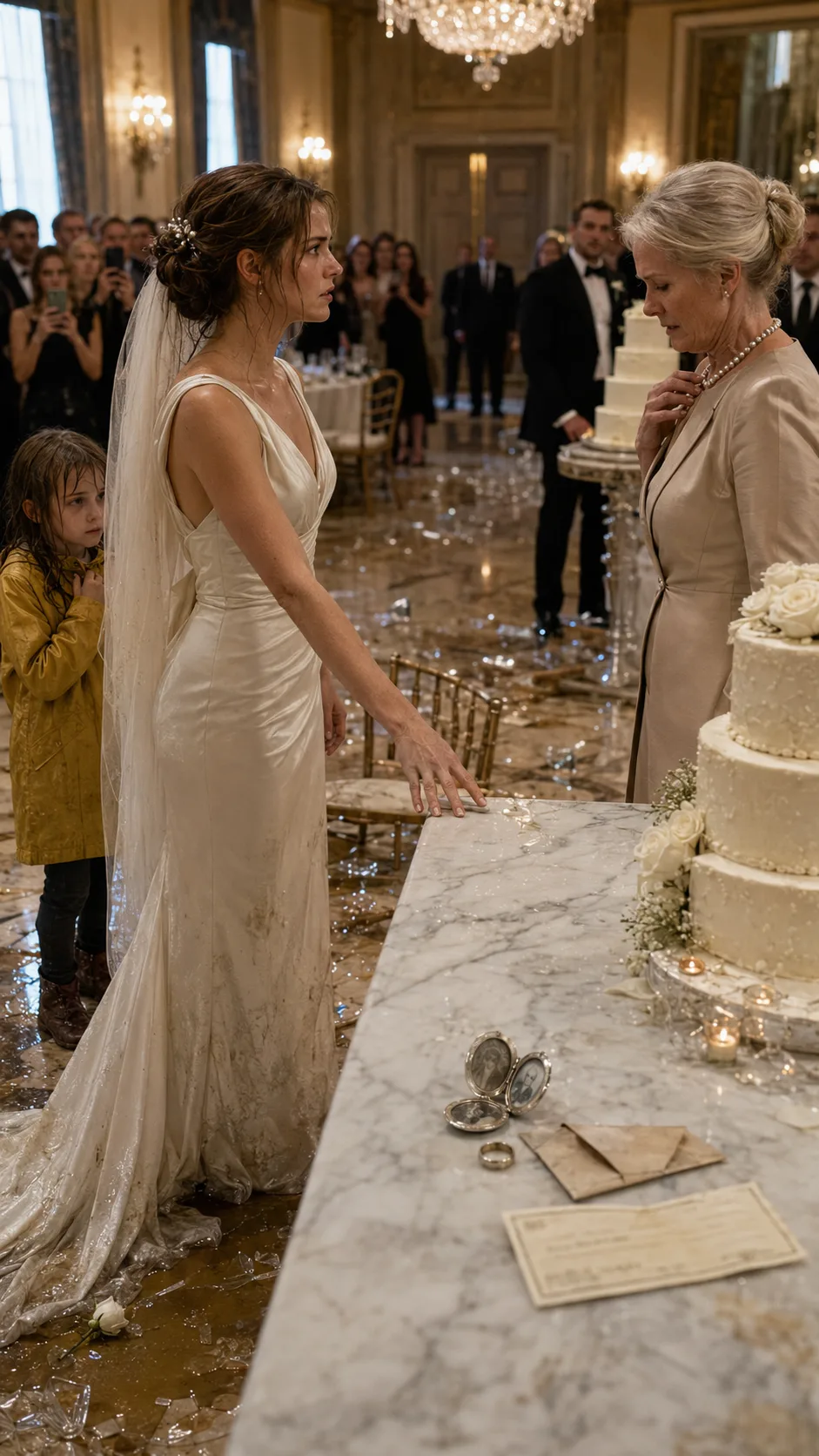
Crystal hit marble in a sound that did not belong at a wedding. One clean crack, then hundreds of smaller breaks, then the rush of pale champagne spreading under the cake table like something alive. People turned. I was standing ten feet from the first row with my bouquet still in both hands, smiling because that was what brides did when something went wrong before the photographer could lower his camera. My cheeks already hurt from it. My veil was pinned too tight behind my ears, and one pearl clip kept pulling at a strand of hair every time I moved. Then I saw the child. She stood beside the wrecked tower in a soaked yellow coat, too small for that ballroom, too wet for that perfect afternoon, with one sleeve hanging lower than the other. Her shoes were dark with rainwater. One shoelace had come undone and dragged through
champagne. She couldn’t have been older than seven. And she was crying. Not loudly. That made it worse. The quartet near the west wall stopped playing halfway through a note. A waiter in a black vest held a tray of untouched crab cakes and forgot to lower it. Someone behind me gave one small cough into a napkin. The chandelier light caught every broken piece on the floor, so the child seemed to be standing inside a field of tiny mirrors. “That’s him,” she whispered. Nobody moved at first. I looked toward Callum. My groom stood beside the wedding cake with one hand still resting near the silver knife. He had been laughing two seconds earlier. Not a big laugh. Callum never liked looking careless in photographs. Just enough teeth for charm, enough restraint for money. Now his face had gone still. “Callum?” I said. He did not look at
me. The girl lifted one wet hand and pointed straight at him. “That’s him.” A murmur went through the ballroom. It started near the back where my cousins from Brighton were standing by the bar, then slid forward through Callum’s side of the guest list, through pearl earrings and navy suits and women who had learned how to whisper without moving their lips. Near the front row, Callum’s mother stood. Vivienne Hale never stood quickly. She believed haste made people look poor. At our rehearsal dinner she had corrected the way I placed my fork on the table, then smiled afterward as if manners were a gift she was generous enough to distribute. Now she rose so fast her chair scraped backward. “Someone remove her.” Too fast. That was the first thing I noticed. Not the child. Not the necklace. Not even Callum’s face. I noticed Vivienne’s voice arriving before
anyone had asked a question. Two security guards stepped away from the ballroom doors. One of them, the younger one, had been looking at his phone a moment earlier, thumb frozen over the screen. The other adjusted his earpiece with the bored patience of a man who had escorted drunk uncles from better weddings than this. The girl did not move. Her fingers went into the pocket of her yellow coat. My habit, when I was nervous, was to press my thumbnail against the seam of my bouquet ribbon. I had done it during the vows rehearsal, during the photographer’s instructions, during Vivienne’s speech about family legacy. I was doing it now. The ribbon had a small dent in it from the pressure. The girl pulled out an old silver necklace. It was not expensive in the way this room understood expensive. No diamonds. No polished shine. The chain was dark in places, the locket scratched along one edge, the hinge slightly bent. But Callum saw it and lost whatever held him upright. “No,” he said. One word. Vivienne came down the center aisle between the rows of chairs, one hand gripping the pearls at her throat. She had given those pearls to herself after Callum’s father died, according to a story she told often enough that it had become part of the family furniture. “Give that to me,” she said. The little girl clutched the locket tighter. “My mommy said if I found this man…” Her mouth trembled around the words. She swallowed once. “I should ask why he left us.” Phones rose around the ballroom. I heard the soft electronic chime of someone starting a recording. My younger brother Finn lowered his champagne glass onto a windowsill and stared at me, not at Callum. He had never liked him, but he had been polite because I asked. “What is she talking about?” I asked. Callum’s hand slipped away from the cake knife. He did not answer. The girl looked at me then. Maybe because I was wearing white. Maybe because I was the only woman in the room holding flowers and not a phone. “My mommy died waiting for you to come back,” she said. The sentence landed badly. Not dramatic. Not clean. It fell into the room and stayed there, uneven and ugly. Callum closed his eyes. Vivienne reached the child first. “Enough.” Her voice lowered, but everyone heard it because nobody else was breathing right. “You don’t know what you’re saying.” The girl stepped back. Her heel caught on a shard of crystal. The younger security guard stopped moving. “Mrs. Hale,” he said. Vivienne turned on him with a look that made the man straighten. “She broke into a private event.” “She’s a child,” he said. One of the bridesmaids made a sound. My cousin Tessa, I think. She had spent the morning fixing my veil with trembling hands because she was afraid of Vivienne. She was not trembling now. I looked at Callum again. “Answer me.” He opened his mouth. Nothing came out. That was when the locket opened. The girl did it herself, with both thumbs, because the hinge stuck. It clicked once, resisted, then gave. Inside was a faded photograph. A young Callum, maybe twenty-three, maybe twenty-four, holding a newborn baby wrapped in a pink hospital blanket. The baby’s face was red and folded and furious at the world. Callum’s smile in the photograph was not the one I knew. It was tired. It was unguarded. It had no audience. The room changed shape around me. My bouquet felt too heavy. I noticed the ribbon seam again, and the dent my nail had made in it. I pressed harder, then stopped because one of the white roses had bent. Vivienne lunged for the locket. “Give me that.” The girl pulled it to her chest. “Don’t touch her,” I said. My voice did not sound bridal. It sounded like a door closing. Vivienne looked at me as though she had forgotten I was there. “Nora, this is not your concern.” I almost laughed. Almost. The photographer had stopped taking pictures. His camera hung against his stomach. Beside him, an elderly aunt from Callum’s side was trying to sit down without looking like she was trying to sit down, but the chair behind her had been moved two inches out of place and she missed it with the back of her knees. “Not my concern?” I asked. Callum finally moved. He took one step toward the child. The girl stepped back at once. That stopped him better than a wall. “What’s your name?” he asked. Vivienne’s head snapped toward him. “Callum.” He did not look at her. The girl held the locket so tightly her knuckles turned pale. “Lily.” The name did something to him. His throat moved. “Lily,” he said. She flinched when he said it, like the name belonged to someone else when it came from his mouth. “My mommy said your name was Callum Hale.” She opened the locket wider with shaky fingers. “It says it inside. See?” She turned it toward the room, though nobody was close enough to read. Maybe she only wanted him to know she had proof. Engraved inside the locket were two lines. CALLUM EDWARD HALE. JUNE 14, 2018. I had seen that date before. Not in a locket. On a calendar invitation buried in the old leather planner Callum kept in his desk, the one he said he never used anymore. I had found it six months earlier while searching for the spare house key after locking myself out. A small blue mark circled June 14. No note. No name. Just a mark pressed so hard the page behind it carried the ghost of the circle. I asked him about it that night. “Old client dinner,” he said, without looking up from his laptop. I believed him because believing is easier when the wedding invitations have already been mailed. Vivienne turned toward the guests. “This is absurd. A cheap stunt.” She pointed at the guards. “Remove her now.” The older guard started forward. I stepped between him and the child. The train of my dress dragged through champagne. It made a sound like wet paper. “Nora,” Callum said. I turned my head enough to see him. “Did you know her mother?” His eyes went to the locket. Not to me. “That was a long time ago.” The room made a noise then. A collective shift. A fork dropped somewhere near the family table. My father, who had stayed quiet through Callum’s speeches and Vivienne’s small insults for almost a year, placed both hands on the back of his chair and stood. Vivienne spoke before anyone else could. “My son is being ambushed on his wedding day by a child trained to repeat whatever lie her mother fed her.” Lily’s chin jerked. I saw it. So did Finn. He moved from the windowsill and came to stand at the edge of the aisle, not close enough to scare her, close enough that she would not be alone. “What was her mother’s name?” I asked. Callum rubbed one hand over his mouth. Vivienne answered for him. “Nobody relevant.” Two words. The child folded around them without moving. Her shoulders stayed up. Her eyes dropped to the broken glass. I hated Vivienne then in a very specific way. Not the grand hate of betrayal. Something smaller and sharper. The hate you feel when someone steps on a thing already cracked and pretends the sound was not their shoe. Callum looked at his mother. “Her name was Mara.” My breath changed. Not much. Enough that the veil shifted near my cheek. Mara. The name had appeared once in our house on a delivery envelope, handwritten in blue ink. I remembered because Callum had gone pale when he saw it. He said it was for the previous owner. We did not have a previous owner. The townhouse had been newly built. I had kept the envelope for three weeks in the kitchen drawer with batteries and rubber bands, waiting for myself to become the kind of woman who asked again. Then it disappeared. “Where is Mara?” Callum asked. Lily stared at him. “My mommy died in March.” He looked at the floor. Vivienne’s pearls clicked under her fingers. The younger guard crouched near the broken tower and began picking the larger shards into a linen napkin, because someone had to do something normal with their hands. A waitress near the bar took one step forward, then back, still holding a silver pitcher of water. I wanted to ask a hundred questions. Did you know about the baby? Did you leave because you were afraid? Did your mother pay someone? Did you plan to marry me with this sealed under the floor of your life? But the ballroom was not built for truth. It was built for flowers and speeches and photographs of people standing close enough to look like family. Lily wiped her nose with the sleeve of her coat. “I didn’t break the glasses on purpose.” That nearly did it. Not the locket. Not the photograph. That. I bent down slowly because my dress fought me, layers pulling against my knees. “Are you hurt?” She shook her head. A tiny piece of crystal was caught in the edge of her shoelace. I reached for it, stopped, and looked at her first. “May I?” She nodded. I removed the shard and placed it on the floor beside my ruined train. The champagne had soaked through the satin. Vivienne would mention that later if there was a later. Callum took another step forward. “Lily, I didn’t know.” Vivienne made a sound, almost a warning. The girl looked up. “My mommy wrote letters.” Callum froze. “She wrote every birthday. She kept copies.” Lily touched the locket again. “She said maybe your mother never gave them to you.” Every phone in the ballroom seemed to lift higher. Vivienne’s face changed. Only for half a second. Then she smiled. That smile had intimidated caterers, junior lawyers, my mother, and once me, in a bridal boutique when she told the attendant that ivory made my skin look tired. It did not work on Lily. “A grieving child has been fed a story,” Vivienne said. “My family will not be blackmailed in public.” I stood. “What letters?” Vivienne turned to me. “You are getting emotional.” “No.” The word came out flat. A child cried somewhere outside the ballroom doors, too young to belong to this scene, and was hushed by an adult. Callum’s uncle pushed his chair back. “Maybe we should all take a breath.” “No,” my father said. He was not loud. He did not need to be. Vivienne looked at him with the same expression she used for servers who refilled wine from the wrong side. “This is a Hale matter.” My father adjusted his cuff. “You made it a room matter.” That was the first time anyone on my side smiled. Not happily. Just enough. Callum touched his jacket pocket, then stopped. He used to do that when he was searching for a cigarette he no longer carried. I had found the habit charming once. A relic of a younger version of him, he said. Another thing he had quit before me. “Where are the letters?” I asked Lily. She looked toward the ballroom doors. A woman stood there in a navy raincoat, hair pulled back, one hand holding a plastic grocery bag. She was maybe forty, with tired eyes and a face that had learned not to ask rooms for kindness. “She has them,” Lily said. The woman stepped in. The older security guard moved to block her. I lifted one hand. “Let her through.” Vivienne laughed once. “You do not give orders here.” I looked at the champagne soaking the hem of my dress, at the silver knife beside the cake, at the locket in Lily’s hands, at the man I had almost married. Then I looked at the hotel manager. Mr. Alvarez stood near the back with a headset clipped to his collar, expression locked in the careful neutrality of people who keep luxury running. He had been the one who helped me arrange the ballroom because Vivienne had insisted on changing table assignments four times. “This event is under my family’s account,” I said. “Let her through.” Vivienne blinked. Callum turned toward me for the first time as if he had remembered I had a life before him. “My father owns thirty percent of this hotel group,” I said. I had not wanted to say that at my wedding. I had spent months letting Vivienne believe my father was only a retired school headmaster because he liked bad sweaters and drove an old Volvo. It was easier than correcting her. It had amused him for a while. Mr. Alvarez nodded to the guard. “Let the guest pass.” The woman in the navy raincoat walked in carefully, avoiding the glass. She carried the plastic bag with both hands. Something inside it had hard corners. Lily ran to her. The woman placed one hand on the child’s wet hood. “I told you to wait by the lobby sofa.” “I saw him.” “I know.” The woman’s eyes moved to Callum. Not with hate. That was too simple. “My name is Ruth Bell,” she said. “Mara was my sister.” Callum said nothing. Vivienne’s shoulders squared. “Then you should know this is harassment.” Ruth looked down at the grocery bag. “I know what harassment looks like.” The fluorescent panel above the service corridor flickered once. Nobody mentioned it. Ruth pulled out a bundle tied with green string. Envelopes. Some white, some cream, some pale blue. All of them worn at the corners, as if handled too often by someone who never mailed anything without hoping. She did not hand them to Callum. She handed them to me. I did not know why until my fingers closed around them. Maybe because I was the bride. Maybe because Ruth understood that women are often asked to carry evidence of damage they did not cause. The top envelope had Callum’s name written across it. Callum Edward Hale. The address beneath was his mother’s old townhouse in Mayfair. I had visited that townhouse during our engagement party. Vivienne had shown me the drawing room curtains before she showed me family photographs. I folded the edge of the top envelope before reading it. A stupid habit. My mother used to do it with bills, creasing one corner before she opened them, as if paper would behave better if marked first. I had picked it up without meaning to. Callum once teased me for it. “You fold everything before you face it,” he said. Maybe I did. I opened the first letter. The paper smelled faintly of damp cardboard and lavender soap. Callum did not move. Vivienne did. She crossed the space between us and snatched at the letters. My father stepped into her path. “Don’t.” She stopped because people like Vivienne could ignore pain, ignore truth, ignore children, but they rarely ignored a man with legal counsel on speed dial and a calm voice. “You don’t know what you’re holding,” she said to me. “That seems to be a family theme.” A few people made small sounds. Not laughter. Something too nervous to be laughter. Ruth’s face did not change. I read the first line. Callum, I don’t know if this will reach you. Your mother said you were gone, but she would not tell me where. The words tilted on the page. I looked up. Callum had gone gray. Vivienne’s hand dropped from her pearls. “She came to me,” Vivienne said. “Pregnant, unstable, making demands. I protected my son.” “Protected him from his daughter?” I asked. “You have no idea what she wanted.” Ruth spoke then. “She wanted him to know.” Vivienne turned on her. “She wanted money.” Ruth’s jaw shifted once. “She asked for a phone number.” The quiet that followed was worse than noise. Callum took one step toward his mother. “You told me she left.” Vivienne’s chin lifted. “She did.” “You told me she married someone else.” “She should have.” “You told me the baby wasn’t mine.” Lily looked at him. The room heard that one. A guest near the dessert table lowered her phone. Another lifted hers higher. The older guard looked at the floor like he wished the marble would open a polite door. Vivienne’s mouth tightened. “You were twenty-four. Your father had just died. You were drinking, failing exams, throwing away every chance he left you. I made a decision.” Callum stared at her. I could see the boy in the photograph then. Not the man beside the cake, not the groom polished for inheritance, but the tired young father holding a newborn with both hands like she might break. “You paid her,” he said. Vivienne did not answer. Ruth opened the plastic bag again and pulled out a smaller envelope. This one was sealed inside a clear sleeve. “Mara kept everything.” She handed it to me too. Inside was a copy of a bank draft. Fifty thousand pounds. Issued by Hale Family Holdings. Payable to Mara Bell. The memo line was blank. Attached to it was a handwritten note. Do not contact my son again. No signature. Vivienne did not need one. Callum reached for the paper. I let him take it. His fingers shook. The champagne had reached the toe of my shoe. Cold satin pressed against my skin. I should have cared. I thought about the deposit on the dress, about how my mother cried when she saw me in it, about the way Vivienne had said the neckline was “brave.” Then I thought about Mara Bell reading that note with a newborn in the room. The ballroom doors opened again. A hotel staff member slipped in with a mop bucket, saw the room, and stopped halfway. Mr. Alvarez gave him one small shake of the head. The staff member backed out with the bucket squeaking once across the marble. Callum looked at Ruth. “Why now?” Ruth’s hand rested on Lily’s hood. “Because Mara asked me not to look for you while she was alive. She said if you wanted to come, you would.” She swallowed. “After the funeral, Lily found the locket in her mother’s sewing box. There was a newspaper clipping inside. Your engagement announcement.” I remembered that clipping. The society page photograph. Callum in a charcoal suit. Me in a cream dress. Vivienne standing between us with one hand on my shoulder like ownership could be mistaken for affection. “She asked what a wedding was,” Ruth said. “Then she asked why her father was having one.” No one looked comfortable holding their phones anymore. I turned to Callum. “Did you search for Mara?” His face folded around the question, not enough to forgive him, enough to answer before he spoke. “I tried once.” Once. The word sat between us. “One email came back. Her number was disconnected. My mother said she’d moved to France with someone from her art program.” Ruth gave a short breath through her nose. “Mara never had a passport.” Callum looked at Vivienne. His mother did not look away. The room had shifted fully now. Not toward Lily, not toward me. Away from Vivienne. There is a difference. People are careful with sympathy when wealth is watching, but they know when a body is falling. Vivienne sensed it. So she did what she always did when a room stopped bending. She attacked the weakest person in it. “That child has no legal claim to anything.” Lily pressed closer to Ruth. I stepped forward. “Nobody asked about money.” Vivienne smiled again, but it had lost its shine. “Don’t be naïve. That is always what this becomes.” My father’s voice came from behind me. “Nora.” I looked back. He held his phone out. On the screen was my father’s solicitor, who had apparently been on a video call for some time. Graham Pike had handled hotel contracts, family trusts, and once my brother’s terrible idea to invest in a nightclub. His face filled the screen from a badly lit office, reading glasses low on his nose. “I heard enough,” Graham said. Vivienne’s eyes sharpened. “You recorded this?” My father raised one eyebrow. “You spoke in a public ballroom to two hundred people holding phones.” That line would have been funny on another day. It was not funny then. Graham looked at Callum through the screen. “Mr. Hale, before anyone says another foolish thing, I suggest you request privacy for the child and preserve all documents presented today.” Vivienne laughed. “There is no case here.” Graham removed his glasses. “I would not be sure.” She stepped forward, voice rising at last. “She has no proof beyond old letters and a sentimental trinket.” Lily’s fingers closed around the locket again. Ruth’s face went still. I watched Vivienne overplay herself. Maybe I should have stopped it. Maybe some part of me wanted to see whether she would choose mercy once, with a child in front of her and her son looking at her like a stranger. She did not. Vivienne turned to the room. “My family rejects this accusation in full. This child is not recognized by us. Her mother attempted to extort the Hale estate eight years ago, and I will have my attorneys issue statements before the hour is done.” There it was. The door closing. A public denial. A public accusation against a dead woman. A child named as a liar in a room full of cameras. Ruth closed her eyes. Lily looked at the floor. Callum whispered, “Mother, stop.” But Vivienne had already lifted her chin toward Mr. Alvarez. “Have security remove them. Now.” The older guard did not move. The younger one looked at me. I set my bouquet on the nearest chair. One white rose fell from the arrangement and landed in champagne with a soft wet tap. Then I took the locket from Lily only after she nodded. It was heavier than it looked. I walked to the cake table where the silver knife still waited beside three perfect tiers of white icing and sugared flowers. My dress pulled behind me through the mess. Every step made satin stick to marble. Vivienne watched with a hard smile. “Be careful, Nora. You are embarrassing yourself.” I placed the open locket on the cake table. The metal touched marble with a small click. No one spoke. The photograph faced up. Young Callum holding the baby. The engraving visible along the inside curve, though too small for most of the room to read. I put the bank draft beside it. Then the first letter. Then the newspaper clipping from our engagement announcement. Last, I removed my ring. Callum made a sound behind me. I set it beside the locket. Another click. Vivienne’s smile faded. I looked at her. “Read the date.” Four words. The room held them. Vivienne did not move. Callum did. He picked up the locket as if the hinge might cut him. His eyes went to the engraving, then to the bank draft, then to the first letter. His face changed in pieces. The groom disappeared first. Then the son. What remained was a man with a photograph of himself holding a baby he had not watched grow. Graham’s voice came from my father’s phone. “The date matters, Mrs. Hale.” Vivienne’s throat moved. Callum looked at her. “June fourteenth.” Nobody helped her. Graham continued. “If that date corresponds with the child’s birth, and the bank draft followed shortly after, it supports contact, knowledge, and possible interference.” Vivienne reached for the table edge. The younger security guard lowered his eyes and stepped back from Lily. A waitress near the bar set the water pitcher down without pouring a single glass. The sound was small but clean. Ruth opened the plastic bag one final time. “I have the birth certificate.” Vivienne turned toward her too quickly. Ruth did not flinch. “Mara listed him. She never removed his name.” Callum took the paper from Ruth. He did not look at me when he unfolded it. I was grateful for that. I did not want to watch him learn how many rooms of his life had been locked from the outside. The birth certificate was not dramatic. Government paper never is. Thin, plain, creased at one corner. It did not care about chandeliers. Callum read it. Lily Mara Bell. Father: Callum Edward Hale. His hand dropped to his side. The paper bent between his fingers. Vivienne whispered something, but it did not become words. My father ended the video call without ceremony. Graham’s face vanished from the screen. A tiny reflection of the chandelier replaced him. Callum walked toward Lily. Slowly. He stopped several feet away. “I’m sorry,” he said. Lily looked at Ruth before answering. “My mommy said you might say that.” Callum closed his eyes. Ruth put a hand on Lily’s shoulder. “This is enough for today.” Vivienne seemed to wake at that. “You are not leaving with Hale property.” Ruth looked at her. “What property?” “The locket.” Lily pulled it close again. The room turned on Vivienne then. Not with shouting. That would have been easier for her. Instead, people looked. Phones stayed up. Chairs shifted. Someone whispered, “My God,” not quietly enough. Mr. Alvarez stepped forward. “Mrs. Hale, I’m going to ask that you allow them to leave.” “This is my son’s wedding.” “No,” I said. Everyone looked at me. I touched the empty place on my finger where the ring had been. “It was.” Callum turned. “Nora.” I shook my head once. Not because I had no words. Because if I started, I might not stop. He looked smaller without certainty. That was cruel to notice. I noticed anyway. “I didn’t know about Lily,” he said. “No.” I looked at the locket. “But you knew there was a woman you stopped looking for.” He flinched. Vivienne spoke, lower now. “Nora, you are making a permanent decision in a temporary scandal.” I picked up the ring and held it out to Callum. He did not take it. So I placed it on the cake table beside the silver knife. “I’m making the first honest decision of the day.” The words did not make me strong. They only made the next breath possible. Finn came to my side and removed his jacket. He held it out because my dress was soaked and the ballroom air had turned cold. I did not put it on at first. The gesture was too kind and I was not ready for kind things. Then I took it. My mother had not moved from the second row. Her hands were folded around her program. When I looked at her, she nodded once. Her lipstick was perfect. Her eyes were not. Ruth guided Lily toward the doors. The child paused near me. I crouched again, carefully this time. “May I fix your shoelace?” She looked confused. Then she nodded. I tied it in a double knot. My fingers were not steady, so the loops came out uneven. She watched them like this was important. “Thank you,” she said. “You’re welcome.” She looked at my dress. “I’m sorry about the glasses.” I wanted to tell her that broken glass was not the worst thing in the room. I did not. “Those can be replaced.” She nodded, though I don’t think she believed me. Callum stood by the cake table, the locket in one hand, the birth certificate in the other. He looked at Lily but did not move closer. Maybe that was the first decent thing he did. He let her leave without asking her to carry his need for forgiveness. Vivienne sat down at last. No one invited her to. She lowered herself into the front-row chair with one hand gripping the seat back, pearls resting wrong against her collarbone. For the first time since I had met her, she did not look arranged. Mr. Alvarez signaled to the staff. The mop bucket returned. The same staff member pushed it in slowly, eyes fixed on the floor. He began with the champagne at the edge of my train, sweeping glass into a neat silver dustpan as if cleaning up after rich people’s disasters was ordinary work. Maybe it was. I walked out through the side corridor, not the main doors. Finn followed. So did my parents. Nobody said anything until we reached the small service hallway near the kitchen, where the air smelled like butter, bleach, and overcooked asparagus. Then I stopped. My hands went to the veil. The pins would not come out. I pulled at one and it caught. “Nora,” my mother said. “Just—wait.” The hallway was narrow. A stack of folded tablecloths leaned against one wall. Somewhere behind the kitchen door, a dishwasher thudded shut. I tried again and one pearl pin fell to the floor, bounced once, and rolled under a metal rack. That was what nearly broke me. Not the wedding. Not the locket. A pearl pin under a rack where I could not reach it. I crouched, then sat on the floor because the dress would not let me bend right. I stared at the dark space beneath the rack and counted the little square tiles one by one until my breathing stopped making noise. Seven tiles across. Four chipped. Finn sat on the floor beside me in his suit without asking. My mother did not touch me. My father went to find scissors.
I laughed once when he returned with kitchen shears from a pastry chef who looked at me through the doorway and pretended not to. The veil came off in pieces. After that, things happened with the strange speed of practical disaster. My father spoke to Mr. Alvarez. My mother called the driver. Finn collected my phone from Tessa, who had been guarding it like evidence. Guests left in clusters, voices lowered, heels clicking through a lobby that still smelled faintly of rain. Callum texted me thirteen times before I reached the car. I read none of them. Ruth was outside under the covered entrance with Lily. The yellow coat looked brighter in daylight, and worse. Too thin for the weather. Ruth held the plastic bag against her chest. I walked to them before anyone could stop me. Callum was not there. Good. “I don’t know what happens next,” I said. Ruth’s mouth pressed into a line. “Neither do we.” “My father’s solicitor can help. Not to pressure you. Just to make sure Vivienne can’t scare you.” Ruth studied me for a long moment. “You don’t owe us.” “No.” I looked back at the hotel doors. “But she owes you.” Lily was staring at my bare ring finger. “Are you still getting married?” I looked down too. There was a pale mark where the ring had been. “No.” She considered that. “Because of me?” “No.” I said it too fast, then slowed myself. “Because of the truth.” She nodded like children do when they accept words now and understand them years later. Ruth gave me her number on the back of a parking receipt. The ink smudged because her hands were wet. I folded one corner before putting it in my clutch. Old habit. My mother’s car pulled up. Before I got in, I looked once through the hotel glass. The ballroom doors were open. Staff moved inside with white cloths, trays, bins for broken glass. The champagne tower was gone. In its place was a yellow caution sign on the marble. Vivienne stood alone near the cake table. Callum stood several feet away from her. Neither of them touched the locket. I got into the car with Finn’s jacket around my shoulders and my wedding dress damp against my legs. My bouquet was still inside somewhere, one rose missing, ribbon dented where my thumb had pressed too hard. My phone lit again. Callum. This time I opened the message. Please let me explain. I looked at it until the screen dimmed. Then I put the phone face down on the seat. Outside, Lily climbed into a taxi with Ruth. The yellow coat disappeared behind the closing door. The taxi pulled away first. For a few seconds, we stayed behind it at the curb. Then my father’s driver put the car in gear. I did not fold the parking receipt again.
Chapter complete
You have reached the end of this chapter.
Continue reading
A few more worlds to get lost in after this chapter.




