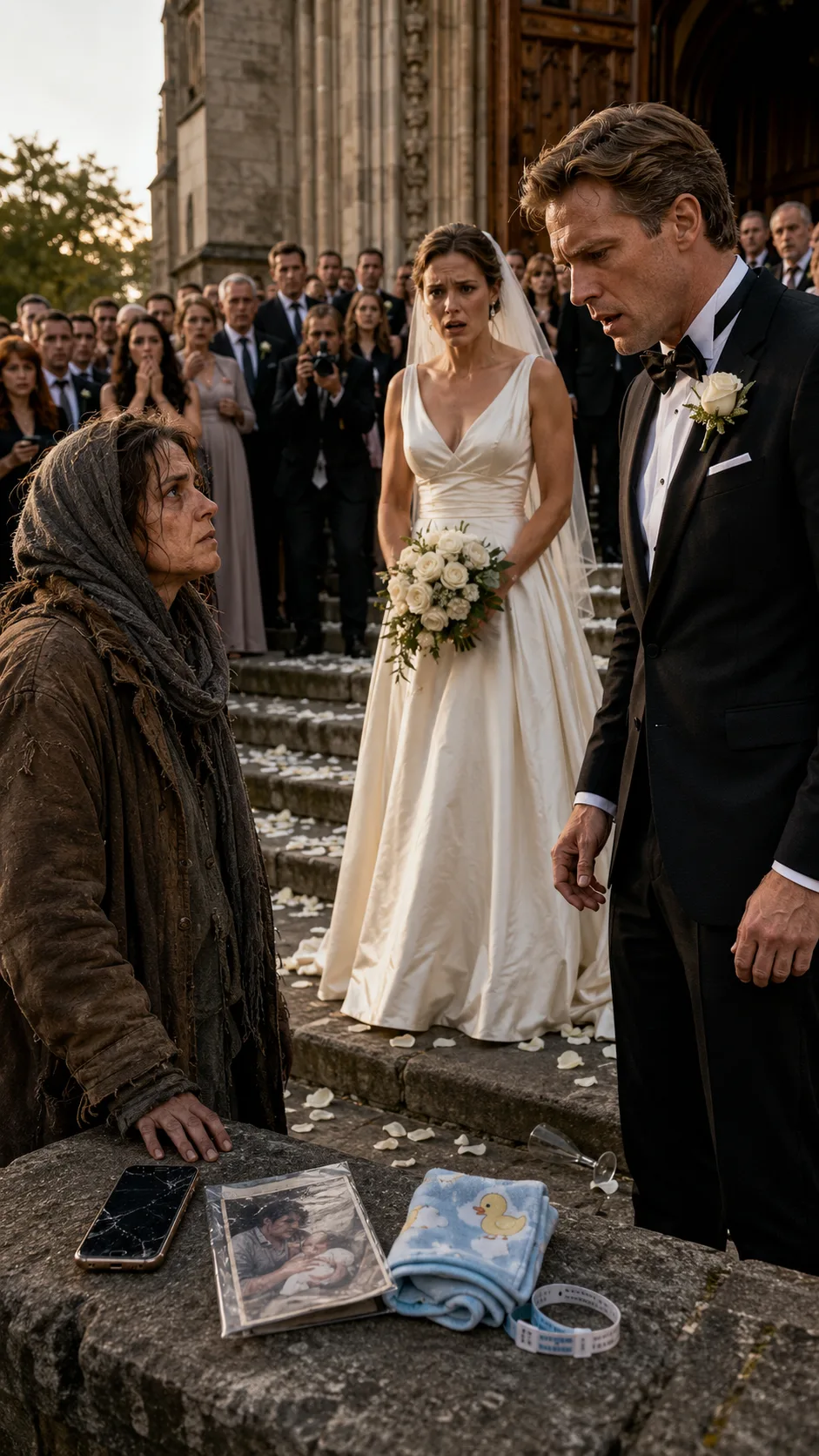
The cathedral bells were still ringing when I stepped out of the alley behind Saint Brigid’s and saw white flower petals stuck to the wet stone.
Chapter 1
The cathedral bells were still ringing when I stepped out of the alley behind Saint Brigid’s and saw white flower petals stuck to the wet stone.
One petal had landed on my shoe. I stared at it longer than I should have, because it was easier than looking at the groom. The guests were gathered across the wide cathedral steps in expensive suits and pale silk dresses, all smiling in the clean golden light that made even the old stone look gentle. A photographer crouched low near the bottom step. Someone’s aunt kept telling people to move left. The bride held a bouquet of white roses so tight that the stems bent against her satin gloves. And beside her stood Julian Vale. My husband. No. Not my husband anymore. Not legally. Not honestly. Not in any way that mattered except the one he had tried to bury. I reached into the inside pocket of my coat and touched the old photograph, folded inside a cracked plastic sleeve. I had carried it so long that the edges
had softened like cloth. A woman from the shelter had once told me to make copies before the original disappeared in the rain or got stolen from my bag. I made twelve. Still, I carried the original. Some things you do because they make sense. Some things you do because losing them would finish you. A boy in a navy suit near the steps turned first. He was maybe nine, with gel in his hair and a loose front tooth. He looked at my coat, at the frayed hem dragging over my boots, then looked quickly away like he had been caught doing something rude. I almost left. That was the closest I came. Then Julian laughed at something his bride said, and the sound reached me across the steps. Same laugh. Lower now. Richer. Trained for rooms where people donated money and pretended it was kindness. But underneath it
was the laugh from our first apartment above the bakery on Grand Street, when he used to come home with flour on his sleeves because the owner paid him cash to unload trucks at dawn. He had laughed like that the night our son was born. The first camera flash went off. I stepped forward. At first, no one understood what I was doing. People make room for brides. They do not make room for women in stained brown coats with a scarf wrapped twice around their hair and hands that look older than they are. A bridesmaid saw me and stiffened. The photographer lowered his camera. Julian’s bride, Elise, noticed the change before he did. Her smile held for one extra second, the way a smile does when the face has not received instructions from the mind yet. Then Julian turned. His face emptied. Not enough for anyone else
to call it fear. But I saw it. I had loved that face once. I knew what it did when it lied. “You can’t be here.” He said it under his breath, but the cathedral steps carried sound strangely. Three people near the flower arch heard him. One of them stopped clapping. I kept my hand in my pocket. The photograph pressed against my knuckles. “That’s okay,” I said. My voice did not sound like mine. It scraped out thin and dry, like I had not used it all winter. “Just check your phone.” A few guests laughed, not because anything was funny. People laugh when the wrong thing happens in a beautiful place and they need someone else to decide what it means. Julian’s jaw shifted. “Call security,” he said. A tall man in a black suit near the church door touched an earpiece, though I was fairly sure it was not connected to anything. Saint Brigid’s hired ushers for weddings, not guards. He had been checking a football score when I passed him earlier. His phone was still glowing blue in his palm. Elise looked from Julian to me. “Do you know her?” The question sat there. Julian gave her the version of his face that made investors relax. I had watched him practice it in our bathroom mirror years ago when he was applying for his first job at a law firm that did not hire men like him unless they had learned how to stand beside money without looking hungry. “No,” he said. “She’s confused.” There it was. Not angry. Not pleading. Not ashamed. Practical. I had been called worse. I had been called unstable by a hospital clerk who never looked up from her screen. I had been called a problem by a detective who lost the file twice. I had been called lucky by a woman at the shelter because I still had all my teeth. But confused was the word Julian liked. Confused made other people do the work for him. I took one step closer. My left boot slid a little on crushed petals. Someone gasped like I had touched the bride’s dress. “Check your phone,” I said again. Julian’s smile returned in pieces. “Whatever you think this is, today is not the day.” A woman behind Elise whispered, “Oh my God, is she one of his cases?” Cases. I almost laughed. Years earlier, when Julian still slept on a mattress on the floor and wrote court filings at our kitchen table, he had told me the law was mostly a language rich people used to keep poor people quiet. He hated them then. The men who signed things without reading them. The women who called lawyers before calling their own children. Then he became fluent. Elise took half a step back from him. Not away from me. From him. That was when I knew she had noticed something. I removed my hand from my pocket, but not the photograph yet. My fingers were stiff, and for one terrible second I worried I would drop it before I could use it. A white petal stuck to the damp cuff of my coat. Julian leaned toward me. “Leave,” he said. The word was small. Private. I heard the old version of it anyway. Leave the hospital. Leave the apartment. Leave the police station before you make this worse. Leave the city and start over. Leave his name out of your mouth. “No.” A camera clicked. Not the wedding photographer. A guest. Julian’s eyes moved toward the sound. He hated cameras when he could not control the angle. Elise noticed that too. The bride still held her bouquet. One rose had split at the edge, brown where someone had handled it too much. “What photo?” she asked. Julian did not look at her. I pulled out my phone first. It was an old prepaid one, the screen cracked in the top corner. The shelter director, Marcy, had bought it for me after I missed two calls from the county office because my last one died in a bus station restroom. Marcy said, “You keep losing proof because you keep thinking memory should be enough.” Memory was never enough. I had learned that in rooms with metal chairs. My thumb found the message thread. The photograph was already sent. Three minutes ago, while the bells were ringing and everyone was looking at the doors, I had sent Julian Vale the one picture he had not managed to destroy. The delivery mark sat beneath it. Julian knew. That was why his face had changed before he looked at the screen. He had felt the phone vibrate in his jacket. He had ignored it because men like Julian believed every inconvenient thing could be ignored until someone poorer was removed from the room. The usher reached me. “Ma’am, you’ll need to step away from the couple.” He smelled faintly of peppermint gum. He was younger than my son would have been. I looked at his hand, which hovered near my elbow but did not touch me. “Please don’t,” I said. The usher’s eyes flicked down to my coat, then to my face. Something in him hesitated. He had a daughter’s name tattooed on the inside of his wrist. Lila, in blue ink. He lowered his hand. Julian saw it. His mouth tightened. “Elise,” he said, “go inside.” She did not move. A church bell struck once behind us, late and heavy. “Who is she?” Elise asked. Nobody laughed now. The question had changed shape. Julian slipped his phone from his jacket pocket. His hand was steady at first. He had always been good with his hands. He could fix a loose cabinet hinge with a butter knife. He could braid a hospital bracelet around my wrist because he said the plastic edges scratched my skin. He could hold a newborn with one arm while making coffee with the other. Then his thumb touched the screen. The steadiness left. He stared at the photograph. The crowd leaned without meaning to. Human beings do that around secrets. They pretend not to want them and move closer anyway. Elise stepped beside him. I saw the moment she saw it. The old photograph showed me at twenty-seven, hair shorter, cheeks full from pregnancy, smiling like I had been given the whole world wrapped in blue cotton. Julian stood beside me in a faded green sweater, one hand cupped around the back of the newborn’s head. Our son’s face was mostly hidden, a tiny red mouth and one fist raised near his cheek. On the back, in Julian’s handwriting, were three words. Miles. First morning. He had written them with the blue pen from the nurses’ station because we could not find one in my bag. Elise covered her mouth. Julian looked at me then. Not at the coat. Not at the dirt under my nails. Not at the scarf or the boots or the woman everyone had already decided I was. At me. “This photo,” he said. I nodded once. “I told you I’d find you.” His throat moved. Elise’s bouquet dipped toward the ground. “Who is Miles?” A small thing happened then. Ordinary. Cruel. The photographer, who had been crouched near the steps for the perfect wedding shot, slowly stood up and lowered his camera against his chest. He did not turn it off. He just stopped pretending this was still a wedding. Julian said, “She’s lying.” I had expected that. For years, I had built entire mornings around expecting that. I reached into my coat again and pulled out the plastic sleeve. The real photograph was inside, along with two hospital bands, a copy of a birth certificate, and a small square of blue blanket folded flat until it was no thicker than a card. The blanket still had a faded yellow duck near the corner. I held the sleeve with both hands. The wind tried to take it. Elise stared at the blue fabric. “Julian.” He did not answer her. I looked at him, and for one second the cathedral steps were gone. The smell of baby shampoo came back through the cold. So did the hospital window with the cracked blind. So did Julian sitting beside my bed, whispering that he was sorry his mother had not come, sorry his father had called the baby a mistake, sorry we had no money, sorry the crib was used, sorry the world was like this. He had cried then. I remember because he wiped his face on the hospital blanket, and I laughed at him for it. A siren passed somewhere beyond the church. Nobody moved. “Ask him,” I said. Elise’s eyes stayed on the photograph. “Ask me what?” Julian’s voice cracked on the last word. Good. Not enough. But good. I stepped closer, until the first row of guests pulled back to make space. “Ask him what happened the night our son disappeared.” The bride stopped breathing for one beat. The usher with Lila on his wrist looked down. Someone near the back said, “Jesus.” Julian’s knees bent like the stone had shifted under him. Then he straightened. That was the part that hurt. Even then, even with Miles between us again, he chose the performance. “She was ill,” he said to Elise, louder now. For the crowd. For the cameras. “After the birth, she had episodes. My family tried to help her. She accused everyone. The child was placed safely, and she ran.” The child. Not our son. The child. I pressed my thumb against the plastic sleeve so hard the corner cut into my skin. Elise turned very slowly toward him. “Placed where?” Julian looked at me. “Enough.” “No,” Elise said. It was the first word she had said that belonged entirely to her. He blinked. She had been his bride for less than ten minutes, and already he looked surprised that she had a spine. A black sedan idled across the street. The driver leaned against the hood, eating from a paper bag and watching the steps like the whole city had turned into a theater. Grease had spotted the front of his shirt. Life keeps doing that. It keeps chewing while your world comes apart. “Elise,” Julian said, “this woman has followed me before.” “No, I haven’t.” He ignored me. “She contacted my office. She sent threats. I didn’t tell you because I didn’t want to upset you before the wedding.” There was his overplay. He could have stopped at confused. He could have stopped at sick. He could have stopped at I’ll explain later. But Julian had never been able to leave a lie small. Elise looked at me. “Did you threaten him?” I shook my head. My tongue stuck to the roof of my mouth. I wanted water. Ridiculous thing to want on cathedral steps while the man who helped erase your child stood in a wedding suit. The photographer’s assistant, a young woman with silver clips in her hair, stepped quietly to a side table where untouched champagne glasses waited. She picked up one glass, changed her mind, set it down again, and wiped her palm on her black pants. Julian pointed at me. “She is trespassing. She is harassing me on my wedding day. I want her removed.” The usher did not move. Julian snapped his fingers. That sound did something to me. Not because it was loud. Because he used to snap his fingers at stray dogs outside the bakery, then feed them the ends of baguettes. “Elise, go inside,” he said. “Now.” Her face went still. “You don’t get to speak to me like that.” A few guests shifted. Julian heard the shift. I saw him recalculate. He turned toward the crowd, spreading one hand in a practiced gesture that belonged in courtrooms and charity galas. “I’m sorry everyone has to see this,” he said. “Mental illness is not something to mock. But today should not be hijacked by a person refusing treatment.” There it was. The public sentence. The noose he tied himself. A woman in a lavender hat nodded, relieved to have a category for me. I almost folded. Not dramatically. Nothing cinematic. My knees did not give out. I did not scream. I did not faint. I simply forgot why I had come. For two seconds, I saw the lavender hat, the petals, the bride’s ruined rose, and I thought, Maybe I am what he says. Maybe all these people cannot be wrong. Maybe a mother can lose the shape of the truth if everyone tells her long enough that she imagined the child in her arms. Then I felt the blue blanket under my thumb. Faded cotton. Yellow duck. Miles had existed. I had washed that blanket in a laundromat at midnight because our building machines were broken. Julian had held the dryer door shut with his knee. A woman beside us had folded tiny socks and told me babies made men honest. Poor woman. I took the second phone from my coat. Not mine. Marcy’s. She had insisted. “Your phone dies at the worst times,” she had said that morning while pushing it into my hand. “And men like him love a dead battery.” I had laughed because she didn’t. Now I unlocked it. Julian’s eyes went to the phone. For the first time, he looked less certain. “This is absurd,” he said. I tapped the screen once. A voice came out. His voice. Older than the hospital. Younger than today. “Tell them she signed it. Tell them she abandoned him. I don’t care what the file says. My father paid for the placement, and she will never find him.” The audio was not loud. It did not need to be. It carried down the steps and into the space between guests like cold water. Julian lunged half a step. The usher moved before I did. “Sir.” Just one word. Julian stopped. The phone kept playing. Another voice followed. His father’s voice. Dead now, but still sounding expensive. “And the boy?” Julian again. “He’ll be renamed before the month ends.” Elise made a sound without words. I did not look at her. My eyes stayed on Julian. He stared at the phone as if it were a living thing. The recording ended with a chair scraping and someone laughing too close to the microphone. No one spoke. A pigeon landed near the bottom step and pecked at a petal. I placed Marcy’s phone on the stone ledge beside the flower arrangement. The cheap plastic case made a small flat click. Then I placed the photograph beside it. Photo. Phone. Blanket. Bands. All of it in a crooked line. Julian’s mouth opened. I said the line I had practiced once in a shelter bathroom with the sink running so nobody would hear me. “Read the name.” Elise looked down. At first, she did not understand. Then she saw the birth certificate copy inside the sleeve. Father: Julian Anthony Vale. Mother: Nora Elise Hart. Her name was Elise too. That was the small mercy and the small cruelty of it. The bride’s name stitched into mine by accident. Elise whispered, “Nora.” I had not heard my name in his world for a long time. Julian stepped back half a step. Only half. But his heel struck the edge of a broken petal basket, and wicker scraped against stone. He looked down at it like the basket had betrayed him. The woman in the lavender hat removed her hand from her pearl necklace. A man near the front pulled his daughter closer. The photographer’s assistant bent and picked up a fallen champagne glass before anyone could step on it. Her hands were careful. She did not look at Julian. “Elise,” Julian said. The bride flinched at her own name. He reached for her. She moved away. “No.” The word did not rise.
It stayed low and plain. A black car door opened at the curb. Marcy climbed out first, wearing her navy shelter cardigan and the flat shoes she used for court days. Behind her came a man in a gray overcoat carrying a folder under one arm. Not expensive. Not flashy. Just old enough to know how to wait. Julian saw him and went pale in a way no photograph could catch. Detective Aaron Pike had retired from the city police three years earlier. He had found me last winter after a volunteer legal clinic reopened the archived missing child complaint under a different classification. He smelled like black coffee and kept cough drops in every pocket. He climbed the steps slowly. His knee was bad. The crowd parted for him because older men with folders still scare people more than desperate women with proof. “Mr. Vale,” Pike said. Julian said nothing. Pike opened the folder. “I’d planned to speak with you after the reception. Mrs. Hart was clear she did not want a scene.” A strange laugh broke out of me. Not joy. Not relief. Just a sound my body made because the sentence was too large. Pike looked at Elise. “I’m sorry, ma’am.” She stared at Julian. “What did you do?” Julian’s face changed again. The cornered version. “Nora was unstable,” he said. “My father handled it. I was twenty-six. I didn’t understand what he’d arranged.” “You understood enough to lie,” I said. He looked at me then. For one second, he was the man from Grand Street again. Tired. Frightened. Too proud to admit he had been bought by his father’s money and too weak to choose a woman and child over a family name. “I thought he’d be better off.” There it was. Not sorry. Never sorry first. Better off. The phrase had sat under all of it for years, waiting to show its face. Elise raised her hand and removed her veil. She did it carefully, pin by pin, while everyone watched. One pin snagged in her hair. She winced but kept going until the lace came free. Then she handed the veil to her maid of honor. “I can’t wear this.” Julian whispered, “Don’t do this here.” She looked at the guests, the phones, the cathedral doors, the flowers he had paid someone to make perfect. “You did this here.” Pike placed a business card on top of the photograph. “The county has located records tied to a private adoption broker your father used,” he said. “The case is open. You’ll be contacted formally.” My legs nearly stopped working. Located. Not found. Not yet. But located records was more than I had been given in eleven years. A child can disappear behind paperwork when enough adults decide a poor mother is easier to erase than a rich father is to question. A name can be changed. A file can be moved. A clerk can retire. A judge can sign what is placed in front of him. But paper keeps fingerprints. So does guilt. Julian looked at the guests. He searched for a friendly face and found mirrors instead. The lavender hat woman looked away. The boy with the loose tooth stared openly now. The driver across the street kept eating. Elise descended one step, then another, until she stood beside me. Her dress brushed my coat. White satin against brown wool. She looked at the photograph for a long time. “He was beautiful,” she said. I nodded. My mouth would not work. Julian said, “Nora, please.” He used my name because he had run out of lies. That was all. I picked up the photograph before the wind could lift it. The plastic sleeve had dust on it from the stone ledge. I wiped it with the side of my thumb, uselessly, because the dust only smeared. “Elise,” I said. Both of us looked up. For a second, I had forgotten. The bride gave a small broken smile with no happiness in it. “Keep your dress clean,” I said. I do not know why I said that. Maybe because my mother had said it to me once before a school recital. Maybe because ruin had a way of spreading, and I did not want mine on her hem. She looked down. There was already dirt on the satin where it had touched the step. She nodded anyway. Pike asked if I could come with him to the precinct to sign a statement. I said yes. Marcy put her coat around my shoulders, though I already had one. She always did that. Gave people what they already had, only warmer. As we walked down the steps, the bells stopped. The city sounded wrong without them. Behind me, Julian said my name once more. I did not turn. At the bottom step, the white petal was still stuck to my shoe. I bent down and peeled it off. It tore in half.
Chapter complete
You have reached the end of this chapter.
Continue reading
A few more worlds to get lost in after this chapter.




