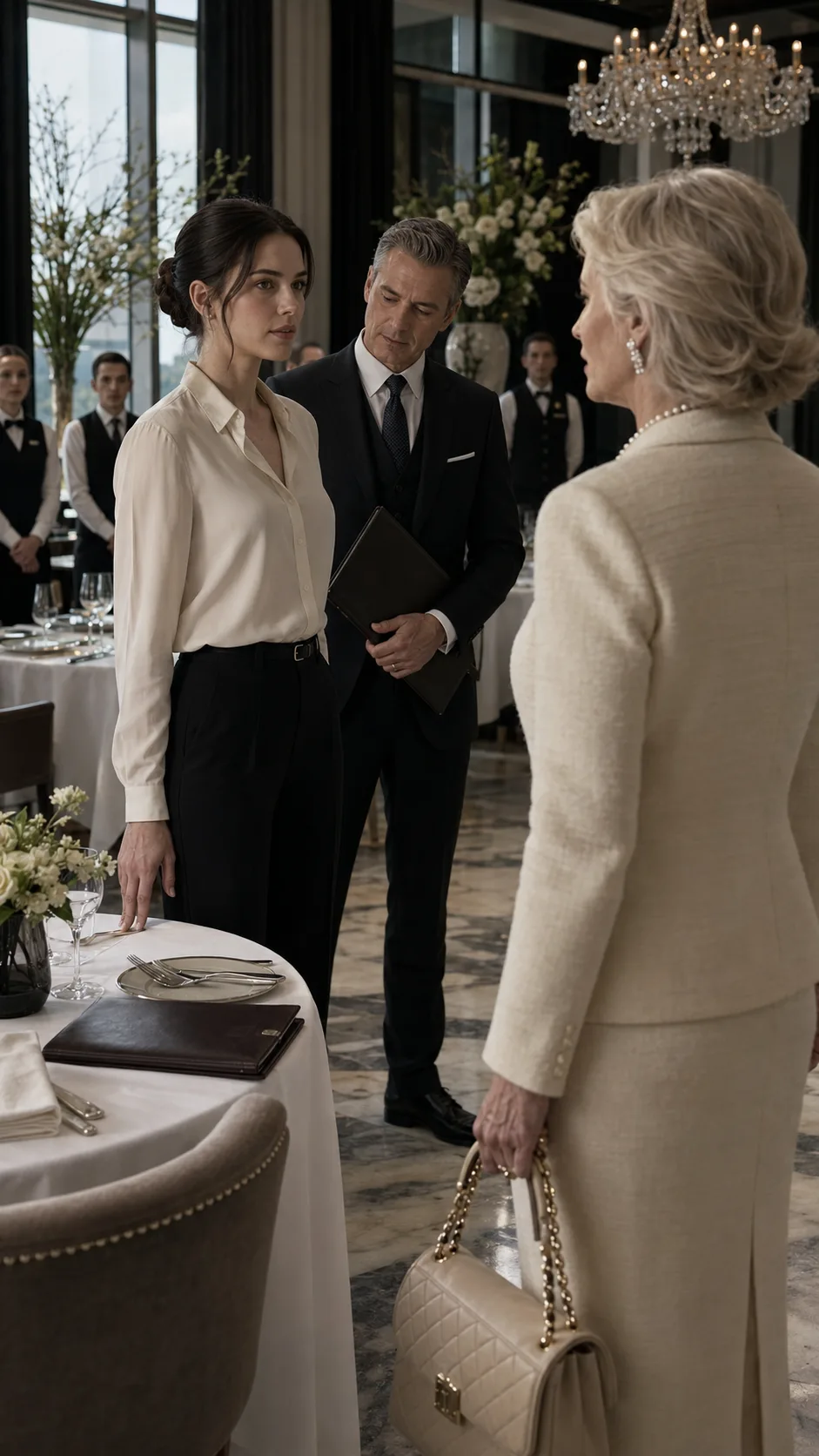
The morning sunlight poured through the tall glass windows of Bellemont House, turning the marble floor into a sheet of pale gold.
Chapter 1
The morning sunlight poured through the tall glass windows of Bellemont House, turning the marble floor into a sheet of pale gold.
The restaurant had always looked expensive from the outside, but inside, it felt almost unreal. Crystal chandeliers hung from the ceiling like frozen rain. White linen covered every table. Silver cutlery reflected the light in narrow flashes. Fresh flowers stood in tall vases along the walls, their fragrance mixing with the smell of polished wood, coffee, and warm bread from the kitchen.
For years, Bellemont House had been the kind of restaurant where people came not just to eat, but to be seen.
Businessmen signed contracts there. Politicians smiled for cameras there. Brides chose it for engagement dinners. Families who wanted to prove they had money reserved the private hall months in advance.
And that afternoon, Bellemont House would host a charity event for children who had aged out of foster care.
The event had been planned quietly. No flashy posters. No loud advertisements. No celebrity announcements.
The new owner
wanted it that way.
She wanted the first event under her leadership to mean something.
At the far end of the main hall, a young woman in a simple cream blouse and black trousers stood beside a long table, adjusting the placement of name cards that did not contain names yet. They were blank, elegant, and clean, waiting for handwritten notes later that afternoon.
Her name was Elena Hayes.
She was twenty-seven years old, tall, slender, and calm in a way that made people underestimate her. Her dark hair was tied neatly at the back of her neck. She wore no heavy jewelry, only a thin silver bracelet that had belonged to her mother. Her face was beautiful, but not in a loud way. It was the kind of beauty that people noticed slowly, after first noticing her quietness.
That morning, she had arrived before everyone else.
The staff had
begged her not to help.
“Ms. Hayes, please,” the manager had said nearly ten times. “You don’t have to arrange the tables yourself.”
But Elena had smiled.
“I want to see the hall the way the guests will see it.”
So she had walked table to table, straightening napkins, checking the flowers, making sure every chair was placed evenly. Not because she did not trust the staff, but because this place mattered to her.
Bellemont House was not just a restaurant.
It was a promise.
Twelve years ago, Elena had stood outside this same building in a secondhand coat, holding her mother’s hand while rain soaked through her shoes. Back then, her mother had worked here as a cleaner. She came after closing, when the wealthy guests had gone home and only wine stains, broken glass, and crumpled napkins remained.
Elena still remembered pressing her face to the cold window
and looking inside.
“Do you think people like us ever eat in places like this?” she had asked.
Her mother had squeezed her hand.
“Maybe not today,” she said gently. “But don’t let any room in this world convince you that you don’t belong in it.”
That sentence had stayed with Elena longer than anything else.
Through college.
Through business school.
Through nights when she worked two jobs and studied until her eyes burned.
Through investors who dismissed her.
Through men in boardrooms who asked if she was the assistant.
Through landlords, bankers, and clients who thought her soft voice meant weakness.
And finally, through the day she signed the papers to purchase Bellemont House from its retiring owner.
Her mother had not lived long enough to see it.
But Elena had brought her silver bracelet that morning.
And when she touched it, she felt, somehow, that her mother had entered the room with her.
“Elena?”
She turned.
Marcus Vane, the restaurant manager, stood near the entrance of the hall. He was in his fifties, dignified, with graying hair and a posture that looked permanently professional. He had worked at Bellemont House for nearly twenty years and knew every important family in the city.
“Everything is ready,” he said. “The kitchen is ahead of schedule. The flower delivery is complete. The press will arrive at four.”
Elena nodded. “Good. And the guest list?”
“Confirmed. Though Mrs. Celeste Whitmore’s assistant called again this morning to ask whether her table could be moved closer to the center.”
Elena gave a small smile. “Of course she did.”
Marcus sighed quietly. “She has always preferred attention.”
Everyone in the city knew Celeste Whitmore.
She was rich, widowed, and powerful in a way that came not from kindness but from fear. She sat on charity boards, owned pieces of half the city, donated publicly, insulted privately, and smiled beautifully while doing both.
Her late husband had built a real estate empire. After his death, Celeste turned his fortune into social control. She could destroy a young designer by not wearing her dress. She could bury a small business by whispering the wrong sentence at lunch. She could make doors open, close, or disappear.
Years ago, when Elena was still a struggling student, Celeste had been one of the donors at a scholarship dinner. Elena had served coffee that night as part of a catering job. She had accidentally spilled a drop near Celeste’s sleeve—not on her, only near her.
Celeste had looked at Elena as if she were something spoiled.
“Girls like you should be grateful to stand near people like us,” she had said.
Elena had never forgotten the words.
Not because they broke her.
Because they sharpened her.
Now Celeste Whitmore was coming to Elena’s charity event.
She did not know Elena owned Bellemont House.
Very few people did. The sale had been handled through a private holding company. Elena had wanted time to understand the business before becoming a public name. The staff knew. The lawyers knew. The previous owner knew. But the city did not.
By evening, everyone would.
“Elena,” Marcus said carefully, “are you sure you don’t want to change before guests arrive?”
She glanced down at her simple clothes. “I will. Later.”
“You look like one of the staff.”
She smiled. “That doesn’t bother me.”
Marcus looked at her for a moment, then softened. “No. I suppose it wouldn’t.”
Before Elena could reply, the front doors opened.
The sound was small, but it changed the room.
Several staff members near the entrance straightened instinctively.
Celeste Whitmore had arrived early.
She entered like she expected the air itself to make space for her. She wore an ivory designer suit, a pearl necklace, and diamond earrings that caught the chandelier light with every step. Her silver-blonde hair was styled perfectly. Her heels clicked on the marble floor, sharp and deliberate.
Behind her came a younger woman, probably an assistant, carrying a tablet and a handbag. She looked nervous, as if she had spent years learning how not to breathe too loudly.
Celeste stopped in the middle of the restaurant hall and looked around.
“Hm,” she said, not greeting anyone. “At least they polished the floor.”
Marcus was still near the side entrance, speaking to the florist. He had not seen her yet.
Elena stood beside a table, holding a folded napkin.
Celeste’s eyes landed on her.
For a second, there was no recognition.
Then came the familiar look.
Not curiosity.
Not politeness.
Judgment.
Celeste’s gaze moved from Elena’s blouse to her trousers, from her modest shoes to the napkin in her hand. Her lips curved slightly.
“You,” Celeste called.
The staff froze.
Elena turned fully toward her.
“Yes?”
Celeste walked closer, her assistant trailing behind.
“You work here?”
Her voice was loud enough for three servers near the bar to hear.
Elena held the napkin calmly. “I’m helping prepare the hall.”
Celeste let out a small laugh.
“Helping prepare the hall,” she repeated, as if the phrase amused her. “Honestly, people like you usually serve others, not sit in places like this.”
The room went still.
One of the servers lowered his eyes.
Another looked toward Elena, waiting for permission to intervene.
Elena gave no sign.
She only placed the napkin on the table and smoothed the edge with her fingertips.
“There’s no shame in working,” she said.
Celeste raised one eyebrow.
“Oh, how noble.”
Her assistant shifted uncomfortably. “Mrs. Whitmore…”
Celeste ignored her.
She stepped closer to Elena, lowering her voice only slightly.
“But with your salary, I doubt you could ever afford to dine in this restaurant.” She glanced around the hall. “Places like Bellemont House have standards. They’re built for certain people.”
Elena looked at her.
For one moment, the old memory returned.
Rain on the sidewalk.
Her mother’s tired hand.
The cold window.
People like us.
People like them.
But Elena did not feel small anymore.
She smiled, not warmly, but calmly.
“And what kind of people would that be, Mrs. Whitmore?”
Celeste seemed pleased to be recognized.
“The kind who understand refinement.”
“Kindness is also refinement,” Elena said.
Celeste laughed again, louder this time.
“Sweetheart, kindness is what people talk about when they have nothing else.”
A sharp silence followed.
The assistant’s face turned pale.
The servers did not move.
Celeste leaned slightly closer.
“Here is a little lesson. When important guests arrive, staff should know where to stand, when to speak, and when to disappear.”
Elena’s expression did not change.
“Is that what you believe?”
“That is how the world works.”
“No,” Elena said softly. “That is how people like you try to keep it working.”
For the first time, Celeste’s smile faded.
“What did you say?”
Before Elena could answer, hurried footsteps approached from the corridor.
Marcus entered the hall, holding a leather folder. He stopped when he saw Celeste standing so close to Elena.
His eyes moved quickly from Celeste’s face to Elena’s.
He understood enough.
But he was a professional man. He did not react dramatically. He simply walked forward, buttoned his suit jacket, and gave Elena a respectful nod.
“Ma’am,” he said, “everything is ready for your charity event. Would you like to personally inspect the hall before the guests arrive?”
The silence that followed was different from the silence before.
It was heavier.
Sharper.
Celeste turned slowly toward Marcus.
“Wait,” she said. “Are you talking to her?”
Marcus looked confused for only half a second.
Then he understood exactly what had happened.
“Of course,” he said. “Ms. Elena Hayes is the new owner of Bellemont House.”
The words seemed to strike Celeste physically.
Her mouth opened, but nothing came out.
The assistant stared at Elena.
The servers finally lifted their eyes.
Elena did not move. She did not smile triumphantly. She did not straighten her shoulders to appear powerful. She simply stood there, the same young woman Celeste had just mocked, the same calm expression on her face.
Celeste blinked.
“The owner?”
“Yes,” Marcus said. “The purchase was finalized last month. Today’s charity event is Ms. Hayes’s first public event as owner.”
Celeste looked at Elena again.
This time, she truly saw her.
Not as staff.
Not as background.
Not as someone beneath her.
As a woman who owned the room she had just tried to rule.
“That’s impossible,” Celeste said.
Elena tilted her head slightly. “Why?”
Celeste’s face tightened. “I mean—Bellemont House is an institution. It doesn’t just fall into anyone’s hands.”
“It didn’t fall,” Elena said. “I bought it.”
The sentence was quiet.
That made it worse.
Celeste looked around, as if searching for someone to correct the situation. But no one did.
The assistant lowered her eyes again, though this time Elena noticed something else in her expression.
Relief.
Maybe even satisfaction.
Celeste forced a laugh.
“Well,” she said, brushing invisible lint from her sleeve, “this is certainly unexpected. You should have introduced yourself properly.”
Elena’s gaze stayed steady.
“I did. You just decided who I was before listening.”
Celeste’s jaw hardened.
“I was simply making an observation.”
“You were making a judgment.”
“Don’t be dramatic.”
“I’m not.”
The two women stood across from each other, surrounded by crystal, flowers, and silent witnesses.
For the first time, Celeste had no audience laughing with her.
Only people watching.
Elena reached for the leather folder Marcus held and opened it.
“Your assistant requested that your table be moved closer to the center,” Elena said.
Celeste’s face eased slightly, believing the conversation had returned to normal rules.
“Yes. Naturally. I am one of the principal donors.”
Elena looked down at the seating chart.
“You were invited as a guest, Mrs. Whitmore. Not as a principal donor.”
Celeste stiffened. “Excuse me?”
“This event is funded by the Hayes Foundation.”
Celeste glanced at the folder, then back at Elena.
“The Hayes Foundation?”
“My foundation.”
Celeste’s eyes narrowed.
The name meant something now. It had appeared in business circles quietly over the last two years—anonymous investments, scholarships, emergency housing grants, legal aid funds. No one knew who controlled it. People speculated it belonged to an old family, or a tech billionaire, or a foreign investor.
Not a young woman standing in simple black trousers.
“You?” Celeste whispered.
Elena closed the folder.
“Yes.”
Celeste’s assistant looked at Elena differently now—not with fear, but with something close to admiration.
Celeste recovered quickly, or tried to.
“Well, then,” she said with a brittle smile, “it seems congratulations are in order. I always support ambitious young women.”
Elena almost laughed.
But she did not.
Instead, she said, “Do you?”
Celeste’s eyes flickered.
“Of course.”
“That’s interesting,” Elena said. “Because ten years ago, at the Whitmore Scholarship Dinner, you told a student working catering that girls like her should be grateful to stand near people like you.”
Celeste went very still.
The assistant looked up.
Marcus’s expression darkened.
Elena continued, her voice even.
“That student was me.”
For once, Celeste could not pretend confusion.
Her face showed recognition now, slow and unwilling.
A younger Elena. A coffee tray. A humiliated girl in a black apron, standing under hotel lights while rich guests looked away.
“You remember,” Elena said.
Celeste swallowed.
“I’ve attended hundreds of events. I can’t be expected to remember every—”
“Every person you humiliated?”
Celeste’s mouth tightened. “Careful.”
Elena stepped closer, not aggressively, but with quiet authority.
“No, Mrs. Whitmore. You be careful. Not because I own this restaurant. Not because I have money now. But because every person you speak down to has a life you know nothing about. Every waitress. Every cleaner. Every driver. Every assistant standing two steps behind you while carrying your bag.”
At that, Celeste’s assistant froze.
Celeste noticed and snapped, “Amelia.”
The assistant lowered her gaze again, but her hand tightened around the tablet.
Elena saw it.
She had seen that look many times.
A person trained to shrink.
“Elena,” Marcus said quietly, “the press will arrive soon.”
“I know.”
Celeste lifted her chin. “Good. Then perhaps we should all behave like adults.”
“We should,” Elena said. “That’s why I’m giving you a choice.”
Celeste’s eyes sharpened. “A choice?”
“You can remain at today’s event as a guest, if you treat every member of my staff with respect.”
“My staff?” Celeste repeated bitterly.
“Yes,” Elena said. “My staff.”
The words landed firmly.
Celeste’s face flushed with anger.
“And if I refuse?”
Elena glanced toward the entrance.
“Then you may leave before the guests arrive.”
Celeste stared at her.
“You would throw me out?”
“I would ask you to leave a private charity event hosted in my restaurant.”
“You have no idea what kind of influence I have in this city.”
Elena’s expression softened, but not kindly.
“I know exactly what kind of influence you have. That’s why I’m not afraid of it.”
Celeste stepped closer, her voice dropping.
“You think buying one restaurant makes you powerful?”
“No,” Elena said. “I think refusing to become like the people who hurt me makes me powerful.”
That sentence hung in the air.
For a moment, Celeste looked less like a queen and more like a woman standing on a floor that had shifted beneath her.
Then the front doors opened again.
Three photographers entered with event staff, followed by two reporters and the first small group of guests.
Celeste instantly changed.
Her shoulders relaxed. Her mouth curved. Her anger vanished behind the practiced smile that had fooled an entire city for years.
“Elena, dear,” she said warmly, loud enough for newcomers to hear. “I had no idea you were behind this wonderful event. What an inspiring story.”
She reached out as if to take Elena’s hands.
Elena did not move.
The gesture remained suspended between them, false and awkward.
One photographer noticed.
Then another.
Celeste’s smile tightened.
“Elena,” she whispered, barely moving her lips, “don’t embarrass yourself.”
Elena looked at the photographers, then at the guests, then back at Celeste.
“I’m not the one who should be embarrassed.”
Celeste’s hand slowly dropped.
Marcus stepped forward.
“Mrs. Whitmore, shall I show you to your table?”
Celeste glanced at him with cold irritation.
Before she could answer, Amelia, the assistant, spoke.
“No.”
Everyone turned.
Her voice was small, but clear.
Celeste’s head snapped toward her. “What did you say?”
Amelia’s face was pale, but she stood straighter than before.
“I said no.”
Celeste looked stunned, as if the handbag had spoken.
Amelia set the handbag carefully on the nearest table.
“I won’t carry this anymore.”
Celeste’s eyes widened with fury. “Have you lost your mind?”
“No,” Amelia said, her voice trembling now. “I think I’m finding it.”
The room fell silent again.
Guests who had just entered stopped near the doorway.
A reporter slowly lowered her notebook, watching.
Amelia looked at Elena, then back at Celeste.
“She talks to everyone like that,” Amelia said. “Drivers. servers. hotel staff. me. She says people should know their place.” Her voice cracked, but she continued. “I think today she found hers.”
A sound moved through the room—not laughter, exactly. Something quieter. Shock mixed with approval.
Celeste’s face turned white.
“You are fired,” she hissed.
Amelia nodded. “I know.”
Elena turned to Marcus.
“Mr. Vane, do we still have an opening in guest relations?”
Marcus understood immediately.
“Yes, ma’am.”
Elena looked at Amelia. “If you want it, come tomorrow morning at nine. Not as charity. As an interview.”
Amelia’s eyes filled, but she held herself together.
“Thank you.”
Celeste looked from Amelia to Elena, realizing she had lost control of both the room and the story.
“This is absurd,” she said.
“No,” Elena said. “This is consequences.”
For the first time, cameras flashed.
Celeste flinched.
She turned sharply toward the photographers. “Do not take pictures of me.”
One reporter stepped forward. “Mrs. Whitmore, would you care to comment on Ms. Hayes’s new charity initiative?”
Celeste opened her mouth.
No words came.
Elena stepped beside her, not to protect her, but to end the scene before it became ugly.
“Mrs. Whitmore was just leaving,” Elena said.
Celeste stared at her.
The old Celeste would have fought. She would have threatened lawsuits, called board members, ruined reputations by dinner.
But this was not a private room full of frightened people.
This was Elena’s house.
Her staff stood behind her.
Her guests watched.
Her assistant had stepped away.
Her mask had cracked where everyone could see it.
Celeste picked up her handbag herself.
It was a small action.
But everyone noticed.
She walked toward the exit with her chin raised, trying to appear dignified. Yet her footsteps sounded different now. Not commanding. Empty.
At the door, she paused and turned back.
Her eyes found Elena.
For a second, something passed across her face—not apology, not quite. Maybe the first uncomfortable taste of seeing another person fully.
Then she left.
The doors closed behind her.
The room remained silent.
Elena took one breath.
Then another.
Marcus approached her carefully.
“Are you all right?”
Elena touched the bracelet on her wrist.
“Yes,” she said. “I think I am.”
The event began fifteen minutes later.
By then, the hall had transformed again. Guests filled the tables. Soft music played. Servers moved gracefully between chairs. Cameras captured the flowers, the food, the donations, the speeches.
But people whispered about what had happened before the event.
They whispered about the young owner.
About Celeste Whitmore.
About the assistant who quit in front of everyone.
About the sentence Elena had spoken so calmly:
“There’s no shame in working.”
When Elena stepped onto the small platform near the center of the hall, the room quieted.
She looked out at the faces before her—wealthy donors, journalists, staff, young adults from the foster care program, former teachers, social workers, and people who had come because they believed in the cause, not the attention.
For a moment, she saw her mother again.
Not as she had been in the hospital, fragile and tired.
But as she had been outside Bellemont House in the rain, holding Elena’s hand and telling her not to let any room decide her worth.
Elena leaned toward the microphone.
“Thank you for being here,” she began.
Her voice was steady.
“Today is not about me. It is not about the purchase of this restaurant, or the people who will write about it tomorrow. Today is about young people who are told too often that their future depends on where they came from.”
She paused.
Several young guests at the front table looked up.
“I know what it feels like to stand outside rooms like this and believe they were not built for you. I know what it feels like to be judged by your clothes, your job, your family name, or your silence.”
The room was still.
“But I also know this: dignity does not come from money. Class does not come from a table reservation. Worth does not come from being served. Sometimes the strongest person in the room is the one carrying plates, cleaning floors, answering phones, or smiling through insults they did not deserve.”
A few staff members lowered their eyes.
Not from shame.
From emotion.
Elena continued.
“My mother cleaned this restaurant many years ago. She never ate here. She never owned a dress expensive enough to enter as a guest. But she had more grace than anyone I have ever known.”
Her voice softened.
“She taught me that work is not humiliation. Cruelty is.”
The first applause came from the back of the room.
Then another table joined.
Then another.
Soon the entire hall was clapping.
Elena looked down for a moment, breathing through the ache in her chest.
When she looked up, she saw Amelia standing near the side wall. She was no longer holding Celeste’s handbag. Her hands were free.
And she was clapping too.
That evening, the charity event raised more money than expected.
Enough to fund housing support, scholarships, job training, and emergency grants for dozens of young people.
The newspapers wrote about Elena Hayes the next morning.
Some articles called her “the mysterious new owner of Bellemont House.”
Some called her “the young philanthropist changing the city’s social scene.”
One headline read:
She Bought the Restaurant Where Her Mother Once Cleaned Floors
Celeste Whitmore’s name appeared too, but not the way she would have wanted.
For weeks, invitations to certain boards quietly stopped arriving. Donors who had once feared her began distancing themselves. Staff from her household resigned one by one. Her influence did not disappear overnight, but it began to weaken, not because Elena destroyed her, but because people had finally seen her clearly.
As for Amelia, she came to Bellemont House the next morning at exactly nine.
She wore a navy dress, carried no one’s bag, and shook Elena’s hand with trembling courage.
Six months later, she became one of the best guest relations managers the restaurant had ever had.
Bellemont House changed too.
It remained elegant. The chandeliers still shone. The food was still expensive. The guests still wore silk and diamonds.
But something in the spirit of the place shifted.
Elena created a staff scholarship fund in her mother’s name.
Every year, Bellemont House hosted free dinners for families who had never been able to afford a meal there.
And near the entrance, beside the hostess stand, Elena placed a small framed sentence.
Not large.
Not flashy.
Just visible enough for anyone entering to read.
No honest work makes a person small.
Years later, when people asked Elena what moment changed everything, they expected her to mention the purchase, the press, the charity event, or the speech.
But Elena always smiled and gave the same answer.
“It was the moment someone tried to remind me of my place,” she said, “and I realized I no longer needed her permission to stand in it.”
And on quiet mornings, before the restaurant opened, Elena still walked through the hall herself.
Sometimes she adjusted a chair.
Sometimes she straightened a napkin.
Sometimes she stood by the window and looked out at the sidewalk where a little girl once stood in the rain, believing beautiful rooms belonged only to other people.
Then she would touch the silver bracelet on her wrist and whisper,
“We made it, Mom.”
And the sunlight would fill Bellemont House again.
Chapter complete
You have reached the end of this chapter.
Continue reading
A few more worlds to get lost in after this chapter.




