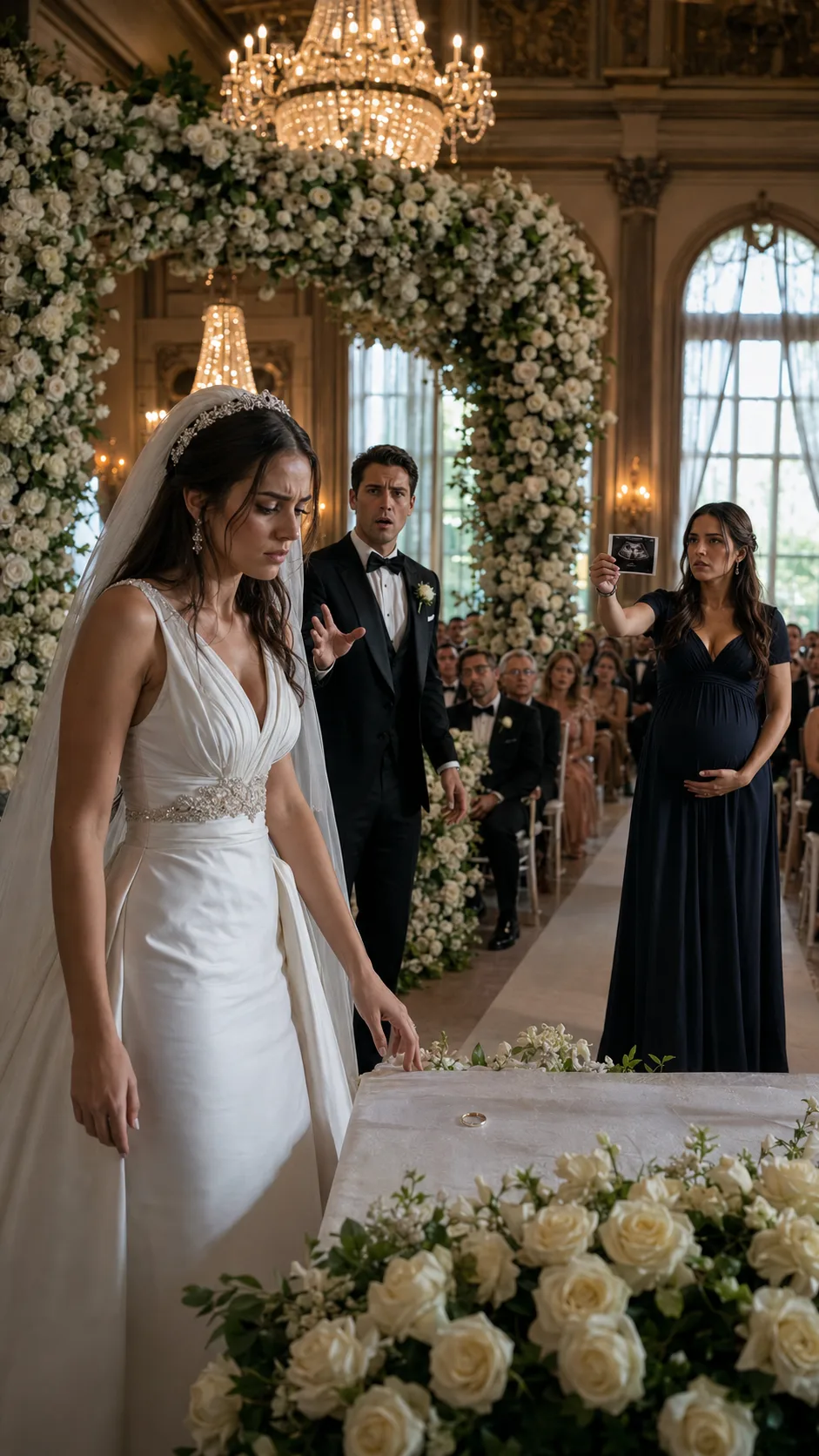
The wedding hall had been booked two years in advance.
Chapter 1
The wedding hall had been booked two years in advance.
That was what Celeste Whitmore’s mother kept telling everyone who asked why the ceremony looked like something from a magazine instead of a family celebration.
Two years for the venue.
Nine months for the dress.
Six months for the flowers.
Three weeks just to approve the shade of ivory on the napkins.
Everything had been chosen, checked, polished, and perfected.
The hall sat on the top floor of the Harrington Grand Hotel, overlooking Boston Harbor through tall arched windows. Late afternoon sunlight entered through sheer curtains, soft and golden, touching the white roses along the aisle and the silver embroidery on Celeste’s gown.
Guests sat beneath chandeliers shaped like falling stars.
The air smelled of roses, champagne, and money.
Celeste stood just behind the closed doors with her father’s arm linked through hers. Judge Richard Whitmore, retired but still feared by half the lawyers in Massachusetts, looked down at his
daughter with a rare softness in his eyes.
“You look like your mother did,” he said.
Celeste smiled, though her throat tightened.
Her mother, Margaret, stood behind them, dabbing the corner of her eye with a handkerchief.
“You’re not allowed to cry before the vows,” Celeste whispered.
Margaret tried to laugh. “I’m your mother. I’m allowed to cry before, during, and after.”
Celeste breathed slowly.
She was twenty-nine years old, educated, composed, and used to walking into rooms where people expected her to be perfect. Her father had raised her to stand straight. Her mother had taught her to smile even when people were watching for weakness.
And today, everyone was watching.
She had agreed to marry Adrian Vale after three years of carefully built love.
At least, that was what she had believed it was.
Adrian was charming without seeming careless, handsome without appearing vain, ambitious without looking cruel.
His family owned Vale Properties, a powerful real estate company that had turned old warehouses into luxury apartments and forgotten neighborhoods into investment maps. His name opened doors. His smile softened negotiations. His mother, Evelyn Vale, spoke of legacy like it was a religion.
Celeste had never been dazzled by wealth.
She had grown up surrounded by respected people who hid ugly things behind clean manners. She knew polished silver could still reflect a lie.
But Adrian had seemed different.
He listened.
He remembered small details.
He brought tea to her office when she worked late.
He held her hand under dinner tables when his family became too performative.
He once told her, “With you, I don’t feel like I have to pretend.”
That sentence had mattered to her.
Now, as the music began and the doors opened, Celeste stepped into the aisle believing she was walking toward the man
who had finally chosen honesty over image.
Every guest rose.
Cameras lifted.
The string quartet played a soft, trembling arrangement of a song Celeste had chosen because Adrian once said it reminded him of rain in Paris.
At the altar, Adrian turned.
For one second, when he saw her, his expression broke open into something that looked sincere.
Celeste saw it and relaxed.
Maybe love was still real, she thought.
Maybe after all the rehearsals, family speeches, careful photographs, and expensive arrangements, the most important thing was still simple: two people deciding to stand together.
Her father placed her hand into Adrian’s.
“Take care of her,” Richard said quietly.
Adrian looked him in the eye. “Always.”
Celeste remembered that word later.
Always.
It would become the sharpest word of the day.
The officiant smiled and opened his leather folder.
“Dearly beloved,” he began.
Then the doors opened behind them.
Not the gentle opening of a late guest slipping inside.
The doors opened fully.
A cold draft moved through the hall.
The music faltered, then stopped.
Every head turned.
Celeste turned too.
A young woman stood at the entrance.
She was perhaps twenty-six, tall and slender except for the unmistakable curve of pregnancy beneath her long dark dress. Her brown hair was pinned loosely at the back of her neck, though a few strands had fallen around her face. She wore no jewelry except a thin silver bracelet. Her makeup was minimal, and her skin looked pale under the golden light.
But her eyes were steady.
She did not look like someone who had wandered into the wrong wedding.
She looked like someone who had fought herself all the way there.
The silence deepened as she walked forward.
Her heels echoed against the marble floor.
Click.
Click.
Click.
No one stopped her.
Perhaps because everyone was too shocked.
Perhaps because scandal, when it enters beautifully dressed, is often mistaken for authority.
Celeste felt Adrian’s hand stiffen around hers.
She looked at him.
His face had changed completely.
The warmth was gone. The color had drained from his skin. His jaw opened slightly, as if his body had recognized danger before his mind could form a lie.
That frightened Celeste more than the woman.
Because Adrian knew her.
The pregnant woman stopped halfway down the aisle.
She did not look at Celeste first.
She looked directly at Adrian.
One hand rested on her belly.
Her voice came out soft, but the room carried every word.
“While you’re promising her forever… your child is already with me.”
A sound moved through the guests.
Not a gasp.
Not yet.
Something lower, uglier, like a hundred people inhaling the same secret.
Celeste’s fingers slowly slipped out of Adrian’s hand.
The woman reached into her bag.
Adrian took one step forward.
“Mara,” he said.
The name landed like proof.
Celeste stared at him.
Mara.
He had not said, “Who are you?”
He had not said, “This is a mistake.”
He had said her name.
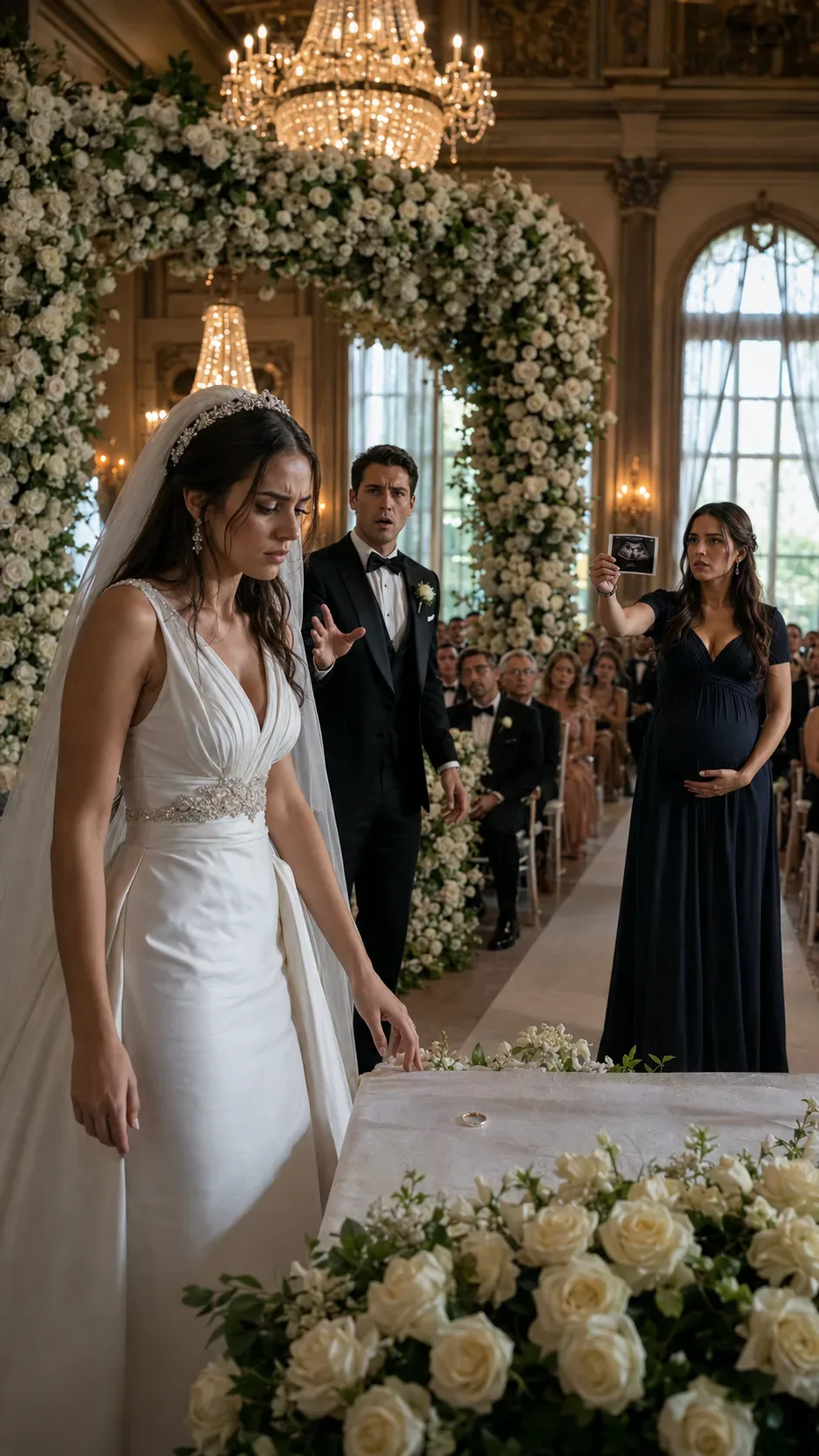
Mara pulled out an ultrasound photo and held it up. Her hand trembled once, then steadied.
“I didn’t come to ruin your wedding,” she said. “I came so that one day this child would never have to hear that his father stood in silence and said nothing.”
The room fell completely silent.
Even Evelyn Vale, who had been sitting in the front row in a pearl-gray dress and diamonds, looked frozen.
Celeste turned fully toward Adrian.
“Is it true?” she asked.
Adrian’s lips moved, but no sound came.
Mara’s eyes flickered toward Celeste for the first time. There was shame there, but not cruelty.
“I’m sorry,” Mara said. “I tried to reach you before today.”
Celeste’s chest tightened.
“Me?”
Mara nodded. “Three messages. One letter to your office. They were returned.”
Celeste slowly looked at Adrian again.
He swallowed.
“Celeste, this is not the place.”
The sentence was so small, so insulting, that something inside her went still.
Not the place.
As if the problem was not the betrayal.
As if the problem was the timing.
As if a wedding hall full of guests was sacred, but the woman carrying his child was not.
Celeste looked at the officiant.
The poor man stood with his mouth slightly open, holding a ceremony script that suddenly belonged to another universe.
Then Celeste looked at Mara.
The young woman was breathing carefully, one hand still on her belly, shoulders squared with the kind of strength that came from having no safe options left.
Celeste turned back to the groom.
“Answer her before you answer me.”
Adrian blinked. “What?”
“You heard me.”
His mother rose from the front row.
“Celeste, darling,” Evelyn said quickly, her voice smooth but tight. “Let us handle this privately.”
Celeste did not even look at her.
“No.”
A single word.
Clean and final.
Evelyn’s expression hardened.
Richard Whitmore stood slowly beside his wife, his eyes on Adrian with the cold patience of a judge who had heard enough weak testimony to recognize guilt before confession.
Adrian lowered his voice. “Celeste, please. Don’t let her turn this into a circus.”
Mara flinched.
Celeste saw it.
That small movement told her more than a confession.
“How long?” Celeste asked.
Adrian stared at her.
“How long have you known she was pregnant?”
He rubbed a hand over his mouth. “It’s complicated.”
“No,” Celeste said. “It is painful. It is humiliating. It may be unforgivable. But it is not complicated.”
A murmur moved through the hall.
Adrian’s best man, Lucas, looked down at the floor.
Celeste noticed.
“Lucas,” she said.
Lucas froze.
Adrian turned sharply. “Don’t.”
Celeste’s voice became quieter. “Lucas. How long?”
Lucas was Adrian’s cousin, his childhood friend, his shadow at every party. He had always been kind to Celeste in a distant, nervous way. Now his face looked gray.
“I’m sorry,” Lucas whispered.
Evelyn snapped, “Lucas.”
He looked at his aunt, then at Mara’s belly, then at Celeste.
“Since December,” he said.
The wedding was in May.
Five months.
Celeste nodded once.
It was strange what the mind did in moments like that.
She did not scream.
She did not cry.
Instead, she remembered December.
Adrian had gone to New York for “investor meetings.”
He had missed her father’s birthday dinner.
He had returned with a Cartier bracelet and guilt disguised as affection.
She had worn that bracelet at Christmas.
It was on her wrist now.
Celeste slowly unclasped it.
Adrian watched her.
“Celeste…”
She placed the bracelet on the altar table beside the unity candle.
It made a small sound against the polished wood.
That sound was louder than it should have been.
Mara’s eyes filled with tears, but none fell.
“I didn’t know about her at first,” Mara said. “Not really. He told me the engagement was over. He said your families were forcing a public announcement to save face because of business ties.”
Celeste almost smiled.
Not because it was funny.
Because it was so perfectly Adrian.
A lie tailored to the person hearing it.
To Mara, he was trapped.
To Celeste, he was devoted.
To his mother, he was useful.
To himself, perhaps he was innocent.
Adrian stepped toward Mara. “You don’t understand what you’re doing.”
Mara held her ground. “I understand exactly what I’m doing.”
“You’re embarrassing yourself.”
Celeste’s head turned sharply.
The sentence revealed him.
Not the cheating.
Not even the pregnancy.
That sentence.
You’re embarrassing yourself.
He had not asked if she was okay. He had not asked about the child. He had not denied it. His first real emotion was anger that she had disturbed his image.
Mara’s mouth trembled, but she lifted her chin.
“For months, you told me to stay quiet,” she said. “You said you would handle it. You said after the wedding, after the honeymoon, after the press photos, after your family foundation gala. There was always an after.”
The guests were no longer whispering.
They were listening.
Mara’s voice grew steadier.
“You sent money through your assistant. You sent a doctor’s name. You sent a message saying stress was bad for the baby, so I should stop calling.”
Celeste looked at Adrian.
His eyes flickered.
That was all.
But it was enough.
Evelyn stepped into the aisle. “This woman is clearly unstable.”
Mara looked at her.
For the first time, anger entered her face.
“No,” Mara said. “I was alone. There’s a difference.”
Evelyn’s lips thinned.
Celeste turned toward Evelyn.
“You knew.”
Evelyn did not answer quickly enough.
Margaret Whitmore covered her mouth.
Richard’s face became carved stone.
Celeste repeated, “You knew.”
Evelyn lifted her chin. “I knew there was a situation.”
“A situation,” Celeste said.
“At this level, families must be practical.”
Mara gave a bitter laugh under her breath.
Celeste felt something cold move through her.
“At this level,” she repeated.
Evelyn looked around the room, realizing too late that everyone was hearing her. “Celeste, you are an intelligent woman. Men make mistakes. Marriage is not built on childish perfection.”
Celeste stared at her.
“And children?” she asked. “What are they built on?”
Evelyn’s expression flickered.
Celeste stepped down from the altar.
The train of her gown moved behind her like white water.
Adrian reached for her arm.
She pulled away before he touched her.
“Do not,” she said.
The softness in her voice made him stop.
She walked toward Mara.
The hall watched.
Mara looked uncertain now, as if she had expected hatred and did not know what to do with dignity.
Celeste stopped a few feet away.
“What’s your full name?” she asked.
“Mara Ellis.”
“How far along are you?”
“Twenty-eight weeks.”
Celeste absorbed that.
Seven months.
The math was cruel.
“Have you had proper medical care?”
Mara blinked.
The question seemed to break something in her.
“Yes,” she whispered. “Mostly.”
“Mostly?”
Mara’s eyes dropped. “I lost my job in March. I was working at a design firm connected to Vale Properties. After I told Adrian I was keeping the baby, my contract wasn’t renewed.”
Celeste turned slowly.
Adrian closed his eyes.
The guests saw it.
This time, even his mother looked nervous.
Richard Whitmore stepped into the aisle.
“Adrian,” he said.
It was not loud.
It did not need to be.
Adrian looked like a boy caught stealing from a drawer.
“Judge Whitmore—”
“No,” Richard said. “You do not get to use my title as shelter.”
Celeste turned back to Mara.
“Do you have family here?”
Mara shook her head. “My mother is in Vermont. She doesn’t know I came today.”
“Did you come alone?”
“Yes.”
Celeste looked toward the back of the hall. Hotel security had appeared near the doors, uncertain whether to intervene.
“No one touches her,” Celeste said clearly.
Evelyn’s face tightened. “Celeste, you cannot be serious.”
“I have never been more serious.”
Adrian moved closer. “Listen to me. I made a mistake.”
Celeste turned to him.
The word mistake sat between them like a dead thing.
“A mistake is forgetting a date,” she said. “A mistake is misreading a contract. A mistake is turning left when you should have turned right.”
Her voice shook now, not with weakness, but with controlled fury.
“You built a second life, created a child, silenced the mother, let your family bury her, and stood here ready to say vows to me under flowers I chose.”
Adrian’s face twisted. “I was going to tell you.”
“When?”
He had no answer.
Celeste stepped closer.
“When the child was old enough to be hidden at boarding school? When your mother found a legal arrangement that sounded tasteful? When I was pregnant too and too trapped to walk away?”
Evelyn gasped. “That is outrageous.”
Celeste looked at her.
“No. What’s outrageous is that you thought I was decorative.”
That silenced Evelyn.
Celeste turned to the guests.
Her heart was pounding so hard she could feel it in her hands, but her voice remained clear.
“I apologize to everyone who came here today believing you were witnessing a marriage.”
A terrible stillness filled the room.
“You are not.”
Adrian’s face went blank.
“Celeste,” he said, almost pleading now. “Don’t do this.”
She looked at him for a long moment.
She saw the man who had brought her tea.
The man who had kissed her forehead in hospital waiting rooms.
The man who had memorized her favorite flowers.
The man who had lied so smoothly that love itself now seemed like a costume he had worn well.
“I’m not doing this,” she said. “You did.”
Then she turned to the officiant.
“There will be no wedding.”
Someone in the back gasped.
The sentence moved through the hall like glass breaking.
Adrian reached for her again, desperation making him careless.
“Celeste, think about what this means.”
She looked at his hand near her arm.
He dropped it.
“I am thinking,” she said. “For the first time today, everyone is.”
Mara’s breathing had become uneven. She pressed one hand harder against her belly.
Celeste noticed immediately.
“Mara?”
“I’m fine,” Mara said, though she clearly was not.
The stress, the walk, the weight of hundreds of eyes—it had cost her more than she wanted to admit.
Celeste turned to her mother. “Mom, call Dr. Levin.”
Margaret, still stunned, reacted instantly. Celeste’s mother had spent twenty years volunteering at women’s clinics before becoming director of a medical charity. Shock had frozen her, but purpose thawed her quickly.
“I’ll call now.”
Mara shook her head. “No, please, I don’t want to cause more—”
“You haven’t caused anything,” Celeste said gently. “You told the truth in a room designed to hide it.”
Mara’s eyes filled again.
Adrian took a step forward. “I’ll take her.”
Both women looked at him.
For one second, his confidence returned, as if he believed action could restore ownership.
Celeste’s reply was calm.
“No.”
Adrian stared. “That is my child.”
Mara’s voice broke through before Celeste could answer.
“Then say it.”
Everyone froze again.
Mara turned toward him fully, both hands now around the ultrasound photo.
“Say it,” she repeated. “Not to me. Not in some private message. Say it here.”
Adrian’s throat moved.
Mara’s voice sharpened.
“You were ready to promise forever in front of everyone. So say one true sentence in front of everyone.”
Celeste stepped aside, leaving a clear line between them.
Adrian looked around.
His relatives.
Business partners.
Friends.
Photographers.
His mother.
The bride he had lost.
The pregnant woman he had abandoned.
The child he could no longer reduce to a problem.
His mouth opened.
Nothing came out.
Mara watched him.
The pain on her face was quiet and devastating.
At last, she nodded once, as if receiving the answer she had always feared.
“That’s what I came for,” she whispered. “Not money. Not revenge. Just to know whether silence was all you had.”
Adrian’s eyes reddened. “Mara—”
“No,” she said. “You don’t get to say my name like it makes you kind.”
A few guests looked away.
There are moments when shame becomes too intimate to watch.
Celeste removed her engagement ring.
It took effort. Her fingers were slightly swollen from nerves and heat. For one absurd second, the ring resisted, as if even jewelry had been trained to perform permanence.
Then it came free.
She walked back to the altar and placed it beside the bracelet.
Evelyn made a wounded sound. “Celeste, please. We can manage this.”
Celeste almost laughed.
“Manage?”
“Yes,” Evelyn said quickly, stepping closer. “There are legal paths. Financial protections. Public statements. You do not have to throw away your future because of one unfortunate—”
“One more word,” Richard Whitmore said, “and I will forget that this is my daughter’s wedding and remember every courtroom instinct I ever had.”
Evelyn stopped.
Adrian’s father, Thomas Vale, who had been silent until now, stood with a face full of exhaustion. He looked older than he had when he entered.
“Evelyn,” he said quietly. “Enough.”
She turned on him. “Don’t you dare.”
Thomas looked at Mara, then at Celeste.
“No,” he said. “I should have dared a long time ago.”
The sentence suggested history.
Old silence.
Old damage.
Celeste did not have room for it now.
Hotel staff brought a chair for Mara. Celeste guided her toward it, one hand hovering near her back but not touching without permission.
Mara sat carefully.
The hall remained full of guests who no longer knew whether they should leave, stay, pray, or pretend they had not attended the collapse of a dynasty.
Celeste crouched slightly beside Mara despite the heavy wedding gown.
“Is the baby moving?” she asked.
Mara nodded. “Yes. He kicked when I got to the doors.”
“He?”
A tiny, broken smile touched Mara’s mouth.
“Yes.”
Celeste looked at her belly, then away, giving her privacy.
“What’s his name?”
“I haven’t decided.”
Adrian stood motionless near the altar.
For the first time, Celeste wondered if he understood that he had not only lost a bride. He had lost the privilege of being believed.
Margaret returned. “Dr. Levin is downstairs at the hotel fundraiser. She’s coming up now.”
Of course she was, Celeste thought.
In a building this expensive, even emergencies arrived through coincidence dressed as convenience.
As they waited, the room began to shift.
People who had come to celebrate power now watched it fail.
Some guests stood awkwardly and left.
Some remained seated, trapped by curiosity.
Adrian’s friends avoided his eyes.
Celeste’s college roommate, Naomi, came down the aisle with tears in her eyes, but Celeste gave a small shake of her head. Not yet. If Naomi hugged her now, she might break.
And she could not break yet.
There were still things to finish.
Celeste stood.
“Photographers,” she said.
Two men near the side froze.
“No more photos,” she said. “Delete nothing. Publish nothing. My attorney will contact you.”
They nodded quickly.
Then she looked at the wedding planner.
“Please inform the reception staff that dinner will not proceed as planned. Any vendor who worked today will still be paid in full.”
The planner blinked, then nodded.
Adrian stared at her. “You’re handling vendors right now?”
Celeste looked at him.
“Yes,” she said. “Because unlike you, I understand that other people’s lives do not stop being real when mine becomes inconvenient.”
That landed harder than shouting.
A doctor arrived minutes later, a woman in her fifties wearing a navy dress and carrying the calm authority of someone used to entering rooms at their worst. She checked Mara discreetly behind a screen of bridesmaids and Celeste’s mother.
The baby was fine.
Mara needed rest, water, and quiet.
Quiet, unfortunately, had become impossible in that hall.
Celeste made a decision.
“She can use the bridal suite,” she said.
Evelyn’s eyes widened. “Absolutely not.”
Celeste turned to the planner. “Please have someone bring water and something light to eat.”
The planner nodded and hurried away.
Evelyn stepped close enough that only those nearby could hear.
“You are making a spectacle of yourself.”
Celeste looked at her almost with pity.
“No, Evelyn. I was almost made into one.”
Then she walked toward the back of the hall, removed her veil, and handed it to Naomi, who had silently appeared beside her.
Naomi whispered, “What do you need?”
Celeste’s lips trembled once.
“Walk with me.”
Together, they escorted Mara out of the hall.
Not Adrian.
Not his mother.
Celeste.
The bride who had every reason to hate her.
As they passed the rows of guests, people looked down, ashamed of their own hunger for drama. Mara kept one hand on her belly and the other gripping the ultrasound photo.
At the doors, she stopped.
Celeste glanced at her.
“What is it?”
Mara looked back at the altar.
Adrian stood beneath the roses, alone in his tuxedo, surrounded by flowers meant for vows he had not deserved.
For one second, his face cracked.
Maybe regret.
Maybe humiliation.
Maybe fear.
Mara did not soften.
“I hope he becomes better,” she said quietly. “But I’m done waiting for it.”
Celeste nodded.
“So am I.”
They left the hall.
The bridal suite was filled with champagne, fruit, emergency makeup kits, silk robes, and the ghost of a morning that now felt like it belonged to another woman.
Mara sat on the couch while Dr. Levin checked her blood pressure again. Margaret stayed nearby, gentle but practical.
Celeste stood by the window, looking out at the harbor.
Behind her, Naomi unbuttoned the back of her wedding gown in silence.
Layer by layer, Celeste stepped out of the dress.
She changed into the ivory suit she had planned to wear when leaving for the reception after-party.
The suit felt like armor.
Her phone had forty-seven missed calls within fifteen minutes.
Adrian.
Evelyn.
Unknown numbers.
She turned it off.
Mara watched her with exhausted eyes.
“I’m sorry,” she said again.
Celeste turned.
“Did you know he was still with me when it started?”
Mara swallowed.
“No. Not at first. When I found out, I ended it. Then I found out I was pregnant. I told him because I thought he had a right to know.” Her voice thinned. “I thought that meant he would act like someone worthy of knowing.”
Celeste sat across from her.
“I believe you.”
Mara pressed her lips together.
Those three words seemed to hurt more than accusation.
“Why?” she whispered.
Celeste looked down at her bare ring finger.
“Because liars create confusion. Truth creates pain. What you did today was painful. But it was clear.”
Mara began to cry then.
Not loudly.
Just silently, with one hand covering her mouth as if she had been holding it back for months.
Celeste did not rush to comfort her. She let the tears exist. Some grief deserved witnesses, not solutions.
Later, after Mara’s mother was called, after Dr. Levin arranged for her to be taken safely to a hospital for monitoring, after Margaret insisted that Mara not leave alone, Celeste finally turned her phone back on.
The messages were exactly what she expected.
Adrian: Please talk to me.
Adrian: You don’t understand everything.
Adrian: I panicked.
Adrian: I love you.
Adrian: Don’t let one mistake destroy us.
Celeste stared at the last message for a long time.
Then she typed:
One mistake did not destroy us. Your character did.
She sent it.
Then she blocked him.
By evening, the wedding that never happened had become a storm moving through private circles, business contacts, and eventually public rumor. No official photos appeared, but people talked. People always talked.
The Vale family released a statement the next morning.
“Due to a private family matter, the wedding of Adrian Vale and Celeste Whitmore has been postponed.”
Celeste read it while sitting at her parents’ kitchen table in sweatpants, drinking coffee her father had made badly but lovingly.
Postponed.
She almost admired the audacity.
Her father saw her expression.
“Do you want me to handle it?”
Celeste shook her head.
“No. I’ll handle this one.”
She opened her laptop and wrote her own statement.
Not emotional.
Not cruel.
Not detailed enough to feed the public forever.
Just true.
“My wedding to Adrian Vale has been canceled, not postponed. I will not be entering a marriage built on deception. I ask for privacy for myself and for the woman and child most affected by choices they did not make.”
She posted it.
Within an hour, the Vale statement disappeared.
Within a week, Adrian stepped down from two charity boards.
Within a month, Vale Properties lost a major partnership connected to the Whitmore family network—not because Celeste asked anyone to punish them, but because powerful people dislike scandal when it stops being useful.
Mara gave birth in August.
A boy.
She named him Elias.
Celeste found out through her mother, who had stayed loosely connected to Mara through the clinic. She did not ask for details. She did not visit. She did not insert herself into a life that did not belong to her.
But she sent one gift.
A small silver frame.
No photo inside.
Just empty space waiting for a memory Elias would one day deserve.
The card said:
For the truth he should never have to beg for.
Mara kept it.
Adrian tried to come back into Celeste’s life three times.
The first time, he sent flowers.
She donated them to a hospice.
The second time, he waited outside her office.
She walked past him with two colleagues and did not slow down.
The third time, almost a year later, he wrote a letter.
It was twelve pages long.
He admitted more than she expected. The affair. The pressure from his mother. His cowardice. His fear of losing status. His shame when Mara asked him to publicly acknowledge the child and he could not make himself speak.
Celeste read the whole letter.
Then she placed it in a drawer.
Not because she forgave him.
Because she no longer needed to answer.
Some doors did not need slamming.
Some only needed to remain closed.
Two years later, Celeste stood in another formal hall.
Not as a bride.
As the keynote speaker at a legal foundation event for women seeking financial and legal protection after abandonment, coercion, or domestic betrayal. Her mother’s charity had expanded. Celeste had helped build its legal arm.
She wore a black satin dress, simple and elegant. Her hair was pinned back. Her ring finger was bare.
In the audience sat women of every age.
Some wealthy.
Some not.
Some divorced.
Some still deciding.
Some holding folders full of evidence.
Some holding nothing but fear.
Celeste stepped to the microphone.
“For a long time,” she began, “I believed dignity meant staying calm while other people decided how much pain I was allowed to show.”
The room quieted.
“I was wrong.”
She looked across the audience.
“Dignity is not silence. Dignity is not protecting someone else’s reputation while they destroy your reality. Dignity is the moment you stop helping a lie look graceful.”
In the third row, Mara Ellis sat with a small boy asleep against her shoulder.
Elias had dark hair, long lashes, and Adrian’s mouth.
But when he stirred, Mara kissed his forehead with a tenderness that belonged only to her.
Celeste had not known Mara would come.
Their eyes met briefly.
Mara smiled.
Not with guilt.
Not with apology.
With peace.
Celeste continued.
“Sometimes the truth arrives at the worst possible moment. In front of guests. Under chandeliers. In a room full of people who would rather watch you smile than hear you speak. But if the truth arrives, let it in.”
Her voice softened.
“Even if it ruins the ceremony.”
A quiet ripple of emotion moved through the room.
Celeste looked down at her notes, then closed the folder.
She no longer needed them.
“Especially if it saves your life.”
When the event ended, Mara approached her near the side of the stage.
Elias was awake now, holding a small toy car.
“He wanted to meet you,” Mara said.
Celeste crouched slightly.
“Hello, Elias.”
The boy looked at her seriously.
“My car is blue,” he said.
Celeste smiled. “That is a very important detail.”
He nodded, satisfied.
Mara laughed softly.
For a moment, the past stood near them, but it no longer had teeth.
Mara touched Celeste’s arm.
“I never thanked you properly.”
“You didn’t owe me thanks.”
“I think I did.”
Celeste looked at Elias, then back at her.
“No,” she said gently. “You owed him courage. You gave him that.”
Mara’s eyes shone.
Across the room, Celeste noticed a man watching them.
Not Adrian.
Thomas Vale.
He looked older, thinner, but calmer. He approached slowly, stopping at a respectful distance.
“Mara,” he said. “Celeste.”
Mara’s posture tightened.
Thomas noticed and did not come closer.
“I won’t stay,” he said. “I only wanted to say the foundation has my support. Quietly, if preferred.”
Celeste studied him.
“And Adrian?”
Thomas looked down.
“He sees Elias twice a month. Supervised for now. He is trying.” A pause. “Trying is not the same as repairing. I know that.”
Mara’s face remained guarded, but she nodded once.
Thomas looked at Celeste.
“I should have spoken that day.”
“Yes,” Celeste said.
He accepted it.
“I’m sorry.”
Celeste did not rush to absolve him.
After a moment, she said, “Then keep speaking when it costs you something.”
Thomas nodded.
“I will.”
He left.
Mara exhaled slowly.
“Do you believe people change?” she asked.
Celeste watched Elias roll his blue car along the edge of a chair.
“I believe people can,” she said. “I don’t believe anyone is owed a front-row seat while they prove it.”
Mara smiled.
“That sounds like something I should write down.”
Celeste laughed.
It surprised her, the ease of it.
For so long, that wedding hall had lived in her memory as a place of collapse. The doors opening. The music dying. Adrian’s face. Mara’s voice. The ultrasound photo trembling in the air.
But standing there now, watching Elias crash his toy car gently into his mother’s shoe and giggle, Celeste understood something she had not understood then.
The wedding had not been the end of her life.
It had been the end of her performance.
That was different.
That was freedom.
Later that night, Celeste returned home to her apartment overlooking the city. It was smaller than the house she and Adrian had planned to buy, but every object in it belonged to a life she had chosen herself.
She placed her keys in a ceramic bowl.
Kicked off her heels.
Opened the window.
The city hummed below.
On her desk sat an envelope she had found earlier that week while clearing old files.
Her wedding vows.
She had written them three days before the ceremony.
For two years, she had not been able to read them.
Now she opened the envelope.
The paper was soft from age, folded once.
The first line read:
Adrian, I promise to stand beside you in truth.
Celeste stared at the sentence.
Then she smiled sadly.
She had kept that promise after all.
Not the way anyone expected.
Not beside him at the altar.
But in front of him, in the one moment truth demanded witnesses.
She folded the paper again.
This time, she did not put it back in the drawer.
She tore it carefully into small pieces—not in anger, not in grief, but with the calm precision of someone clearing space.
Then she dropped the pieces into the trash.
Outside, the harbor lights shimmered.
Her phone buzzed.
A message from Mara.
A photo.
Elias asleep with one hand curled under his cheek, the silver frame on the table behind him. Inside it now was a picture of Mara holding him in the hospital, tired and radiant, smiling like a woman who had survived the worst room of her life and walked into something better.
Below the photo, Mara had written:
He’ll know the truth. But he’ll also know we were brave.
Celeste held the phone for a long moment.
Then she replied:
That is more than enough.
She set the phone down.
The apartment was quiet.
Not empty.
Quiet.
There was a difference.
And for the first time since the doors of that wedding hall had opened, Celeste felt no echo of humiliation.
Only breath.
Only space.
Only the life that began when she looked at the man waiting to become her husband and said:
“Answer her before you answer me.”
He never had.
And that had been answer enough.
Chapter complete
You have reached the end of this chapter.
Continue reading
A few more worlds to get lost in after this chapter.




