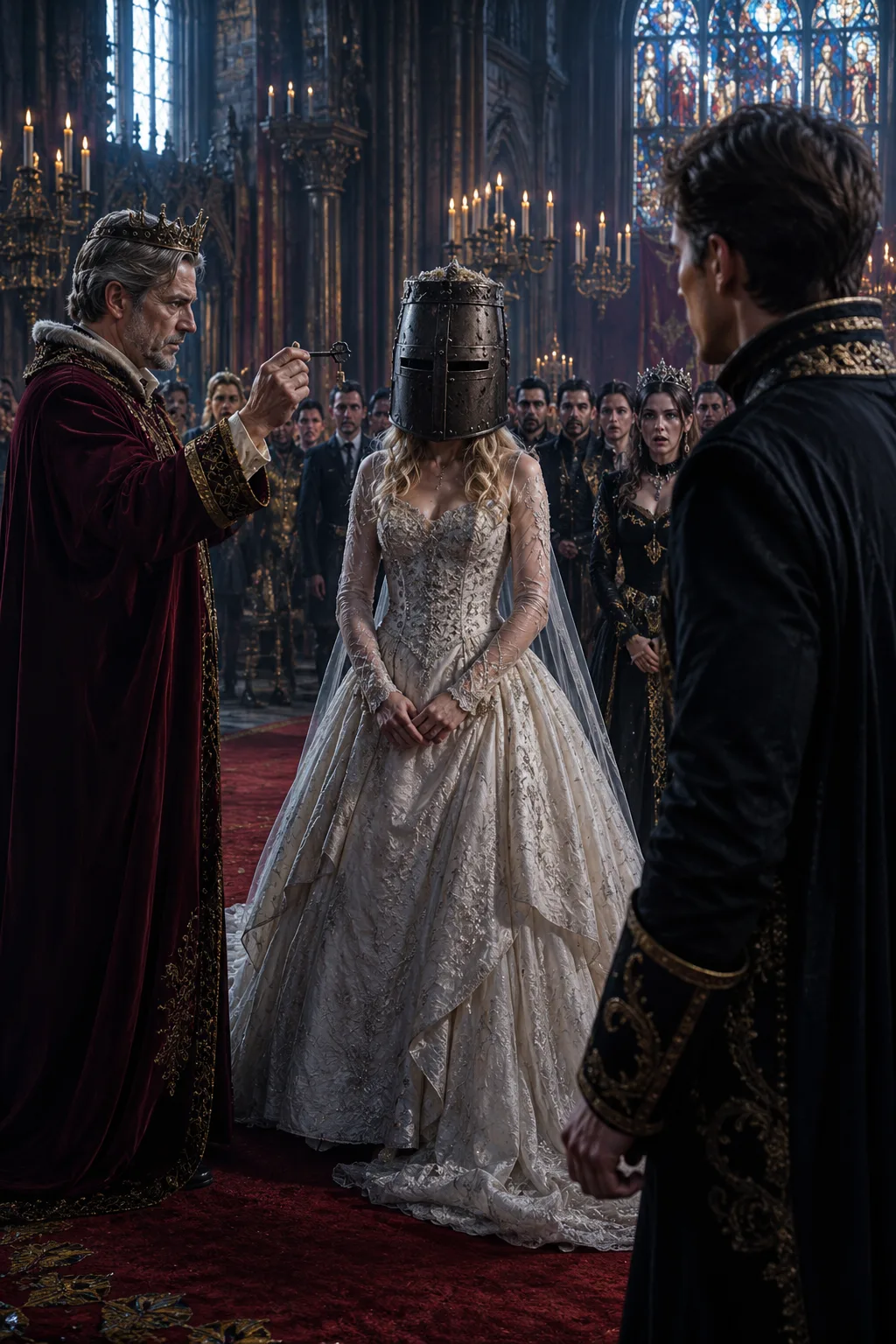
When Princess Elina turned six years old, the entire kingdom learned to fear something they had never seen.
Chapter 1
When Princess Elina turned six years old, the entire kingdom learned to fear something they had never seen.
It began on a cold autumn evening, when the sky above the palace turned the color of old silver and the bells in the eastern tower rang three times without explanation. The palace servants were ordered to close every curtain, extinguish every hallway lamp except the ones outside the royal chambers, and leave the western wing empty.
No one understood why.
Before sunset, the king summoned the finest blacksmiths, carpenters, jewelers, and lockmakers in the kingdom. They were brought through the palace gates under armed escort. Their tools were inspected. Their mouths were warned into silence.
By midnight, they had created the strangest object any of them had ever made.
It was a helmet.
Not a warrior’s helmet meant for battle, but something far more unsettling. It was made of dark wood reinforced with black iron bands. It covered the entire head. Two narrow slits had been carved for the
eyes, and a small opening had been left near the mouth so the wearer could eat, drink, and breathe. Around the neck was a thick iron collar, joined by a heavy padlock.
The helmet was small enough for a child.
When the blacksmiths carried it into Princess Elina’s chamber, the little girl was sitting on the carpet beside her mother, holding a cloth rabbit with one missing button eye.
Elina looked up at the men.
She did not cry at first.
She only stared.
The queen’s face had already gone pale, as if she had been sick for days. She clutched Elina’s hand so tightly the child winced.
“Please,” the queen whispered to the king. “Do not do this.”
King Aldric stood beside the bed, his expression harder than stone. Around his neck hung a gold chain. From that night forward, a single iron key would hang from it.
“There
is no other way,” he said.
The queen shook her head. “She is only a child.”
“She is the heir to this kingdom.”
“She is our daughter.”
The king’s jaw tightened.
“That is why I must protect her.”
No one outside that room heard the rest of their argument. The doors were closed. The guards stood at the end of the hall. The servants were sent away.
But near dawn, when the first pale light touched the palace roofs, Princess Elina emerged from her chamber wearing the helmet.
She walked between the king and queen, small hands folded before her, her face hidden forever behind iron and dark polished wood.
The palace never felt the same again.
At first, people thought it was temporary. Perhaps the princess had been injured. Perhaps she had caught some terrible illness. Perhaps the king feared infection. But days became weeks, and weeks became months.
The helmet never came off.
Then the queen fell ill.
Some said grief had hollowed her out. Others said she had stopped eating. The royal physician visited her chamber each morning and left with a face so grave that the servants began whispering prayers in the laundry rooms.
Three months after Elina first wore the helmet, Queen Marielle died.
At her funeral, Princess Elina stood beside her father beneath a black veil, but even the veil could not hide the helmet beneath it. The kingdom mourned the queen, but many eyes were not on the coffin.
They were on the child.
And from that day forward, the rumors became darker.
Some said Elina had been born with the face of a beast.
Some said the queen had made a bargain with forbidden spirits, and the child was the price.
Some said King Aldric had looked into his daughter’s eyes and seen the future destruction of his bloodline.
Others whispered that beneath the helmet there was no face at all.
The king never answered any of it.
Whenever anyone asked, he gave only one sentence.
“She will remove it on the day of her wedding.”
That sentence became law.
As Elina grew older, fear grew with her.
She became a quiet presence in the palace, more ghost than girl. She ate alone. Studied alone. Walked through the garden only at dawn, when the roses were still wet with dew and the gardeners had not yet arrived.
The helmet made every movement strange. When she turned her head, the hinges creaked softly. When she walked, the small iron lock at her throat tapped against the collar.
Children of noble families were invited to the palace to play with her when she was young. None returned twice.
Not because Elina was cruel.
Because their parents were afraid.
Once, the daughter of a duke saw Elina sitting beside the fountain, feeding crumbs to sparrows. The girl had been told not to stare, but she did anyway.
“Are you ugly under there?” the child asked.
Elina paused.
The sparrows scattered.
After a long silence, she said, “I don’t know.”
The duke’s daughter frowned. “How can you not know?”
Elina touched the side of the helmet with her small fingers.
“I have not seen myself since I was six.”
That story spread through the palace faster than any scandal before it.
The servants began avoiding her eyes. Knights crossed themselves when she passed. Ladies of the court smiled too brightly and turned away too quickly.
Elina learned to become invisible.
She read books until the candles burned low. She learned languages no one expected her to speak. She mastered history, law, music, diplomacy, and the complicated maps of neighboring kingdoms. She could play the piano with such sorrow that servants stopped outside the music hall at night and listened with tears in their eyes.
But no one praised her.
No one touched her shoulder.
No one called her beautiful.
No one called her anything except “Your Highness,” and even those words were spoken with caution.
Only one person in the palace treated her like a human being.
His name was Tomas.
He was the son of the palace gardener, three years older than Elina, with sun-browned skin, gentle eyes, and dirt always beneath his fingernails. He first met her when she was nine and found her kneeling in the rose garden, trying to save a bird with a broken wing.
Most children would have run from the helmet.
Tomas only looked at the bird.
“You’re holding it too tightly,” he said.
Elina froze. No one her age had spoken to her so casually in years.
“I am trying not to drop it,” she answered.
“If you squeeze it, it won’t need falling to die.”
She stared at him through the narrow eye slits.
“You are very rude.”
“You are very royal.”
She almost laughed.
Almost.
Tomas showed her how to wrap the bird in a handkerchief and feed it drops of water from his fingertip. For three weeks, they cared for it in secret behind the orange trees. When the bird finally flew again, Elina stood very still as it rose into the morning sky.
“It left,” she said.
“That means it lived,” Tomas replied.
From that day on, Tomas became her secret friend.
He never asked what was beneath the helmet. Not once.
That made Elina trust him more than anyone.
Years passed. Tomas grew into a tall young man with strong shoulders from hauling soil and pruning branches. Elina grew into a graceful young woman hidden inside a prison made for a child. The helmet had been adjusted many times by the royal blacksmith as she grew, but the lock remained the same. The key remained on the king’s chain.
And the king grew older.
His hair whitened. His back bent. His temper hardened into silence.
He no longer attended festivals. He no longer hosted banquets unless duty demanded it. Sometimes Elina caught him staring at her from across the throne room with an expression she could not understand.
Fear.
Guilt.
Love.
Perhaps all three.
One evening, when she was twenty, she asked him the question she had carried for fourteen years.
They were alone in the royal library. Rain struck the tall windows. The fire was low.
“Father,” she said, “what is wrong with my face?”
The king did not look up from the letter in his hand.
“Nothing you need to know yet.”
Elina’s hands tightened around the book in her lap.
“I am not a child anymore.”
“No,” he said quietly. “You are not.”
“Then tell me.”
The king finally looked at her.
For a moment, she saw something break in his eyes.
Then his voice became cold.
“You will know on your wedding day.”
“What if I never marry?”
“Then you will never need to know.”
The words struck harder than any slap.
Elina stood.
“Is that what I am to you? A secret to be locked away until some man agrees to take me?”
The king’s face darkened. “You speak of things you do not understand.”
“Because you refuse to let me understand!”
The room seemed to tremble with the force of her voice. The guards outside the door shifted, but none entered.
Elina stepped closer.
“People fear me because of what you did. They call me cursed because of what you did. I have lived my whole life hearing my own breath echo inside this cage, and you still think silence is protection?”
The king’s mouth opened.
No answer came.
For the first time, Elina saw him not as a ruler, not as a wall, but as an old man crushed under the weight of something he had done and could not undo.
Then he whispered, “I promised your mother.”
Elina went still.
“What did you promise her?”
The king looked away.
“That I would keep you alive.”
Before she could ask more, he left the room.
The next month, suitors began arriving.
Not because they loved her. Not because they had heard of her wisdom, kindness, or music.
Because King Aldric was dying.
Everyone knew it, though no official announcement had been made. And if Elina remained unmarried when he died, the kingdom would fall into chaos. Distant cousins would claim the throne. Noble families would raise private armies. Neighboring rulers would send troops “to keep peace” and never leave.
The Iron Princess, as people called her, had become the most valuable mystery in the land.
The first suitor was an old duke with three dead wives and greedy eyes. He bowed to Elina but never looked at her helmet.
The second was a prince from the north who asked whether the lock could be opened before the wedding, “for inspection.”
The third sent a physician to examine her, as if she were livestock.
Elina refused them all.
The king raged.
“You think you can choose freely?” he shouted one evening in the council chamber. “You think kingdoms survive on feelings?”
Elina stood before him in a dark blue gown, the helmet gleaming under the candlelight.
“No,” she said. “I think kingdoms die when people are treated like objects.”
The council gasped.
The king lifted his hand as if to strike the table, but a coughing fit seized him. He bent forward, shaking. Servants rushed to help, but he waved them away.
Elina watched him, fear piercing through her anger.
He was dying faster than anyone admitted.
That night, Tomas found her in the garden.
She was standing beside the fountain, where moonlight turned the water black.
“You’ll catch cold,” he said.
“I wear iron on my head,” she replied. “I think cold has given up on me.”
He smiled faintly, but she did not.
After a long silence, she said, “They are going to marry me to someone.”
Tomas looked down.
“I know.”
“You should tell me to be brave.”
“I think you are tired of being told that.”
She turned toward him.
“You never ask.”
“Ask what?”
“What I look like.”
Tomas picked up a fallen rose and turned it between his fingers.
“I know what you look like.”
Elina’s breath caught.
“No, you don’t.”
“I know how you stand when you are angry. I know how your hands move when you play piano. I know you tilt your head when someone lies. I know you stop walking when you hear a bird. I know you pretend not to care when people whisper, but your fingers close into fists.”
He looked at her then.
“That is what people look like, Elina. The rest is only skin.”
For one dangerous second, the world became too quiet.
Then footsteps sounded behind them.
A guard appeared at the garden entrance.
“Your Highness,” he said, bowing stiffly. “The king requests your presence.”
The next morning, Prince Richard arrived.
He was not like the others.
He came without a parade, without jeweled horses, without musicians announcing his greatness. His kingdom lay across the southern mountains, poor after years of drought and war. He was handsome in a tired way, with sharp cheekbones, calm eyes, and a soldier’s posture. His clothes were fine but worn at the cuffs.
At court, people whispered that he had come for the throne.
They were right.
Richard did not pretend otherwise.
During their first private meeting, Elina sat across from him in the sunroom while two guards stood by the door. Between them was a table set with tea neither touched.
“I know what people say about me,” Richard said.
“That you are desperate?”
“That I am practical.”
Elina almost smiled. “Those are often the same thing.”
He nodded. “Yes.”
Most men would have flattered her. Richard did not.
“My father’s kingdom is collapsing,” he said. “Our farms are ruined. Our army is unpaid. If I marry you, my people survive.”
“And what do I get?”
“A husband who will not lie about why he came.”
Elina studied him through the slits of her helmet.
“Do you fear what is under this?”
Richard’s eyes flicked to the lock.
“Yes.”
The honesty surprised her.
“But not enough to leave?”
“No.”
“Why?”
“Because fear is not the worst thing in the world.”
“What is?”
Richard leaned back slightly.
“Power in the hands of cowards.”
That answer stayed with her.
Over the next weeks, they walked together in the palace gardens under careful supervision. Richard never tried to touch her. Never asked to see her face. Never called her cursed. He spoke of politics, drought, trade routes, military debts, and the difficulty of ruling people who expected miracles from empty treasuries.
He was not warm like Tomas.
But he was not cruel.
And cruelty, Elina had learned, was often the first thing to measure.
The king approved the match quickly. Too quickly.
The wedding was set for the first day of spring.
The kingdom erupted in excitement and dread.
For the first time in fourteen years, the helmet would be removed.
People traveled from distant villages just to stand outside the cathedral. Nobles fought for seats. Merchants sold tiny iron charms shaped like helmets. Priests warned against superstition, then secretly asked each other what they expected to see.
The night before the wedding, Elina went to the music hall.
She played until her fingers ached.
When the final note faded, someone spoke from the doorway.
“You always play that song when you’re sad.”
Tomas stood there in his gardener’s coat.
Elina did not turn around.
“You should not be here.”
“I know.”
“If they find you—”
“I know.”
Silence stretched between them.
Then Tomas walked closer, stopping several steps away.
“Do you want to marry him?”
Elina’s hands rested on the piano keys.
“Want has never been the question.”
“It should be.”
She laughed softly, without humor.
“I am a princess in an iron helmet. My father is dying. My kingdom is waiting to tear itself apart. Want is a luxury for girls who can look in mirrors.”
Tomas’s voice lowered.
“Run away.”
The words struck the air like a forbidden spell.
Elina turned.
“What?”
“Tonight. Now. There are old hunting roads beyond the west orchard. I know them. We could reach the coast before anyone—”
“No.”
“You didn’t even think.”
“I have thought of it every day since I was twelve.”
“Then why not?”
“Because a kingdom is not a room I can simply leave.”
Tomas stepped closer, pain tightening his face.
“And what about you?”
Elina’s throat burned.
“I am not separate from it.”
“You are a person before you are a crown.”
“No,” she whispered. “I was never allowed to be.”
Tomas looked at her for a long time.
Then he reached into his coat and placed something on the piano.
A small silver mirror.
Elina stared at it as if it were a weapon.
“I thought,” Tomas said, voice unsteady, “after tomorrow, you might want to see yourself before everyone else decides what you are.”
Her hands trembled.
“I can’t open it.”
“I know.”
He swallowed.
“I just wanted you to have one.”
Then he bowed, not like a servant to a princess, but like a man saying goodbye to someone he loved and had no right to keep.
When he left, Elina sat alone with the mirror until dawn.
The wedding day arrived beneath a pale sky.
The cathedral was enormous, built from gray stone and colored glass, with arches so high they disappeared into shadow. Hundreds of candles burned along the aisles. Nobles filled every pew. Soldiers lined the walls. Outside, thousands waited in the square, silent as if the whole kingdom were holding its breath.
Elina stood in the bridal chamber wearing a white gown embroidered with silver thread. Her hands were bare. Around her throat, the iron collar rested beneath lace.
The helmet felt heavier than ever.
King Aldric entered without knocking.
He looked smaller in his ceremonial robe. The crown seemed too large for him now.
For a moment, neither spoke.
Then Elina said, “Tell me before we go.”
The king closed his eyes.
“Please.”
His fingers touched the key around his neck.
“I loved your mother more than my life,” he said.
Elina waited.
“When you were born, she said you had my stubbornness and her eyes. She was happy. Happier than I had ever seen her.”
His voice thinned.
“But on your sixth birthday, your gift arrived.”
“My gift?”
“A mirror. Sent from the northern court. Framed in black glass.”
Elina’s breath slowed.
“You looked into it,” the king said, “and screamed.”
A chill moved through her.
“I don’t remember.”
“You fainted. When you woke, you would not speak. Your mother found markings on the mirror frame. Old magic. Forbidden magic.”
Elina’s hands curled.
“What did it do?”
The king’s eyes filled with tears he refused to let fall.
“It did not curse your face, Elina.”
“Then why?”
“It cursed the eyes of others.”
She stared at him.
“Anyone who saw your face directly would see the thing they feared most. Not reality. Not you. Their own terror reflected back at them. Some would see a monster. Some a dead loved one. Some their guilt. Some their sins.”
Elina could not move.
“The curse was meant for me,” the king whispered. “A punishment from enemies I had made in war. But you opened the gift first.”
“So you locked me away.”
“I tried to save you.”
“You made everyone fear me.”
“They would have feared you more if I had not.”
“Did Mother agree?”
The king flinched.
“She believed the curse could be broken.”
“How?”
“By someone seeing your face and choosing truth over fear.”
Elina’s voice broke. “Then why not try?”
“Because the first servant who saw you after the curse clawed at his own eyes and nearly lost his mind.”
She stepped back.
The king reached for her, then stopped himself.
“I was afraid,” he said. “I was a coward. Your mother begged me to keep searching for another way. I promised her I would. But after she died, I only kept the easiest promise. I kept you alive.”
Elina felt fourteen years of silence crash through her at once.
The lonely meals.
The whispers.
The children staring.
The mirrorless rooms.
The garden at dawn.
Tomas saying the rest was only skin.
Her father had not hidden ugliness.
He had hidden fear.
A knock sounded.
“Your Majesty,” a guard called. “It is time.”
King Aldric looked at his daughter.
“I am sorry.”
Elina wanted to hate him.
Part of her did.
But another part saw the trembling old man before her and understood something worse than cruelty.
Fear could love you and still destroy your life.
She lifted her chin.
“Take me to the altar.”
The cathedral doors opened.
Every head turned.
Elina walked beside her father down the red carpet while the candles flickered and the iron lock tapped softly at her throat.
Prince Richard waited at the altar in a dark formal coat. He looked pale but steady.
The priest began the ceremony.
His voice shook.
Elina heard almost none of it.
She heard the breathing of hundreds of guests. The rustle of silk. The faint creak of old wood. Somewhere outside, the crowd murmured like distant thunder.
Then came the moment.
The priest turned to the king.
“By royal decree, before vows are sealed, the princess shall stand unveiled before her groom.”
The entire cathedral leaned forward.
King Aldric removed the key from his neck.
His hands trembled so violently that the first attempt missed the lock.
A whisper passed through the crowd.
Elina did not look at them.
She looked at Richard.
His face was tense. Afraid, yes. But still there.
The key entered.
The lock clicked.
The sound echoed like judgment.
The king removed the padlock, then loosened the iron collar. Slowly, with both hands, he lifted the helmet from Elina’s head.
For the first time in fourteen years, air touched her face.
Cool.
Soft.
Alive.
The helmet left her.
And the cathedral froze.
A woman gasped.
Someone dropped a glass.
Several people cried out.
Prince Richard staggered backward.
Elina stood completely still.
She did not know what they saw.
That was the true horror.
Not her face.
Their fear.
In the front row, an old general shouted and reached for his sword, eyes wide with panic. A noblewoman covered her mouth and sobbed, whispering, “No, no, you’re dead.” A bishop fell to his knees, praying at frantic speed.
The curse had awakened.
Each person saw something different.
Each person saw themselves.
Richard stared at Elina, face drained of color. His lips parted, but no words came.
Elina’s heart cracked quietly.
“So,” she whispered. “What do you see?”
Richard swallowed.
His eyes glistened with terror.
“My brother.”
The cathedral hushed around them, though panic still rippled through the pews.
Richard’s voice shook. “He died because I left him on the battlefield. I told everyone I had no choice.”
Elina did not move.
“And now?” she asked.
Richard looked at her as if the sight physically hurt him.
“Now he is standing where you are.”
The priest backed away.
King Aldric whispered, “Richard…”
Elina raised one hand, stopping him.
She looked at the prince who had promised honesty.
“Can you see me?”
Richard’s breathing grew uneven.
He took one step forward.
Then stopped.
The entire kingdom waited inside that pause.
Richard closed his eyes.
When he opened them again, tears had spilled down his face.
“No,” he said.
The word was barely audible.
Then louder.
“No. I cannot.”
Elina’s chest tightened.
Richard bowed his head.
“I am sorry.”
And with that, the last practical hope for her marriage died in front of everyone.
The cathedral erupted.
Some shouted that she was cursed. Others begged the king to put the helmet back on. Guards rushed forward, uncertain whether to protect her or restrain her.
King Aldric seized the helmet with shaking hands.
“Elina, please—”
“No.”
Her voice cut through the chaos.
The king froze.
Elina turned slowly toward the crowd.
For the first time in her life, she stood before them uncovered. She could feel her hair loosen around her shoulders. She could feel the air on her cheeks. She could feel their terror pressing toward her like heat from a fire.
But she did not hide.
“No more,” she said.
The cathedral quieted, not because they were calm, but because her voice had changed.
It carried.
“You wanted to see what was beneath the helmet,” she said. “Look well.”
People trembled.
“You see monsters. Ghosts. Sins. Death. Shame. Betrayal. But none of you see me.”
Her gaze moved across the nobles.
“For fourteen years, you called me cursed because it was easier than asking what had been done to me. You feared a child because a king told you to fear her. You turned loneliness into legend and cruelty into gossip.”
King Aldric lowered his head.
Elina faced him last.
“And you, Father, mistook a cage for protection.”
The old king’s face collapsed.
“I know.”
The words were small. Broken.
Then, from the back of the cathedral, a voice rang out.
“I see you.”
Everyone turned.
Tomas stood near the great doors.
He wore no noble clothes. No sword. No royal crest. His gardener’s coat was dark with rain, and mud stained his boots. Guards moved to seize him, but Elina lifted her hand.
“Let him pass.”
No one obeyed at first.
Then the king, barely breathing, whispered, “Let him pass.”
Tomas walked down the aisle.
The nobles recoiled as he passed, offended and frightened, but he did not look at them. His eyes stayed on Elina.
When he reached the altar, the curse struck him.
Elina saw it happen.
His face changed.
Pain entered his eyes. His jaw tightened. His hands shook at his sides.
“What do you see?” Elina asked, though she feared the answer.
Tomas looked at her.
For a moment, he could not speak.
Then he said, “My father.”
Elina remembered. Tomas’s father had died two winters earlier, crushed beneath a fallen tree during a storm in the royal orchard.
“He is angry,” Tomas whispered. “He says I was not strong enough to save him.”
Elina’s eyes filled.
“Tomas…”
He took one step closer.
The cathedral held its breath.
“I loved him,” Tomas said, voice shaking. “And I could not save him. But that is my grief speaking. Not you.”
Another step.
The air seemed to tighten.
“I see fear,” he said. “I see guilt. I see what I carry.”
He stopped directly before her.
Then, slowly, he lifted his hand—not to touch her face, but to offer his palm.
“And behind it,” he whispered, “I see Elina.”
The candles went still.
A sound like glass cracking filled the cathedral.
Not loud.
Not violent.
But everywhere.
The colored windows trembled. The iron helmet in King Aldric’s hands split down the center. The black lock fell to the stone floor and broke open.
Elina gasped.
A warmth moved across her face, like sunlight after years underground.
One by one, the people in the cathedral blinked.
The visions faded.
The general lowered his sword, confused and ashamed. The noblewoman stopped sobbing. The bishop opened his eyes.
And for the first time since she was six years old, the kingdom saw Princess Elina as she truly was.
She was not a monster.
Not a ghost.
Not a curse.
She was a young woman with pale gold hair loosened from years of confinement, tired eyes the color of storm-washed blue, and faint marks along her jaw where the helmet had rested too long against her skin. She was beautiful, yes, but not in the flawless way people told stories about.
She looked human.
That was what made the silence unbearable.
The crowd had not been horrified by her ugliness.
They had been horrified by themselves.
Prince Richard bowed deeply, shame written across his face.
“Princess,” he said, “I cannot ask your forgiveness.”
“No,” Elina replied. “You cannot.”
He nodded once, accepting the judgment.
Then he stepped away from the altar.
The priest looked lost. “The wedding…”
“There will be no wedding,” Elina said.
A wave of shock moved through the cathedral.
King Aldric looked at her, but this time he did not command. He did not forbid.
He only asked, “What will you do?”
Elina looked at the broken helmet on the floor.
Then at Tomas.
Then at the crowd.
“I will rule.”
No one spoke.
“My father is ill. The succession will not wait for my marriage. If the law says a woman must have a husband before she can inherit, then the law was written by men who feared women standing alone.”
Several council members stiffened.
Elina turned toward them.
“Change it.”
One old lord found his courage. “Your Highness, tradition cannot be overturned in a moment.”
Elina’s gaze hardened.
“Neither can fourteen years be returned to me. Yet here we are.”
The king, with great effort, removed the crown from his head.
The cathedral went silent again.
He held it out to her.
“My daughter,” he said, voice breaking, “was always the heir.”
Elina stared at the crown.
For a moment, she was six again, holding a cloth rabbit, waiting for adults to decide her fate.
Then she was twenty, standing uncovered before a kingdom that had feared her and needed her.
She took the crown.
Not to wear yet.
To hold.
The square outside roared when the cathedral doors opened, but the sound faded when people saw the princess emerge without the helmet.
Rumors died slowly. Shame lived longer.
In the weeks that followed, the kingdom changed in ways no one expected.
King Aldric publicly confessed the truth of the curse and his failure. Many praised his honesty. Others condemned his cowardice. He accepted both in silence.
The law of succession was rewritten.
Prince Richard returned to his starving kingdom, but Elina did not punish him. Instead, months later, she sent grain, engineers, and irrigation workers—not as a bride price, but as a treaty between rulers. Richard wrote back once, thanking her and admitting that truth had cost him a throne but saved what remained of his soul.
Tomas did not become prince overnight.
Elina would not allow the court to turn love into another chain.
He returned to the gardens at first, though people now bowed awkwardly when he passed. He hated it. Elina laughed the first time she saw him bow back to a terrified duchess.
“You look miserable,” she told him.
“I was not raised for silk rooms.”
“Neither was I, apparently.”
Their friendship changed slowly, carefully, with the patience of things that had survived too much pressure to be rushed. He sat with her in the garden without guards. He brought her flowers without meaning. She played piano with the windows open.
And one morning, he found her standing before a mirror.
The same small silver mirror he had given her.
She was looking at herself.
Not with wonder.
Not with vanity.
With grief.
He stopped at the doorway.
“Should I leave?”
“No,” she said.
He came closer.
Elina touched the faint scars along her neck.
“I thought I would feel free immediately.”
Tomas stood beside her.
“And do you?”
She considered.
“Sometimes. Then sometimes I still hear it.”
“The helmet?”
She nodded.
“In my breathing. In my sleep. In the way people look at me and then look away because they remember what they believed.”
Tomas was quiet.
Then he said, “Healing is not a door opening. It is learning the room is gone.”
Elina looked at him through the mirror.
“That sounds like something from a very boring book.”
“My mother says I become wise only when no one important is listening.”
Elina smiled.
It was small.
Real.
A year later, King Aldric died.
Elina sat beside his bed in the final hour, holding his hand as rain tapped softly against the windows.
“I failed you,” he whispered.
“Yes,” she said.
His eyes closed in pain.
Then she added, “And you loved me.”
A tear slipped down his temple.
“I do not know which one hurt me more,” she said.
He looked at her one last time.
“Be better than fear.”
“I will.”
He died before sunrise.
Princess Elina became Queen Elina before the assembled court three days later.
She wore no veil.
No helmet.
No mask.
When the crown was placed on her head, every noble in the hall bowed.
Some out of loyalty.
Some out of shame.
Some out of fear.
Elina accepted all of it, because queens did not get to choose the hearts of those who bowed—only what kind of kingdom they would build above them.
Years later, people still told the story of the Iron Princess.
But the story changed.
At first, they told it as a tale of horror: the cursed princess whose face made a cathedral scream.
Then they told it as a romance: the gardener who saw past fear and broke the spell.
But Elina never liked either version.
When children asked her if the helmet had been terrible, she would take them to the old music hall where it was displayed inside a glass case, split in two, the broken lock resting beside it.
“Yes,” she would say. “It was terrible.”
Then she would kneel so they could see her eyes clearly.
“But the most dangerous cages are not made of iron. They are made of what people are too afraid to question.”
And whenever she said that, the children would look at the broken helmet, then at the queen’s uncovered face.
And they would understand.
The horror beneath the helmet had never been Princess Elina.
It had been the fear that taught an entire kingdom to look at a lonely girl and see a monster.
In the end, the helmet was removed only once.
But the kingdom spent the rest of its life learning how to see.
Chapter complete
You have reached the end of this chapter.
Continue reading
A few more worlds to get lost in after this chapter.




