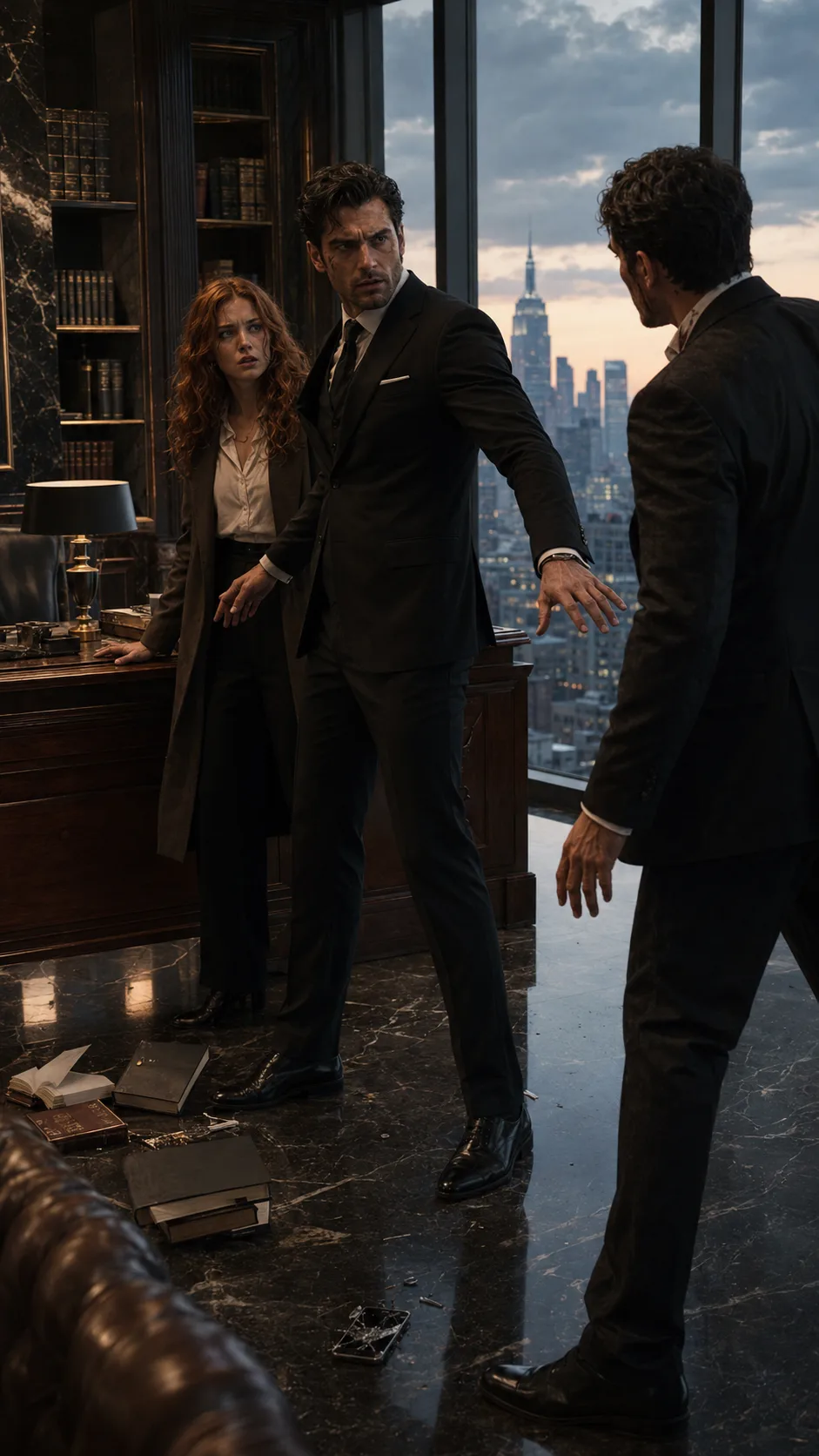
Ruby did not run.
Chapter 1
Ruby did not run.
That was the first mistake.
The second was believing she had time.
For five seconds after Alessandro’s promise, she stood frozen in the Metropolitan Library processing room, her phone pressed to her ear, the archive box sitting on the table like a grave that had learned how to breathe.
“Ruby,” Alessandro said through the line. “Listen to me carefully. Do not open the box there.”
Her fingers tightened around the phone. “My father wrote on it.”
“I know.”
“You know?”
A pause.
Not hesitation.
Calculation.
“I know he had one more failsafe. I did not know it had been triggered.”
“Triggered by what?”
“By someone searching for it.”
Ruby stared at the brown tape sealing the box.
Nora, the assistant archivist, stood a few feet away, her face pale with concern.
“Ruby?” she whispered.
Ruby lifted one finger, silently asking for a moment.
On the phone, Alessandro’s voice sharpened. “Where
is Emma now?”
Ruby forced herself to look at the messages again.
“She said someone followed her from class. She’s outside her dorm. Or near it. She hasn’t answered since.”
“Call Agent Martinez.”
“I already called you.”
“Call Martinez now.”
The command sparked anger through the fear.
“You don’t get to give orders.”
“Not orders,” he said. “Priorities. Martinez can reach Columbia faster than I can cross an ocean.”
That was true.
Ruby hated that it was true.
She hung up and called Sofia Martinez.
The federal agent answered with the flat, alert tone of someone who had never truly believed danger was over.
“Ruby?”
“Emma’s being followed.”
The line went quiet for half a heartbeat.
“Location?”
“Columbia. Near her dorm. She messaged that someone said Dad left something that belongs to them.”
“Stay where you are.”
Ruby almost laughed.
Everyone kept telling her to stay.
People always said that
when the danger was moving toward someone else.
“Agent Martinez, my sister—”
“I’m sending campus security and two federal units now. Ruby, listen to me. If this is connected to your father’s final files, they may be trying to split you from the box. Do not leave it unattended. Do not open it. Do not hand it to anyone.”
Ruby looked at the box again.
The handwriting cut through her.
If Ruby receives this, run first.
“My father told me to run,” she whispered.
Martinez exhaled slowly. “Then your father knew something we don’t.”
The processing room door opened.
A man stepped inside wearing a navy courier jacket and carrying a clipboard.
Nora turned. “Can I help you?”
The man smiled politely.
“Pickup confirmation for Miss Callahan.”
Ruby’s blood chilled.
Martinez heard the shift in her breathing.
“What is it?”
“A courier just walked in.”
“Ruby, get away from him.”
The courier’s smile did not change.
He looked directly at Ruby.
“Miss Callahan. I need the box.”
Nora frowned. “What box?”
Ruby moved one step backward, putting the archive table between herself and the man.
The courier sighed, as if disappointed by a child.
“Let’s not make this harder than it needs to be.”
His right hand slipped beneath his jacket.
Ruby did not wait to see what he was reaching for.
She grabbed the archive box with both hands and ran.
Nora screamed behind her.
The courier cursed.
Ruby slammed her shoulder into the emergency exit bar and burst into the staff corridor. The box was heavier than it looked, awkward against her chest. Her shoes skidded on polished stone as she sprinted past storage carts, old exhibition panels, and a stack of conservation crates.
Behind her, the stairwell door banged open.
“Ruby!” Martinez shouted through the phone, still connected somehow, her voice tinny and distant. “Ruby, talk to me!”
Ruby could not talk.
She could barely breathe.
She hit the basement level and ducked into the manuscript preservation room, locking the door with shaking hands. The room smelled of paper, dust, and cold metal shelving. No windows. One exit.
A terrible hiding place.
A perfect trap.
Her phone buzzed.
Unknown number.
Then a message appeared.
Your sister is safe for now. Bring the box to the old ferry terminal by 7:00. Come alone.
A photo followed.
Emma, seated on a wooden chair in what looked like an empty warehouse, hands bound in front of her, face tear-streaked but alive.
Ruby’s world went silent.
Not quiet.
Silent.
The kind of silence that swallowed thought.
Her sister’s eyes in the photo were wide with fear, but her chin was lifted. Brave, even terrified. Just like their mother.
Another message appeared.
No FBI. No Moretti. Or she disappears like your parents did.
Ruby sank to the floor with the archive box in her lap.
For three years, she had believed the worst thing that could happen was not knowing why her parents died.
She had been wrong.
The worst thing was knowing exactly what powerful people could do, and still being unable to stop them from reaching the only family she had left.
Her phone rang again.
Alessandro.
She answered without speaking.
“I received the photo,” he said.
Ruby closed her eyes. “How?”
“Martinez forwarded it.”
“They said no FBI. No you.”
“Of course they did.”
“I have to go.”
“No.”
“She’s my sister.”
“And that is why you are thinking like a sister, not like someone walking into an execution room.”
Ruby’s grief sharpened into fury.
“Do not say that word to me.”
Alessandro’s voice softened, but only slightly. “Ruby, they do not want the box alone. They want you with it.”
“Then they can have me.”
“No.”
The word came out colder than anything he had said since the office one year ago.
Ruby leaned her head back against a cabinet and tried not to cry.
“You don’t get to decide that.”
“No,” he said. “But I get to tell you what your father already knew. That box is not leverage because of what is inside. It is leverage because people believe you can understand it.”
Ruby looked down at the sealed cardboard.
“What does that mean?”
“Your father hid something in a format only an archivist would recognize.”
“My father was an accountant.”
“Your mother was a restoration specialist.”
Ruby went still.
Alessandro continued, “She knew paper. Binding. Watermarks. Ink. She helped him hide records in plain sight. My father searched financial ledgers and digital drives. He never understood books.”
Ruby pressed her palm against the lid of the box.
Her mother had sung badly while cooking. Her father had written notes in grocery margins.
And together, they had outsmarted killers using paper.
A sudden knock struck the preservation room door.
Ruby stopped breathing.
“Miss Callahan?” a male voice called. “Library security. Open the door.”
Martinez spoke through Alessandro’s line now, patched in somehow.
“Ruby, don’t open it. My units are three minutes out.”
The handle rattled.
“Miss Callahan, we need to verify your safety.”
Ruby stood slowly, lifting the box.
The handle rattled again.
Then the voice changed.
Lower.
Impatient.
“Open the door, Ruby. Or your sister starts paying for your stubbornness.”
Every part of Ruby wanted to obey.
Instead, she looked around the preservation room.
Shelves. Cabinets. Worktable. Ventilation grate. Old dumbwaiter shaft used for moving sealed archival crates between floors.
Too small for a person.
Large enough for a box.
Ruby dragged a metal step stool beneath the dumbwaiter hatch. Her hands shook so badly she almost dropped the archive box while forcing the hatch open.
The pounding on the door grew harder.
“Ruby!”
She shoved the box into the dumbwaiter and pressed the manual lift button.
The old motor groaned.
Too loud.
The door behind her splintered.
Ruby backed away.
A second blow cracked the frame.
The dumbwaiter rose slowly, carrying her father’s last secret upward through the walls of the library.
The door burst open.
Two men entered.
The courier was one of them.
The other wore a gray coat and leather gloves. Older. Calm. Handsome in a severe way, with silver at his temples and eyes that looked almost kind.
That made him worse.
He glanced at the empty room, then at the open dumbwaiter hatch.
“Clever girl,” he said.
Ruby lifted her chin.
“Where is Emma?”
“Alive.”
“That wasn’t my question.”
“No,” the man said. “But it is the only answer you have earned.”
The courier moved toward her.
Ruby grabbed a bottle of conservation solvent from the worktable and held it out like a weapon.
The older man smiled faintly.
“Your mother once threatened me with a letter opener.”
Ruby’s arm trembled.
“You knew my mother.”
“I knew both your parents.”
“Then you know they were better than you.”
His smile faded.
“Yes,” he said. “That was always the problem.”
The courier lunged.
Ruby threw the solvent.
It hit his chest and splashed across his jacket. He swore, stumbling back. Ruby bolted left, but the older man caught her wrist with shocking speed.
Not brutal.
Precise.
A practiced grip.
“You have her fire,” he said quietly.
Ruby twisted, but he held firm.
“Let me go.”
“I can’t.”
The words struck her because of how calmly he said them. Not like a thug. Like someone regretful but committed.
A shout echoed from the hallway.
“Federal agents!”
The older man’s expression hardened.
He pulled Ruby close and spoke near her ear.
“Tell Alessandro that Enzo Bellini remembers Palermo.”
Then he shoved her away and disappeared through the broken doorway with the courier limping after him.
Seconds later, Martinez stormed in with two agents behind her.
Ruby barely saw them.
Enzo Bellini.
Palermo.
The name meant nothing to her.
But when Alessandro heard it, the line went silent.
Then he said, very softly, “Ruby, listen to me. This is worse than Victor.”
By dawn, Emma had not been found.
The kidnappers had abandoned the first warehouse before federal agents arrived. They left behind the chair from the photograph, one cut zip tie, and a single page from a children’s book Ruby recognized instantly.
The Secret Garden.
Emma’s favorite when she was little.
Across the blank back page, someone had written one sentence in black ink.
The garden opens only for the daughter.
Martinez spread the evidence across a conference table in the federal field office while Ruby sat rigidly beside her.
No one had slept.
Ruby’s hair had come loose from its clip. Her blouse was stained with dust from the basement. Her hands still smelled faintly of conservation solvent.
“What does it mean?” Martinez asked.
Ruby stared at the page.
“The garden,” she said. “It might refer to a collection.”
“What collection?”
“My mother restored children’s books before she started working with grant archives. She used to call damaged books ‘locked gardens.’ She said restoration was finding the hidden door.”
Martinez studied her. “Could your father have used that phrase as a code?”
“My father used Mom’s phrases for everything.”
The door opened.
Every agent in the room turned.
Alessandro Moretti entered wearing a dark overcoat over a black suit, his hair wind-touched, his face drawn from travel and something colder than exhaustion.
He looked at Ruby first.
Only for a second.
Enough to confirm she was alive.
Then he looked at Martinez.
“Where is Emma?”
“If we knew,” Martinez said, “you wouldn’t be in this room.”
His jaw flexed.
Ruby stood.
“You know Enzo Bellini.”
At that name, two agents exchanged glances.
Martinez noticed.
Alessandro did not look away from Ruby.
“Yes.”
“Who is he?”
“A man my father should have feared more.”
“That is not an answer.”
“It is the only simple one.”
Ruby stepped closer. “He knew my mother.”
“Yes.”
“How?”
Alessandro looked at the page from The Secret Garden.
“Before your parents discovered the laundering through library grants, your mother restored private collections. Rare books. Family archives. Estate libraries.”
Ruby’s stomach tightened.
“The Bellini family?”
“Yes.”
Martinez crossed her arms. “Bellini was never in our Moretti files.”
“No,” Alessandro said. “Because Bellini did not work under my father. My father worked under him until he became ambitious enough to break away.”
The room went very still.
Ruby whispered, “There was someone above your father.”
“There is always someone above men who think they are kings.”
Martinez leaned over the table. “What does Bellini want?”
Alessandro’s eyes remained on the children’s book page.
“The Seraphim Ledger.”
Ruby frowned. “A ledger?”
“A complete record of judges, police commissioners, senators, contractors, bankers, shell companies, offshore accounts. Not just Moretti operations. Bellini operations. International routes. Political protection. Thirty years of power.”
Ruby’s hands went cold.
“My parents found that?”
“Your father found money trails. Your mother found where the ledger was hidden.”
“In a book?”
“In a collection of books.”
Ruby looked at the sentence again.
The garden opens only for the daughter.
“Why only me?”
Alessandro’s voice lowered.
“Because your mother made sure only you would understand the final layer.”
Ruby sat down slowly.
For years, she had thought of her mother as warmth. Singing in the kitchen. Paint on her fingers. Scarves in winter. A laugh that filled the apartment.
Now she had to imagine her mother hunted, terrified, hiding evidence inside the language of old books while raising two daughters who had no idea a shadow had already entered their home.
Martinez placed a hand on the table.
“Ruby, where did the archive box go?”
Ruby swallowed.
“I sent it up through the dumbwaiter.”
“To what floor?”
“Third. Conservation intake.”
An agent left immediately.
Ten minutes later, he returned with the box.
Still sealed.
Ruby almost collapsed with relief.
Martinez reached for it, but Alessandro spoke.
“Wait.”
Everyone looked at him.
“If Bellini wanted it opened by force, he would have taken it. He needs Ruby to open it correctly.”
Ruby gave a humorless laugh.
“Lucky me.”
Alessandro’s expression tightened.
“I’m sorry.”
“Stop saying that.”
He went quiet.
Ruby picked up a scalpel from the evidence kit and carefully sliced the tape.
Inside the box were three objects.
A restored copy of The Secret Garden with a pale green cloth cover.
A stack of old restoration notes in her mother’s handwriting.
And a cassette tape labeled in her father’s hand:
For Ruby, when the garden opens.
Ruby touched the cassette with trembling fingers.
“I don’t know if I can listen to this.”
Martinez’s voice was gentle. “You don’t have to do it alone.”
Ruby looked across the table.
At Martinez, who had risked her life to testify.
At Alessandro, who had destroyed his inheritance and still stood inside its wreckage.
Then she looked at her mother’s notes.
“Yes,” she said. “I do.”
They found an old cassette player in evidence storage.
The sound crackled at first.
Then her father’s voice filled the room.
Ruby pressed both hands over her mouth.
“Ruby,” Daniel Callahan said, his voice tired but steady. “If you are hearing this, then your mother and I failed to get home. I am sorry, sweetheart. I am sorry for every ordinary morning you deserved and did not get.”
Ruby squeezed her eyes shut.
The tape continued.
“You are probably angry. Good. Anger can keep you standing. But do not let it make you careless. What we found is bigger than Moretti. Bigger than the city. Your mother discovered that Bellini’s ledger was hidden inside a restoration sequence. Not one book. Several. A library within a library.”
There was a pause.
Her father breathed shakily.
“Your mother created the key from the stories you loved as children. The garden. The little princess. The railway children. Peter Pan. She said if evil men wanted to hide behind old money, old paper could answer them.”
Ruby let out a broken sound that was almost a laugh.
That was her mother.
Soft hands.
Sharp mind.
Her father continued.
“The first key is in The Secret Garden. Page ninety-one. Not the printed text. The repair.”
Ruby opened the book.
Her hands became steady.
That surprised her.
The room faded until there was only paper, binding, thread, glue, and memory.
Page ninety-one had been repaired along the inner margin. Almost invisible. Beautiful work. Her mother’s work.
Ruby tilted the page beneath the lamp.
There.
A watermark.
Not in the original paper.
In the repair tissue.
Tiny letters, visible only when angled against light.
BELLINI / PIER 47 / BELOW CLOCK
Martinez leaned closer.
“Pier 47,” she said. “Old ferry terminal.”
Ruby looked up.
The same place they had demanded she bring the box.
Alessandro’s face had gone still.
“They have Emma there,” Ruby said.
Martinez was already moving. “We need tactical clearance.”
“No,” Ruby said.
Everyone turned to her.
“If you storm the place, Bellini runs or kills her.”
Martinez’s expression hardened. “Ruby—”
“He needs me. He said the garden opens only for the daughter. He doesn’t know I opened the first layer.”
Alessandro understood before the others did.
His voice was low. “You want to go.”
“I want my sister back.”
“No.”
The word detonated between them.
Ruby stood so fast her chair scraped the floor.
“You do not get to say that to me again.”
Alessandro stepped closer, eyes burning. “Bellini is not Victor. He will not panic. He will not posture. He will smile at you while removing every option you think you have.”
“Then help me have better options.”
His anger faltered.
Ruby’s voice shook, but she did not stop.
“You once told me I was thinking like a sister. You were right. I am. I will always think like her sister. But I am also the daughter of two people who died protecting this. If my mother built the key for me, then I am going to use it.”
Alessandro looked at her for a long moment.
Then he turned to Martinez.
“She wears a wire.”
Martinez shook her head. “Too risky.”
“She wears two,” Alessandro said. “One federal. One mine.”
“No private surveillance.”
“Bellini will scan for federal equipment.”
“And yours?”
Alessandro’s expression was cold. “He taught my father. Not me.”
Martinez stared at him.
Ruby saw the moment they both accepted the same terrible truth.
They needed each other.
By sunset, Ruby stood outside Pier 47 with The Secret Garden in her hands and terror under her skin.
The old ferry terminal crouched beside the river, all rusted beams, broken glass, and faded grandeur. A clock tower rose above the central entrance, its hands frozen at 6:12. The sky was bruised purple over the Hudson. Wind moved through the abandoned structure with a low, hollow moan.
Martinez’s team waited blocks away.
Alessandro stood beside Ruby in the shadow of a shuttered ticket booth.
He had argued until the last possible second that he should go in with her.
Bellini’s message had forbidden it.
Ruby had refused to risk Emma.
Now Alessandro adjusted the small pin on her coat collar. His fingers did not touch her skin.
“Bellini will try to make you emotional,” he said.
“I am emotional.”
“He will try to make you reckless.”
“I’m already here.”
His mouth tightened.
“You have three exits. Main doors behind you. East maintenance corridor. Lower service tunnel.”
“You memorized the building?”
“I memorized every place my father feared.”
Ruby looked at him.
“What if this goes wrong?”
“It won’t.”
“That’s not an answer.”
His green eyes held hers.
“If it goes wrong, I come in.”
“They said they’ll hurt Emma.”
Alessandro’s voice dropped.
“If Bellini touches your sister, there will be no room left in this city where his name can hide.”
The old Alessandro was there in that sentence.
Not the empire-builder.
The protector.
Dangerous. Focused. Terrifying.
Ruby should have hated that it comforted her.
She did not.
“Alessandro.”
He paused.
“If I don’t come out—”
“You will.”
“If I don’t,” she insisted, “get Emma out. Promise me.”
His jaw clenched.
“Ruby—”
“Promise me.”
The wind moved between them.
Finally, he said, “I promise.”
Ruby nodded, turned, and walked into the ferry terminal.
The inside smelled of river water, rust, and old dust. Her footsteps echoed across cracked tile. Light filtered through broken windows in thin gray-blue strips.
At the center of the terminal, beneath the frozen clock, Emma sat in a wooden chair.
Alive.
Bound.
A strip of tape covered her mouth, but her eyes widened the moment she saw Ruby.
Ruby’s heart nearly broke with relief.
Enzo Bellini stood behind Emma with one gloved hand resting lightly on the back of the chair.
He looked elegant in a charcoal coat, silver hair neat, expression almost paternal.
“Ruby Callahan,” he said. “Your mother would be proud.”
Ruby stopped ten feet away.
“Don’t say anything about my mother.”
Bellini nodded as if accepting a polite correction.
“Fair.”
“Let Emma go.”
“After you open the garden.”
Ruby lifted the book.
“I opened it.”
Bellini’s eyes sharpened.
“Then tell me what she left.”
“Pier 47. Below clock.”
A smile touched his face.
“First door only.”
Ruby’s stomach sank.
Bellini stepped away from Emma and gestured toward the base of the clock tower.
“There is a maintenance panel beneath the clock mechanism. Your mother hid the second key there.”
“Then why do you need me?”
“Because the panel is trapped.”
Ruby went still.
Bellini smiled sadly.
“Not with explosives. Your mother was not crude. The trap is archival. Acid release. Open it incorrectly, and thirty years of hidden ledger material dissolves before anyone can read it.”
Despite everything, Ruby felt a flash of fierce pride.
Her mother had built a lock out of preservation science.
Bellini saw it.
“She was brilliant.”
“She was murdered.”
“Yes,” he said. “By men less patient than I am.”
Ruby’s fingers tightened around the book.
“You ordered it.”
“No.”
The answer came too calmly.
“My father did,” Bellini said. “And Alessandro’s father carried it out.”
Ruby’s throat tightened.
“My father believed mercy was inefficiency,” Bellini continued. “I disagreed. Your parents should have been brought in. Persuaded. Paid. Frightened if necessary. But not killed.”
“You expect me to appreciate that?”
“No. I expect you to understand that I am not here because I enjoy cruelty. I am here because that ledger would destabilize systems your young mind cannot comprehend.”
Ruby almost laughed.
“There it is.”
Bellini tilted his head.
“What?”
“The speech. Powerful men always have one. The world is complicated. The truth is dangerous. Ordinary people cannot understand the cost of justice.”
His expression cooled.
“You speak like your father.”
“Good.”
Emma made a muffled sound behind the tape.
Bellini glanced down at her.
Ruby stepped forward. “Don’t look at her.”
Bellini looked back at Ruby.
“Then open the panel.”
Ruby moved to the clock base.
Every nerve in her body screamed.
The panel was old brass, greened with age, set into the stone beneath the clock mechanism. Along its edges, someone had applied what looked like decorative paper trim.
No.
Not decorative.
Japanese repair tissue.
Her mother’s preferred material.
Ruby knelt.
The wire beneath her collar felt suddenly heavy.
Alessandro’s voice did not speak in her ear. They had agreed on silence unless absolutely necessary.
Good.
She needed to think.
She opened The Secret Garden to page ninety-one again. The watermark had given the location. But Bellini said it was only the first door.
Ruby examined the repaired margin more closely.
A tiny pattern had been embedded in the fibers.
Not letters.
Dots.
No, not dots.
Stitches.
Her mother had taught her this once when she was little. A game. Ruby and Emma would sit at the kitchen table while Margaret Callahan repaired torn book pages, and she would say, “Every tear has a direction. Every repair has a path.”
Ruby followed the stitch pattern with her eyes.
Top. Left. Left. Down. Right.
A sequence.
She touched the brass panel.
There were four screws.
Top. Left. Right. Bottom.
Her mother had made a combination out of repair work.
Ruby almost smiled.
Bellini leaned closer. “Careful.”
Ruby looked over her shoulder.
“If you rush me, I destroy it.”
He stepped back.
Ruby unscrewed the top screw one turn.
Left screw two turns.
Left again.
Bottom one turn.
Right three turns.
Something clicked inside the wall.
The brass panel loosened.
No hiss.
No liquid.
No destruction.
Ruby pulled the panel open.
Inside was not a ledger.
It was a small metal box and a stack of microfilm canisters.
Bellini inhaled.
For the first time, hunger broke through his elegant mask.
“Bring it to me.”
Ruby removed the metal box.
It was cold and surprisingly heavy.
On top, taped beneath yellowing plastic, was a small photograph of Ruby and Emma as children in the library, sitting on the floor between their parents.
Ruby’s vision blurred.
Her mother had known.
Somehow, before death came, she had known her daughters might one day kneel here.
Bellini’s voice hardened. “Ruby.”
She stood and turned.
“Let Emma go first.”
“No.”
“Then I drop it.”
His eyes flicked to the metal box.
“You won’t.”
Ruby held it out over the stone floor.
“You knew my mother,” she said. “So you know she raised me stubborn.”
Bellini’s polite mask vanished.
“Do not mistake sentiment for power.”
“I’m not. I’m using yours against you.”
A shadow moved behind the upper balcony.
Ruby saw it only because Bellini’s eyes shifted upward for the smallest fraction of a second.
Alessandro.
He was inside.
Bellini knew.
And suddenly everything accelerated.
Bellini grabbed Emma’s chair and yanked it backward.
Ruby shouted.
A gunshot cracked through the terminal, but it hit stone, not flesh. Dust exploded from the clock base. Emma screamed behind the tape.
Federal agents surged through the side entrances.
Bellini dragged Emma toward the lower service tunnel.
Ruby ran after them, clutching the metal box.
“Bellini!” she shouted. “You want this?”
He turned.
Ruby threw the metal box—not to him, but sideways, across the floor toward the open ticket counters.
Bellini’s eyes followed it by instinct.
That half-second saved Emma.
Alessandro came down from the balcony stairs like a shadow given form. He struck Bellini from the side, tearing him away from Emma. Both men slammed into an old wooden bench. The gun skidded across the floor.
Ruby reached Emma and ripped the tape from her mouth.
Emma sobbed. “Ruby!”
“I’ve got you.”
Her hands shook as she worked at the bindings.
Behind them, Alessandro and Bellini struggled in brutal silence—no dramatic shouting, only the impact of bodies against old wood, the scrape of shoes, the harsh sound of breath.
Bellini was older, but not weak.
He drove his elbow into Alessandro’s ribs and reached for a knife hidden in his sleeve.
Ruby saw the blade flash.
“Alessandro!”
He twisted, but Bellini caught his shoulder. Not deep, but enough. Alessandro staggered.
Bellini turned toward Ruby.
His face was no longer kind.
No elegance.
No patience.
Only rage.
“You stupid girl,” he said.
Emma’s bindings came loose.
Ruby pushed her sister behind her.
Bellini advanced.
Alessandro rose behind him, one hand pressed to his shoulder.
“Enzo.”
Bellini did not stop.
His eyes were on Ruby.
“You had no idea what you were holding. No idea what your parents nearly destroyed.”
Ruby backed away, Emma clutching her coat.
Bellini reached for her.
And Alessandro’s voice cut through the terminal.
“Touch her again…”
Bellini froze.
Not because of the words.
Because of the tone.
The same deadly calm that had once frozen Victor.
Alessandro stood beneath the broken clock, blood darkening the shoulder of his suit, eyes cold enough to empty the room of warmth.
“And you die with your father’s secrets in your mouth.”
For the first time, Bellini looked afraid.
Not of prison.
Not of the FBI.
Of Alessandro.
Then Martinez stepped from behind a pillar, weapon steady.
“Enzo Bellini,” she said. “Hands where I can see them.”
Bellini looked at Ruby.
A faint smile returned, cracked and bitter.
“You think this ends with me?”
Ruby held Emma tighter.
“No,” she said. “But it starts ending with you.”
Bellini lowered the knife.
Agents moved in.
This time, no one hesitated.
By midnight, Pier 47 was sealed.
The microfilm canisters were transported under federal guard. The metal box contained the index key: names, dates, codes, and references linking the canisters into a readable archive.
Ruby’s mother had not just hidden the Seraphim Ledger.
She had preserved it.
Over the next six months, the Bellini network collapsed in stages.
Not all at once. Evil rarely fell with cinematic neatness. It cracked. It denied. It leaked money. It sacrificed lesser men. It tried to rename itself.
But the ledger was too complete.
Bankers resigned before indictments.
A retired police commissioner vanished, then reappeared in custody.
Three international accounts were frozen.
A former deputy mayor confessed after agents showed him a transfer record signed in his own hand.
And Bellini, who had once believed patience could outlast justice, discovered that paper could be more dangerous than bullets.
Emma recovered slowly.
She returned to classes in spring, though she switched dorms and called Ruby every night for weeks. Sometimes they talked for an hour. Sometimes they said almost nothing. That was fine. Silence, Ruby learned, could be safe when shared with someone you loved.
Alessandro disappeared again after giving his statement.
This time, Ruby knew where he was.
Not Italy.
Not hiding.
Witness protection.
The idea would have made her laugh once.
Alessandro Moretti, protected by the same system his family had once tried to corrupt.
But justice had a strange sense of symmetry.
On the first anniversary of Bellini’s arrest, Ruby received a letter.
No return address.
Inside was a single page.
No dramatic confession.
No apology.
Just one sentence.
Your mother’s garden is open now. I hope you finally get to walk through it in peace.
Ruby read it at her kitchen table while Emma made terrible pancakes and sang loudly off-key, exactly like their mother.
“Who’s it from?” Emma asked.
Ruby folded the letter.
“Someone who owed us a goodbye.”
Emma studied her face.
“Are you sad?”
Ruby thought about that.
The answer was complicated.
She was sad for what had been lost. For what could not be restored. For the version of herself who had once believed danger announced itself clearly. For Alessandro, who had chosen truth and paid for it with the last remains of his old life.
But she was not only sad.
“No,” Ruby said softly. “Not just sad.”
Emma slid a burnt pancake onto her plate.
“That sounds healthy.”
“It sounds annoying.”
Emma grinned.
Later that day, Ruby went to the Metropolitan Library.
The Callahan Restoration Archive had opened to researchers that morning. Not all of it, of course. Some documents remained sealed for legal reasons. Some were too fragile. Some still belonged to ongoing investigations.
But one exhibit was public.
At the center of the room stood a glass case containing her mother’s restored copy of The Secret Garden, opened to page ninety-one.
Beside it was a small placard explaining how restoration tissue, watermarking, and repair sequencing had been used to preserve hidden evidence.
Ruby had written the final line herself.
Sometimes preservation is not about saving the past from time. Sometimes it is about saving the truth from power.
She stood before the case long after the visitors moved on.
A little girl with red hair tugged her mother’s sleeve nearby and asked why the book was so important.
Her mother bent down and whispered, “Because someone brave protected it.”
Ruby closed her eyes.
For years, she had thought bravery meant not being afraid.
Now she knew better.
Bravery was being afraid and still opening the box.
Still walking into the terminal.
Still testifying.
Still living after the story should have ended.
When she left the library that evening, autumn light spilled across the stone steps.
The same kind of light that had filled Meridian Cafe on the day her life broke open.
Ruby paused at the top of the stairs.
Her phone buzzed.
A message from Emma.
Dinner tonight? I promise not to cook.
Ruby smiled.
Thank God. Yes.
She put the phone away and descended into the city.
For the first time in years, she did not look over her shoulder.
Not because danger no longer existed.
It did.
It always would.
But the past no longer had its hand around her throat.
Her parents were not just victims in a file.
They were voices.
Evidence.
Memory.
Love.
And Ruby Callahan, librarian, sister, daughter of two people who had hidden justice inside paper and thread, kept walking forward.
Behind her, the library doors closed softly.
Ahead of her, New York glittered beneath the evening sky.
No empire waited for her.
No mafia boss stepped from the shadows.
No final threat echoed through the street.
Only life.
Ordinary, fragile, unfinished life.
And this time, Ruby was ready to live it.
Chapter complete
You have reached the end of this chapter.
Continue reading
A few more worlds to get lost in after this chapter.




