He stayed in the hospital hallway until sunrise, seated on a plastic chair beneath a flickering ceiling light, still wearing the same dark suit from the hotel.
Chapter 1
He stayed in the hospital hallway until sunrise, seated on a plastic chair beneath a flickering ceiling light, still wearing the same dark suit from the hotel.
His tie had loosened. His shirt collar was creased. There was a faint smear of blood on his cuff where Lucía’s nails had dug into his palm during the ambulance ride.
He did not wash it off.
Every time he looked down, he remembered her voice.
“You taught me to hide pain.”
Those words were sharper than anything Ximena had said, colder than anything his mother had done, because they were not designed to hurt him.
They were simply true.
Behind the hospital room door, Lucía slept with their newborn son beside her.
Mateo.
Gabriel whispered the name once, barely moving his lips.
Mateo Montes.
A child Gabriel had almost never known. A child his mother had been willing to erase before he was even born. A child Lucía had protected alone while cleaning floors in a hotel hallway.
A nurse passed by and glanced at him.
“Mr. Montes, you
should rest.”
Gabriel shook his head.
“I’m fine.”
The nurse paused, then said quietly, “No, sir. You’re not.”
For once, Gabriel did not argue.
At seven in the morning, his head of security, Rafael, arrived carrying a sealed folder.
Rafael had worked for the Montes family for twelve years. He was a broad-shouldered man in his fifties, quiet, disciplined, and rarely unsettled. That morning, however, his expression looked grim.
Gabriel stood immediately.
“What did you find?”
Rafael looked toward Lucía’s hospital room.
“Enough to start a war.”
Gabriel’s jaw tightened.
“Then start.”
Rafael opened the folder.
“Eight months ago, on the night Mrs. Montes disappeared, six calls were placed from her phone to yours between 9:14 p.m. and 10:02 p.m. None reached your device. They were intercepted by a corporate security filter.”
Gabriel’s stomach turned.
“Who authorized it?”
“Your mother’s credentials.”
Gabriel closed his eyes for one second.
Rafael continued,
“The driver assigned to Mrs. Montes that night was paid in cash two days later. He has already admitted he was ordered to take her to a private terminal and leave her there. When she refused to board, he abandoned her outside the airport with one suitcase.”
Gabriel’s hand closed slowly.
“And the photograph?”
“Staged. The shirtless man was a paramedic. His license expired two years ago. He now works private jobs. He was hired through one of Mrs. Mercedes’s assistants.”
Gabriel’s voice dropped.
“Where is he?”
“Being brought in for questioning.”
“And Ximena?”
Rafael’s mouth hardened.
“She tried to leave the city last night. Security stopped her at the private airport. She claims she is being harassed.”
Gabriel gave a humorless laugh.
“Good. Let her use that word while she still can.”
Rafael hesitated.
“There is more.”
Gabriel looked at him.
“Say it.”
“The hotel job. Mrs. Montes did
not apply under her real name. Someone recommended her directly to former manager Salazar. The recommendation came from an anonymous contact, but the phone used to make the call was purchased by one of Ms. Robles’s staff.”
Gabriel turned toward the window.
Morning light was spreading over the city, soft and indifferent.
“So they didn’t just throw her out,” he said. “They placed her where they could keep watching her.”
“Yes.”
Gabriel felt something colder than rage enter him.
For months, he had sat in boardrooms deciding which companies survived and which ones were absorbed. He had believed control was power. But the people closest to him had controlled the one place where he had been most blind.
His home.
His marriage.
His trust.
“Freeze every account connected to my mother’s discretionary foundation,” Gabriel said.
Rafael blinked.
“Sir, that will trigger alerts.”
“Good.”
“Your mother will call the board.”
“She can call God if she wants.”
Rafael nodded once.
Gabriel continued, “Suspend every employee who worked at the mansion that week. Drivers, security, household staff, assistants. No exceptions. Pull all internal messages. Hire outside forensic auditors. Not Montes legal. Outside.”
“Yes, sir.”
“And Rafael?”
“Yes?”
“If anyone tries to contact Lucía without her written permission, I want them removed before she even hears their name.”
Rafael’s expression softened slightly.
“Understood.”
When Rafael left, Gabriel remained standing by the window.
Inside Lucía’s room, Mateo began to cry.
The sound passed through the door thinly, softly, but it struck Gabriel like a command. He turned, took one step, then stopped.
He did not know if he had the right to enter.
A moment later, the door opened.
Lucía stood there in a hospital robe, pale and exhausted, one hand resting against the doorframe. Her hair was tied loosely at the back of her neck. Her face looked fragile in the early light, but her eyes were steady.
“You can come in,” she said. “He needs changing.”
Gabriel stared at her.
“You want me to?”
“No,” she said honestly. “But he is your son.”
That answer humbled him more than kindness would have.
He entered the room slowly.
Mateo lay in a clear hospital bassinet, his tiny face wrinkled in outrage. Gabriel looked down at him with the helpless terror of a man who had negotiated billion-dollar deals but had never changed a diaper.
Lucía sat carefully on the bed.
“There are wipes in the drawer.”
Gabriel opened the wrong drawer first.
“The other one.”
He opened the second drawer and nearly dropped the diaper package.
Lucía watched without smiling.
“You hold his ankles gently. Not like that. Gently, Gabriel.”
“I am being gentle.”
“You are holding him like a legal document.”
Gabriel froze, then adjusted his hands.
Mateo cried louder.
“I think he hates me,” Gabriel muttered.
“He is two hours old. He hates air.”
For the first time, the corner of Lucía’s mouth moved.
Not quite a smile.
But almost.
Gabriel saw it and felt something crack open inside him.
He changed the diaper badly. The tape stuck to his sleeve. Mateo kicked once and Gabriel flinched as if attacked. Lucía corrected him three times, then finally leaned back against the pillows, too tired to continue judging his technique.
When he finished, Gabriel lifted Mateo awkwardly against his chest.
The baby quieted.
Lucía’s eyes changed.
Gabriel noticed.
“What?”
“Nothing.”
“No. Tell me.”
She looked away.
“You always wanted a son.”
Gabriel swallowed.
“I wanted a child with you. Son, daughter, it didn’t matter.”
Lucía’s face hardened.
“Do not rewrite the past to make yourself kinder.”
The words landed heavily.
Gabriel looked down.
“You’re right.”
Silence stretched between them.
Mateo breathed against his chest, tiny and warm.
Lucía said, “I need legal separation documents prepared.”
Gabriel nodded.
“I’ll have your attorney handle it. Not mine.”
“I already called someone.”
“Good.”
“I want the house placed in my name.”
“It will be.”
“I want a trust for Mateo that your mother cannot touch.”
“Already started.”
Lucía looked at him sharply.
“You started it without asking me?”
Gabriel froze.
Then he said, “I’m sorry. I should have asked. I can stop it until you review everything.”
She studied him.
That mattered.
Not because the trust mattered more than safety, but because for the first time, Gabriel caught himself before turning protection into control.
Lucía leaned back.
“Have the documents sent to my lawyer.”
“I will.”
Another silence.
Then she said, “And I don’t want to return to the mansion.”
“I’m selling it.”
Lucía looked at him.
He held Mateo carefully, eyes fixed on their son.
“That house stopped being a home the day you were forced out of it.”
Lucía did not respond.
But her fingers tightened against the blanket.
By noon, Mercedes Montes arrived at the hospital.
She came dressed in cream silk, pearls at her throat, her silver hair pinned perfectly. Two family lawyers followed her like shadows. She did not look like a woman accused of cruelty. She looked like a queen arriving to correct disorder.
Rafael stopped her outside the maternity ward.
“Mrs. Montes, you are not permitted beyond this point.”
Mercedes stared at him as if he were furniture that had spoken.
“Move.”
“I cannot.”
“You work for my family.”
“I work for Mr. Montes.”
Her mouth tightened.
“My son is emotional right now.”
Gabriel’s voice came from behind Rafael.
“My son is sleeping right now.”
Mercedes looked past Rafael.
Gabriel stood in the hallway, holding himself with dangerous stillness.
For the first time in his life, he did not bend beneath his mother’s presence.
Mercedes’s eyes swept over him.
“You look terrible.”
“You look calm.”
“That is because someone in this family must be.”
Gabriel stepped closer.
“You knew Lucía was pregnant.”
Mercedes did not deny it.
“She claimed to be pregnant.”
“She gave birth last night.”
“A child’s birth does not prove paternity.”
Gabriel’s expression did not change, but Rafael shifted slightly as if sensing a storm.
Mercedes continued, “Gabriel, listen to me. You have always been impulsive where that girl is concerned. She has humiliated you once already. Do not let a baby become another weapon.”
“That girl,” Gabriel said quietly, “is my wife.”
“She is a mistake you romanticized.”
“No. She is the woman you threatened, isolated, and tried to erase.”
Mercedes’s eyes flashed.
“I protected what your father built.”
“You used his name to justify cruelty.”
“I did what was necessary.”
Gabriel leaned in slightly.
“Say that again.”
Mercedes paused.
He wanted her to hear herself.
He wanted the lawyers to hear it.
He wanted Rafael’s recorder, hidden in his jacket pocket, to catch every syllable.
But Mercedes was too careful.
She changed direction.
“I want to see the child.”
“No.”
Her face hardened.
“You cannot deny me my grandson.”
Gabriel’s voice stayed quiet.
“You denied me my wife. Be grateful I am only denying you a room.”
One of the lawyers stepped forward.
“Mr. Montes, legally, Mrs. Mercedes has—”
Gabriel looked at him.
“You have ten seconds to decide whether you represent my mother privately or Montes Global. Because by the end of the day, no one will be allowed to do both.”
The lawyer stopped speaking.
Mercedes’s nostrils flared.
“You would destroy your own mother in public?”
Gabriel looked at her for a long moment.
“No,” he said. “You did that privately. I’m only turning on the lights.”
For the first time, Mercedes looked shaken.
Then a small sound came from behind Gabriel.
Lucía stood in the doorway of her hospital room, holding Mateo wrapped against her chest.
She looked pale, but not weak.
Mercedes’s eyes moved to the baby.
Something like possession flickered across her face.
Lucía saw it and held Mateo closer.
Mercedes smiled, but it was not warmth.
“Lucía,” she said. “You have caused enough chaos. Let us handle this like adults.”
Lucía’s voice was quiet.
“You threw a pregnant woman out of her home.”
Mercedes’s smile thinned.
“You were never helpless.”
“No,” Lucía said. “I wasn’t. That is why you failed.”
Gabriel turned slightly, stunned by the strength in her voice.
Lucía looked at Mercedes.
“You told me no one would believe me. You said your name was stronger than my truth.”
Mercedes said nothing.
Lucía adjusted Mateo in her arms.
“Look at him.”
Mercedes’s eyes dropped to the baby.
Lucía continued, “This is the child you called a problem.”
The hallway seemed to hold its breath.
Mercedes’s face barely changed, but her silence was enough.
Lucía nodded once.
“That is what I thought.”
She turned to Gabriel.
“I’m tired.”
Gabriel immediately stepped aside.
Before she went back into the room, Lucía looked at Mercedes one last time.
“You will not touch my son.”
Then she closed the door.
Mercedes stood frozen.
Gabriel faced his mother again.
“Leave.”
“You will regret this.”
“I already regret too much. Not this.”
By evening, the first public statement was released.
It did not name Mercedes at first. Gabriel wanted evidence locked before the press storm began. But the statement confirmed that Lucía Montes had been found alive, that she and her newborn son were safe, and that Montes Global had opened an independent investigation into misconduct involving private staff, falsified evidence, and abuse of family resources.
The internet erupted within minutes.
For eight months, Lucía’s disappearance had been whispered about in society columns. Some had called her a runaway wife. Others had suggested she had married Gabriel for money and left when exposed. Anonymous sources had painted her as unstable, selfish, manipulative.
Now the same world that had judged her wanted details.
Gabriel hated them for it.
He also hated himself because he had once wanted details too, not truth.
Two days later, Lucía left the hospital.
Not through the front entrance.
Gabriel arranged a private exit, but only after her lawyer approved it. He placed the new house in her name before she arrived there. It was not large compared with the Montes mansion, but it had sunlight, a small garden, warm wooden floors, and a nursery painted pale green.
Lucía stood in the doorway for a long time.
Gabriel held Mateo’s carrier beside her.
“If you don’t like it, we can find another,” he said.
Lucía looked at him.
“We?”
He corrected himself immediately.
“You can find another. I’ll arrange whatever you choose.”
Her expression softened by one degree.
“It’s fine.”
“Only fine?”
“It has locks.”
Gabriel understood the answer.
He placed Mateo’s carrier gently on the floor.
“I’ll leave Rafael outside for security.”
“No.”
Gabriel stopped.
Lucía removed her coat slowly.
“I don’t want guards watching my doors unless I ask for them.”
His first instinct was to argue. It rose in him automatically, dressed as concern. But he swallowed it.
“All right.”
“You can give me emergency contacts. That’s enough.”
“Okay.”
Lucía looked around the living room.
“And Gabriel?”
“Yes?”
“No surprise visits.”
He nodded.
“I’ll call first.”
“No. You’ll ask first.”
The correction stung.
It also taught him.
“I’ll ask first.”
For the next month, Gabriel lived by rules.
Lucía’s rules.
He asked before visiting. He asked before sending groceries. He asked before arranging childcare. He asked before speaking to reporters about anything involving her. Sometimes she said yes. Often she said no.
He learned to accept both.
The investigation moved quickly.
The staged photograph was traced back to Mercedes’s assistant. The assistant broke after being shown payment records. The driver signed a sworn statement. The paramedic admitted he had been hired to create “medical confusion” in the bedroom, though he insisted he had not known the full plan. Salazar, the former hotel manager, confessed that Ximena had pressured him into hiring Lucía under an alias and reporting her movements.
Gabriel read each report alone in his office.
Every page felt like another brick removed from the life he thought he had lived.
But the worst discovery came in a small audio file pulled from Ximena’s cloud storage.
It was a recording of Mercedes and Ximena.
Mercedes’s voice was unmistakable.
“Once the child is born, we will decide whether it is useful.”
Useful.
Gabriel replayed the word three times.
Then he closed the laptop and was sick in the private bathroom.
That night, he called Lucía.
She answered on the fourth ring.
“What is it?”
He could hear Mateo fussing softly in the background.
“I found something,” Gabriel said. “You need to hear it from me before the lawyers send it.”
Lucía went quiet.
He told her.
Not all at once. Carefully. Plainly. No excuses.
When he finished, Lucía did not speak for almost a minute.
Then she said, “She knew he might be yours.”
“Yes.”
“And she still…”
Her voice broke.
Gabriel closed his eyes.
“Yes.”
Mateo cried louder.
Lucía inhaled shakily.
“I have to go.”
“Lucía—”
The call ended.
Gabriel sat in the dark with the phone in his hand.
The next morning, he received a message from her attorney.
Mrs. Montes requests no direct contact for seven days.
Gabriel obeyed.
Those seven days felt longer than the eight months she had been gone, because this time he knew exactly where she was, and he knew the distance was deserved.
On the eighth day, Lucía called him.
“Mateo has a doctor’s appointment tomorrow,” she said.
Gabriel sat up straighter.
“Do you want me there?”
A pause.
“Yes.”
He closed his eyes.
“I’ll be there.”
At the clinic, Gabriel arrived fifteen minutes early and waited outside instead of entering first. When Lucía arrived carrying Mateo, he opened the door but did not touch her back, did not reach for the baby, did not assume.
Lucía noticed.
Inside the examination room, the doctor weighed Mateo and smiled.
“He’s healthy. Strong lungs too.”
“He gets that from his mother,” Gabriel said.
Lucía looked at him.
The doctor laughed politely, unaware of the history under that sentence.
After the appointment, they walked slowly to the parking area.
Lucía stopped beside her car.
“Thank you for coming.”
“Thank you for letting me.”
She studied him.
“Do you always speak like you’re in court now?”
Gabriel almost smiled.
“I’m trying not to say the wrong thing.”
“You will.”
He nodded.
“Probably.”
“And I will still be angry sometimes.”
“You should be.”
Lucía looked down at Mateo.
“He looks for your voice.”
Gabriel’s face changed.
“What?”
“When you spoke in the clinic, he turned his head.”
Gabriel looked at his son, asleep against Lucía’s chest.
A tiny miracle.
A tiny punishment.
A tiny hope.
“I don’t deserve that,” he whispered.
Lucía’s voice was quiet.
“No. But he does.”
From then on, Gabriel came to appointments. Then short visits. Then dinners where he sat at Lucía’s kitchen table while she fed Mateo and corrected the way Gabriel folded baby clothes.
One evening, rain tapped against the windows while Lucía cooked soup and Gabriel walked Mateo around the living room.
The baby had been crying for twenty minutes. Gabriel murmured nonsense in Spanish under his breath, rocking him carefully.
Lucía stood in the kitchen doorway, watching.
“You never spoke Spanish at the mansion,” she said.
Gabriel looked up.
“My mother disliked it.”
“I know.”
“My father spoke it when I was little. After he died, she said it made us sound provincial.”
Lucía leaned against the doorframe.
“And you listened.”
“I listened to many things I should have questioned.”
Mateo finally quieted.
Gabriel looked down at him, then back at Lucía.
“I want him to know your language first.”
“Our language,” she corrected.
The word our stayed in the room longer than either of them expected.
The trial did not happen publicly at first. Much of it unfolded through civil proceedings, sealed depositions, and negotiated resignations. But Mercedes refused to disappear quietly.
Three months after Mateo’s birth, she gave an interview through an old society journalist.
She sat in a bright room wearing pearls and grief like a costume.
“My son has been manipulated,” she said. “Our family has been targeted by a woman who understood exactly how to use motherhood as a weapon.”
The interview aired at eight in the morning.
By nine, Gabriel was at Lucía’s house.
He did not knock frantically. He stood on the porch and waited after sending one message.
I am outside. I will leave if you want.
Lucía opened the door with Mateo on her hip.
Her face was calm in a way that frightened him.
“You saw it,” he said.
“Yes.”
“I’m sorry.”
“I am tired of being called a weapon.”
Gabriel’s voice hardened.
“I’ll respond.”
“No.”
He blinked.
Lucía stepped aside.
“Come in.”
In the living room, her attorney was seated with a laptop open. Rafael stood near the window. On the coffee table sat Lucía’s old cracked phone.
Gabriel looked at it.
Lucía said, “I’m responding.”
He stared at her.
“Publicly?”
“Yes.”
“You don’t have to.”
“I know.”
The simple sentence stopped him.
Lucía sat on the sofa, adjusted Mateo in her lap, and looked into the camera her attorney had set up.
She did not wear diamonds. She did not dress like a billionaire’s wife. She wore a soft blue blouse, her hair tied back, her face tired but clear.
When the recording began, she spoke without drama.
“My name is Lucía Montes. For eight months, people spoke about me as if I were absent, guilty, or dead. I am none of those things. I was threatened, isolated, and forced out while pregnant. I survived because strangers were kinder to me than my own family by marriage.”
Gabriel stood behind the camera, unable to breathe.
Lucía continued, “I am not a weapon. My son is not a weapon. The truth is not a weapon. It only feels like one to people who built their lives around lies.”
The video was three minutes long.
It ended with one sentence.
“I will not disappear again.”
By midnight, the world had changed sides.
Not because society suddenly became noble, but because truth delivered calmly can be more powerful than outrage. People shared her words. Former employees came forward. Women wrote messages about financial control, family intimidation, and being silenced by wealthier relatives.
Mercedes’s interview became a disaster.
Ximena tried to release a statement denying responsibility. Gabriel’s legal team responded by releasing a short excerpt of her own recorded threat to Lucía.
No one defended her after that.
But the final confrontation came privately.
Mercedes requested a meeting with Gabriel.
He ignored the first three requests.
The fourth came through his father’s old attorney, who said Mercedes was willing to surrender certain assets in exchange for avoiding further public exposure.
Gabriel agreed to meet under one condition.
Lucía would decide whether to attend.
When he asked her, she went silent.
Then she said, “Yes.”
“Are you sure?”
“No,” she said. “But I want to look at her when she loses.”
The meeting took place in a conference room on the top floor of Montes Global.
Gabriel sat on one side of the long table. Lucía sat beside him, not behind him. Her attorney sat to her left.
Mercedes entered with two lawyers.
For a moment, her eyes landed on Lucía.
“You look well,” Mercedes said.
Lucía answered, “No thanks to you.”
Mercedes sat.
The negotiation began coldly. Assets. Public statements. Resignations. Non-disparagement. Cooperation with investigations. Mercedes tried to maintain dignity, but each clause stripped away another piece of her influence.
Finally, she pushed the document aside.
“This is excessive.”
Gabriel said, “This is merciful.”
Mercedes looked at him with wounded pride.
“I raised you.”
Lucía’s fingers tightened slightly on the table.
Gabriel saw it.
“You raised an heir,” he said. “Not a son.”
Mercedes’s face changed.
For the first time, pain appeared.
Real pain.
But Gabriel no longer confused pain with innocence.
Mercedes turned to Lucía.
“And you,” she said softly. “You think you have won?”
Lucía met her gaze.
“No.”
Mercedes smiled faintly.
“At least you understand.”
Lucía leaned forward.
“I did not win when I gave birth afraid. I did not win when I cleaned floors with swollen feet. I did not win when strangers believed your lies. I did not win when my husband looked at me like I was guilty before asking one honest question.”
Gabriel looked down.
Lucía continued, her voice steady.
“But I survived you. That is enough.”
The room fell silent.
Mercedes looked away first.
That was the moment Gabriel knew she had lost.
Not legally. Not financially.
Completely.
She signed.
Six months later, the mansion was sold.
Lucía did not attend the sale. Gabriel did. He walked through the empty rooms alone: the grand staircase, the dining room where Mercedes had hosted diplomats, the bedroom where Lucía had been staged into a scandal, the nursery Mercedes had never allowed to exist.
In the master closet, he found one thing left behind.
A pair of women’s black shoes.
Not Lucía’s real shoes. Those had stayed with her. These were an expensive imitation, probably purchased by Mercedes for some image campaign that never happened.
Gabriel stared at them.
Then he threw them into the trash.
The estate became Casa Amanecer one year later.
Lucía arrived for the opening ceremony wearing a simple white dress, Mateo holding her hand with the unsteady seriousness of a child learning to walk. Gabriel stood at the entrance, nervous in a way that boardrooms had never made him.
The building no longer looked like the Montes mansion. The gates had been changed. The cold portraits removed. The rooms were warm now, filled with legal offices, counseling spaces, childcare rooms, and a small garden where women could sit in sunlight without being watched.
Lucía looked around.
“You really did it.”
Gabriel nodded.
“It should have existed before you needed it.”
She glanced at him.
“That almost sounds like wisdom.”
“I’ve been practicing.”
Mateo tugged on Gabriel’s pant leg.
“Papá.”
Gabriel bent immediately.
“Yes?”
Mateo held up a small wooden toy car.
Gabriel accepted it as if receiving a royal honor.
Lucía watched them, her expression unreadable.
After the ceremony, when the guests moved toward the garden, Lucía remained in the hallway.
Gabriel stood beside her.
“This was where the old dining room was,” she said.
“Yes.”
“I hated that room.”
“I know.”
“No,” she said. “You don’t. But you listened when I told you.”
Gabriel accepted the correction.
“You’re right.”
She looked toward the garden, where Mateo was now chasing bubbles with Rafael.
“I signed something today,” she said.
Gabriel went still.
“The divorce papers?”
Lucía shook her head.
“No.”
He did not breathe.
She took an envelope from her bag and handed it to him.
Inside was a document from her attorney.
Not divorce papers.
A revised separation agreement.
The final clause allowed for reconciliation without removing Lucía’s financial independence, legal protections, or separate property rights.
Gabriel read it twice.
His hands trembled.
Lucía said, “This is not forgiveness.”
“I know.”
“It is not trust.”
“I know.”
“It is a door.”
Gabriel looked up at her.
“A door is more than I deserve.”
“Yes,” Lucía said. “But less than Mateo deserves if we never try.”
His eyes filled.
He did not reach for her.
He waited.
Lucía noticed.
Slowly, she extended her hand.
Gabriel took it carefully.
Not like possession.
Like permission.
One year and three months after the hotel hallway, Gabriel returned to the Grand Reforma with Lucía and Mateo.
The hotel had changed ownership. Salazar was gone. The staff had been retrained. The old management contracts had been replaced. Lucía had been invited as the guest of honor for a fundraiser supporting Casa Amanecer.
She almost refused.
Then she said, “I want to walk through it once.”
Gabriel understood.
They entered through the same marble hallway.
Sunlight fell across the floor.
The gold sconces shone.
A cleaning cart stood near the far wall, but this time Lucía did not lower her eyes.
Gabriel carried Mateo on one arm. The boy was half-asleep, cheek pressed against his father’s shoulder.
Lucía stopped at the exact place where Gabriel had first seen her.
For a moment, neither spoke.
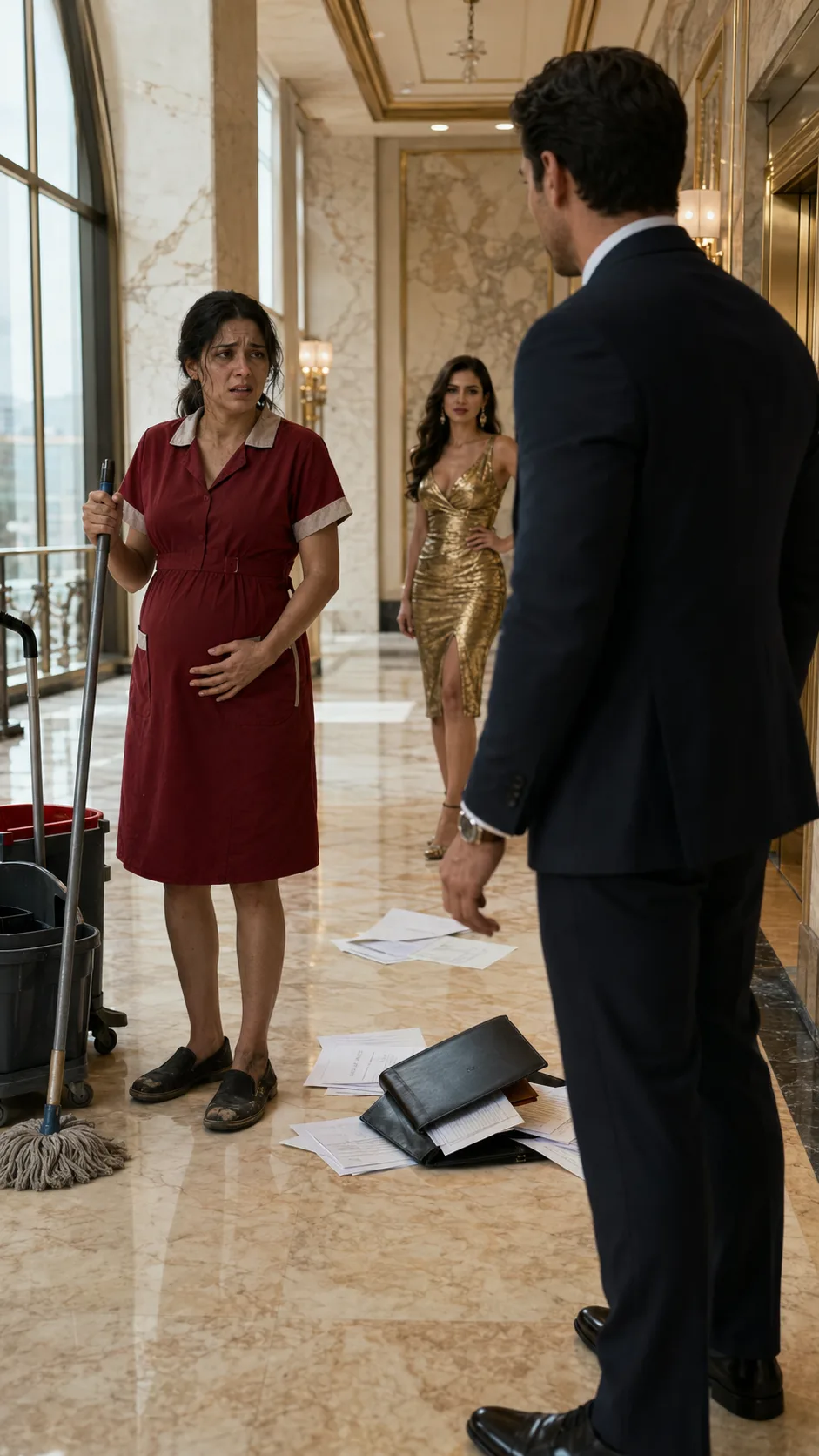
Gabriel could still see it: the red uniform, the mop handle, her hand over her belly, the terror in her eyes.
“I almost walked past you,” he said.
Lucía looked at the floor.
“Yes.”
“I will be sorry for that for the rest of my life.”
“I know.”
She turned toward him.
“But I did not disappear that day.”
“No.”
“You found me.”
Gabriel shook his head.
“Too late.”
Lucía looked at Mateo, then back at Gabriel.
“Late is not the same as never.”
The words entered him slowly.
He had learned not to grab hope too quickly. Hope, like trust, could be frightened away by careless hands.
So he only nodded.
They continued down the hallway together.
Near the elevator, Lucía paused again.
“What is it?” Gabriel asked.
She looked at him with quiet strength.
“The last time I stood here, I thought my life had become something small.”
Gabriel waited.
Lucía took Mateo’s hand and kissed his fingers.
“But it was not small. It was hidden. There is a difference.”
Gabriel’s throat tightened.
The elevator doors opened.
Inside, their reflections appeared in the polished metal: Gabriel in a dark suit, Lucía beside him, Mateo between them, not a perfect family, not an untouched one, but a real one.
That evening, Lucía gave her speech at the fundraiser.
She stood before a room of wealthy donors, lawyers, social workers, journalists, and survivors. Gabriel sat in the front row with Mateo on his lap.
Lucía did not tell the whole story. She did not need to.
She said, “Sometimes people ask me why I did not speak sooner. The answer is simple. I did speak. The people with power chose not to hear me.”
The room fell silent.
She continued, “So Casa Amanecer exists for women whose voices are treated as inconvenient. It exists for mothers told they are problems. It exists for anyone who has been made invisible inside a beautiful house.”
Gabriel bowed his head.
Lucía looked at him once.
Then she said, “And it exists because survival should not depend on whether the right person finally decides to believe you.”
When she finished, the room stood.
Gabriel did not clap first.
He stood first.
Mateo clapped because everyone else did, laughing at the sound of his own hands.
Lucía smiled at her son.
That smile was not broken.
After the event, they went home together.
Not to the mansion.
Never there.
To Lucía’s house, where Gabriel now had a drawer but not ownership, a key but not entitlement, a place at the table but not control.
Mateo fell asleep in the car.
Gabriel carried him inside and placed him gently in the crib.
When he returned to the kitchen, Lucía was making tea.
Rain tapped softly against the windows.
For a while, they stood in peaceful silence.
Then Lucía said, “I am still afraid sometimes.”
Gabriel’s chest tightened.
“Of me?”
“Of believing you.”
He nodded slowly.
“That makes sense.”
She looked at him.
“The old you would have defended himself.”
“The old me lost you.”
Lucía looked down at her cup.
“I do not want a love story where pain is erased because the man feels guilty.”
“Neither do I.”
“I do not want people to say you saved me.”
“You saved yourself.”
She looked up.
“And I do not want Mateo to grow up thinking love means control.”
Gabriel stepped closer, stopping at a respectful distance.
“Then we teach him differently.”
“How?”
“One day at a time,” he said. “By telling the truth. By apologizing without demanding forgiveness. By never using money as a leash. By letting him see that strength can be gentle.”
Lucía’s eyes softened.
“And if we fail?”
“We correct it.”
She studied him for a long moment.
Then she placed her cup on the counter.
“Stay tonight.”
Gabriel’s breath caught.
Lucía lifted a hand.
“On the sofa.”
He laughed softly, tears already in his eyes.
“The sofa is perfect.”
She almost smiled.
“Do not make it dramatic.”
“I am trying very hard not to.”
That night, Gabriel lay awake on the living room sofa, staring at the ceiling while rain whispered against the glass.
He could hear Mateo breathing faintly through the baby monitor.
He could hear Lucía moving once in the hallway, checking the lock, checking the nursery, checking the world.
Gabriel understood then that love was not the grand gesture people wrote about. It was not private jets, diamonds, public statements, or destroying enemies.
Love was being allowed to stay on the sofa.
Love was honoring locked doors.
Love was hearing fear and not punishing it.
Love was choosing, every day, to become safer than yesterday.
Years later, when people told the story, they liked to begin with the dramatic part.
The billionaire CEO found his missing wife cleaning floors.
They spoke of scandal, betrayal, revenge, and empire.
But Gabriel never told it that way.
When Mateo was old enough to ask why his parents looked sad in certain old photographs, Gabriel sat him down beside Lucía and told him the truth carefully.
Not every detail.
Enough.
He said, “I made the worst mistake of my life when I believed lies about your mother.”
Mateo looked at Lucía.
“And Mamá?”
Lucía brushed a hand through his hair.
“I survived.”
Mateo frowned, serious just like Gabriel.
“Did Papá fix it?”
Lucía and Gabriel looked at each other.
Then Lucía said, “No. He helped repair what could be repaired. That is different.”
Mateo thought about this.
Then he asked, “Are you still sad?”
Lucía smiled gently.
“Sometimes.”
Gabriel added, “But we are also happy.”
Mateo looked relieved.
Children liked answers that could hold more than one truth.
That night, after Mateo slept, Lucía and Gabriel stood on the porch watching the garden lights glow softly in the dark.
Gabriel reached for her hand, still slowly, even after all those years.
Lucía let him take it.
“You still ask,” she said.
“I always will.”
She leaned her head against his shoulder.
For a while, they said nothing.
The past had not vanished. It never would.
But it no longer owned the house.
Inside, their son slept safely. Outside, rain washed the garden clean. And between them stood a love that had not returned to what it once was.
It had become something harder.
Something humbler.
Something true.
Gabriel looked at the woman he had almost lost, the woman he had once failed to believe, the woman who had rebuilt herself without waiting for him to become worthy.
“I love you,” he said quietly.
Lucía closed her eyes.
“I know.”
Then, after a moment, she added, “I love you too.”
No music swelled.
No crowd applauded.
No empire bowed.
There was only a porch, a sleeping child, rain in the garden, and two people who had learned that love was not proven by how loudly someone claimed you.
It was proven by whether they could protect your peace when no one was watching.
And this time, Gabriel did.
The end.
Chapter complete
You have reached the end of this chapter.
Continue reading
A few more worlds to get lost in after this chapter.




