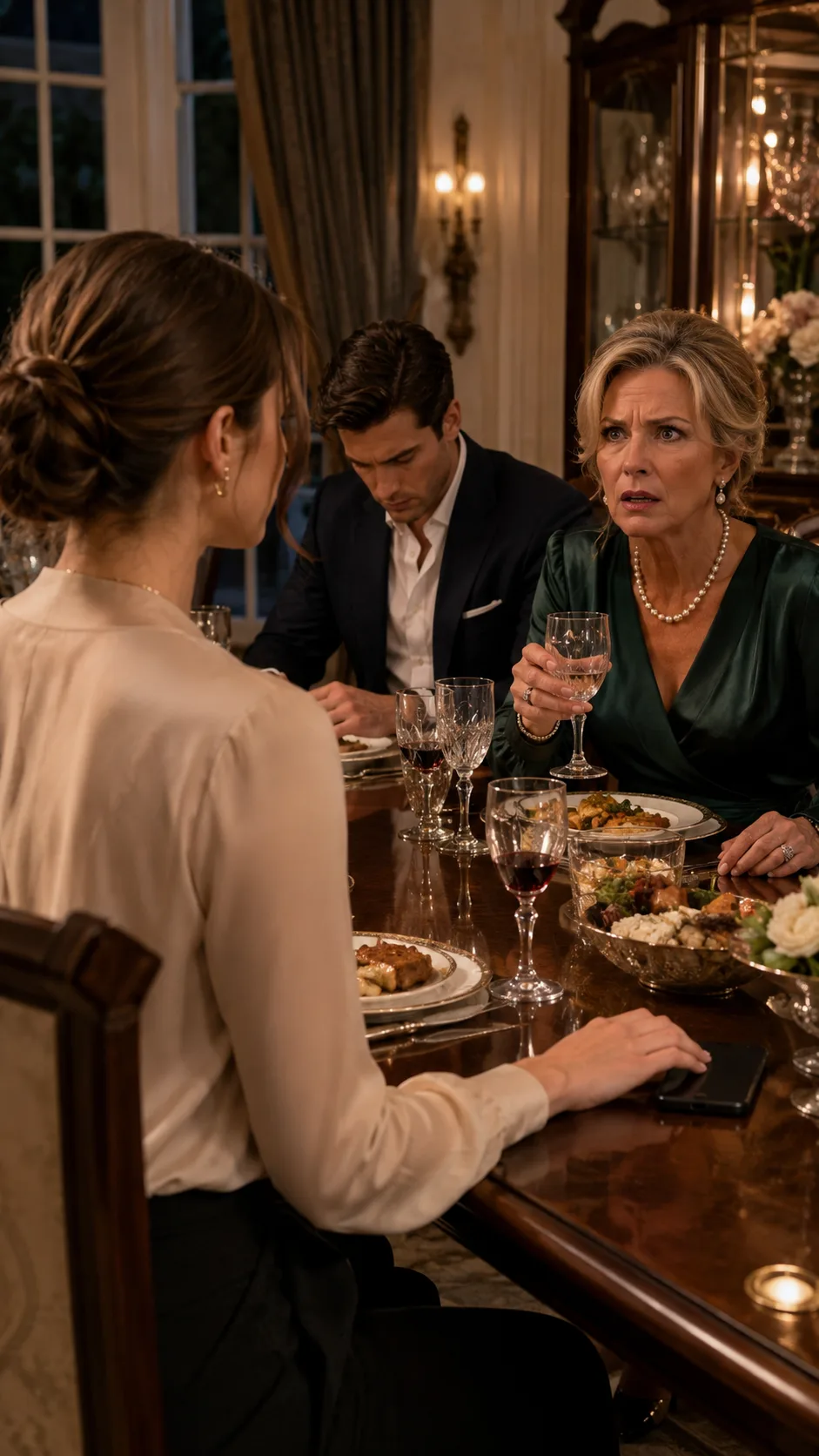
“You’re not coming on the cruise, Chloe.”
My mother-in-law said it like she was doing me a favor.
Chapter 1
“You’re not coming on the cruise, Chloe.”
My mother-in-law said it like she was doing me a favor.
The chandelier above Beatrice Whitmore’s dining room scattered warm light across crystal glasses, polished silverware, and plates arranged so perfectly they looked staged for a magazine. Everything in that house was chosen to impress people who already had too much. The linen napkins were folded like little white sculptures. The wine was imported. The table was long enough to make family feel like a board meeting.
And at the far end of it sat Beatrice, smiling at me as if she had just removed something unpleasant from her evening.
I lowered my fork.
“Sorry?”
Beside me, Ryan went still.
That told me everything before anyone else said a word.
He knew.
My husband knew.
Beatrice’s smile widened with soft, practiced cruelty.
“I said you’re not coming on the cruise. I know this may disappoint you, but I think it’s better for everyone if we’re honest.”
“Honest?” I repeated.
Amber, Ryan’s
younger sister, pressed her lips together, but the smile leaked through anyway. Robert, my father-in-law, checked his phone even though the screen was dark. He always did that when Beatrice became unbearable. He disappeared into cowardice and called it peace.
Beatrice took a slow sip of wine.
“Chloe, dear, this is a luxury cruise. Gala dinners. Private cocktail hours. Investors, donors, people with standards. There is etiquette involved. Expectations. You would feel terribly out of place.”
The words were wrapped in silk, but the insult underneath was bare.
Someone like you doesn’t belong.
Someone like you should know her limits.
Someone like you is tolerated, not welcomed.
I looked at Ryan.
He stared at his plate.
“Ryan?” I said.
His fingers tightened around his fork.
“Mom,” he said weakly, “maybe this isn’t the right time.”
I almost laughed.
Not because anything was funny.
Because my own husband had reduced my
humiliation to poor timing.
Beatrice gave him a sharp look.
“I’m not being unkind. I’m preventing discomfort. Chloe is sweet, but she has never been part of our world.”
“Our world,” I said quietly.
“Yes,” Beatrice replied. “Our world.”
Amber leaned back in her chair.
“She doesn’t even like formal events,” she said. “Remember the foundation dinner? She wore that plain black dress.”
“It was appropriate,” I said.
“It was boring,” Amber replied.
Beatrice sighed.
“Exactly. And this cruise is not the place for boring.”
Something in me tightened, but I kept my voice calm.
“Does my ticket already exist?”
Beatrice’s eyes flickered.
“What?”
“The cruise,” I said. “Did Ryan book me a ticket?”
Ryan swallowed.
No one answered.
That was enough.
I turned to my husband.
“You let them remove me.”
He finally looked at me, and the guilt in his face was almost worse than the silence.
“I
was going to explain later.”
“Explain what?”
He lowered his voice.
“That Mom thought it would be better if—”
“If your wife stayed home while your family vacationed without her?”
Beatrice cut in.
“Don’t dramatize it. Ryan needs to network. This trip matters for the family.”
I looked around the table.
“For the family,” I repeated.
Robert cleared his throat but still didn’t look at me.
Amber lifted her wineglass like she was watching a show.
I sat very still.
All my life, my father had taught me that money revealed people, but the absence of money revealed them faster. He never said it bitterly. He said it like weather. Like tides. Like something you had to respect if you wanted to survive.
When I was twelve, I asked him why he never told people immediately who he was.
He had been standing at the marina in a faded polo shirt while men in suits waited to meet him, not recognizing that the quiet man checking ropes beside the dock owned the entire port behind them.
“Because, Chlo,” he told me, “the way someone treats you before they know your last name is the only version of them that matters.”
I had carried that sentence into adulthood like a compass.
When I met Ryan at an architecture fundraiser, I didn’t introduce myself as Chloe Whittaker. I introduced myself as Chloe Lane, using my mother’s maiden name professionally, the name printed on my portfolio, the name I had built my career under. I didn’t lie. I just didn’t offer the part of my life people usually grabbed first.
Ryan had seemed different then.
Kind. Funny. Slightly nervous around me. He admired my designs before he asked who my clients were. He brought me coffee when I worked late. He remembered small things. For a while, I believed I had found someone who loved the quiet version of me.
Then I met his mother.
Beatrice did not shout. She did not need to. She could cut a person into pieces using manners alone.
At our first dinner, she asked what my parents did.
“My father works in tourism,” I said.
“How charming,” she replied, in a tone that made tourism sound like selling postcards from a beach cart.
When she learned I worked as an architect, she called it “creative.” When I bought a modest townhouse before marrying Ryan, she said it was “practical for someone starting out.” When I paid for half the wedding, she told guests my “independent streak” was refreshing.
And Ryan let it happen.
At first, he apologized in private.
“She’s just particular.”
“She takes time to warm up.”
“She doesn’t mean it like that.”
But after a while, apologies became silence. Silence became agreement. Agreement became betrayal.
And now we were here.
At a dinner I had cooked myself internally to survive, being told I lacked class by a woman whose entire identity was built on appearing rich enough to matter.
“Do you already have reservations?” I asked.
Beatrice frowned.
“Of course.”
“Which line?”
Amber answered before her mother could stop her.
“Azure Crown Line. The Sapphire Meridian. Seven nights. VIP balcony suites.”
My breath caught for half a second.
Not enough for them to notice.
The Sapphire Meridian.
My mother’s ship.
My father had named it three years after she died. I remembered standing beside him at the christening ceremony, my hand tucked into his arm, watching the bottle break against the hull while he cried silently behind sunglasses. The ship was not just part of his company. It was personal.
And Beatrice Whitmore had just told me I was not classy enough to board it.
“What a coincidence,” I said.
Ryan looked confused.
“What is?”
“I know Azure Crown Line.”
Beatrice laughed once.
“I’m sure you’ve seen advertisements.”
I smiled slightly.
“No. Not advertisements.”
Her eyes narrowed.
“Chloe, whatever performance you’re about to attempt, I suggest you stop.”
I reached into my bag.
Ryan turned toward me.
“What are you doing?”
“Checking something.”
“Chloe.”
His voice carried warning now. Not concern. Warning.
I looked at him.
“You had time to stop this before tonight.”
His face tightened.
“I didn’t want a scene.”
“You married me,” I said. “That made this your scene.”
He had no answer.
I placed my phone on the table, tapped a number I knew by heart, and turned on the speaker.
Beatrice leaned forward.
“Put that away.”
I ignored her.
The call rang twice.
A woman answered.
“Good evening, Azure Crown Line corporate office.”
The room changed.
It was subtle. A shift in posture. Amber’s eyebrows pulled together. Robert lowered his phone. Ryan stared at the device as if it had become dangerous.
“Hi,” I said. “This is Chloe. Could you connect me with my father, please?”
Beatrice’s expression hardened.
The woman on the line answered immediately.
“Of course, Miss Whittaker. One moment.”
Miss Whittaker.
The name settled over the table like thunder without sound.
Amber’s glass paused halfway to her mouth.
Robert blinked.
Ryan turned to me.
“Whittaker?”
I did not look at him.
My father’s voice came through a moment later, warm and familiar.
“Chloe? Is everything okay, sweetheart?”
For one small second, hearing him almost broke me.
Because suddenly I was not Ryan’s silent wife sitting under Beatrice’s judgment. I was my father’s daughter. Loved. Known. Protected.
I straightened.
“Yes, Dad. I need to review a reservation for the cruise leaving Port Meridian this Saturday. Sapphire Meridian. VIP balcony suites.”
A pause.
“Whose reservation?”
“Beatrice Whitmore.”
Silence.
Then faint keyboard clicks.
Beatrice’s face had gone pale beneath her perfect makeup.
“Chloe,” Ryan whispered, “what is going on?”
I finally turned to him.
“What should have gone on a long time ago.”
My father’s voice returned, lower now.
“I see the reservation.”
Beatrice sat back slowly.
“Dad,” I said, “is my name on it?”
Another pause.
“No.”
Ryan closed his eyes.
I felt the answer like a door shutting.
My father continued, “There are three suites under Beatrice, Robert, Amber, and Ryan Whitmore.”
I did not move.
Ryan opened his eyes.
“Chloe, I was going to—”
I raised one hand, and he stopped.
“Anything else?” I asked my father.
The pause that followed was different.
Longer.
Colder.
When my father spoke again, the warmth was gone from his voice.
“Yes. There’s a special service note attached. It says, ‘Do not permit Chloe Lane access to boarding activities, private events, or check-in under the Whitmore reservation.’”
No one breathed.
Amber’s mouth fell open.
Robert said, “Beatrice.”
Beatrice’s eyes flashed.
“That is private booking information.”
My father heard her.
“Mrs. Whitmore,” he said through the phone, very calm, “you placed a block request against my daughter on my ship.”
The word daughter hit the table like a gavel.
Beatrice gripped her wineglass.
“I didn’t know she was your daughter.”
My father’s voice sharpened.
“That is not a defense.”
I watched Beatrice search for a way out.
For the first time since I had known her, she could not find one.
Ryan turned toward his mother.
“You tried to block her from check-in?”
Beatrice snapped, “I was protecting the family from embarrassment.”
I laughed softly.
Everyone looked at me.
It wasn’t a happy sound.
“From embarrassment,” I repeated. “You invited your son, his father, his sister, and yourself onto a ship my family owns, then secretly tried to have me stopped at the port like I was a stranger causing trouble.”
“You never told us,” Amber said quickly, as if that somehow helped.
I looked at her.
“No. I didn’t.”
“Why?” Ryan asked.
His voice cracked a little.
That almost hurt.
Almost.
“Because I wanted to know if you loved me when you thought I was ordinary.”
His face fell.
The room went quiet again, but this silence was different from the first. The first silence had been conspiracy. This one was exposure.
My father spoke.
“Chloe, do you want me to cancel the reservation?”
Beatrice’s head snapped up.
“No.”
The word came out too fast. Too desperate.
Amber leaned forward.
“Wait, you can’t just cancel it.”
Robert muttered, “Amber.”
My father ignored them.
“Chloe?”
I looked at Ryan.
He looked terrified, but not only because of the cruise. I could see the realization arriving slowly, like cold water rising around him.
He had thought my patience was weakness.
He had thought my quiet meant I had nowhere else to go.
He had thought silence would protect him from choosing.
Now the choice was sitting between us.
“No,” I said.
Beatrice blinked.
My father paused.
“No?”
“No,” I repeated. “Don’t cancel it.”
Relief flashed across Beatrice’s face.
Too soon.
I continued, “Remove Ryan from their suite.”
Ryan stared at me.
“What?”
“And transfer him to a separate standard cabin,” I said. “If he wants to go, he can go alone.”
My father waited.
“And Beatrice?”
I looked at her. Her lips were pressed tight, her eyes bright with fury and fear.
“Leave her reservation active,” I said. “But remove all VIP privileges connected to my family’s account. No private events. No owner’s reception. No complimentary upgrades. No executive lounge. No family courtesy access.”
Amber made a small choking sound.
Beatrice stood so abruptly her chair scraped the floor.
“You vindictive little—”
“Careful,” my father said through the phone.
She froze.
I stood too, slowly.
“I’m not vindictive,” I said. “I’m accurate.”
Ryan stood beside me.
“Chloe, please. Let’s talk.”
I turned to him.
“We are talking.”
“Privately.”
“You had three years to defend me privately. Tonight I’m done hiding the damage publicly.”
His face flushed.
“I made a mistake.”
“No,” I said. “You made a habit.”
That silenced him.
My father’s voice softened.
“Sweetheart, do you want me to send a car?”
I looked around the dining room one last time.
At the expensive table.
At the cold food.
At the woman who had spent years measuring my worth with a ruler she did not even own.
“Yes,” I said. “Please.”
Then I picked up my phone, ended the call, and walked out before anyone could stop me.
Ryan followed me into the foyer.
“Chloe.”
I kept walking.
“Chloe, wait.”
I reached for my coat.
He caught the sleeve, not hard, but enough to make me turn.
“Don’t leave like this.”
I looked down at his hand.
He let go.
“I didn’t know Mom put in that note,” he said.
“But you knew I wasn’t invited.”
He swallowed.
“Yes.”
“And you accepted that.”
“I thought I could fix it later.”
“When?”
He had no answer.
“When the ship left?” I asked. “When your mother posted photos from the gala? When people asked where your wife was and you told them I had work?”
His eyes filled with shame.
“I was trying to keep peace.”
I stepped closer.
“No, Ryan. You were trying to keep comfort. Yours.”
He looked like I had slapped him.
Behind him, Beatrice appeared in the doorway.
“This is absurd,” she said. “All families have disagreements.”
I laughed again, quieter this time.
“You tried to have me blocked from a ship.”
“You humiliated me in my own home.”
“You humiliated yourself in your own home.”
Her face hardened.
“You think your father’s money makes you better than us?”
“No,” I said. “That’s the difference between us.”
For a second, I saw something flicker in her expression.
Not remorse.
Recognition.
She knew I had won.
And she hated me for doing it without raising my voice.
A black car arrived fifteen minutes later.
My father’s driver, Malcolm, stepped out before I reached the curb. He had known me since I was sixteen. He did not ask questions. He only opened the rear door and said, “Miss Chloe.”
I got inside.
Ryan stood under the porch light, helpless and pale.
“Where are you going?” he asked.
“To my father’s house.”
“For how long?”
I looked at him through the open window.
“Until I can breathe.”
Malcolm closed the door.
As the car pulled away, I saw Beatrice behind Ryan, arms crossed, still proud enough to pretend she had not just destroyed everything she wanted to control.
My father was waiting when I arrived.
He lived in a house by the water, not the largest house he owned, just the one that still felt like my mother. The porch lights were on. The bay was dark beyond the windows. When I stepped inside, he was standing in the entryway in a sweater and old slippers, looking more like a worried dad than a shipping magnate.
That was all it took.
I broke.
He crossed the room and pulled me into his arms, and I cried harder than I wanted to. Not because of the cruise. Not because of Beatrice.
Because of Ryan.
Because some part of me had still been waiting for him to stand up.
And he hadn’t.
My father held me without speaking until the worst of it passed.
Then he led me to the kitchen, made tea he forgot to steep properly, and sat across from me.
“Tell me everything,” he said.
So I did.
Not just tonight.
All of it.
The little comments. The dinners. The jokes about my clothes. The way Beatrice introduced me as “Ryan’s little architect wife.” The way Amber asked if I understood wine lists. The way Robert avoided conflict by becoming furniture. The way Ryan apologized only after we were alone, when it no longer cost him anything.
My father listened.
His face grew still in the way it did when lawyers were about to have a bad week.
When I finished, he asked, “Do you want me to intervene?”
I shook my head.
“No.”
He studied me.
“You’re sure?”
“I don’t want you to fight my marriage for me.”
His expression softened.
“Is there a marriage left to fight for?”
I looked down at my tea.
“I don’t know.”
Ryan called seventeen times that night.
I didn’t answer.
He texted.
Please pick up.
I’m sorry.
I should have defended you.
I didn’t know how bad it had gotten.
That last message made me stare at the screen for a long time.
Because he did know.
Maybe not every detail. Maybe not every bruise. But he knew enough.
He had simply chosen not to measure the damage if measuring it meant he had to act.
The next morning, I woke up in my old bedroom overlooking the water. My father had not changed much after I moved out. The shelves still had design books from college. My mother’s sketch of the marina still hung above the desk. For a while, I sat there in the quiet, feeling strangely young and very old at the same time.
At 9:12 a.m., my phone rang.
Ryan.
This time, I answered.
He exhaled like he had been holding his breath all night.
“Chloe.”
“What do you want, Ryan?”
“To talk.”
“So talk.”
A pause.
“I left Mom’s house after you did.”
“Congratulations.”
He winced audibly.
“I deserved that.”
I said nothing.
“I confronted her,” he continued. “About the reservation. About everything.”
“And?”
“She said you manipulated us.”
I almost smiled.
“Of course she did.”
“I told her she was wrong.”
That made me pause.
“She cried,” he said. “Then she got angry. Then she said if I chose you over the family, I shouldn’t expect to come on the cruise.”
“And what did you say?”
He took a shaky breath.
“I told her I wasn’t going.”
For a moment, I did not speak.
Outside the window, gulls cut across the gray morning sky.
“That must have been hard for you,” I said.
“It should have been easier.”
The honesty in that sentence caught me off guard.
“I’m not asking you to forgive me today,” he said. “I know I don’t deserve that. But I want to come over. I want to apologize to your face. And I want to tell your father I’m sorry too.”
“My father is not the one you hurt.”
“I know.”
“Do you?”
“Yes,” he said softly. “I think I’m starting to.”
That was not enough.
But it was more than I expected.
I let him come at noon.
My father insisted on being present for the first ten minutes. Ryan arrived without his usual confidence. No expensive watch. No tailored jacket. Just jeans, a sweater, and a face that looked like he hadn’t slept.
He stepped into the living room and looked at my father.
“Mr. Whittaker,” he said. “I owe you an apology.”
My father stared at him.
“You owe my daughter one.”
Ryan nodded.
“I know.”
Then he turned to me.
“I’m sorry,” he said.
I folded my arms.
“For what?”
He closed his eyes briefly.
“For letting my mother decide where you belonged. For staying silent because it was easier than fighting her. For making you feel alone in a family I promised would be yours too.”
My throat tightened, but I kept my face still.
“And for last night,” he said. “When she told you that you weren’t coming, I knew before dinner. I didn’t know about the check-in block, but I knew she removed you from the trip, and I let myself believe I could smooth it over later. That was cowardly.”
My father’s expression did not change, but I saw his hand relax slightly on the armrest.
Ryan looked at him.
“I also need to be honest. I didn’t know who Chloe’s family was. But that shouldn’t matter. The way I treated her should have been the same if her father owned the ship or if he sold tickets at the dock.”
The room went quiet.
That was the first thing he had said that sounded like truth instead of damage control.
My father stood.
“I’ll give you both privacy,” he said.
As he passed Ryan, he stopped.
“But understand this. My daughter does not need your last name, your family, or your protection to survive. Marriage should add safety to her life, not subtract it.”
Ryan nodded.
“Yes, sir.”
When we were alone, he sat across from me, not beside me. That mattered. He was not assuming closeness he had not earned.
“I’m moving out of our apartment for a while,” he said.
I blinked.
“What?”
“I booked a short-term rental. I think you need space without having to leave your own home.”
The words hit somewhere tender.
Our apartment had become another place where I swallowed things.
“You don’t have to decide anything now,” he said. “Divorce, separation, counseling. Whatever you need. I’ll cooperate.”
I studied him.
“Did your mother tell you to say that?”
His mouth twisted with pain.
“No. My mother told me to make you apologize before people found out.”
There it was.
I leaned back.
“People?”
“She’s worried about her social circle. Apparently she told several friends she had owner-level access on the cruise.”
Despite everything, I laughed.
Ryan looked miserable.
“She’s afraid your father will blacklist her.”
“My father doesn’t blacklist people for being rude,” I said. “He blacklists them for abusing staff, committing fraud, threatening employees, or creating security issues.”
Ryan swallowed.
“She did call the concierge desk and imply you might cause a disturbance if you arrived.”
My stomach turned.
“She said that?”
He nodded.
“I heard her last week. I thought she was just being dramatic.”
“You heard her?”
His face crumpled.
“Yes.”
That changed the room.
I stood and walked to the window.
Behind me, Ryan said, “Chloe—”
“You heard her suggest I was a security problem.”
“I didn’t understand—”
“You understood enough to remember it.”
He went silent.
The water outside looked cold and flat.
For the first time, I saw clearly that love was not only measured by what someone felt. It was measured by what they stopped.
Ryan had felt bad.
He had stopped nothing.
I turned around.
“I need you to leave.”
He stood slowly.
“Okay.”
He looked like he wanted to say more, but didn’t.
Good.
At the door, he paused.
“I love you,” he said.
I looked at him for a long moment.
“I know.”
His face fell.
Because I had not said it back.
After he left, I expected to collapse again. Instead, I felt calm. Not peaceful. Not happy. But calm in the way a storm becomes calm when it finally decides where to land.
By evening, Beatrice called.
I let it go to voicemail.
Then she texted.
This has gone far enough.
I did not answer.
Another message came.
You have embarrassed this family.
Then another.
Ryan is devastated because of you.
Then:
We need to discuss the cruise like adults.
That one made me smile.
I forwarded the messages to Ryan.
A minute later, he replied.
I’m sorry. Don’t respond. I’ll handle her.
For once, he did.
The next two days passed in a blur of decisions.
I returned to our apartment while Ryan moved out. He left a note on the kitchen counter.
I know a note is not enough. I’m not asking it to be. I’ll start therapy Monday. I’ll send you the lease details for my temporary place. I won’t come by without asking.
I read it twice, then placed it in a drawer.
On Friday morning, one day before the cruise, my father asked if I wanted to come to Port Meridian with him.
“The Sapphire Meridian departs tomorrow,” he said. “I have a pre-departure inspection.”
I almost said no.
Then I thought of Beatrice walking up the gangway, expecting luxury to bend around her. I thought of her friends. Her pearls. Her beautiful luggage. Her desperate need to be seen as important.
“I’ll come,” I said.
Port Meridian smelled like salt, diesel, sunscreen, and expensive perfume. The Sapphire Meridian rose over the terminal like a floating city, white and gold against the blue sky. I had seen it many times, but that morning it looked different.
Not like inheritance.
Like evidence.
My father walked beside me through the private entrance. Staff greeted him warmly, then looked at me with the kind of discreet recognition I had spent years avoiding.
At the executive lounge, a woman named Marina approached us with a tablet.
“Mr. Whittaker, Miss Whittaker.”
I smiled.
“Hi, Marina.”
She looked relieved to see me.
“I’m sorry about the note on your file,” she said quietly. “It should never have been accepted.”
“It wasn’t your fault.”
Her expression tightened.
“Mrs. Whitmore was very insistent. She implied there was a family legal matter.”
My father’s face darkened.
I touched his arm.
“Dad.”
He stopped himself.
Marina continued, “We flagged it after your call. Security has been briefed. Mrs. Whitmore’s party is still permitted to board, but without executive privileges.”
“Thank you,” I said.
An hour later, I saw them.
Beatrice entered the terminal wearing a cream suit, oversized sunglasses, and the stiff posture of a woman determined not to look afraid. Amber walked beside her, scrolling furiously on her phone. Robert followed with the luggage, looking like he wanted to vanish into the floor.
Ryan was not with them.
That mattered more than I wanted it to.
Beatrice reached the priority check-in desk and smiled at the attendant.
“Beatrice Whitmore. VIP balcony suite.”
The attendant typed.
Her polite expression did not change.
“Yes, Mrs. Whitmore. Your balcony suite is confirmed.”
Beatrice relaxed.
“Good.”
“However,” the attendant continued, “your VIP privileges are not attached to this reservation.”
Amber looked up.
“What?”
Beatrice stiffened.
“That’s incorrect.”
The attendant remained calm.
“I can call a supervisor.”
“Do that,” Beatrice snapped.
My father and I stood behind the glass wall of the executive corridor. She had not seen us yet.
The supervisor arrived.
Then Marina.
Then Beatrice began speaking in the tone she used when she wanted workers to feel small.
“This is a mistake. We are personal guests of the owner.”
Marina’s expression stayed professional.
“No, ma’am. You are paying passengers.”
Amber flushed.
Beatrice lowered her voice.
“You clearly don’t understand who you’re dealing with.”
That was when my father stepped out.
“I think she does.”
Beatrice turned.
For a second, all the blood seemed to leave her face.
Then she saw me beside him.
Her mouth tightened.
“Chloe.”
“Beatrice.”
Robert looked down.
Amber whispered something under her breath.
My father walked forward.
“Mrs. Whitmore,” he said. “My staff will be treated with respect. If that is a problem, you will not board.”
Beatrice’s nostrils flared.
“I paid for this trip.”
“Yes,” he said. “And you will receive exactly what you paid for. Nothing more.”
Amber looked horrified.
“But the owner’s reception—”
“Is private,” my father said.
Beatrice stared at me.
“You must be enjoying this.”
I thought about it.
Was I?
Not exactly.
Revenge, I discovered, did not taste as sweet as people imagined. It tasted like exhaustion. Like finally putting down a heavy bag someone else had packed for you.
“No,” I said. “I’m not enjoying this.”
Her eyes narrowed.
“I don’t believe you.”
“I know,” I said. “That’s why you lost.”
For the first time, she had nothing clever to say.
Then a voice behind us said, “Mom.”
Ryan.
I turned.
He stood near the terminal entrance, one small suitcase beside him. He looked nervous but steady.
Beatrice’s face lit with relief.
“Ryan. Thank God. Tell them this is ridiculous.”
He walked toward us.
For one terrible second, I felt my body brace.
Old habit.
Old hope.
Old fear.
Ryan stopped beside me, not beside his mother.
“I’m not boarding with you,” he said.
Beatrice froze.
“What?”
“I came to say this in person.”
Amber scoffed.
“Ryan, don’t be dramatic.”
He looked at her.
“You don’t get to speak right now.”
Amber recoiled.
Beatrice’s voice sharpened.
“This is your wife’s doing.”
“No,” Ryan said. “This is yours.”
The words seemed to stun even him.
But he continued.
“You tried to exclude my wife. You humiliated her. You lied to staff. And I let too much of it happen because I was afraid of upsetting you.”
Beatrice’s eyes filled with furious tears.
“After everything I’ve done for you?”
“You raised me to think keeping you happy was the same thing as being good,” he said. “It isn’t.”
The terminal noise seemed to fade around us.
I looked at Ryan, unable to speak.
He turned to me.
“I’m not asking this to fix anything. I just wanted you to hear me say it where I should have said it first.”
Then he faced his mother again.
“I won’t be joining the cruise. I won’t attend family dinners where Chloe is disrespected. And if you want a relationship with me, you’ll start with an apology to her.”
Beatrice looked at me as if the apology itself might poison her.
“I will not be bullied into—”
“Then don’t,” Ryan said.
The simplicity of it stopped her.
He picked up his suitcase.
“I booked my own ticket home.”
Amber stared at him.
“You’re choosing her over us?”
Ryan looked tired.
“No. I’m choosing the person I promised not to abandon.”
My heart hurt then.
Not because everything was healed.
Because something true had finally arrived too late to be simple.
Beatrice boarded the ship that afternoon.
Without VIP access.
Without owner privileges.
Without Ryan.
Robert followed her like a shadow. Amber complained loudly enough that three staff members heard, and Marina upgraded another family into the executive lounge just to make a point.
I did not board.
Neither did Ryan.
We stood outside the terminal as the Sapphire Meridian prepared to depart. The horn sounded low and deep across the water.
Ryan kept a careful distance beside me.
“I meant what I said,” he told me.
“I know.”
“I started therapy.”
“I know. You sent me the appointment confirmation.”
He nodded awkwardly.
“I wasn’t sure if that was too much.”
“It wasn’t.”
The ship began moving, slowly pulling away from the dock. Sunlight flashed across its windows.
“My mother wants me to believe you destroyed the family,” Ryan said.
I watched the water churn white beneath the hull.
“And what do you believe?”
He took a long breath.
“I think the family was already broken. You just stopped pretending it wasn’t.”
That answer settled between us.
Not perfect.
But honest.
I turned to him.
“I don’t know if I can stay married to you.”
His eyes reddened, but he nodded.
“I know.”
“I don’t know if love is enough.”
“I know that too.”
“I need time.”
“I’ll give it.”
Months passed before I made a decision.
Not days.
Not one dramatic apology. Not one public confrontation. Real life does not heal on a cruise schedule.
Ryan went to therapy. Alone first, then with me when I was ready. He learned words he had avoided his whole life: enmeshment, avoidance, emotional coercion, boundaries. At first, he sounded like a man repeating vocabulary from a pamphlet. Then slowly, painfully, he began to understand what those words had cost us.
Beatrice did not apologize.
Not immediately.
For three months, she sent messages through Robert, through Amber, through family friends who thought they were being diplomatic.
Surely this has gone too far.
A mother deserves grace.
Chloe should understand Beatrice was embarrassed.
I ignored all of them.
Then one rainy afternoon in October, a letter arrived.
Handwritten.
Beatrice’s handwriting was as elegant as the rest of her.
Chloe,
I have rewritten this letter six times because every version sounded like an excuse. I am not good at apologizing. That is not an excuse either.
I treated you badly because I believed status made me safe. I measured you because I was terrified of being measured myself. I tried to exclude you from the cruise because I wanted control. What I did with the check-in note was cruel and wrong.
You did not embarrass me. I embarrassed myself.
I am sorry.
Beatrice
I read it three times.
Then I placed it in the same drawer as Ryan’s note.
I did not forgive her that day.
But I believed, for the first time, that she had told the truth.
A year later, Ryan and I renewed our vows.
Not in a ballroom.
Not at a country club.
Not on a cruise ship.
We did it in my father’s backyard by the water, with thirty people, folding chairs, and wind that kept trying to steal the flowers. My father walked me down the small stone path, then whispered, “You can still run.”
I laughed.
Ryan heard and smiled nervously.
He was different by then.
Not perfect. Not magically reborn. Just different in the way that mattered: he noticed. He spoke. He stopped things.
When Beatrice arrived, she wore a simple navy dress and no pearls.
She approached me before the ceremony.
For a moment, we stood facing each other with the bay behind us.
“You look beautiful,” she said.
“Thank you.”
She swallowed.
“I know I have not earned a place here easily.”
“No,” I said. “You haven’t.”
She nodded.
“But you came,” I added.
Her eyes shone.
“Yes.”
I looked at her for a long moment.
Then I said, “Then sit in the second row. My father gets the first.”
A startled laugh escaped her.
Not offended.
Not cruel.
Almost human.
She sat in the second row.
Ryan and I said new vows that day. Not the polished kind people say for guests. Real ones.
He promised never to leave me alone in a room where I was being diminished.
I promised not to hide pain until it became distance.
He promised that peace would never again mean my silence.
I promised that love would not mean testing him in secret, but trusting myself enough to speak sooner.
After the ceremony, my father raised a glass.
“To my daughter,” he said, “who never needed a ship to prove she belonged anywhere.”
Everyone laughed.
I looked across the yard.
At Beatrice, sitting quietly beside Robert.
At Amber, who had spent the last year learning that sarcasm was not a personality.
At Ryan, who reached for my hand but did not grip it too tightly.
And at the water beyond them all.
The Sapphire Meridian passed far out in the bay that evening, its lights glowing against the darkening horizon.
For a second, I remembered that dinner.
The polished table.
The phone on speaker.
The silence when my last name changed everything.
Back then, I thought the revelation was about power.
It wasn’t.
It was about truth.
My mother-in-law had tried to keep me off a ship because she thought I didn’t belong in her world.
But the real question had never been whether I belonged on that cruise.
It was whether I belonged in a family that needed me small.
And in the end, I didn’t.
I belonged beside people who could look at me fully — without the last name, without the money, without the performance — and still choose me out loud.
That was the only luxury I ever wanted.
And this time, I did not have to ask for permission to board.
Chapter complete
You have reached the end of this chapter.
Continue reading
A few more worlds to get lost in after this chapter.




