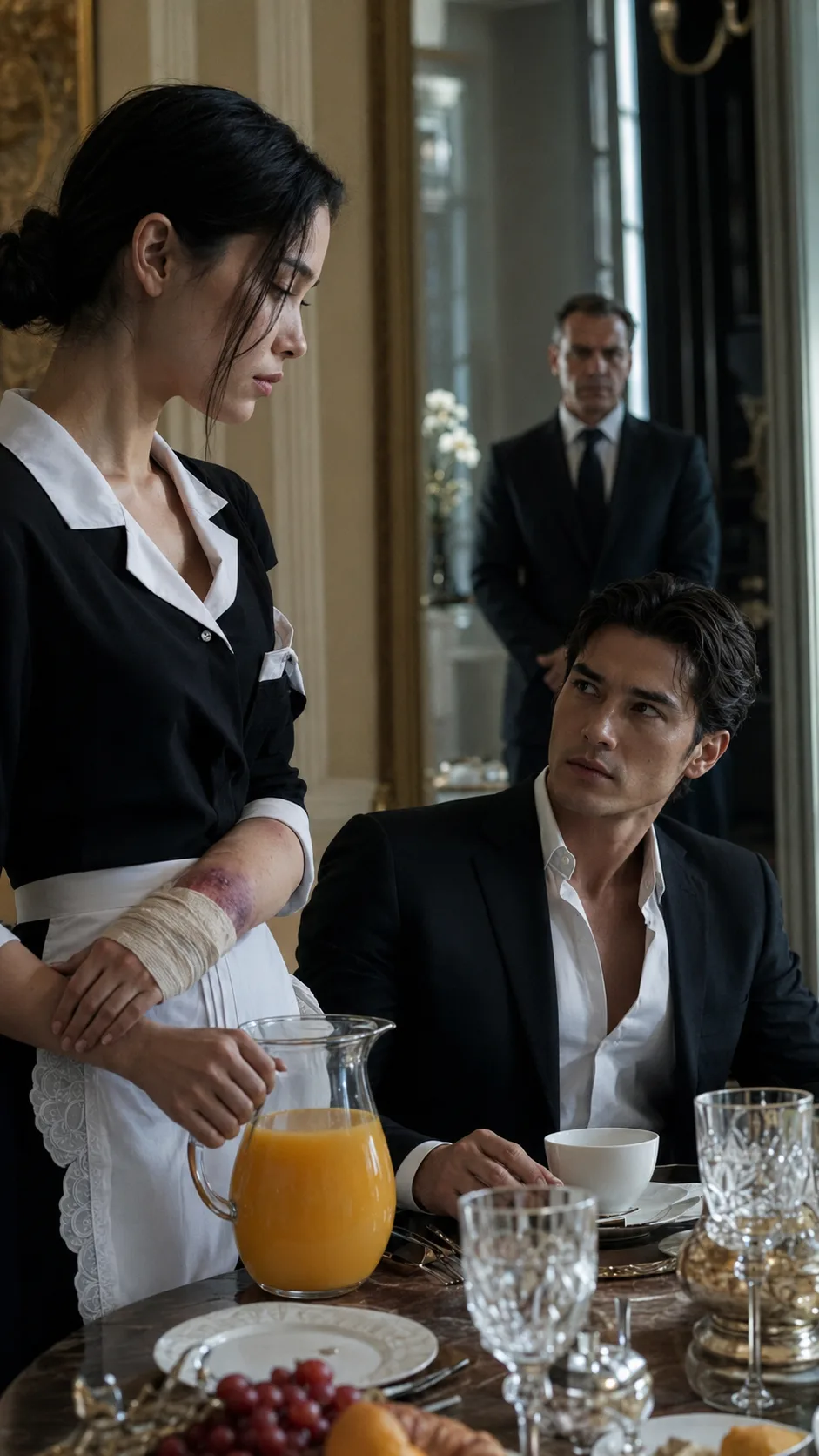
At seven o'clock in the morning, inside the Montenegro mansion, no sound rose louder than the delicate clinking of fine porcelain.
Chapter 1
At seven o'clock in the morning, inside the Montenegro mansion, no sound rose louder than the delicate clinking of fine porcelain.
The servants drifted in and out of the dining room like shadows, trained not to exist. The coffee had to arrive without a single drop spilled, the toast had to be warm but not burned, the napkins folded with exact precision, and every pair of eyes kept lowered.
In that house, where marble floors gleamed like mirrors and the walls held secrets that could make half the city tremble, being invisible was practically a survival strategy.
Isabela Rivas knew this better than anyone.
She was twenty-seven years old, with dark hair pulled back into a tight bun and hands that had learned the rhythm of labor long before they ever knew rest. She had arrived at the Montenegro mansion six months earlier with nothing but an old suitcase, two changes of clothes, and a desperate need to disappear from the world hunting her.
No one asked too many questions in
the home of Damián Montenegro.
The staff knew better.
The city knew better.
Damián Montenegro was the most feared millionaire on the coast, owner of nightclubs, hotels, private ports, shipping companies, and a dozen legal businesses that people suspected were only the clean surface of something much darker beneath. He was rich enough to be invited into every elite room and dangerous enough that no one dared whisper his name without checking who stood behind them.
The man himself always ate breakfast in silence.
Tall, elegant, and coldly composed, Damián never needed to raise his voice to instill fear. His gray eyes seemed to have witnessed too many betrayals and forgiven none of them. All it took was for him to place his cup down on its saucer, and every person in the room remembered how easily silence could become a warning.
That morning, Isabela carried the silver tray herself.
Orange juice, freshly squeezed.
Black coffee.
A porcelain cup.
A folded newspaper no one had dared to open first.
She stepped to Damián’s right side, keeping her gaze low, careful not to breathe too loudly. Her wrist pulsed beneath her sleeve with a pain so sharp it made the room tilt around her.
She had wrapped it before dawn in a strip of clean cloth stolen from the laundry room.
Not well.
Not tightly enough.
But enough to hide it.
At least, that was what she had believed.
As she poured the juice into Damián’s glass, her fingers trembled.
The pitcher shifted.
A single drop slipped down the rim.
Isabela froze.
No one moved.
Damián’s eyes lifted from the table.
Isabela quickly steadied the pitcher, but the movement caused her sleeve to slide back a few centimeters.
Just enough.
Enough to reveal the swollen wrist.
Purple at the edges.
Wrapped
in white cloth.
Bruised in the shape of fingers.
The dining room changed.
Not loudly.
There was no gasp. No shout. No dramatic crash.
Only a silence so sudden that even the ticking of the antique clock seemed afraid to continue.
Damián looked at her wrist.
Then at her face.
Isabela pulled her sleeve down immediately, pressing it tight with her other hand.
Too late.
“What happened to your hand?” Damián asked.
His voice was calm.
That made it worse.
Every servant in the room became still.
Near the far wall, Bruno Varela, head of security, stopped chewing. Behind him, two guards stood by the carved double doors: Víctor and Ramiro. Both men were broad-shouldered, expensive suits hiding the roughness of men who were paid to do ugly work quietly.
Their eyes flicked toward each other.
Barely a second.
But Damián saw it.
Isabela saw it too.
Her heart struck against her ribs.
“I fell, sir,” she said softly. “It was just my own clumsiness.”
Damián did not answer.
He lifted his coffee cup, stared into the dark surface for a moment, then placed it back down.
The cup touched the saucer with a small, clean sound.
“In this house,” he said, “no one falls like that.”
Isabela’s throat tightened.
She wanted to disappear into the polished floor.
She wanted to become one of the shadows again.
Because Isabela had not fallen.
And before that day was over, the men who had broken her wrist would discover that hurting a powerless woman in Damián Montenegro’s house was not an act of strength.
It was a confession of stupidity.
---
Isabela had learned early that fear had many sounds.
Sometimes it sounded like fists on a door.
Sometimes like a man laughing too softly.
Sometimes like silence after someone powerful asked a question you could not safely answer.
Six months earlier, she had come to the Montenegro estate under a false surname, recommended by a woman who owed the housekeeper a favor. She had not lied about knowing how to work. She could clean, cook, serve, sew, polish silver, memorize schedules, disappear during conversations, and keep secrets better than anyone.
What she had lied about was why she needed the job.
She told the housekeeper she had lost her apartment.
That was true.
She said she had no family nearby.
That was true too.
She did not say that her younger brother, Mateo, had borrowed money from men he should never have spoken to. She did not say that after Mateo vanished, those men came looking for her. She did not say they had followed her from one neighborhood to another until she slept with a chair against her door and a kitchen knife under her pillow.
She also did not say that two of those men now worked security inside the Montenegro mansion.
Víctor and Ramiro had recognized her on her third week there.
They cornered her in the lower corridor near the wine cellar, where the cameras had a blind spot.
Víctor smiled first.
“Well,” he said. “Look who found herself a rich roof.”
Ramiro stepped closer, blocking her way.
Isabela had felt the world turn cold.
“I don’t know you,” she whispered.
Víctor laughed. “That’s smart. Keep saying that.”
They did not attack her then. Not in a way anyone could see.
They only warned her.
Mateo still owed money.
Mateo was gone.
Someone had to pay.
And if Isabela told anyone, they said, they would make sure Damián believed she was stealing from him.
That was the first threat.
Then came the second.
They found the small envelope of cash she kept hidden beneath the lining of her suitcase. Three months of wages. Every coin she had saved to leave the city.
The envelope disappeared.
When she confronted them, Ramiro leaned close and whispered, “You should be grateful we only took money.”
After that, Isabela learned to move around the mansion as if she were walking through a room full of knives.
She memorized where Víctor stood during night shifts.
She avoided the cellar.
She stopped eating dinner with the other staff.
And when she heard footsteps behind her, she never turned around.
The night before Damián saw her wrist, she had been carrying folded linens to the east wing when Víctor stepped from an alcove.
Ramiro was with him.
“You’ve been paid again,” Víctor said.
Isabela kept walking.
He caught her arm.
She tried to pull away.
Ramiro grabbed her wrist.
Hard.
Too hard.
Pain flashed white behind her eyes.
“I don’t have it,” she said.
Víctor’s face hardened.
“You work in the richest house on the coast. Don’t insult us.”
“I sent it already.”
“To who?”
She said nothing.
That was the mistake.
Ramiro twisted her wrist until Isabela dropped the linens. She made one sound, small and broken, before biting it back.
Víctor leaned down and picked up one of the fallen towels.
“Clean that up,” he said.
Then he walked away.
By morning, her wrist was swollen.
By breakfast, Damián had seen it.
And now the room waited for her answer.
---
Damián leaned back in his chair.
“Leave us,” he said.
The servants moved immediately.
No one questioned him.
Chairs did not scrape. Shoes did not stomp. The room emptied with the quiet efficiency of people who understood that survival sometimes meant obeying before the second breath.
Only Isabela, Bruno, Víctor, and Ramiro remained.
Damián looked at Bruno.
“You too.”
Bruno’s face tightened. “Sir, with respect—”
“With respect,” Damián interrupted, “I did not ask for protection from my own dining room.”
Bruno lowered his head.
“Yes, sir.”
He left.
Now only three men and one injured woman remained.
Isabela wished desperately that Damián had let the others stay. A room full of witnesses, even frightened ones, felt safer than a room with only powerful men and secrets.
Damián’s gaze did not leave her.
“Show me your wrist.”
Isabela shook her head faintly.
“It is nothing, sir.”
“Show me.”
There was no anger in his voice.
Only command.
Slowly, Isabela lifted her hand and pulled back the sleeve.
The bandage had loosened.
Beneath it, the skin was bruised in dark uneven marks.
Damián’s expression did not change.
That frightened everyone more than rage would have.
He stood.
The chair did not scrape loudly, but the sound carried.
Víctor straightened.
Ramiro looked at the floor.
Damián walked around the table and stopped in front of Isabela. He did not touch her. He looked only at the injury.
“Who did this?”
Isabela’s eyes burned.
“No one.”
Damián turned his head slightly.
“Víctor.”
The guard looked up.
“Yes, boss?”
“Did I ask you anything?”
Víctor blinked. “No.”
“Then why did your face answer before she did?”
The room seemed to shrink.
Víctor’s jaw tightened.
Ramiro’s breathing changed.
Isabela felt it then—the dangerous shift. The moment men who were used to frightening others realized they were the ones being studied.
Damián returned to his seat.
He picked up his napkin, folded it once, and placed it beside his plate.
Then he said, “Bruno.”
The door opened almost immediately.
Bruno stepped back inside.
“Yes, sir.”
“Seal the house.”
Bruno’s eyes flicked toward Víctor and Ramiro.
“For what reason?”
Damián’s eyes lifted.
Bruno went pale.
“I apologize,” he said. “I’ll handle it.”
“No one leaves,” Damián continued. “No one deletes footage. No one touches the staff quarters. Bring me the camera records from the east wing, the lower corridor, and the service stairs. Last night. Midnight to four.”
Ramiro spoke before he could stop himself.
“The service stairs camera has been faulty.”
Damián looked at him.
No one breathed.
“How fortunate,” Damián said, “that you know that.”
Ramiro’s mouth closed.
“Bring the records,” Damián told Bruno. “And bring the night ledger.”
Bruno nodded and left.
Isabela’s knees felt weak.
Damián turned back to her.
“You will sit.”
She froze. “Sir?”
“You will sit,” he repeated. “Before you fall for real.”
It was not tenderness exactly.
Damián Montenegro did not speak softly like a kind man.
But the order held something strange beneath it. Not pity. Not warmth.
Recognition.
As if he knew what it meant to stand while injured because sitting felt like surrender.
Isabela sat on the edge of a chair near the wall.
Víctor watched her.
Damián saw that too.
“Look at me,” Damián said.
Víctor obeyed.
“If she becomes more frightened while you stare at her,” Damián said, “I will assume there is a reason.”
Víctor looked away.
---
By noon, the Montenegro mansion had changed from a palace into a courtroom.
Staff whispered in corners.
Security men stood at locked doors.
The kitchen stopped smelling of bread and began smelling of fear.
Damián did not shout.
He never needed to.
He sat in his private office, where the windows overlooked the sea and every surface was polished dark wood. One by one, people entered. One by one, they answered questions.
The gardener had seen Víctor near the east wing after midnight.
A kitchen maid had heard linens fall in the corridor.
The laundress remembered Isabela washing blood from a white cuff before dawn.
Isabela denied nothing, but explained nothing.
She sat in a leather chair near the window, her injured wrist resting in her lap, eyes lowered. Damián had called a doctor. The doctor had examined her wrist and confirmed what everyone already knew.
It was not a fall.
It was pressure.
Force.
Deliberate.
Damián listened without blinking.
When the doctor left, Isabela finally spoke.
“Please don’t make this worse.”
Damián stood near the window.
“For whom?”
She swallowed. “For me.”
He turned.
“For you,” he said slowly, “or for them?”
Isabela looked away.
Damián watched her for a long moment.
“I know fear when I see it,” he said.
That sentence changed something.
Not because it was gentle.
Because it was true.
Isabela’s composure cracked slightly.
“They knew me before I came here,” she whispered.
Damián said nothing.
“My brother owed money. I didn’t borrow it. I didn’t even know how much. When he disappeared, they came to me. I ran. Then I found work here.”
“Víctor and Ramiro?”
She nodded.
“They recognized me.”
“How long?”
“Since my third week.”
Damián’s face remained still.
But his fingers curled once at his side.
“And you told no one.”
Isabela gave a bitter little smile.
“Who would believe a maid over your guards?”
Damián’s eyes hardened.
That answer had struck something deeper than anger.
Something personal.
“Everyone in this house,” he said, “believes what I tell them to believe.”
“That is why I was afraid.”
The honesty landed heavily.
For the first time, Damián looked away.
Outside, waves broke against the black rocks below the estate.
His empire had been built on fear. He knew that. He had chosen it. Fear kept enemies distant. Fear kept partners loyal. Fear made men hesitate before betraying him.
But inside his own house, fear had made a woman with a broken wrist remain silent at breakfast.
That was different.
That was rot beneath marble.
He turned back to her.
“You thought my house was no safer than the street.”
Isabela did not answer.
She did not need to.
A knock came at the door.
Bruno entered, carrying a black folder and a tablet.
His face was grim.
“We found something.”
Damián took the tablet.
The footage was imperfect.
The service stairs camera had indeed gone dark for several minutes. But men like Víctor and Ramiro always made the mistake of thinking one blind spot meant all eyes were closed.
The east wing camera showed Isabela walking with folded linens at 1:13 a.m.
Víctor entered the corridor thirty seconds later.
Ramiro followed.
At 1:18, Isabela returned alone, cradling her wrist, face colorless.
At 1:21, Víctor and Ramiro appeared from the other end of the hallway.
Ramiro was laughing.
Damián watched the clip once.
Then again.
Then he placed the tablet on the desk.
“Where are they?”
Bruno’s throat moved.
“In the old wine room.”
“Did they speak?”
“They denied everything.”
Damián looked at Isabela.
Her face had gone pale again.
“No,” he said to Bruno.
Bruno paused. “Sir?”
“She does not go near them.”
Isabela looked up.
Damián’s voice remained even.
“She has already given them enough of her fear.”
---
Night fell over the Montenegro mansion like a curtain pulled over a stage.
By ten o’clock, the staff had been sent to their rooms.
By eleven, the security men loyal to Bruno had replaced everyone on Víctor and Ramiro’s shift.
By midnight, Damián stood in the old wine room.
It was not a dungeon. Not the kind of place city rumors would invent.
It was worse in its own way.
Quiet.
Elegant.
Rows of expensive bottles rested in carved wooden racks. A single lamp glowed above a long tasting table. The air smelled of oak, dust, and old money.
Víctor and Ramiro stood on the other side of the table.
Their jackets had been removed. Their confidence had gone with them.
Damián entered alone.
That frightened them more than if he had brought ten men.
“Boss,” Víctor said carefully. “This is a misunderstanding.”
Damián did not sit.
“A misunderstanding,” he repeated.
Ramiro nodded too quickly. “She’s lying. She has problems. Debts. Family issues. You know how these people—”
Damián lifted one hand.
Ramiro stopped.
“These people,” Damián said.
The words came out quietly.
Víctor glanced at Ramiro as if realizing the mistake.
Damián placed the black folder on the table.
Inside were printed stills from the security footage. Payment records. Staff statements. A copy of Isabela’s stolen wage envelopes found hidden behind a loose panel in Víctor’s locker.
Víctor’s face changed.
Not much.
But enough.
Damián saw guilt in men the way others saw rain.
“You stole from my employee,” he said. “You threatened her inside my house. You injured her. Then you sat at my breakfast table and watched her serve me with a broken wrist.”
“She owed money,” Víctor said.
“No,” Damián replied. “Her brother owed someone money. Not you. I checked.”
Víctor went still.
Damián stepped closer.
“You were collecting a debt that was never yours.”
Ramiro’s breathing became uneven.
“We didn’t mean to hurt her,” he said.
Damián looked at him.
“No. You meant to scare her. The injury was only proof that you enjoyed it.”
Silence.
For a moment, even Víctor had no answer.
Damián’s voice dropped.
“There are rules in my house.”
Víctor swallowed. “We know.”
“No,” Damián said. “You knew the rules for my enemies. You forgot the rules for people under my roof.”
Ramiro’s face tightened with fear.
“We’ll apologize,” he said. “We’ll pay her back.”
Damián tilted his head.
“You think forgiveness is a fee?”
“No, sir.”
“You think pain is a number?”
“No.”
“You think a woman stays silent because she is weak?”
Neither man answered.
Damián leaned both hands on the table.
“Before dawn,” he said, “you will confess to Bruno, to the house manager, and to the attorney who is already on his way. You will sign statements. You will return every cent you stole. You will name every person who helped you. Then you will leave this city with nothing from me except the knowledge that I chose paperwork over blood because she deserves peace more than you deserve punishment.”
Víctor’s face flushed.
“You can’t just throw us away.”
Damián’s eyes sharpened.
“I can throw away anything that rots.”
Ramiro lowered his head.
Víctor did not.
That was his final mistake.
“You’ve gone soft over a maid,” he said.
Damián did not move.
The room became colder.
Then Damián smiled faintly.
Not kindly.
“Soft?”
Víctor’s confidence faltered.
Damián turned toward the door.
“Bring her envelope.”
The door opened.
Bruno entered with a sealed packet.
Damián placed it on the table.
“Every dollar you took from her is inside. Double.”
Víctor stared.
“This is ridiculous.”
“No,” Damián said. “This is the part you understand. Money. Loss. Consequence.”
He slid the packet back to Bruno.
“This goes to Isabela.”
Then he looked at Víctor and Ramiro.
“But the apology is not for me to hear.”
---
At four-thirty in the morning, Isabela was awake.
She had not slept.
Her wrist throbbed beneath a proper medical brace now. The doctor had told her it would heal. Rest, he said. Protection. Time.
He said it as if those things were easy to find.
A soft knock came at the staff room door.
Isabela sat up quickly.
“Who is it?”
“Marisol,” came the housekeeper’s voice. “You are safe.”
Safe.
The word felt unfamiliar.
Isabela opened the door.
Marisol stood outside, a robe wrapped over her nightdress, her silver hair braided down one shoulder.
“Mr. Montenegro asks if you are willing to come downstairs,” she said. “Only if you wish. You do not have to.”
Isabela stared.
In six months, no one in that house had ever said those words to her.
You do not have to.
Her first instinct was to refuse.
Her second was to run.
Her third, quieter but stronger, was to go.
She dressed slowly and followed Marisol through the quiet mansion.
At the bottom of the stairs, dawn had not yet broken. The halls were blue with early light. The air smelled faintly of coffee and rain.
They entered the main foyer.
Damián stood near the front doors.
Bruno stood beside him.
Víctor and Ramiro stood opposite them.
They looked smaller now.
Not physically.
But in the way men shrink when the story they told about themselves has been stripped away.
Isabela stopped several steps away.
Damián did not approach her.
He simply said, “They have something to say.”
Víctor’s mouth tightened.
Ramiro spoke first.
His voice was rough.
“I stole from you,” he said. “I threatened you. I hurt your wrist. You did nothing to deserve it.”
Isabela’s face remained still.
Ramiro swallowed.
“I’m sorry.”
The words did not fix anything.
But they were heavy.
Then Víctor looked at her.
For a moment, she thought he would refuse. His pride fought desperately across his face.
Damián’s voice cut through the silence.
“Careful.”
Víctor lowered his eyes.
“I’m sorry,” he said. “For what I did. For what I took. For making you afraid.”
Isabela stared at him.
Months ago, those words might have made her cry.
Now they only made her tired.
She said nothing.
Víctor looked up, uncertain.
Damián spoke.
“She does not owe you forgiveness.”
The sentence settled over the foyer like a verdict.
Isabela felt her throat tighten.
Not because of Víctor.
Because someone had said aloud what she had never been allowed to believe.
That her pain did not require her kindness.
That survival did not obligate mercy.
That silence had not made her guilty.
Bruno stepped forward and handed her the packet.
“This belongs to you,” he said.
Isabela looked inside.
Money.
More than she had lost.
Her hands began to tremble.
“I can’t take this.”
Damián looked at her.
“You earned the first half. You are owed the second.”
She shook her head faintly. “I don’t want trouble.”
“You already had trouble,” Damián said. “This is the end of it.”
Outside, two black cars waited in the driveway.
No shouting.
No spectacle.
No dramatic violence.
Just consequence.
Víctor and Ramiro were led out before sunrise.
By the time the first gold line of dawn touched the sea, they were gone from the Montenegro mansion.
And for the first time in six months, Isabela breathed without listening for footsteps behind her.
---
The next morning, breakfast sounded different.
The porcelain still clinked.
The coffee still steamed.
The marble still shone.
But the silence no longer felt like a hand around Isabela’s throat.
She had been ordered to rest for three days.
She obeyed for one.
On the second morning, she appeared in the dining room wearing her uniform, her wrist braced, her hair pinned neatly as always.
Every servant turned to look.
Marisol frowned.
“You are supposed to be resting.”
“I know,” Isabela said.
“Then why are you here?”
Isabela looked toward the dining room.
“Because I wanted to come back standing.”
Marisol’s expression softened.
Damián was already seated at the table.
He looked up when Isabela entered.
For a moment, neither spoke.
Then his gaze moved to her wrist.
“You disobey doctors,” he said.
“I rested yesterday.”
“That was not the instruction.”
“I’m not good at doing nothing.”
A faint shadow of amusement crossed his face and vanished almost immediately.
“No,” he said. “I imagine you are not.”
She stepped forward carefully.
“I came to thank you.”
Damián’s expression closed slightly.
“For what?”
“For believing me.”
“I did not believe you,” he said.
Isabela froze.
Damián picked up his coffee.
“I believed the evidence. I believed their fear. I believed your silence. But most of all, I believed what I should have noticed sooner.”
She did not know what to say.
He looked at her then.
“I failed to see what was happening in my own house.”
Isabela stared at him, startled by the admission.
Men like Damián Montenegro did not apologize. At least, that was what the world said.
But the world did not sit at his breakfast table in the pale morning light and see the exhaustion beneath his control.
“You were not responsible for them,” Isabela said.
“I was responsible for the house that made you afraid to speak.”
The words were calm.
But not empty.
He placed an envelope on the table.
Isabela stiffened.
“No more money.”
“It is not money.”
She hesitated before taking it.
Inside was a document.
Her real name was written at the top.
Isabela Rivas.
Below it was a legal notice confirming that the men who had been using her brother’s debt to threaten her had no lawful claim against her. There was also a second page: an address, a phone number, and the name of a lawyer.
“I had people look into Mateo,” Damián said.
Her breath caught.
Damián continued carefully.
“He is alive.”
The room seemed to disappear.
Isabela gripped the paper with her good hand.
“What?”
“He left the city under another name. He is in San Aurelio. Working at a repair shop. He has been hiding too.”
Her eyes filled before she could stop them.
“He never called me.”
“No,” Damián said. “He did not.”
The truth hurt.
But it was different from not knowing.
Isabela pressed the paper against her chest.
“Why would you do this?”
Damián looked toward the windows.
Outside, the sea glimmered cold and silver.
“Because men like Víctor and Ramiro survive by convincing people they are alone.”
He turned back to her.
“You are not.”
For the first time since she entered the Montenegro mansion, Isabela truly looked at him.
Not at the name.
Not at the rumors.
Not at the danger.
At the man.
He was not gentle.
He was not innocent.
He was not the kind of hero stories gave to wounded women.
But he had drawn a line in a house built on shadows, and for reasons she did not fully understand, he had drawn it around her.
“Thank you,” she whispered.
Damián nodded once.
Then, as if emotion made the air too crowded, he looked back at his breakfast.
“You are still not working today.”
A small laugh escaped her.
It surprised them both.
“I can pour coffee with one hand,” she said.
“I am aware.”
“Then I can work.”
“No.”
She raised an eyebrow.
His eyes lifted.
For one second, the entire staff held their breath again.
But this silence was different.
This time, it carried something almost human.
Damián sighed.
“One cup,” he said. “Then you rest.”
Isabela picked up the coffee pot carefully.
Her wrist still hurt.
Her past was still complicated.
Her brother was still a wound waiting to be reopened.
But as she poured the coffee, her hand did not tremble.
Damián noticed.
Of course he did.
He noticed everything.
Only now, Isabela no longer wished to be invisible.
---
Three weeks later, the Montenegro mansion had new rules.
Not the kind written for guests.
The kind written for people who worked behind the doors guests never saw.
Every corridor camera was inspected.
Every staff complaint went to Marisol first, then Bruno, then directly to Damián if ignored.
Security shifts were rotated.
No guard was allowed alone in the staff wing.
No debt collector, no private lender, no outside enforcer could enter the estate under any excuse.
The staff whispered that the house had changed.
Some said Damián had changed too.
Isabela was not so sure.
Powerful men did not change overnight.
But houses could.
Rules could.
Silences could.
And sometimes, that was where survival began.
One evening, as sunset burned red over the sea, Isabela stood on the balcony outside the library. Her wrist had healed enough that she no longer needed the brace. A thin ache remained when it rained, but the doctor said that would fade.
She held a phone in her hand.
On the other end, Mateo cried.
He apologized.
Again and again.
Isabela listened.
For a long time, she said nothing.
Then finally, she spoke.
“I loved you,” she said. “I still do. But I will not carry what you ran from.”
Mateo went quiet.
“I know,” he whispered.
“No,” Isabela said softly. “You don’t. But maybe one day you will.”
She ended the call.
Not because she hated him.
Because forgiveness, she had learned, was not a door other people could kick open.
It was hers.
Only hers.
Behind her, the library door opened.
Damián stepped out.
He did not ask about the call.
He simply stood beside her, leaving enough space that she could decide whether his presence was comfort or intrusion.
For a while, they watched the sea in silence.
Then he said, “You are thinking of leaving.”
Isabela glanced at him.
“How do you know?”
“You looked at the front gate twice today.”
She almost smiled.
“You really do notice everything.”
“No,” he said. “Not everything.”
The honesty hung between them.
Isabela looked back at the water.
“I thought leaving would make me free.”
“And now?”
“Now I think running and freedom are not the same thing.”
Damián said nothing.
“I still may leave,” she added.
“I know.”
“You won’t stop me?”
He looked at her then, almost offended by the question.
“No.”
For some reason, that answer touched her more than any promise could have.
Below them, the mansion lights began to glow one by one.
A house of marble.
A house of secrets.
A house where fear had once moved like a shadow through every corridor.
But shadows changed when someone finally turned on the light.
Isabela rested her hands on the balcony rail.
The night air was cool.
Her wrist ached faintly.
She welcomed the feeling.
It reminded her that she had survived something real.
It reminded her that silence was not the same as safety.
And it reminded her that the morning Damián Montenegro saw her broken wrist, the world she feared did not end.
Only the lie did.
By dawn, the men who hurt her had begged for forgiveness.
But Isabela never remembered that part most clearly.
What she remembered was the sound of a coffee cup touching porcelain.
The room going still.
A dangerous man looking at her injury and saying what no one had ever said before.
“In this house, no one falls like that.”
And for the first time in years, someone had been willing to prove it.
Chapter complete
You have reached the end of this chapter.
Continue reading
A few more worlds to get lost in after this chapter.




