The badge reader made the same tired beep every morning, but that Monday it sounded sharper.
Chapter 1
The badge reader made the same tired beep every morning, but that Monday it sounded sharper.
Maybe because I was holding coffee in one hand, my laptop bag slipping off my shoulder, and a blue folder pressed against my ribs like it could keep me upright if my knees decided not to.
The lobby smelled like burnt espresso and floor polish. The security guard, Luis, looked up from his little desk by the turnstiles and gave me the kind of nod people give when they know your face better than your title.
“Morning, Nina.”
“Morning.”
He glanced at the folder. “Big meeting?”
I should have said no. I should have made a joke. Instead, I tucked the folder tighter under my arm and said, “Something like that.”
He watched me for half a second longer than usual. Luis noticed things. He noticed who came in before sunrise, who left after cleaning crew, who smiled at people only when executives were nearby. He had once handed me
my forgotten charger and said, “You always look like your computer’s chasing you.”
That morning, the computer wasn’t chasing me.
A man was.
By 8:17, the conference room on the fifth floor already had my boss’s name on the screen.
Not literally his name. The screen showed a slide deck with a blue-and-gray title page: Q-Core Operations Platform: Three-Year Performance Review. Under it, in small letters, it said Presented by Martin Voss, Senior Product Strategy Lead.
The system had been mine from the first broken spreadsheet.
I had built Q-Core after our regional teams nearly collapsed under six different ticketing tools, three vendor dashboards, and a collection of Excel sheets so tangled that one warehouse manager in Ohio called them “digital spaghetti with legal consequences.” I had mapped the data flows. I had written the first scripts. I had stayed through a snowstorm because inventory reconciliation failed at midnight. I
had named the original folder qcore_nina_test because I had been too tired to be clever.
Martin hated that folder name.
“Use neutral labels,” he told me two years ago, standing behind my chair, chewing peppermint gum like punctuation. “Executives don’t need to know who typed what.”
At the time, I told myself he was right. Maybe mature professionals didn’t care about credit. Maybe good work spoke for itself. Maybe if I just kept building, someone would eventually notice.
That was the first lie I helped him tell.
The second came when he started saying “my architecture” in meetings.
The third was when he corrected a VP who called me the technical owner.
“Nina supports the workflow side,” Martin said smoothly. “I designed the operating model.”
I remember the VP looking at me. Not suspiciously. Not kindly either. Just waiting to see whether I would object.
I didn’t.
My hands were
under the table, fingers pressed so hard around a cheap ballpoint pen that the plastic barrel cracked.
After that, Martin learned the exact size of my silence.
He fed it for three years.
Every quarter, the system grew. Every quarter, he presented. Every quarter, I sat two seats away from him, ready to answer the questions he couldn’t, while he smiled like the room belonged to him and I was lucky to be invited into it.
The blue folder under my arm that Monday was not dramatic. It was not locked. It did not contain a secret recording or a court order or anything cinematic enough to make a room gasp on sight.
It contained printouts.
Plain paper. Stapled corners. Screenshots with the readable parts blacked out except the parts that mattered. A system access log. A dated architecture memo. A copy of a vendor email chain. And one page I had not planned to print until Friday night, when Martin sent me a message at 11:42 p.m.
Need you in the director review Monday. Don’t overtalk. I’ll handle ownership questions.
Ownership.
I stared at that word on my phone while sitting on my kitchen floor beside the dishwasher because the dishwasher had started leaking again and I could not afford to call anyone until payday. A towel soaked through under my knee. The kitchen light flickered. My cat, Miso, sat beside the puddle and blinked at me like disappointment had a shape.
I typed three different replies.
Sure.
Understood.
Can we discuss credit?
I deleted all of them and wrote: I’ll bring the system documentation.
Three dots appeared.
Disappeared.
Then Martin replied: Don’t complicate this.
That was when I opened the old repository logs.
At 8:22, I stepped into Conference Room 5B.
Martin was already there, sleeves rolled just enough to look casual, silver watch catching the fluorescent lights every time he moved his wrist. He always adjusted that watch before he lied. Not because he was nervous. Because he liked looking precise.
“Nina,” he said, too warmly. “There you are.”
Twelve people sat around the table. Regional leads. Finance. Compliance. Two engineers from infrastructure. Marcy from HR, which made my stomach tighten. And at the far end sat the new director, Lena Ortiz.
She had started six weeks earlier after our old director retired with a cake and a speech about synergy. Lena was not loud. That made people underestimate her. She wore a navy blazer over a plain white shirt, no jewelry except a thin black watch, and she had the habit of pausing before she spoke, as if letting weak answers expose themselves.
I had met her once in the kitchenette.
She was rinsing a mug with a chipped handle. I was trying to shake sugar into coffee from a packet that had gone hard at the corners.
“You’re Nina Patel,” she said.
I nearly spilled the coffee.
“Yes.”
“I’ve seen your name in a few backend notes.”
That was all. No praise. No promise. Just my name, said accurately, in a building where it had been treated like a footnote.
Martin clapped his hands once. “All right, everyone. Let’s respect time.”
His peppermint gum clicked softly against his teeth.
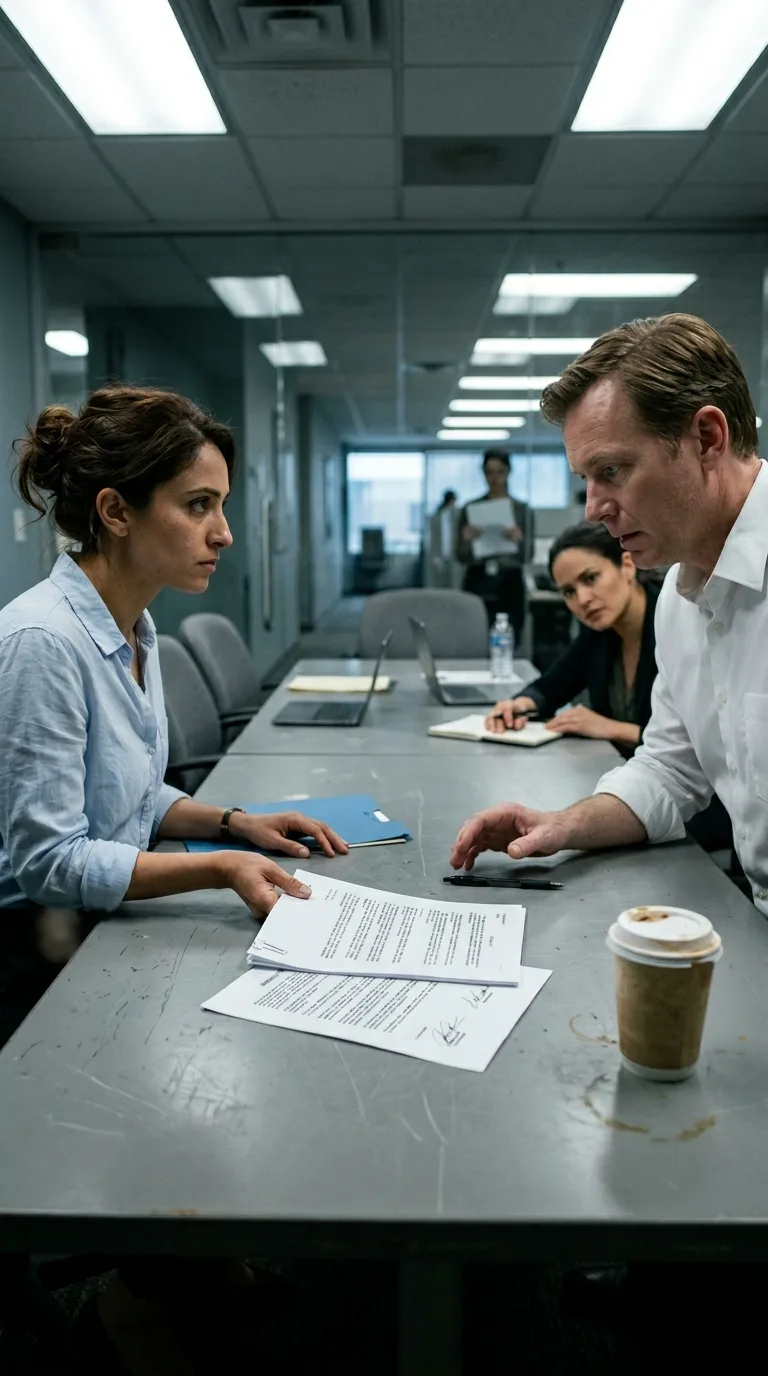
I sat on the left side of the table, three chairs down from the screen. The blue folder went on my lap. My coffee cup sat in front of me, lid slightly warped from the heat.
The presentation began the way his presentations always began: clean slides, confident voice, stolen verbs.
“I initiated Q-Core in response to operational fragmentation across regions.”
Click.
“I developed the first integrated dashboard to align warehouse, vendor, and compliance reporting.”
Click.
“I led the cross-functional build across three years.”
Click.
Every sentence had been polished until my fingerprints disappeared.
People nodded. A finance manager typed notes. Someone whispered, “Impressive,” under their breath.
I looked down at my coffee. A brown drop had leaked through the lid and dried on the cup seam. I focused on that stupid little stain because if I looked at Martin too long, I was afraid my face would tell the truth before my folder did.
He got to the slide with the timeline.
2019 — Concept Development.
2020 — Pilot Architecture.
2021 — Regional Expansion.
2022 — Compliance Integration.
2023 — Full Deployment.
His timeline was perfect except for one thing.
He had not joined our department until March 2020.
I knew because his first day was the same day the old reporting server crashed and he asked me where the “data people” sat. He did not know I was one of them. He handed me his empty coffee cup and said, “Could you toss this?”
I tossed it.
Then I fixed the server.
Lena leaned forward slightly.
“Martin,” she said, “who built the first prototype?”
His smile stayed on, but it moved a little slower.
“I did, with support from the analytics team.”
“Which analyst?”
“A few people contributed.”
I felt the room shift without anyone moving.
Lena tapped her pen once against her notebook. “Names help.”
Martin laughed softly. “Of course. Nina supported some early workflow testing.”
Supported.
A small word. A clean word. A word built to make theft sound like management.
I looked at the blue folder on my lap.
My fingers had gone cold.
Part of me wanted to open it right there. Part of me wanted to stand up and say, “He’s lying.” Just like that. No polish, no strategy, no careful documentation. Three years of swallowed sentences had collected somewhere behind my ribs, and for one second they all pushed upward at once.
Then Martin turned toward me.
“Nina, you remember those early workshops, right?”
There it was. The old trick. Pull me in just enough to validate him. Let me speak only if my words served his version.
I heard the air conditioner hum above us. I heard someone’s chair creak. I heard my own pulse in my ear.
“Yes,” I said. “I remember.”
Martin’s smile widened, relieved.
Lena looked at me. “Could you walk us through your role?”
Before I could answer, Martin lifted one hand.
“I can summarize. Nina was helpful on requirements gathering. Very diligent. But the strategic build came through my office.”
His office was a glass-walled room with a standing desk he never used standing.
My office was a cubicle under a vent that dripped once in the summer and left a faint water mark on the ceiling tile above my monitor.
Lena did not smile.
“Martin, I asked Nina.”
The room went still in that polite corporate way where everyone pretends not to enjoy tension.
Martin’s jaw tightened.
I opened my mouth.
Nothing came out.
Not because I did not know what to say. Because for three years, every time I tried to name what was mine, my brain showed me rent, health insurance, my mother’s pharmacy bill, the dishwasher leaking under my knee. It showed me Martin’s calm voice in performance reviews.
Needs stronger executive presence.
Sometimes struggles with strategic framing.
Excellent contributor, not yet leadership-ready.
I had read those phrases so many times they started to sound like facts.
I swallowed.
“My role was broader than requirements,” I said.
Martin chuckled, not kindly. “Nina, let’s not get lost in implementation details.”
Lena’s eyes flicked to him.
He ignored it and advanced the slide.
The next one showed a diagram I had drawn on a whiteboard at 10:18 p.m. during a pilot outage. Martin had copied it into PowerPoint months later. He had changed the colors. He had not changed the structure.
“That architecture,” he said, “was the breakthrough.”
My throat tightened so fast it hurt.
I remembered the night I drew it. My hair had been damp from rain. The night janitor was vacuuming around my feet. I had been eating vending machine pretzels for dinner because the cafeteria closed at six. I drew three boxes, then crossed them out, then drew the data path that eventually became Q-Core’s spine.
Martin had not been there.
He had sent one email at 9:04 p.m.: Any update?
Then, at 9:06: Need this fixed before morning.
I stood up too quickly.
My chair legs scraped the floor.
Everyone looked at me.
“I’m sorry,” I said. “I need a minute.”
I walked out before anyone could answer.
The hallway outside 5B was empty except for Priya, the new intern from compliance, kneeling beside the printer with a stack of jammed paper in her hands. She looked up, startled.
“You okay?”
I nodded too hard. “Printer?”
“Possessed,” she said.
I almost laughed. Instead, I kept walking until I reached the single-stall restroom near the stairwell.
Inside, under the flat white light, I locked the door and put both hands on the sink.
My face looked wrong in the mirror. Not dramatic. Not shattered. Just tired in a way makeup could not negotiate with.
I turned on the cold water and held my wrists under it.
For a moment, I saw myself from above: thirty-four years old, senior systems analyst in title, invisible department backbone in practice, standing in a bathroom with cheap soap smell and a blue folder waiting in a conference room where a man was still using my work as his ladder.
Maybe I was overreacting.
That thought arrived automatically, like spam.
Maybe this was just how offices worked. Maybe leaders always took credit. Maybe I should be grateful my work had mattered at all. Maybe asking for my own name was petty.
Then my phone buzzed.
A message from Martin.
Get back in here. Don’t make this awkward.
A second later:
We need alignment.
Alignment.
I wiped my wrists with a paper towel that tore down the middle.
When I stepped back into the hall, Priya was still by the printer. She had freed the paper jam and was staring at one crumpled sheet.
“You dropped this,” she said.
It was one page from my folder. The repository activity log. My name appeared in the author column again and again beside dates that predated Martin’s involvement.
I took it carefully.
“Thanks.”
She glanced toward the conference room. “Is that yours?”
The question was quiet. Not loaded. Just human.
I looked at the page.
“Yes,” I said. “It is.”
When I returned, Martin had moved on to the cost savings slide. The room had loosened again. People were nodding. A regional lead was asking about licensing efficiency. The machine had almost recovered from my interruption.
I sat down without apologizing.
Martin didn’t look at me. “As I was saying, the system reduced manual reconciliation hours by forty-two percent.”
Lena watched me place the blue folder on the table.
Not open. Just there.
Martin saw it too.
His voice tightened around the next sentence.
“We should be careful not to confuse tooling work with system ownership.”
There are insults that come dressed as clarification.
That was one of them.
Marcy from HR shifted in her seat. The infrastructure engineer, Ben, stopped typing. Priya slipped quietly into the back of the room carrying replacement paper for the printer and froze when she felt the temperature of the meeting.
Lena folded her hands.
“Martin,” she said, “I’m going to ask directly. Did you personally build the original Q-Core prototype?”
He gave the room a patient smile, the kind used by men who believe calmness is proof.
“Yes. I led the build.”
“Personally?”
His watch flashed as he adjusted it.
“I designed it. Nina and others assisted with execution.”
I felt something in me settle.
Not calm exactly. More like the part of me that had been begging not to make trouble finally stepped aside.
Lena turned to me.
“Nina?”
Before I could speak, Martin pushed back his chair slightly.
“With respect, this is becoming counterproductive. We’re here to review a platform, not litigate old task assignments.”
He looked around the room, collecting sympathy. Some people gave it to him. Not with words. With their eyes. With the relief of choosing the louder person because it requires less courage.
Then he made his mistake.
He stood.
“Let’s be clear,” he said, voice louder now. “Without my leadership, Q-Core would still be a patchwork of Nina’s scripts sitting in some forgotten folder. I took raw technical work and turned it into a business system.”
The words landed like a slap because they were close enough to truth to hurt.
Yes, there had been scripts. Yes, there had been forgotten folders. Yes, I had built quietly, messily, urgently, while waiting for someone with a better title to call it strategy.
But he had not turned my work into a system.
He had turned my silence into his reputation.
Lena’s face did not change.
“Sit down, Martin.”
He didn’t.
“Actually,” he said, “I think this needs closure.”
He reached for the printed ownership summary beside his laptop. I recognized the document. He had sent it to me Friday night as a PDF and told me to “review for factual consistency.” It stated that he was the creator and strategic owner of Q-Core, with me listed as operational support.
He slid it across the table toward me with two fingers.
“Since there seems to be confusion, Nina can confirm her role right now.”
My mouth went dry.
Marcy said, “Martin, perhaps—”
“No,” he said. “This is exactly why we document things.”
He took a pen from his jacket pocket and placed it on top of the summary.
The pen rolled once, stopped against my coffee cup, and clicked softly.
“Sign the acknowledgment,” he said. “Then we can move forward professionally.”
No one breathed normally after that.
Even the air conditioner seemed too loud.
The room had stopped pretending this was a review.
This was a public test.
If I refused, I would look difficult. If I signed, he would have exactly what he wanted: my hand confirming his lie.
Martin lowered his voice, but not enough.
“Don’t damage your career over ego.”
There it was.
The noose with a corporate knot.
Lena looked at the paper, then at Martin. “You are asking an employee to sign an authorship acknowledgment in a director review?”
“I’m asking for clarity.”
“On the record?”
He smiled. “Absolutely.”
He should have stopped there.
If he had stopped there, maybe he could have blamed misunderstanding. Maybe he could have said he meant leadership, not authorship. Maybe he could have turned theft into ambiguity and ambiguity into policy.
But he picked up the pen again and signed his own name at the bottom of the ownership summary.
The scratch of ink sounded small.
It was not.
He dated it.
Then he pushed the paper back to me.
“Your turn.”
I stared at his signature.
For three years, he had been careful. Verbal claims. Slide decks. Performance language. Credit taken in rooms without transcripts. Enough to build a reputation, not enough to leave a clean fingerprint.
Now his fingerprint sat in blue ink under a false statement he had chosen to make in front of twelve witnesses.
My hands still shook when I opened the blue folder.
That bothered me.
I wanted the moment to feel clean. Powerful. I wanted my fingers steady, my voice flat, my spine straight. Instead, the folder corner caught on the table edge because my thumb slipped. One staple snagged another page. My breath came unevenly once, and I hated that he could see it.
Then Priya, from the back of the room, moved half a step closer to the wall, as if making room for the truth to pass.
It helped.
I took out one stapled packet and placed it on top of Martin’s signed acknowledgment.
Paper against paper made a dry little sound.
Not loud.
Enough.
Martin glanced down.
His smile did not leave immediately. It faded in pieces.
The first page was a system access log.
The second was an original architecture memo dated November 14, 2019.
The third was a screenshot of the repository history, with every sensitive line blacked out except the author, timestamp, and project folder path.
qcore_nina_test.
Martin looked at the page. Then at me.
I did not explain.
I turned the packet to face Lena.
Then I said the line I had practiced once in my kitchen, once in the elevator, and once in the bathroom with cold water running over my wrists.
“Read the name.”
The silence that followed did not feel empty.
It felt full of people rearranging what they knew.
Lena reached for the packet. She did not rush. Her eyes moved from page to page, slower than I wanted and exactly as slow as the moment needed.
Martin’s hand stayed on the pen.
Then his fingers opened.
The pen rolled off the paper, crossed the table seam, and stopped near my coffee cup.
No one picked it up.
Ben from infrastructure leaned forward, squinting. “That repo path is from the old server.”
Martin’s head turned slightly. “Ben—”
Ben did not look at him. “We migrated that archive. Those timestamps would be preserved.”
Marcy’s chair made a small sound as she pulled herself closer to the table. “Martin, did you sign this stating you created the prototype?”
“I led the initiative,” he said, but the words came out thinner.
Lena looked at him.
“That is not what this document says.”
He swallowed. It was barely visible, just a movement in his throat that did not become language.
I should have felt triumph.
Mostly I felt tired.
The kind of tired that arrives after you stop holding up something heavy and realize your arms have been shaking for years.
Lena turned another page.
“Vendor email,” she said.
“Yes,” I answered.
My voice sounded unfamiliar. Not strong. Just present.
She read the header. “November 2019. Addressed to you.”
“Yes.”
“And Martin is not copied.”
“No.”
Martin’s face changed then. Not dramatically. No shouting. No collapse. Just a dull loss of color around his mouth.
He tried one more time.
“Nina had technical access. That doesn’t mean she owned the strategic direction.”
I looked at him.
For a second, I remembered the first year. How he complimented my diagrams when no one else was around. How he told me I had “real potential” if I learned to be less defensive. How I had mistaken selective kindness for mentorship because I needed the job and wanted the world to be fair enough that effort mattered.
Then I reached into the folder again.
Martin stiffened.
I took out the last page.
It was not a log. Not a screenshot. Not an email.
It was the meeting note from January 2020, written by our former director, Elaine Cho, after the pilot review. Elaine had retired to Vermont and stopped answering most work emails, but she had answered mine.
Nina Patel is the originating architect of Q-Core. Martin Voss to support executive packaging after transfer into Product Strategy.
Elaine’s digital signature sat at the bottom.
I had almost not included it. It felt too personal, somehow. Like needing an adult from the past to confirm I had existed.
Lena read it once.
Then again.
The room shifted.
This time, not toward Martin.
Marcy exhaled through her nose, slow and controlled. “We’ll need to pause the review.”
Martin’s eyes snapped to her. “That’s unnecessary.”
“It’s very necessary,” Lena said.
Her voice had cooled.
She placed Martin’s signed acknowledgment beside my packet.
“Martin, you publicly asked Nina to confirm a false authorship statement after signing it yourself.”
He opened his mouth.
Lena continued.
“You did so in front of leadership, HR, compliance, and technical staff.”
His mouth closed.
Luis, the security guard, appeared in the glass outside the conference room, walking past with a delivery person. He glanced in. Our eyes met for half a second through the glass.
He didn’t know the details.
He saw enough.
He stopped walking.
Priya stood in the back with printer paper still in her arms. Her grip had tightened, bending the top sheet slightly. When Martin looked toward her, she looked down, not out of fear exactly. More like she refused to lend him her face.
That small refusal nearly broke me.
Not the director. Not HR. Not the official confirmation.
The intern with a stack of paper choosing not to help him pretend.
Lena turned to me.
“Nina, did you bring copies?”
“Yes.”
My fingers found the remaining packets.
This time, they did not shake as much.
I passed one to Lena, one to Marcy, one to Ben. The rest stayed in the folder, blue cover bent at one corner from three years of being shoved into drawers, laptop bags, and finally my arms that morning.
Martin sat down slowly.
The chair accepted his weight with a faint creak.
He stared at the packet but did not touch it.
Someone’s phone vibrated on the table. No one reached for it.
Lena said, “This meeting is suspended. Martin, you’ll meet with HR and me in thirty minutes. Nina, I’d like you to stay.”
Martin’s eyes lifted to mine.
For the first time in three years, he looked at me without deciding what I was worth.
He looked at me like a problem he had failed to calculate.
“You planned this,” he said quietly.
I thought about the bathroom sink. The leaking dishwasher. The cracked pen barrel. The first folder named with my own name because I had been too tired to hide myself.
“No,” I said. “You did.”
That was the last thing I said to him in that room.
People began moving carefully, the way they do after a glass breaks and nobody wants to step wrong. Chairs slid back. Laptops closed. The regional leads avoided Martin’s side of the table. Ben held the packet against his chest like evidence. Marcy spoke softly into her phone near the window.
Lena waited until the room emptied.
Only then did she sit back down.
She looked older suddenly. Not weak. Just aware of the weight that came with seeing something clearly.
“I’m sorry,” she said.
Two words.
Not enough.
Still more than I had gotten in three years.
I nodded because if I opened my mouth, I did not know what would come out.
“We’ll review compensation, title history, authorship, and performance records,” she said. “I can’t promise the outcome today. But I can promise this won’t stay informal.”
Informal.
Another clean word for dirty things.
I touched the edge of the coffee cup. It had gone cold. The brown stain on the seam looked darker now.
“I don’t just want a title correction,” I said.
Lena waited.
“I want the record fixed. In writing. I want my name on the system documentation. I want every leadership deck corrected. I want my last three performance reviews reviewed by someone who didn’t benefit from undergrading me.”
My voice wobbled on the last word.
I hated that too.
Lena did not make me feel ashamed of it.
“Reasonable,” she said.
Outside the glass wall, Martin walked past with Marcy. His shoulders were stiff. His watch hand hung at his side. He did not adjust it.
That, more than anything, told me he knew.
When I left the conference room, Luis was back at the security desk downstairs. I had no memory of taking the elevator. The lobby looked the same as it had that morning: polished floor, burnt espresso smell, people tapping badges against readers like nothing in the world had changed.
Luis looked up.
“Big meeting?” he asked again.
This time, his voice was softer.
I shifted the blue folder under my arm.
“Something like that.”
He glanced at the bent corner. “You win?”
I thought about saying yes.
I thought about Martin’s face when the pen rolled away. I thought about the three years I had spent making myself smaller so my paycheck would keep arriving. I thought about every late night when I told myself recognition was less important than survival, then wondered why survival felt so much like disappearing.
“I didn’t lose,” I said.
Luis nodded like he understood the difference.
Outside, the rain had started again, thin and ordinary. I stood under the building awning and checked my phone.
There were already two emails from HR.
One calendar invite from Lena.
One message from Martin.
Nina, please don’t escalate this further. We can discuss.
I stared at it until the screen dimmed.
Then I put the phone in my coat pocket without answering.
My coffee was still in the conference room, cold by now, probably sitting beside the pen no one picked up.
For some reason, that bothered me.
Not enough to go back.
I stepped into the rain with the blue folder pressed against my ribs, the badge reader’s tired beep still echoing somewhere behind me.
Chapter complete
You have reached the end of this chapter.
Continue reading
A few more worlds to get lost in after this chapter.




