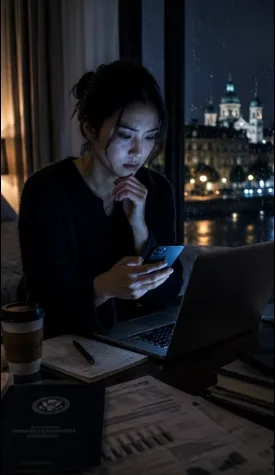
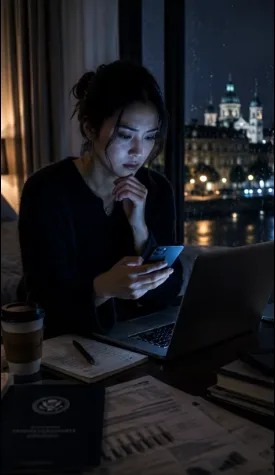
The first thing I heard was my phone buzzing against the wooden nightstand.
Chapter 1
The first thing I heard was my phone buzzing against the wooden nightstand.
Not ringing. Buzzing.
That small, angry vibration that somehow sounds louder when you are alone in a hotel room three thousand miles from home.
I opened one eye and saw the red numbers on the alarm clock: 3:47 a.m.
Prague was black outside my window. Rain tapped against the glass. Somewhere below, a delivery truck groaned over wet cobblestones, and the old radiator in my room clicked like somebody quietly counting down.
I reached for my phone, expecting a message from my supervisor, Janet, or one of the analysts in Frankfurt who always forgot time zones existed.
Instead, it was our family group chat.
The preview showed my brother Marcus’s name, followed by a photo.
I tapped it.
For a second, my brain refused to understand what I was looking at.
There was my house in Arlington, Virginia. My small, plain, two-bedroom house with the blue-gray shutters I painted myself
one Saturday while my neighbor’s golden retriever kept stealing my gloves.
The lawn looked freshly cut. The sidewalk was clean.
And in the front yard, jammed into the grass like a flag of conquest, was a bright red SOLD sign.
Marcus had written:
Finally got rid of that starter home albatross. Investors paid $400K cash. Maya’s going to thank me when she stops playing government desk jockey and gets a real job that can afford something decent.
Three champagne emojis followed.
I sat upright so fast the blanket slid to the floor.
My coffee from the night before sat cold beside my laptop. The air smelled like burnt espresso and rain-soaked stone. I stared at the photo, zoomed in, zoomed out, then zoomed in again, as if the image would change if I looked at it hard enough.
It didn’t.
Mom replied first.
Thank God someone in this family has
business sense.
Dad wrote:
About time. That mortgage was probably eating her alive.
My sister Jessica added:
Maybe now she can move somewhere actually nice instead of that basic little box.
Seventeen messages rolled in over the next few minutes, each one more cheerful than the last. They congratulated Marcus. They praised his initiative. They talked about me like I was a child who had wandered too close to traffic and needed an adult to yank me back by the collar.
Nobody asked where I was.
Nobody asked whether I knew.
Nobody asked whether I had agreed.
I placed the phone flat on the desk and stared at it while my pulse slowed into something cold and clean.
My family thought I was a low-level government employee. They thought I filed paperwork in some windowless federal office and barely scraped together enough money to keep my “starter home.” That was
the phrase they loved. Starter home. Cute little box. Government girl house.
I let them think that because it was safer.
When you work in financial crimes, safer matters.
I took a screenshot of Marcus’s message. Then another of the responses. Then another of the photo.
My laptop was already open to a spreadsheet involving shell companies, layered transfers, and suspicious trade finance patterns moving through three European banks. Boring work, my family would have said.
I opened a secure channel and forwarded everything to Janet.
Unauthorized property transfer. Please advise.
I sent it.
Then I sat there in the blue light of my laptop, listening to rain hit the window in a city my family couldn’t even find on a map.
Three minutes later, Janet replied.
Do not engage with family. Continue audit. Federal asset monitoring already flagged movement. I’m initiating protocol.
I read that sentence twice.
My hands were steady now.
Marcus thought he had sold my house.
What he had actually done was wake up a system built to catch people much smarter than him.
And somewhere in Virginia, before the sun had even risen, federal alarms had already started going off.
I did not answer the family chat.
That was the first thing people misunderstood later.
They thought silence meant shock. Or fear. Or guilt. My mother would tell my aunt Celia that I had “gone quiet because deep down she knew Marcus was right.” Jessica would say I was being dramatic and waiting for everyone to beg me to speak. Dad would say I had always been too proud.
The truth was less poetic.
I was documenting.
I took screenshots with timestamps. Exported the chat history. Saved the photo metadata. Then I called the Arlington County land records portal from a government VPN and pulled the filing.
My stomach tightened when the deed appeared.
There it was.
My name.
My full legal name.
A signature that looked like mine if somebody had only ever seen it on a birthday card from twelve years ago.
Below it, a notarized acknowledgment.
The notary’s seal was from Fairfax County.
The date was three days earlier, while I had been sitting in a conference room in Prague listening to a Czech compliance officer explain why sixteen million dollars had passed through a furniture import company with no warehouse.
Attached to the deed was a power of attorney.
I opened it.
That was when the hotel room felt smaller.
The power of attorney had been drafted to give Marcus authority to manage “residential real estate assets” on my behalf. It claimed I had signed it before a notary six months earlier.
Six months earlier, I had been in my kitchen making soup because I had the flu. I remembered that week because my neighbor, Mr. Alvarez, had brought over ginger tea and left it on my porch next to a bag of oranges. I had waved to him through the window in sweatpants, hair greasy, nose red. I had not been in Fairfax signing away control of my house.
The signature was better on the power of attorney.
Not good. Better.
Marcus had practiced.
I stared at that false version of my name and felt something inside me bend.
Not break. Bend.
There is a difference.
Breaking is loud. Bending is quiet and dangerous because nobody hears it happening.
My phone buzzed again.
Marcus had tagged me.
Maya, don’t be weird about this. You never understood real estate anyway. I handled it. You’re welcome.
Then:
Investors close fast. You’ll get your cut when everything clears.
My cut.
Of my own house.
A laugh came out of me, one small sound that didn’t belong in that room.
I stood, walked to the tiny bathroom, turned on the light, and gripped the edge of the sink.
The mirror showed a woman with one side of her hair flattened from sleep, dark circles under both eyes, and a federal badge clipped to the chair behind her like a secret she had been tired of carrying.
For a few seconds, I wanted to call Marcus.
I wanted to hear his voice turn slippery when I asked him what he had done. I wanted to ask my mother why her first instinct had been gratitude. I wanted to ask my father whether my house had looked like a burden when he borrowed money against my name in college and I quietly paid it off after he claimed it was an “administrative mix-up.”
That was the family pattern.
They made messes.
I cleaned them up.
Then they called me uptight for remembering where the stains had been.
I splashed water on my face. It was so cold my breath caught.
“Not like this,” I whispered to the mirror.
Then I shut off the tap.
By 4:22 a.m., Janet had added two people to the secure thread: Special Agent Leung from a task force I had worked with twice, and a Department of Justice attorney named Priya Sen whose emails were always short enough to make you sit straighter.
Priya wrote:
Do not contact alleged buyers. Preserve communications. We need certified land records and bank movement confirmation. You are now both victim and material witness. Step back from direct investigative decisions.
I stared at “victim” longer than I should have.
That word annoyed me.
Not because it was wrong.
Because it fit too well.
My family had spent years making me feel ridiculous for protecting what was mine. They joked about my locks, my document folders, my refusal to co-sign anything after Dad’s “mix-up.” Marcus called me paranoid every Thanksgiving. Mom said I had “a government personality,” which meant I asked questions before surrendering money.
Yet the first time I ignored their jokes and kept records, it became the reason I did not lose my home.
At 7:05 a.m. Prague time, Janet called.
Her face appeared on my laptop screen, gray hair pinned back, reading glasses low on her nose. Behind her, Washington morning light cut across the blinds in her office.
“You okay?” she asked.
That was Janet. No warm-up. No fake calm.
“I’m functional.”
“That’s not what I asked.”
“I’m angry.”
“Good. Angry people sometimes do stupid things. Functional angry people follow procedure.”
I almost smiled. Almost.
“What do we know?” I asked.
Her eyes moved to another monitor. “The buyer entity is Potomac Renewal Partners LLC. Formed eight weeks ago. Registered agent appears on three other entities flagged in an active laundering inquiry.”
My mouth went dry.
“Marcus knew them?”
“Too early.”
“Janet.”
She looked back at me. “Too early. But your brother’s personal account received two incoming wires last week. One marked consulting fee. One marked reimbursement. Total just under the threshold that would make a lazy bank ask questions.”
I closed my eyes for one second.
Marcus had always loved being almost clever.
He was the kind of man who read half of an article about tax shelters and then corrected accountants at dinner. He wore watches too large for his wrist. He said “liquidity event” when he meant “I sold something.” He once told me my federal salary proved I lacked ambition, then asked me if I knew anyone who could help him get a government contract.
“What happens now?” I asked.
“You finish the Prague audit.”
I stared at her.
“Maya,” Janet said, voice firm, “you are not flying home to confront your family. You are not knocking on the buyer’s office door. You are not giving Marcus the gift of warning him.”
“They filed a fake deed.”
“And we are going to let them believe it worked for about forty-eight more hours.”
The old radiator clicked again.
Counting down.
I nodded once.
“Also,” Janet added, “your house is not gone. Filing a fraudulent deed does not magically make it legal. We’ve put a hold request through the county and notified the title insurer.”
The breath I had been holding left too slowly.
I hated that I had been holding it at all.
After the call, I got dressed for the audit.
Navy blazer. White blouse. Black trousers. Low heels. Hair pulled into a bun tight enough to make me look more composed than I felt.
Before leaving the hotel room, I checked the family chat one more time.
Marcus had sent another photo. This one showed him standing in front of my porch, grinning, one hand on the SOLD sign, his sunglasses pushed up on his head.
My porch.
The same porch where I had sat the first night after closing, eating takeout lo mein from the carton because I did not own plates yet. The same porch where I had painted the shutters blue-gray because the original green made the house look seasick. The same porch where Mr. Alvarez’s golden retriever had once dropped one of my stolen gloves like a guilty offering.
Marcus wrote:
Real investors see potential. Sentimental people see shutters.
Mom replied with laughing emojis.
I saved that too.
For two days, I did my job.
That sounds impossible, but work can become a railing when the floor moves. I sat in glass conference rooms. I asked bankers why invoices from a shipping company matched no vessel records. I watched men in expensive suits discover that the quiet woman from Washington was not there to admire their espresso machine.
At night, I returned to the hotel and read updates.
Potomac Renewal Partners had attempted to transfer the house again before funds fully settled.
That was the first stupid move.
The second was Marcus sending me a private text.
You’re welcome, by the way. Mom says don’t punish everyone because you’re embarrassed. I negotiated hard for you.
I did not respond.
Then he sent:
Also don’t call the county. You’ll just confuse them. These things are complicated.
I forwarded that too.
On Monday morning, I flew back to Dulles.
The plane landed under a low gray sky. As soon as the cabin door opened, the air smelled like jet fuel and wet asphalt. Home, technically.
A federal driver met me outside baggage claim. I knew him vaguely. Tim. Former Marine. Quiet. He held a paper cup of coffee and said, “Agent Morales sent this. She said you take it black when people commit felonies before breakfast.”
I took the cup.
“Thank you.”
He nodded toward the exit. “Rough family?”
I looked at him.
His face stayed professional, but his eyes softened a little. Not pity. Recognition.
“Something like that,” I said.
We drove directly to the U.S. Attorney’s Office in Alexandria.
The building lobby smelled like floor polish and damp wool coats. A receptionist named Denise, whom I had seen a dozen times but never really spoken to, looked up as I approached security. Her gaze flicked to my suitcase, then to my face.
“You want me to hold that behind the desk?” she asked gently.
The question was so ordinary that my throat tightened.
“Yes, please.”
She took my suitcase like it mattered.
Upstairs, Priya Sen had arranged documents across a conference table in neat stacks. Janet stood by the window. Special Agent Leung sat with a legal pad and the unreadable calm of someone who had spent years letting suspects talk themselves into trouble.
Priya did not waste time.
“Your brother is scheduled to attend a closing-related meeting tomorrow at noon,” she said. “Potomac Renewal Partners requested an in-person transfer confirmation at Capital Commonwealth Bank.”
“Why would they need him there?”
“Because the second transfer failed. Their compliance department froze movement after our notice, but they did not tell the parties why. The buyers think the issue is routine. Marcus thinks he needs to sign supplemental documents.”
I looked at the table.
There were copies of my forged signature. Copies of wire records. Copies of the family chat. My little house reduced to exhibits.
“What do you need from me?”
“Presence,” Priya said. “Identification. Confirmation that you did not authorize the sale. Then you leave the rest to us.”
My laugh was dry. “My family will be there.”
Janet looked at me. “Yes.”
That was the first time my hands shook.
Not in Prague. Not when I saw the SOLD sign. Not when I read the forged power of attorney.
There, in a clean government conference room, with people doing everything correctly, my hands shook.
Because suddenly I could see my mother’s face.
Not angry. Worse.
Disappointed.
As if I had embarrassed her by refusing to be robbed quietly.
I pushed my hands under the table.
Janet saw anyway.
“Maya,” she said, softer than usual, “you do not have to perform strength for them tomorrow.”
“I know.”
“You only have to tell the truth.”
“That’s harder in my family.”
Nobody laughed.
Tuesday came with thin sunlight and a wind that pushed grit along the sidewalk.
Capital Commonwealth Bank sat on a corner near Dupont Circle, all glass doors and marble floors, the kind of place designed to make money look clean. By 11:48 a.m., I stood in a private conference room on the second floor with Priya, Agent Leung, a bank compliance officer, and a title company representative who kept smoothing the front of her blazer.
Through the glass wall, I could see the hallway.
At 11:56, Marcus arrived.
He wore a tan coat, polished shoes, and the satisfied expression of a man arriving early to his own applause.
My mother came beside him in a cream cardigan and pearls. Dad followed, checking his phone. Jessica trailed behind them with oversized sunglasses perched on her head though we were indoors.
They had made it a family event.
Of course they had.
Marcus saw me through the glass and stopped.
For one clean second, his face emptied.
Then he smiled.
Not warmly.
Strategically.
He pushed open the conference room door without waiting to be invited.
“Well,” he said, spreading his hands, “there she is. The dramatic homeowner.”
Mom looked me up and down. “Maya, honestly. You couldn’t just call your brother?”
I glanced at Priya.
She gave the smallest nod.
I stood at the far end of the table. “Hello, Marcus.”
Dad shut the door behind Jessica. “Let’s not turn this into a federal case.”
Agent Leung looked down at his legal pad.
Priya’s pen paused.
Marcus chuckled. “Exactly. Look, everyone here understands this was a family matter. I was helping my sister liquidate an underperforming asset.”
“Stop saying asset,” I said.
The room went still for half a beat.
Marcus blinked. “Excuse me?”
“It’s my house.”
Mom made that tiny sound she used when I was being difficult in public. “Maya.”
I kept my eyes on Marcus. “Who signed the power of attorney?”
He tilted his head. “You did.”
“No.”
His smile tightened. “You may not remember. You were overwhelmed.”
“That’s your explanation?”
“You’ve always been bad with practical things.”
Jessica crossed her arms. “Oh my God, Maya, he got you four hundred thousand dollars. Most people say thank you.”
The title company representative looked down at the documents, then away.
Marcus noticed. His voice lifted, becoming performative.
“My sister has spent years clinging to that tiny place like it proves something. I found real investors. I got her out. I handled the paperwork. If Maya wants to be emotional now, fine, but—”
Priya placed a folder on the table.
The sound was quiet.
Still, everyone heard it.
“Mr. Whitaker,” she said, “before you continue, I need to advise you that this meeting is being observed by federal law enforcement.”
Mom’s pearls shifted against her throat.
Dad straightened. “What?”
Marcus laughed once. “That’s ridiculous.”
Agent Leung closed his legal pad. “It is not.”
I watched Marcus’s eyes move from Leung to Priya to the bank compliance officer.
Calculating.
Then dismissing.
“You people are overreacting,” Marcus said. “It’s a deed correction issue.”
“No,” Priya said. “It is a forged power of attorney, a fraudulent deed transfer, interstate wire activity, and attempted movement of funds through an entity already under investigation.”
Jessica’s mouth opened.
No sound came out.
Mom turned to me. “Maya, tell them this is a misunderstanding.”
There it was.
Not “Are you okay?”
Not “Did he forge your name?”
Not “Marcus, what did you do?”
Tell them.
Fix this.
I looked at my mother’s face and saw every dinner where she had passed me the bill because Marcus was “between opportunities.” Every birthday where Dad praised Jessica’s engagement ring and asked me if my house had gone up in value yet. Every Thanksgiving where Marcus called me “Miss Paperwork” while asking if I could look over a contract.
My voice came out flat.
“I did not sign the power of attorney. I did not authorize the sale. I did not receive proceeds. I did not ask Marcus to act for me in any capacity.”
Marcus slammed one palm on the table.
Not hard enough to be violent. Hard enough to remind everyone he wanted the room back.
“This is insane,” he snapped. “Maya, you’re going to ruin me over a house you barely deserve?”
Denise, the receptionist from the U.S. Attorney’s Office, was not there.
But I thought of how carefully she had taken my suitcase.
I thought of Mr. Alvarez leaving ginger tea on my porch.
I thought of blue-gray paint drying on my hands.
“My house,” I said again.
Priya opened the folder.
Inside were screenshots.
Marcus’s message.
Mom’s reply.
Dad’s reply.
Jessica’s.
The SOLD sign.
The champagne emojis.
The room seemed to lose temperature.
Priya slid the pages across the table. “These communications were voluntarily sent in a group chat and preserved by Ms. Whitaker. They establish knowledge, intent, and post-transfer celebration.”
Mom stared at her own words.
Thank God someone in this family has business sense.
For the first time in my life, my mother looked ashamed of a sentence before she looked angry about being caught saying it.
Dad put a hand to his forehead. “Marcus.”
Marcus pointed at me. “She’s making this look worse than it is.”
Agent Leung stood.
“Marcus Daniel Whitaker, you need to come with us.”
My brother’s face changed in pieces.
First confusion.
Then offense.
Then fear, small and fast, before pride covered it.
“You can’t arrest me in a bank.”
Agent Leung’s expression did not move. “Yes, we can.”
The bank compliance officer stepped back from the table. The title representative pressed one hand to her mouth. Outside the glass wall, two junior bank employees had stopped walking and stood frozen with folders against their chests.
Public enough.
Quiet enough.
Real enough.
Mom reached for Marcus’s sleeve. “Wait. Wait, there has to be—Maya, please.”
That please almost did it.
Not because she meant it.
Because some old part of me still wanted my mother’s voice to be a door home.
My vision blurred around the edges. I looked down and saw my own hand gripping the chair so tightly my knuckles had gone pale. For one second, the room tilted. I wanted to sit on the floor like I had when I was eight and Marcus broke my model airplane, then told Mom I was crying because I could not share.
I breathed in.
Burnt coffee, marble polish, expensive perfume.
Not Prague rain.
Not my porch.
Here.
Now.
I let go of the chair.
“No,” I said.
Mom recoiled as if I had shouted.
I hadn’t.
Marcus looked at me with something close to hatred. “You’d really do this to your own brother?”
I looked at the screenshots on the table.
“You did this to your own sister.”
Agent Leung guided him toward the door.
Marcus twisted once, not fighting, just trying to keep the last word.
“You think this makes you powerful?” he said. “You’re still just a government employee.”
Janet had been standing in the hallway, out of view until then.
She stepped into the doorway.
“Maya is the lead forensic analyst who identified a three-bank laundering structure tied to your buyer entity,” she said. “The only reason you are not dealing with a much uglier room right now is because she forwarded evidence before contacting you.”
Marcus stared at her.
Then at me.
All those years of “desk jockey” and “paperwork girl” and “basic little box” sat between us like unpaid debt.
He had never wondered what kind of paperwork I did.
That was his mistake.
After they took him, nobody moved for several seconds.
Jessica started crying silently, mascara gathering under one eye. Dad sat down heavily, both hands on his knees. Mom remained standing, one hand still lifted as if Marcus’s sleeve were there.
The junior bank employee outside the glass wall bent, picked up a folder someone had dropped, and set it carefully on a side table. Such a small thing. A normal person restoring order where my family had made a mess.
Priya closed the folder.
“We’ll need your formal statement later today,” she said to me.
I nodded.
Mom turned. “Maya.”
I waited.
Her lips trembled. She looked older than she had ten minutes ago.
“I didn’t know it was forged.”
The sentence hung there, weak and naked.
I believed her.
That was the worst part.
She had not known because she had not asked.
“I know,” I said.
Relief crossed her face too soon.
I finished, “You didn’t care enough to know.”
She looked down.
Dad stood slowly. “What happens to the house?”
I almost laughed again.
After everything, the house.
“The title will be corrected,” Priya said. “The attempted transfer will be unwound. That is not your concern.”
Dad flinched at being answered by someone he could not intimidate.
Jessica wiped her cheek. “Maya, are we supposed to just leave?”
I looked at her sunglasses, still perched uselessly on her head.
“Yes.”
No one argued.
That surprised me more than it should have.
After they left, I stayed in the conference room alone for a few minutes. Priya gave me that. Maybe she knew I needed to look at the empty chairs and prove to myself that the room had not swallowed me.
My phone buzzed.
Family group chat.
For a second, my body forgot everything. My thumb hovered over the screen.
It was Jessica.
Did you have to let them take him like that?
Then Dad:
Your mother is devastated.
Then Mom:
Please call me.
I turned the phone face down.
Outside, sunlight slid across the marble floor. A cleaning woman in a gray uniform pushed a cart past the conference room. She glanced through the glass, saw me standing there with one hand on the table, and gave me a tiny nod.
Not curious.
Not dramatic.
Just human.
I nodded back.
That was the moment I almost cried.
Not when Marcus was taken.
Not when Mom pleaded.
When a stranger nodded like she understood that standing upright sometimes took everything.
That afternoon, I gave my formal statement. I said the same things three times. I signed where I was supposed to sign. My real signature looked nothing like the forged one when placed beside it. Sloppier, faster, mine.
By evening, the news had not reached local media yet, but it would. Federal complaints do not stay invisible forever, especially when real estate fraud, shell entities, and family betrayal fit too neatly into a headline.
Janet drove me back to Arlington herself.
She did not talk much.
When we turned onto my street, my chest tightened.
The SOLD sign was still there.
Bright red.
Obscene.
Mr. Alvarez was on his porch with the golden retriever, now older, muzzle white around the edges. The dog lifted his head and thumped his tail once.
Janet parked at the curb.
“You want me to call someone to remove it?” she asked.
I looked at the sign.
Then at the blue-gray shutters.
One of them had a chip in the paint near the lower hinge. I remembered Marcus’s text.
Sentimental people see shutters.
He was wrong.
Sentimental people see what something cost.
I got out of the car, walked across the lawn, and pulled the SOLD sign out of the ground.
It resisted at first, metal legs sunk deep into wet soil. I had to rock it back and forth until mud loosened around the stakes. When it came free, it made a sucking sound so ugly and satisfying that I nearly smiled.
Mr. Alvarez called softly from next door, “You okay, Maya?”
I turned with the sign in my hand.
“No,” I said.
He nodded. “Tea?”
The word landed hard.
Ginger tea. Flu week. Six months earlier. Proof I had been home.
“Maybe tomorrow,” I said.
He lifted one hand.
Inside my house, everything smelled faintly stale, like closed rooms and old wood. A stack of mail waited on the floor beneath the slot. One envelope from the county recorder. One from the title company. Three grocery flyers. A postcard from a dentist I had been meaning to quit.
Normal things.
I leaned the SOLD sign against the wall beside the door.
Then I went to the kitchen and opened the cabinet where I kept mugs. The chipped blue one was still there. So was the coffee tin. So was the cheap screwdriver I used to tighten the loose handle on the drawer every few months because replacing the whole thing felt unnecessary.
My phone buzzed again.
Mom.
Please, Maya. I can’t sleep until I hear your voice.
I stood in the kitchen with the phone in my hand.
The old part of me moved first. The daughter trained to answer. The fixer. The translator. The one who made everyone comfortable after they hurt her.
My thumb hovered over Call.
Then the radiator in my memory clicked.
Prague rain. Red numbers. 3:47 a.m.
I set the phone on the counter without answering.
From the drawer, I took out the screwdriver.
The handle still wobbled.
So I tightened it.
Chapter complete
You have reached the end of this chapter.
Continue reading
A few more worlds to get lost in after this chapter.




