My parents cut me off for four years like I had died and they did not want to pay for the funeral.
Chapter 1
My parents cut me off for four years like I had died and they did not want to pay for the funeral.
No calls. No Christmas cards. No birthday texts pretending to be polite. No “how are you holding up?” from my mother, who used to cry if I did not answer her within ten minutes. No voicemail from my father saying my name in that stiff, disappointed way that made me feel nine years old even when I was thirty.
Just silence.
Clean, cruel, intentional silence.
And honestly, after the first year, I stopped mistaking it for grief. It was punishment. My father did not lose people. He exiled them. He made the whole family pretend you had walked out of the room on your own, even when everyone saw him shove you toward the door.
The reason was simple.
I said no.
Back then, “no” had been one small word at a family dinner, spoken over a cooling plate of roast chicken while my younger sister Layla scrolled on her
phone and my mother folded a napkin into nervous little squares. My father wanted me to sign something. He always wanted someone to sign something. A loan. A guarantee. A “family investment agreement.” His words were always polished, but the meaning was always the same.
Give me control, and call it love.
I refused.
He stared at me from the head of the table, his silver fork resting beside his plate, and said, “Then you’re on your own.”
My mother did not look at me. Layla whispered, “Mara, don’t be dramatic.”
So I stopped being dramatic.
I got up, put my coat on, and walked out with my hands shaking inside my pockets.
Four years later, my hands did not shake anymore.
At least not where anyone could see.
I owned a coffee shop on Alder Street, a narrow corner unit wedged between a florist and a shoe repair place
that smelled like polish, wet leather, and old rain. When I first leased it, the front window was cracked, the floor slanted near the register, and the old ceiling fan made a clicking sound like a loose tooth. The first winter, cold air came through the doorframe so sharply that I kept a towel rolled against it during closing.
But I loved that ugly little space.
I painted the walls myself. I bought used stools from a diner auction three towns over. I found our first espresso machine in a restaurant liquidation warehouse, dented on the left side but stubborn enough to survive the morning rush. I rewrote the chalkboard menu every day because it made the place feel alive.
Cappuccino. Honey oat latte. Brown sugar cold brew. Blueberry scones from Lila Mae’s bakery down the block.
By the time Riverside Coffee turned two, regulars knew which corner table had
the best outlet, which barista made the prettiest foam art, and which hour of the afternoon the sun hit the front window just right.
That Tuesday started like any other.
The sky was pale and cold. The sidewalk outside still held little dark patches from overnight rain. Inside, the shop smelled like espresso, cinnamon, and toasted bagels. Nina, my barista, was wiping the steam wand with one hip leaned against the counter, humming under the music. Grant, one of our regulars, had already claimed the window table with his laptop and his ridiculous noise-canceling headphones.
I was pouring milk into a pitcher when the bell above the glass door rang.
At first, I did not look up. Bells rang all morning. Customers came in with wet shoes and tired faces, asking for caffeine like it was a legal right.
Then I heard my mother laugh.
Not a big laugh. Not even a real one. A soft, airy little sound she used when she wanted strangers to think she was kind.
My fingers tightened around the milk pitcher.
I looked up.
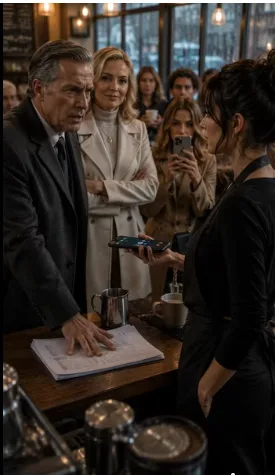
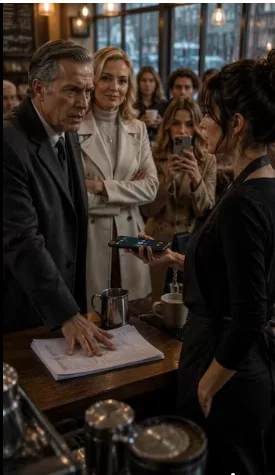
My father walked in first.
Daniel Pierce still had the same broad shoulders, the same expensive coat, the same steady stare that used to make waiters apologize for things they had not done. My mother came in beside him, blonde hair swept neatly under a cream wool hat, mouth curved into a bright smile that did not reach her eyes.
Behind them came Layla.
She held her phone at chest height.
Filming.
For a second, my shop seemed to shrink around them. The lights felt too warm. The music too soft. The hiss from the espresso machine sounded suddenly far away, like steam escaping from another room.
They did not stop at the line.
They did not look at the menu.
They moved straight toward the counter, smiling at my customers like they had arrived for a ribbon-cutting.
“Mara,” my mother said, spreading her arms slightly, not wide enough to hug me, just wide enough to perform one. “Look at this place.”
The way she said this place made it sound like she had found me living inside a bus station.
My father scanned the shelves, the pastry case, the brass pendant lamps I had installed with Marcos from the shoe repair shop. His gaze landed on the tip jar, then the tablet register, then the framed health inspection certificate by the wall.
“A lot smaller than the photos,” he said.
Nina stopped wiping the counter.
Grant lifted one side of his headphones.
Layla angled her phone a little higher.
I set the milk pitcher down carefully. The metal touched the counter with a soft click.
“Are you here to order coffee?” I asked.
My mother’s smile twitched. “That’s how you greet your family?”
“You haven’t been my family in four years.”
A woman near the pastry case looked down at her croissant like it had suddenly become fascinating.
My father leaned one elbow on the counter. He had always liked barriers. Dining tables. Desks. Counters. Anything that let him occupy the larger side.
“We’re not doing this in front of strangers,” he said.
“You walked into my shop during business hours.”
“Our shop, hopefully,” Layla said from behind her phone.
I looked at her then.
Layla was twenty-eight, with our mother’s careful blonde waves and our father’s habit of blinking slowly when she wanted someone to feel stupid. She wore a camel coat I recognized from my mother’s favorite boutique, and her nails were painted dark red, glossy as cherries.
“Turn the camera off,” I said.
She smiled. “It’s just for family records.”
“We don’t have those.”
Dad’s jaw moved once.
He reached inside his coat and pulled out a folder.
Black leather. Smooth. Expensive. The kind he used for contracts he wanted people to be afraid of. He placed it on the counter, squared it with the edge, then opened it with two fingers.
A stack of papers sat inside.
I saw my name.
Riverside Coffee LLC.
Fifteen percent.
Nina whispered, “Oh no,” so softly I almost did not hear it.
Dad tapped the top page. “This is a partnership amendment.”
“No.”
“You haven’t read it.”
“You haven’t changed.”
My mother let out a disappointed breath. “Mara, please. Your father came here to help.”
“He came here with a contract.”
“He came here because you clearly need guidance,” she said, glancing around my shop as if the full tables offended her. “Small businesses fail all the time. Especially when people get emotional instead of strategic.”
I wiped my hands on the towel tucked at my waist. It was blue cotton, fraying on one corner, the same towel I used every morning to polish the espresso machine before opening. My fingers kept smoothing the edge of it.
Dad noticed.
Of course he noticed.
He had built a whole life on noticing where pressure could be applied.
“You’re doing well enough to be interesting,” he said. “Not well enough to be protected.”
There it was.
Not love. Not apology. Not even curiosity.
A valuation.
“What do you want?” I asked, though the paper had already answered.
“Fifteen percent equity,” he said. “Voting rights on leases, debt, expansion, vendor contracts, and any sale or transfer.”
Grant removed his headphones completely.
The café quieted by degrees. First the spoon against ceramic stopped. Then the conversation near the window table thinned. Then the milk steamer clicked off, leaving the room with the soft scrape of rainwater from tires outside.
My father seemed pleased by the silence.
He mistook it for power.
“I’m not signing that,” I said.
“You will.”
“No.”
Dad’s eyes narrowed. “You always say that word as if it has weight.”
“It does in my building.”
My mother laughed again, but it came out brittle. “Your building?”
“My business.”
Dad picked up the contract and turned it toward me. “You’re leasing this space from Warren Holt.”
I did not move.
He continued, “Warren and I had a conversation this morning.”
Nina looked at me fast.
I kept my face still.
My father placed one palm on the counter and lowered his voice. He wanted it to sound private, but everyone near the front could still hear.
“Sign over fifteen percent, Mara. Or I call your landlord tonight.”
My mother’s smirk arrived slowly, like she had been saving it.
Layla’s phone stayed steady.
Dad leaned closer.
“He can make things difficult,” he said. “Inspections. Renewal delays. Maintenance issues. Rent adjustment. You know how these things happen.”
The old me would have argued.
The old me would have explained that I paid on time, that I fixed the bathroom sink myself, that I had scrubbed coffee stains from the grout on my knees at two in the morning because I could not afford a cleaning crew that first year.
The old me would have tried to make him see me.
But four years is a long time to keep knocking on a locked door.
Eventually, your hand heals.
I looked at the folder, then at my mother, then at Layla’s phone.
“Sure,” I said. “Let’s call him.”
My father blinked.
Just once.
“What?”
“Call Warren,” I said. “Now.”
Layla’s smile slipped. My mother glanced at Dad, a tiny quick look she probably thought no one caught.
I caught it.
So did Nina.
Dad recovered first. He slid his phone from his coat pocket, but he did not unlock it.
“You don’t want to embarrass yourself.”
“I’m not the one threatening a tenant in front of twenty customers.”
His mouth tightened. “You have no idea how ugly this can get.”
“I have a pretty good imagination.”
We stared at each other across the counter.
Behind him, Marcos from the shoe repair shop appeared at the open doorway connecting our stores through the shared back hall. He had a strip of black leather looped around his wrist and a tiny brass tack stuck to his sleeve.
He looked at Dad.
Then at me.
Then he stayed exactly where he was.
Dad unlocked his phone.
He tapped a contact and held it to his ear.
For the first time since they walked in, my pulse stumbled.
Not because I was afraid of Warren.
Because I still hated hearing my father use my life like a switch he could flip.
I had been twenty-two the first time he threatened to stop paying my rent if I changed majors. Twenty-five when he told my first boss I was “unreliable under stress” because I refused to quit and come work for his company. Thirty when he tried to put my name on a loan I had never agreed to. Each time, his hand found some wire behind the wall. Each time, the lights flickered.
Now he was smiling in my coffee shop like he had found the main breaker.
The call rang once.
Twice.
Three times.
Then Warren Holt answered.
“Daniel,” Warren said, his voice dry and rough through the speaker.
Dad had not put it on speaker.
I reached across the counter and pressed the icon myself.
Layla sucked in a breath.
Dad snatched the phone back, but the damage was done.
“Warren,” he said tightly. “I’m here with my daughter.”
“So I hear.”
My mother’s face changed.
Just a little.
The shop became so quiet I could hear the fan above the pastry case clicking in its same crooked rhythm.
Dad frowned. “I’m trying to resolve a family business matter.”
“No,” Warren said. “You’re standing in her café threatening her lease.”
A chair scraped softly near the back.
Dad’s face went red from the neck upward. “I don’t know what she told you—”
“She didn’t call me,” Warren said. “Nina did.”
Nina stiffened beside me.
My father turned his stare on her.
She raised her chin, though one hand gripped the towel so hard her knuckles blanched.
Warren continued, “And before you start, Daniel, I’m going to say this slowly. Who told you I’d evict her?”
No one moved.
Not my mother.
Not Layla.
Not the woman with the croissant.
The words landed on the tile floor and stayed there.
Dad’s mouth opened, then closed.
Warren gave a small cough. “Because I sure didn’t.”
Dad recovered with a laugh that had no warmth in it. “Come on, Warren. We both know leases have pressure points.”
“Not this one.”
My father’s stare shifted back to me.
There it was.
The first crack.
Tiny. Clean. Beautiful.
“What does that mean?” he asked.
I leaned both hands on the counter.
The edge of my blue towel brushed the same dent in the espresso machine I had touched every morning for three years.
“It means,” I said, “you should have read more than the old county record.”
My mother whispered, “Daniel.”
Warren exhaled through the phone. “Mara, you want me to explain, or you want to?”
I looked at my father.
For four years, I had imagined this moment in ugly ways. I had imagined yelling. Throwing him out. Telling him every single thing his silence had done to me during that first winter when I ate toast for dinner three nights in a row because the compressor repair cost more than expected.
But the actual moment felt quieter.
Smaller.
My voice did not shake.
“You called the wrong landlord,” I said.
Dad stared.
Then he laughed.
A short, insulting sound.
“Mara, don’t be absurd.”
“I bought the building eighteen months ago.”
Layla lowered the phone an inch.
My mother’s face went blank.
Dad looked at the ceiling, then the floor, then the front windows, as if ownership might be painted somewhere in gold letters if he searched hard enough.
“No, you didn’t,” he said.
“I did.”
“With what money?”
That question scraped more than I expected.
Not because I owed him an answer.
Because it was the same question he had asked when I bought my first used car, when I paid my own deposit on a studio apartment, when I registered Riverside Coffee as an LLC. With what money. As if money only became real after passing through his hands.
I swallowed once.
“With the money I earned,” I said. “And the money I did not give you.”
Grant made a sound under his breath. Almost a laugh. Almost something sharper.
Dad pointed at the contract. “This is ridiculous.”
“It is.”
“You think owning a building makes you untouchable?”
“No. I think owning my building means you can’t use Warren to scare me.”
Warren cleared his throat. “For the record, Daniel, I manage the property because Mara asked me to stay on during the transition. That’s it.”
Dad’s eyes cut toward the speaker. “You sold to her?”
“No,” Warren said. “My wife did.”
A second silence fell over the room.
He added, “After Mara helped her during the flood.”
My mother blinked rapidly. “What flood?”
I did not answer her.
But the memory came anyway.
A February night. Freezing rain. Water rushing under the back door after the drainage grate clogged behind the building. Warren’s wife, Elaine, trapped upstairs with a broken ankle while he was out of town visiting their son. Me and Marcos dragging towels, sandbags, boxes of pastry flour, anything we could use. Nina calling the fire department. Elaine sitting on the landing in her pink robe, shaking with cold, apologizing for the water like it was her fault.
Afterward, I brought her coffee every morning for three weeks.
Not because I wanted a building.
Because she was lonely and hated asking for help.
Elaine Holt had watched me mop my own floor at midnight more than once. She had watched me pay contractors in installments and still bring soup upstairs when Warren got sick. She had watched me treat that old building like it was a living thing with bad knees.
So when Warren decided to retire and Elaine wanted out from under maintenance calls, she came to me first.
Not my father.
Not some investor.
Me.
Dad looked back at me. His expression hardened, but underneath it something moved. Panic, maybe. Or humiliation trying to disguise itself as anger.
“You hid this,” he said.
“You didn’t ask.”
“We are your parents.”
“You were strangers with my last name.”
My mother flinched.
I almost regretted it.
Almost.
Then she lifted her chin and said, “We did what we had to do. You were impossible.”
There it was again.
That word.
Impossible.
As a child, I was impossible when I cried too long. As a teenager, impossible when I questioned why Layla got rescued from every mistake while I got lectures for being too serious. As an adult, impossible when I would not sign papers I did not trust.
I untied the towel from my waist and set it beside the contract.
“Leave,” I said.
Dad placed his phone flat on the counter, Warren still on speaker. “No.”
The word snapped through the café.
A few customers shifted.
Marcos stepped fully into the doorway now.
Nina moved closer to the register, where the small panic button sat under the lip of the counter. Dad did not know about it. Another thing he had not bothered to learn.
Layla lifted the phone again.
“Dad,” she whispered. “Maybe we should—”
“Quiet.”
She went quiet.
That hurt too, in a place I had not cleaned out yet.
Dad leaned forward, both palms on the counter. “You think you can humiliate me and keep operating peacefully in this town?”
“I think you should lower your voice.”
“You always were ungrateful.”
The word hit an old bruise.
Behind my ribs, something hot and humiliating rose fast. For a second, I saw my hands as they had been four years ago, trembling inside my coat pockets outside my parents’ house while sleet collected on the hood of my car. I remembered sitting in that car for forty minutes because I could not see the road through my own breathing. I remembered calling my mother once that night.
Once.
She let it ring.
My vision blurred at the edges.
Not with tears exactly.
With rage trying to become something visible.
I turned away from the counter.
“Mara?” Nina said.
“Give me one second.”
I walked through the swinging door into the back hallway.
The hallway smelled like cardboard, coffee grounds, and the lemon disinfectant Marcos used in the shared bathroom. I placed both hands against the cinderblock wall and bowed my head.
One breath.
Then another.
My body wanted to shake. It wanted to fold at the waist. It wanted to become that daughter again, the one waiting for permission to be loved.
I pressed my thumb against the small scar on my index finger from the day I burned myself installing the secondhand espresso machine.
That scar had outlasted the fear.
I counted five breaths.
Then I opened the small metal cabinet above the mop sink and took out the folder I kept there.
Not black leather.
Plain gray cardboard.
Slightly bent on one corner.
Inside were copies. Lease transfer. Deed. Security agreement. Cease-and-desist draft. A printed email from my attorney. A USB drive with security footage from the last three years. And at the very back, one document I had hoped never to use.
The old loan application.
The one with my forged signature.
I returned to the café.
Dad was still at the counter, but his posture had shifted. He was talking to Warren in a lower voice now.
“—misunderstanding,” he said. “Family gets complicated.”
“Not this complicated,” Warren replied.
I placed the gray folder on the counter.
Dad looked at it.
Then at me.
“What is that?”
“The reason you’re going to walk out quietly.”
My mother’s mouth tightened. “Mara, stop making a scene.”
“You brought the scene in with you.”
Layla’s camera hovered between us.
I looked straight into it.
“Keep filming,” I said.
Her eyes widened.
Dad reached for the gray folder.
I put my hand on top of it.
“No.”
His nostrils flared.
I opened it myself.
First, the deed.
Then the management agreement with Warren.
Then the letter from my attorney, dated six months earlier, after Dad sent one of his employees into my shop pretending to ask about franchise interest.
Dad stared at the pages.
His face did something strange then. It did not soften. It rearranged. Like he was trying to find the version of himself that still looked in control from the outside.
“This proves nothing,” he said.
“It proves you had no leverage here.”
“You think that’s enough?”
“No.”
I took out the final document.
The old loan application.
My father froze.
My mother saw it and made a small sound.
Not surprise.
Recognition.
Layla lowered her phone again.
“What is that?” she asked.
Dad did not answer.
I did.
“It’s the loan application Dad submitted three years ago using my name as guarantor.”
A murmur moved through the café.
My father’s voice came out flat. “You don’t know what you’re talking about.”
“I know my signature was copied from the documents you tried to make me sign at dinner.”
His lips parted.
I pointed to the lower corner of the page. “You forgot one thing.”
No one spoke.
“My legal name changed two months before this was filed.”
My mother closed her eyes.
“I had removed Pierce as my middle name,” I said. “The signature you used was already outdated.”
Warren’s voice came through the phone, quiet now. “Daniel.”
Dad turned the color of ash.
Grant stood up from the window table, his headphones hanging around his neck.
“Do you want witnesses to stay?” he asked me.
It was such a simple question. So ordinary. So decent.
My throat tightened more from that than from anything my parents had said.
“Yes,” I said. “Please.”
He nodded once and stayed where he was.
Nina pressed her lips together, then turned the little sign near the register from Open to Closed. Her hand shook, but she did it anyway.
The bell above the door rang as one customer slipped out. Then stopped halfway and turned back.
“I can stay too,” the woman with the croissant said.
My father looked around the café.
For the first time, he seemed to notice that the room did not belong to him.
It belonged to people who knew my name, my coffee, my hours, my bad handwriting on the chalkboard, my habit of giving free refills to anyone grading papers. It belonged to people who had watched me build something one small repair at a time.
My mother whispered, “Daniel, enough.”
He ignored her.
“You kept this for three years?” he asked me.
“I kept everything.”
“Planning to destroy your own family?”
“No,” I said. “Planning to survive mine.”
Layla’s face changed then.
Not dramatically.
Just enough.
Her phone sank to her side.
“Dad,” she said. “You told me she left because she stole from you.”
I looked at her.
The room tilted slightly.
“What?”
Layla’s eyes flicked to mine, then away. “You said she emptied the emergency account. You said she ran.”
My mother gripped her purse with both hands.
Dad’s voice sharpened. “This is not the place.”
Layla laughed once, ugly and short. “You made it the place.”
For the first time all morning, I saw my sister without the coat, the phone, the smirk. I saw the girl who used to climb into my bed during thunderstorms and press her cold feet against my legs. I saw someone who had been fed a story and had chosen to enjoy it because it made her life easier.
Both could be true.
That was the worst part.
I slid the loan application back into the folder.
“My attorney has copies,” I said. “So does the bank’s fraud department. They agreed to hold off on escalation as long as you stayed away from me and my business.”
Dad went very still.
That was the real reveal.
Not the deed.
Not Warren.
This.
“You contacted the bank?” he asked.
“I had to. Your loan officer called me when the account went delinquent.”
My mother’s hand flew to her mouth.
Layla stared at Dad. “You said it was handled.”
“It is handled,” he snapped.
“No,” I said. “It was postponed.”
Warren spoke again, and this time his voice carried the tired disgust of a man who had seen enough. “Daniel, leave the building.”
Dad looked at the phone as if it had betrayed him.
“You don’t give orders here,” he said.
“I do when the owner asks me to enforce trespass policy.”
I picked up my phone from beside the register.
My thumb hovered over my attorney’s contact.
Dad watched it.
The café held its breath.
“I’m asking once,” I said. “Leave. Do not contact my landlord, my employees, my vendors, or my customers. Do not come back to this property. Do not send anyone here. If you do, I file the complaint today instead of Friday.”
My mother whispered, “Friday?”
“Yes,” I said. “I gave myself three days to decide.”
Dad’s eyes searched my face for a crack.
He used to find them easily. A trembling lip. A lowered gaze. A quick apology. That morning, he found coffee steam, bad fluorescent reflection in the window, and a woman he had not known for four years.
He gathered his contract slowly.
His hands were not steady.
I noticed.
I hated that I noticed.
My mother stepped back first.
Layla did not move.
“Come on,” Dad said to her.
She looked at me.
“I didn’t know,” she said.
It was not an apology.
Not yet.
Maybe it never would be.
“I believe that,” I said. “I also believe you wanted to.”
Her face went red.
That one landed.
Dad grabbed her arm, not hard, but enough to make her pull away.
“Don’t,” she snapped.
He looked stunned.
My mother opened the door.
Cold air spilled into the café. The bell above it rang once, too cheerful for the room.
Dad stepped outside without looking back.
My mother followed.
Layla paused at the threshold.
For a second, I thought she might say something. Something useful. Something human.
Instead, she looked at the chalkboard menu behind me.
“You still spell macchiato wrong,” she said quietly.
Then she left.
The door closed.
The bell shivered into silence.
Nobody moved.
Then Marcos crossed the room, reached over the counter, and took the blue towel beside my hand.
He folded it once.
Then again.
Very carefully.
“You want me to fix that fan?” he asked.
A laugh broke out of me before I could stop it.
Not a happy laugh.
A cracked one.
Nina covered her mouth. Grant looked down. The woman with the croissant wiped at the corner of one eye with a napkin and pretended she was checking the pastry flakes.
I picked up Warren’s call.
“You okay?” he asked.
“No.”
“Good answer.”
I nodded even though he could not see me. “Thank you.”
“Elaine wants you upstairs for soup later.”
That almost did it.
My eyes burned.
“Tell her I’ll come after closing.”
“She said bring the blueberry scones that never make it to the display case.”
“She knows too much.”
“She always has.”
I ended the call and looked at the café.
The contract folder was gone.
The gray folder remained.
So did the customers.
So did the dented espresso machine, the crooked fan, the slanted floor, the towel Marcos had folded into a neat blue square.
Nina unlocked the door again after ten minutes.
The first customer who came in after it all ordered a small drip coffee and a plain bagel. He had no idea he was walking into the aftershock of a family ending in public.
I made his coffee myself.
My hands shook then.
Just a little.
Enough that a few drops spilled onto the saucer.
He did not comment.
At three in the afternoon, Layla texted me.
I’m sorry.
Then another message.
I have questions.
Then a third.
Can we talk without them?
I stared at the screen until it dimmed.
I did not answer.
Not because I wanted to punish her.
Because I did not know yet which part of me would pick up the phone.
That evening, after we closed, I carried a paper bag of blueberry scones upstairs to Elaine Holt’s apartment. The hallway smelled like old varnish and radiator heat. The fan in the café was still clicking below us, though Marcos had promised to fix it tomorrow.
Elaine opened the door in her pink robe, one hand on her cane.
“Heard your father came by,” she said.
“You heard fast.”
“I live above a coffee shop. I hear everything.”
She stepped aside.
I handed her the bag.
She peeked inside and smiled. “You brought the good ones.”
“I owed you.”
“No,” she said, taking the bag gently. “You don’t.”
I looked past her into the warm apartment, at the little kitchen table set for two bowls of soup.
Downstairs, my phone buzzed again in my coat pocket.
Layla.
I left it there.
Elaine held the door open wider.
And for the first time all day, I stepped into a room where nobody asked me to sign anything.
Chapter complete
You have reached the end of this chapter.
Continue reading
A few more worlds to get lost in after this chapter.




