I should have known something was wrong the moment the lobby smelled like bergamot and wintergreen.
Chapter 1
I should have known something was wrong the moment the lobby smelled like bergamot and wintergreen.
For eight months, I had rebuilt my life around small precautions no one saw. I changed my phone number twice, stopped using the same coffee shop more than once a week, paid cash when I could, kept my illustration work under a shortened name, and memorized exits before I looked at menus. In Brooklyn, in the back room of a laundromat that rented illegal studios to artists and night-shift musicians, I slept with my shoes pointed toward the door and a chair under the handle. It was not a glamorous kind of survival, but it was survival, and after being engaged to Evan Whitmore for almost four years, survival felt like a miracle with bad lighting.
Evan came from the kind of New York family that did not threaten people directly because other people did it for them. His father’s name was on a wing of a hospital. His mother
chaired charity auctions where women in pearls pretended not to notice when she corrected the waitstaff by snapping her fingers. His uncle had served two terms in the state senate, his cousin sat on a federal bench, and his friends smiled for society photographers while quietly owning judges, editors, and half the private security firms in Manhattan. Evan himself looked harmless in photographs: golden hair, gray suits, white teeth, one hand in his pocket as if he had never needed to raise it.
But I knew the pressure of that hand around my wrist under a dinner table while he smiled at his mother. I knew the way his voice could drop so low no one else heard it when he told me exactly what would happen if I embarrassed him again. I knew what it felt like to clean blood from a white marble sink while rehearsing the word
accident until I could say it without flinching.
That Tuesday morning, I had gone to the Grayson Crown Hotel in Midtown for one reason only: rent. The hotel had commissioned a series of hand-drawn panels for its winter art catalog, and the curator had promised half the fee on delivery. I checked the emails twice, then three times. No Whitmore names. No familiar foundations. No shared vendors. I used a train route I had never used before and carried the portfolio against my chest like armor.
The delivery took six minutes.
The curator was a polished woman with silver glasses and a soft voice. She flipped through my illustrations at the front desk, praised the texture of the ink, promised that accounting would process the payment by Friday, and shook my hand without looking too closely at the tremor in my fingers. I thanked her, turned toward the revolving doors,
and made the mistake of breathing in.
Bergamot.
Wintergreen.
Expensive, clean, sharp.
Evan.
My body recognized him before my mind accepted it. I did not turn quickly. People who are being hunted learn not to move like prey unless they are already running. I angled my face toward the gold-framed mirror behind the concierge desk and saw him reflected there, standing beneath a chandelier, smiling at the hotel manager as if he owned the building and had only misplaced a decorative object.
Me.
His suit was pale gray. His hair was perfect. His expression was pleasant enough to fool strangers and cruel enough to paralyze me from thirty feet away. When his eyes shifted toward the lobby, I knew he had not come to ask questions. Evan never came in person unless he wanted someone to see him win.
I walked toward the service corridor.
Not fast at first. Not in panic. Just a woman looking for the restroom, an artist with an empty portfolio, someone invisible to rich guests and hotel staff. Then I passed the corner by the floral arrangement, stepped out of the mirror’s reflection, and ran.
The corridor narrowed behind the front desk, smelling of bleach, steam, and folded linen. A housekeeper pushed a cart past me and did not look up. Somewhere behind me, I heard a man say my name.
“Maya.”
Not loud.
Not dramatic.
Just certain.
That was worse.
At the end of the corridor stood an elevator with brushed steel doors and no public sign. I did not notice the missing call panel until later. At that moment, the doors were open, and open meant escape. I slipped inside, jabbed at the panel, and only after the doors closed with a soft, luxurious whisper did I see there was only one button.
P.
Not lobby.
Not garage.
Not service level.
Penthouse.
The elevator was already rising.
For one ridiculous second, I stared at that single polished button and hoped the letters might change. They did not. My reflection stared back from the steel wall: pale face, dark hair coming loose from its clip, mouth parted around a breath I could not finish.
I reached for the emergency panel.
The elevator stopped before my fingers touched it.
The doors opened into a room so bright and high and silent that it felt less like a penthouse than a courtroom above the city. Floor-to-ceiling glass showed Manhattan spread below in cold October sunlight. White marble ran beneath dark rugs. A black grand piano stood near the windows, untouched and shining. Somewhere, coffee brewed. Somewhere, woodsmoke lingered though no fire was lit.
And in the center of the room stood Roman Calder.
I knew his face because everyone in New York knew his face.
He was on the cover of business magazines in airport kiosks, in the society pages when he donated buildings and refused interviews, in blurry photographs taken outside courtrooms when someone tried and failed to sue him. Roman Calder was the kind of man people described with words like private, ruthless, disciplined, impossible. His hotels did not just have five stars. They had reputations. His name moved through Manhattan the way weather moved over water—quiet, large, impossible to ignore.
He was not alone.
A woman in a dark green suit stood near a marble island with a tablet tucked under one arm. A silver-haired man in a security earpiece waited beside the far wall. Both turned when the elevator opened. Roman did not.
He was looking at me already.
Not surprised. Not irritated. Not even curious.
Just looking.
I stepped backward so quickly my shoulder hit the elevator frame.
“I’m sorry,” I said. My voice came out thin. “I didn’t—I was looking for the service exit. The doors were open. I didn’t know this was—”
Roman lifted one hand.
Not sharply. Not like Evan. Just enough to stop the apology before I wasted more breath.
His eyes moved from my face to the portfolio clutched against my chest, then to the loose strand of hair stuck to my cheek with sweat.
“Maya Vale,” he said.
My stomach went cold.
I had not used Vale with the hotel.
For eight months, I had signed my work as M. Vail, with an i, a tiny lie folded into my invoices and email headers. It was not clever enough to fool a determined man, but it had been enough to keep me breathing.
The woman in the green suit looked down at her tablet.
Roman took one step toward me, then stopped when I flinched.
That was the first thing I noticed about him.
He noticed fear.
And he did not punish it.
“You’re safe here,” he said.
People always say that in movies. Usually right before someone opens the wrong door.
I shook my head. “No. I’m not. I need to go.”
“From whom?”
The question was calm. Too calm.
Behind me, the elevator gave a soft chime.
My body moved before my mind did. I turned toward the doors, one hand lifting as if I could hold them shut through will alone.
The doors opened.
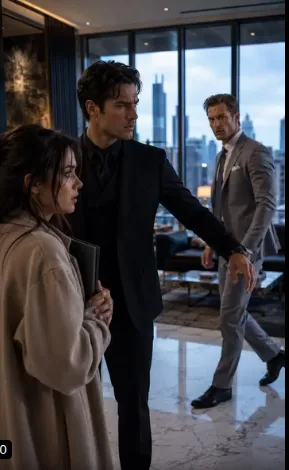
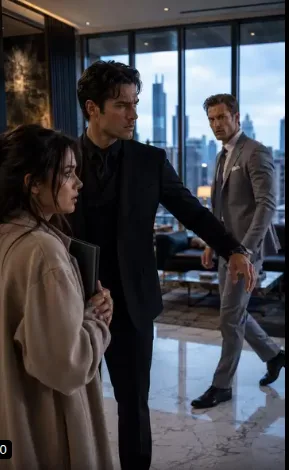
Evan Whitmore stood inside the elevator.
He was not out of breath. That frightened me more than if he had been. His pale gray suit was still immaculate, his blond hair still smooth, his smile still in place. The only sign that he had chased me through the hotel was the faint flush under his cheekbones.
His eyes went to me first.
Then to Roman.
Then back to me.
“Maya,” he said softly. “You scared everyone.”
No one had been scared.
No one except me.
I took one step back and my heel hit the edge of the rug. My portfolio slipped slightly in my hands.
Roman did not turn around at first.
He looked at me, just long enough for me to understand that he was giving me a choice to speak.
I could not.
Evan stepped out of the elevator as if he had every right to enter a billionaire’s private penthouse. Men like Evan were born with invisible keys. Rooms opened because people assumed they must belong somewhere.
“Mr. Calder,” Evan said, with a pleasant nod. “I apologize for the interruption. My fiancée has been under a great deal of stress.”
The word fiancée landed against my skin like a slap.
“I’m not,” I said.
It was barely audible.
Evan smiled without looking at me. “She gets embarrassed. It’s part of the situation.”
The woman in the green suit stopped tapping on her tablet.
Roman finally turned.
He did it slowly, as if Evan had only now become worth the effort.
“There is no situation,” Roman said.
Evan’s smile held. “I’m afraid there is. She’s been missing for months. Her family has been worried sick.”
“My family is dead,” I said.
That time my voice was louder.
A silence opened.
Evan’s jaw flexed once. A tiny movement. Most people would have missed it. I had spent four years surviving those tiny movements.
“Maya,” he murmured.
“No,” I said.
My fingers tightened around the portfolio until the cardboard bent.
Roman’s gaze flicked down to my hands.
Evan saw it too. His expression shifted, almost imperceptibly, from polite concern to ownership.
“Come here,” he said.
Two words.
Not shouted. Not angry.
Worse.
Familiar.
I stayed where I was.
He took a step toward me.
Roman moved before Evan took the second.
It was not dramatic. There was no raised voice, no shove, no threat. Roman simply stepped between us, placing his body in the narrow space Evan had been trying to claim. His left hand rested flat on the glass table beside my portfolio. The silver watch at his wrist caught the pale morning light.
Evan stopped.
Roman’s voice dropped.
“Try touching my wife.”
The room went so still I could hear the elevator doors trying to close behind Evan, catching against his shoulder, opening again with a soft mechanical sigh.
My wife.
For a second, I forgot Evan existed.
I looked at Roman.
He did not look back.
My heart banged once, hard enough to hurt.
Wife.
I had not married him. I had never met him. I had never stood beside him in a courthouse or signed a license or said yes to anything except a hotel catalog job I desperately needed for rent.
Evan laughed.
It came out wrong.
“Excuse me?”
Roman’s hand remained flat on the table. “You heard me.”
Maya Vale, who had slept with a chair under a doorknob for eight months, who had memorized subway exits and changed phone numbers and taught herself to eat without sitting near windows, should have said something.
I should have said, I’m not his wife.
I should have said, I don’t know this man.
Instead, I stood behind Roman Calder and let the lie stand in the air between us.
Because for the first time in eight months, Evan Whitmore looked uncertain.
Only for half a second.
But I saw it.
Evan recovered quickly. He always did. His smile returned, thinner now. “That’s quite a claim.”
“It is,” Roman said.
“I know Maya.”
“No,” Roman replied. “You knew how to frighten her.”
The sentence did not rise. It did not need to.
Evan’s eyes sharpened.
“There are legal matters you don’t understand.”
Roman almost smiled. Almost. “There usually are when men like you enter rooms uninvited.”
The silver-haired security man stepped away from the wall.
Evan noticed. His posture changed again, polished into something injured and reasonable.
“Maya,” he said, leaning just enough to see around Roman’s shoulder. “Please. This is humiliating for you. You’re confused, and this man is using that.”
The old part of me stirred.
The part that still remembered Evan bringing me soup when I had the flu the first winter we dated. The part that remembered him standing outside an art supply shop in the rain because I had wanted one specific ink brush and he said he liked watching me choose things. The part that had taken years to understand kindness could be bait.
I swallowed.
Roman still did not move.
Evan’s voice softened. “You don’t have to keep doing this. We can go home. We can fix it quietly.”
Home.
There it was.
The word he used for every room where I disappeared.
Something in me slipped.
Not completely. Just enough that the penthouse blurred at the edges.
I looked down at my hands. My left thumb was rubbing the corner of the portfolio, over and over, the way I used to rub the seam of my sleeve at charity dinners while Evan’s mother talked about breeding and manners and women who knew how to support powerful men. I hated that my body remembered him better than I did.
Then Roman said my name.
Not loudly.
“Maya.”
I looked up.
He had turned his head slightly, just enough that I could see his profile. Not pity. Not command.
Permission.
I breathed in.
Bergamot and wintergreen were still there, sharp and expensive from Evan’s suit.
But beneath it was coffee.
Woodsmoke.
Clean linen.
A room that did not belong to him.
“I’m not going with you,” I said.
Evan stared at me.
The mask cracked at the edge.
“You don’t mean that.”
“I do.”
“You’re frightened.”
“Yes,” I said. My voice shook, but it did not break. “Of you.”
The woman in the green suit looked up fully then. The security guard’s expression changed, not much, but enough. A small human flicker.
Evan’s face went pale under the polished tan.
“This is absurd,” he said. “Mr. Calder, I don’t know what game you’re playing, but I suggest you be careful. The Whitmore family has relationships with—”
“I know your relationships,” Roman said.
He reached for the silver card beside my portfolio and slid it across the glass table. It made a soft, cold sound.
“You have twelve minutes before hotel security escorts you out through the lobby,” he continued. “You have fourteen before my legal office sends a notice to your family counsel. You have twenty before the first copy of the elevator footage is preserved off-site.”
Evan stopped smiling.
There was the room’s second silence.
This one belonged to Roman.
Evan’s eyes moved toward the ceiling corners.
I had not noticed the cameras. Small black glass circles set into the clean white architecture. Discreet. Unblinking.
Roman noticed me noticing.
“So did the service corridor,” he said.
My throat tightened.
The corridor. The bleach. The linen cart. Evan saying my name like a man calling back a dog.
Captured.
Preserved.
Not my word against his.
Not this time.
Evan adjusted his cuff. That was his tell when he needed a second to think.
“This could become uncomfortable for everyone,” he said.
Roman’s expression did not change. “It already is.”
“For her,” Evan said, and now something ugly entered his voice. “You don’t know what she’s like. She makes stories. She draws them, sells them, lives inside them. I spent years trying to help her stay grounded.”
I felt it then.
The old trap.
He had done it in restaurants, in doctors’ offices, in front of his mother’s friends. He would lower his voice, make himself look tired, make me look fragile. If I cried, I proved him right. If I got angry, I proved him right. If I stayed silent, he filled the silence with his version.
Roman said nothing.
That frightened Evan more than interruption would have.
So Evan turned to me.
“Maya, show him your wrist.”
My breath stopped.
Roman’s eyes did not move from Evan.
Evan’s mouth curved. “Go on. Show him. Or should I tell him about the night you broke the vase and cut yourself because I wouldn’t let you drive in that state?”
The room tilted.
There it was. The white marble sink. The broken glass. His hand around my wrist. His voice saying, Look what you made me do. Now clean up before my mother sees.
I had told no one.
Because people like Evan did not leave bruises where photographers could see them.
My fingers loosened.
The portfolio slipped.
It hit the marble with a flat, ugly slap.
The sound made me jump.
A single sheet slid out. One of the winter catalog sketches. A hotel lobby in ink and pale watercolor, all chandeliers and polished floors, with tiny figures drawn in the background.
Roman looked at the page.
Then at me.
I bent too quickly to pick it up and nearly lost my balance. The woman in the green suit moved first. She crossed the room, crouched without ceremony, and lifted the sketch carefully by the edges.
“Here,” she said.
Her voice was soft.
Normal.
A normal person’s voice in an abnormal room.
I took the paper with both hands.
“Thank you,” I whispered.
She nodded once and stepped back.
That small kindness almost undid me.
Not Roman’s power. Not the cameras. Not Evan’s fear.
A woman in a green suit handing me my drawing like it mattered.
My eyes burned. I looked down at the sketch until the lines steadied.
Evan exhaled through his nose. “This is exactly what I mean.”
Roman finally moved.
He picked up the silver card and placed it in his jacket pocket.
Then he looked at the security guard. “Bring Ms. Hart.”
The guard nodded and left through a side door.
Evan’s eyes narrowed. “Who is Ms. Hart?”
“My general counsel,” Roman said.
“I have counsel.”
“I assumed.”
“You’re making a mistake.”
“No,” Roman said. “You did that when you followed an artist through my hotel after she clearly attempted to avoid you.”
Evan’s face tightened.
For the first time, he looked less like a prince and more like a man who had been told no in a language he did not speak.
“Artist,” he repeated, almost laughing. “Is that what she told you?”
My hands curled around the sketch.
Roman’s voice stayed level. “That is what her contract says.”
Evan blinked.
“You commissioned her?”
“The hotel did.”
“Why?”
Roman looked at me then.
Something unreadable passed across his face.
“Because her work was worth buying.”
The sentence hit me in a place I had not protected.
For years, Evan had called my illustrations charming. Pretty. A hobby that would be more impressive once we were married and I could attach the Whitmore name to it. His mother had asked if I would consider painting place cards for her charity luncheons, as if that were the highest use of my hands.
Worth buying.
I looked away before anyone could see my face clearly.
A side door opened.
A woman in her fifties entered, short silver hair, navy suit, no jewelry except a narrow gold band. She carried a leather folder and moved like someone who had never hurried for a man in her life.
“Mr. Calder,” she said.
“Ms. Hart,” Roman replied. “Mr. Whitmore believes he has a legal claim over Ms. Vale.”
Ms. Hart looked at Evan.
Not impressed.
“Does he.”
Evan’s smile returned because lawyers were familiar ground. “I don’t have to discuss private family matters with you.”
“No,” Ms. Hart said. “You don’t. But you may want to explain why your family attorney sent three cease-and-desist letters to galleries that attempted to represent Ms. Vale after your engagement ended.”
My lungs forgot how to work.
Evan went still.
Roman’s eyes shifted to me.
I stared at Ms. Hart.
“What?” I said.
She opened the folder.
“Canvas & Crane Gallery, March nineteenth. Eastmere Illustration Agency, May second. Bellweather Books, June twenty-seventh.” She looked at me over the folder. “Each letter claimed you were under an exclusive domestic partnership contract with Whitmore Holdings and that your work could not be sold without Mr. Whitmore’s approval.”
The room blurred again, but differently this time.
Not fear.
Recognition.
The gallery that loved my city birds and then stopped replying.
The agency that scheduled a call and canceled ten minutes before.
The children’s book editor who said there had been a complication and wished me luck in a voice too careful to be honest.
Eight months of closed doors.
Not because I was not good enough.
Because Evan had locked them.
I laughed once.
It sounded broken.
Evan looked at me sharply. “Maya.”
“No,” I said, still looking at Ms. Hart. “No, I want to hear it.”
Ms. Hart’s mouth softened only slightly. “There are more.”
My knees weakened.
Roman saw it and pulled out the chair beside the glass table without touching me.
I did not sit.
If I sat, I might not stand again.
Evan’s face hardened.
“She was unstable,” he said. “Her work was being used by people who didn’t understand her condition.”
“I don’t have a condition,” I said.
His eyes cut to me.
I used to shrink from that look.
This time, I kept breathing.
“I had you,” I said.
The words came out flat.
No drama. No performance.
Just truth.
Evan’s mouth opened, then closed.
Ms. Hart turned a page. “Mr. Whitmore, your father’s office also contacted Grayson Crown procurement last week.”
Roman looked at Evan.
That was new to him.
“Did they,” he said.
Evan’s nostrils flared. “My family does business with half this city.”
Ms. Hart continued. “They advised the hotel to reconsider using Ms. Vale’s artwork due to possible reputational risk.”
I remembered the curator’s soft voice.
Accounting would process by Friday.
Had she known?
Had she hired me anyway?
Roman’s expression darkened almost imperceptibly. “Who took the call?”
“Deputy procurement director,” Ms. Hart said. “He forwarded it to legal because of the name involved.”
“The name involved,” Evan repeated. “You people speak as if you’re immune to consequences.”
Roman stepped closer.
Not to Evan. To the table.
He picked up my sketch from where my hands had lowered it and placed it carefully back into the portfolio. His movements were slow, precise, almost reverent.
Then he closed the flap.
“Mr. Whitmore,” Roman said, “I want you to listen very carefully.”
Evan stared at him.
“Ms. Vale is under contract with Grayson Crown Arts, a subsidiary whose majority shares I own personally. Your family’s interference with her commissions is now interference with my company’s contracted vendor. Your presence in my private residence after following her through restricted hotel space is now a security breach. Your attempt to remove her after she refused is now recorded.”
He paused.
“And if you ever approach her again without written legal cause, you will discover how quickly private influence stops mattering when someone richer decides to become inconvenient.”
The sentence was quiet.
It landed like a locked door.
Evan’s eyes were no longer on me.
They were on Roman.
Measuring. Calculating. Hating.
“You said wife,” Evan said.
Roman did not blink. “Yes.”
“She’s not your wife.”
“No.”
My head snapped toward him.
The word cracked through me.
No.
Roman had lied.
Of course he had.
Relief and fear hit at the same time, twisting together until I could not tell which one made me dizzy.
Evan smiled again, but there was sweat at his temple now.
“So you admit it.”
Roman looked at him as if he had missed the point by miles.
“I said what was necessary to stop you from putting your hands on a woman who clearly feared you.”
Evan gave a soft laugh. “That’s noble. Very cinematic. Unfortunately, false statements have consequences.”
“So do forged domestic partnership contracts,” Ms. Hart said.
Evan’s smile vanished.
I turned slowly toward her.
“What forged contract?”
Ms. Hart hesitated for the first time.
Roman looked at me, and something in his face shifted.
Not pity.
Regret.
“Maya,” he said, “when my office flagged the Whitmore letters, we requested supporting documentation. Your signature appeared on a private partnership agreement granting Evan Whitmore limited management authority over your creative assets.”
I felt nothing at first.
My body went quiet.
Then I remembered a night two years earlier, sitting at Evan’s dining table while his mother planned a donor dinner in the next room. Evan had pushed a stack of documents toward me with a fountain pen. Venue insurance, he said. Nondisclosure forms. Basic paperwork because the family photographer might capture my sketches on the walls.
I had signed where he pointed.
I had been tired.
I had trusted the hand covering the top of the page.
“No,” I whispered.
Evan said, “Careful.”
That single word dragged the room back into focus.
Careful.
He had said it at dinner tables. In elevators. Outside coatrooms. In the marble bathroom where my wrist hurt too much to lift.
Careful.
Something in me straightened.
Not fully.
Just enough.
I picked up the portfolio from the table and held it against my chest.
“Show me,” I said.
Ms. Hart looked at Roman.
He nodded.
She removed a photocopy from the folder and placed it on the glass table, face down so no words were visible from across the room. She turned it only toward me.
I did not read all of it.
I did not need to.
My signature sat at the bottom.
Maya Vale.
But the M was wrong.
Too rounded. Too careful.
I stared at it.
Then I laughed again.
This time it did not sound broken.
It sounded almost alive.
Evan’s eyes narrowed.
“You forged it badly,” I said.
His expression flickered.
“My mother taught me to sign my name with a hard angle in the M,” I continued. “She said soft letters made people think you could be talked over.”
The woman in the green suit looked at the signature.
Ms. Hart leaned closer.
I touched the page with one fingertip. “That isn’t mine.”
Evan’s mouth tightened. “You’re an illustrator. You change your hand all the time.”
“Yes,” I said. “But not that.”
I opened my portfolio with shaking hands and pulled out the original hotel contract I had signed at the front desk. The curator had given me a copy. I had folded it into the back pocket because I did not trust promises anymore.
I placed it beside the photocopy.
Two signatures.
The real one looked like my mother’s stubbornness.
The fake one looked like Evan’s idea of me.
Soft.
Small.
Easy.
Ms. Hart studied both.
Roman did not look away from Evan.
The elevator chimed again.
No one had pressed it.
Two uniformed hotel security officers stepped out, followed by the hotel manager from the lobby. He looked pale and deeply unhappy.
Behind him stood the curator with silver glasses.
When she saw me, her face changed.
Not surprise.
Concern.
“Maya,” she said softly.
Evan turned toward the growing audience and immediately became charming again. “This is getting unnecessary.”
The curator ignored him.
She looked at Roman. “I’m sorry, Mr. Calder. I told front desk staff not to let anyone ask after her.”
My throat tightened.
“You knew?” I asked.
The curator’s hands folded around a slim envelope. “I knew someone called twice yesterday asking whether M. Vail had arrived with artwork. He said he was your fiancé. You had written in your delivery notes that no personal information should be released to anyone.”
I had forgotten that.
One small line at the bottom of an email.
Please do not share my arrival time with anyone.
A line I had written while half-ashamed of sounding paranoid.
The curator swallowed. “So I moved your appointment earlier and asked accounting to prepare a paper confirmation in case you needed proof you were here for work.”
She held out the envelope.
My fingers shook when I took it.
“Thank you,” I said.
It was too small for what I meant.
She nodded, and her eyes shone once before she looked away.
Evan stared around the room.
For the first time, the story was not his.
There were witnesses now. Not his friends. Not his mother’s donors. Not security men paid by firms his family knew.
Hotel staff. A curator. Roman Calder’s counsel. Cameras.
Ordinary people with ordinary faces watching him fail to control the room.
That was when Evan made his last mistake.
He turned to me and let the mask drop.
“You think they’ll keep protecting you?” he said. “You have no idea what happens after you walk out of here.”
The security officers moved.
Roman lifted one hand.
They stopped.
He wanted the cameras to catch every word.
Evan knew it too late.
His face changed.
But the words were already in the room.
Ms. Hart closed her folder.
“Thank you,” she said. “That will be included.”
Evan’s lips parted.
No sound came out.
Roman looked at the hotel manager. “Mr. Whitmore is no longer welcome in any Calder property. Effective immediately.”
The manager nodded quickly. “Yes, sir.”
Evan gave a short, humorless laugh. “Do you know who my father is?”
Roman’s expression remained empty.
“Yes.”
That was all.
Somehow it was worse than a speech.
The security officers stepped closer.
Evan looked at me one last time.
Not with love.
Not even anger.
With disbelief.
As if I had broken a rule by standing somewhere he could not reach.
“Maya,” he said.
I thought the sound of my name in his voice would pull something loose in me.
It did not.
I looked at him and saw what strangers probably saw: a handsome man in an expensive suit, sweating slightly under perfect hair, trying to smile while two security guards waited for him to move.
“Don’t call me again,” I said.
His face hardened.
Then he turned and walked into the elevator as if leaving had been his idea.
The doors closed on him.
This time, they did not open again.
No one spoke for several seconds.
The penthouse hummed around us. Air conditioning. Distant traffic. The faint sound of coffee being poured somewhere behind marble and glass.
My knees finally gave.
Not completely. I caught myself on the edge of the table, but the portfolio slid again, and the envelope from the curator bent under my palm.
Roman moved half a step, then stopped.
“May I?” he asked.
Two words.
I nodded.
He pulled the chair closer, not touching me, and I sat before I could make falling more dramatic.
My hands would not unclench.
The woman in the green suit brought a glass of water and set it near me.
“I’m Elise,” she said. “Executive office. Not scary, despite the tablet.”
A laugh escaped me.
Tiny. Embarrassing. Real.
She smiled.
The curator stood near the elevator, looking as if she wanted to apologize for the entire hotel industry.
“I didn’t tell him,” she said. “I swear.”
“I know,” I said.
And I did.
Because Evan had not found me through her.
He had found me the way men like him found people: through pressure, favors, systems that bent when money leaned on them.
Roman sat across from me, leaving the glass table between us.
That mattered.
“Why did you call me your wife?” I asked.
My voice sounded distant to my own ears.
Ms. Hart answered before Roman could. “Because spouse language triggers a different immediate security protocol in private residential disputes. It gave hotel security authority to treat Mr. Whitmore as a threat to a resident’s household rather than a guest conflict.”
I stared at her.
“That’s insane.”
“It is,” she said. “It is also effective.”
Roman’s mouth tightened. “I apologize.”
I looked at him.
“For lying?”
“For making you part of a lie without asking.”
The apology was so plain that I did not know where to put it.
Evan apologized like a man placing flowers over a trap.
Roman apologized like he expected nothing in return.
I looked down at my hands.
The water glass reflected my fingers. Long, ink-stained, still shaking. My mother used to say my hands gave me away before my face did.
“Why help me?” I asked.
Roman did not answer immediately.
He looked toward the portfolio.
“My sister was an artist,” he said.
The room changed.
Not visibly. The piano remained black and shining. The skyline remained pale beyond the glass. But Elise’s expression softened, and Ms. Hart looked down at her folder.
Roman’s voice stayed controlled. “She married into a family like his. Not the same names. Same architecture.”
I did not ask what happened.
His eyes told me enough.
“She left behind sketchbooks,” he continued. “No one bought them while she was alive. After she died, everyone wanted to call her brilliant.”
The words were even.
Too even.
I looked at the black grand piano by the window. Untouched. Shining.
“Was that hers?” I asked.
Roman followed my gaze.
“Yes.”
A silence sat between us.
Not empty this time.
Full.
“I’m sorry,” I said.
He nodded once.
“So am I.”
Ms. Hart placed a business card on the table. “Ms. Vale, we can connect you with independent counsel. Not ours, unless you request it after disclosure. You need someone who works only for you.”
I looked at the card.
Independent counsel.
Legal words. Expensive words.
“I can’t afford that.”
“The foundation can,” Roman said.
I stiffened.
He noticed.
“Not my personal charity,” he clarified. “A legal defense fund for artists facing contract coercion. My sister’s name is on it. You can refuse.”
I almost did.
Refusal had become my last remaining proof that I belonged to myself.
But then I thought of the forged signature. The closed galleries. The emails that stopped coming. The way Evan had walked into the penthouse certain the world would tilt toward him.
“No,” I said. “I don’t refuse.”
Ms. Hart nodded. “Good.”
The curator placed the slim envelope on the table again. “Your payment confirmation is inside. Accounting processed the first half early.”
I touched the envelope.
Paper.
Ordinary.
Real.
Rent.
For some reason, that was what almost made me cry.
Not the threat.
Not the footage.
Not even the forged contract.
Rent.
The small, stupid miracle of being able to pay for one more month in a room behind a laundromat where the pipes screamed at two in the morning.
Roman stood.
Everyone else seemed to breathe when he did.
“I’ll have a car take you wherever you want to go,” he said.
“No.”
The word came too quickly.
He stopped.
I swallowed. “Sorry. I mean—no car. If he sees a Calder car near my building, he’ll know where I live.”
Roman accepted that without argument. “Then Elise will arrange a different exit. No branding. No record visible to front desk.”
Elise nodded. “Already doing it.”
I looked at her tablet.
For the first time that day, technology did not feel like something used to track me. It felt like a door being opened from the inside.
Ms. Hart gathered her papers.
“Before you leave,” she said, “I recommend making a statement while your memory is fresh. Only what you’re comfortable giving.”
My fingers tightened around the envelope.
Eight months of silence pressed against my ribs.
Four years before that.
All the almosts.
Almost telling a doctor.
Almost telling a friend.
Almost calling my aunt in Oregon, then hanging up because Evan had convinced me she would think I was dramatic.
Almost walking into a precinct after the marble sink, then seeing a campaign photo of Evan’s uncle shaking hands with the police commissioner.
My throat closed.
“I don’t know if I can,” I said.
Ms. Hart’s face did not change.
“Then we start with what you can.”
What I could.
I could say the lobby smelled like bergamot and wintergreen.
I could say he followed me.
I could say I ran.
I could say I entered an elevator because open doors look like mercy when you are afraid.
So I did.
Not all of it.
Not the worst.
Not yet.
But enough.
I sat at Roman Calder’s glass table above Manhattan and told a lawyer, a curator, a woman with a tablet, and a billionaire with a dead sister’s piano that Evan Whitmore had followed me through the Grayson Crown Hotel after I tried to avoid him.
My voice shook.
No one corrected it.
No one told me to calm down.
No one said Evan came from a good family.
When I finished, Elise handed me a napkin.
I had not noticed I was crying until then.
I laughed under my breath and pressed the napkin under my eyes carefully so I would not smear ink from my fingers across my face.
“Sorry,” I said.
Roman looked toward the windows.
“Don’t apologize for evidence of pain,” he said.
It was exactly the kind of sentence that could have sounded polished from someone else.
From him, it sounded like a rule he had learned too late.
An hour later, I left through a service elevator that required two keys and opened into a loading bay smelling of rain, cardboard, and diesel. A woman from housekeeping stood by a linen cart near the exit. The same woman who had passed me in the corridor earlier.
She recognized me.
For one second, I thought she would look away the way people do when they almost saw something and chose comfort.
Instead, she reached into the cart and pulled out a folded navy scarf.
“It’s cold,” she said.
I stared at it.
“I can’t take that.”
She shrugged. “Lost and found. No tag.”
I took it because refusing would have been harder.
“Thank you.”
She nodded toward the street. “Don’t use the front.”
“I won’t.”
The scarf smelled faintly of laundry soap and lavender.
Outside, October had sharpened the air. Trucks backed into loading docks. Somewhere, a man cursed at a stack of crates. Steam rose from a street vent in white bursts.
Normal city things.
Beautiful, ugly, alive.
Elise walked me to the corner but not past it.
“We’ll contact you through the email you gave procurement,” she said. “No phone unless you approve. No address.”
“Thank you.”
She hesitated. “For what it’s worth, he scared me too.”
I looked at her.
She gave a small, embarrassed smile. “Evan. In the lobby. Before anything happened. Some men smile like doors locking.”
Then she went back inside.
I stood on the corner with my portfolio under one arm, a borrowed scarf around my neck, and an envelope that meant rent in my coat pocket.
My phone buzzed.
For a second, my whole body went cold again.
But the screen showed an unknown email notification, not a call.
From: Grayson Crown Arts.
Subject: Winter Catalog Payment Confirmation.
I opened it with numb fingers.
One line from the curator sat above the attached receipt.
Your work belongs in rooms that do not frighten you.
I read it three times.
Then I put the phone away and walked toward the subway.
Not my usual station.
Not the closest one.
Old habits do not disappear because one powerful man stands between you and another. Fear does not bow politely and leave the room.
At the laundromat that night, the dryers turned orange behind scratched glass. Someone’s radio played an old song through static. My room still smelled like detergent, dust, and the cheap peppermint tea I drank when my hands would not stop shaking.
I placed the chair under the door handle.
Then I looked at it.
For a long time.
Finally, I pulled it away.
Not far.
Just six inches.
Enough that the door could open if I needed to leave.
Not enough that I trusted the world.
On my desk, beside a chipped mug full of pens, I laid out three things.
The payment confirmation.
Ms. Hart’s card.
The hotel sketch that had fallen onto Roman Calder’s marble floor.
In the tiny background of the drawing, beneath a chandelier, I had inked a woman walking toward an exit with a portfolio held against her chest.
I had drawn her weeks before I became her.
My phone buzzed again.
This time it was a message from an unknown number.
For one terrible second, bergamot and wintergreen filled my memory.
Then I read it.
This is Roman Calder. Ms. Hart gave me permission to send one message only. You are not obligated to reply. The forged contract issue is bigger than we thought. Evan’s family used your name in a second filing. We will handle what we can from our side. Your counsel will explain tomorrow.
I stared at the screen.
A second filing.
There it was.
The thing not finished.
The door not fully closed.
I should have been terrified.
Part of me was.
But another part—the part my mother had tried to build with hard angles and stubborn letters—reached for a pen.
I turned over the hotel sketch and wrote one sentence on the back.
I never agreed to disappear.
Then I placed Ms. Hart’s card beside it, set my alarm for seven, and left the chair six inches away from the door.
Chapter complete
You have reached the end of this chapter.
Continue reading
A few more worlds to get lost in after this chapter.




