The receipt was curled at the edges from the steam of my coffee.
Chapter 1
The receipt was curled at the edges from the steam of my coffee.
I remember that more clearly than I remember my mother’s face that morning. The thin white paper sat beside my chipped blue mug on the kitchen table, trembling every time the old refrigerator kicked on. Four dollars and eighty-seven cents. A plain grocery receipt from Miller’s Market: eggs, store-brand bread, a bruised bag of apples marked down with a yellow sticker.
I was twenty-eight years old, wearing my work blouse with the missing cuff button, sitting in the apartment I paid rent for, staring at a receipt like it was evidence in a crime.
My mother had texted me at 6:12 a.m.
Send photo of receipt.
Not “good morning.” Not “how did you sleep?” Not even “please.”
Just an order.
I took the picture. My thumb hovered over send.
Outside my kitchen window, the buses were already hissing at the corner. It had rained during the night, and the alley
behind my building smelled like wet cardboard and diesel. Somewhere above me, Mrs. Alvarez’s grandson was practicing scales on a trumpet, hitting the same wrong note over and over again.
I envied him a little.
At least he was allowed to sound bad in his own home.
My phone buzzed again.
Nora. Receipt.
My name looked strange coming from her. Like a label on a box she owned.
I sent the photo.
Three dots appeared immediately.
You bought apples again?
I stared at the message until the screen dimmed.
They were on sale, I typed.
You have canned peaches at home.
I looked toward the cabinet above the stove. Three cans of peaches sat there, lined up with their labels facing forward because my mother had taught me that messy cabinets were a sign of messy character. I hated canned peaches. I had hated them since I was nine, when
my father bought a wholesale case after losing his job and told me fresh fruit was for people who understood money.
The apples were soft in the middle, almost too sweet. I had sliced one the night before and eaten it standing over the sink. It had tasted like rebellion, which was embarrassing, because it was an apple.
I did not answer my mother.
That was my first mistake, according to my parents.
According to me, it was the first full breath I had taken in years.
My paycheck had landed at midnight. I knew because my bank app notified me while I was half asleep, the blue light of my phone cutting across the bedroom ceiling. Three thousand four hundred and eighteen dollars after taxes. I was a senior billing coordinator at a medical equipment company in Columbus, Ohio. I trained two new hires. I corrected mistakes my manager
made quietly so patients did not end up with collections notices for wheelchairs they had already returned.
And every other Friday, like clockwork, I transferred most of my paycheck to my parents.
Not because they were poor.
That was the part people never understood.
My father, Arthur, owned a small insurance office with his name painted in gold on the window. My mother, Denise, did bookkeeping for three local dentists and wore pearl earrings to the grocery store. They lived in a brick house with white shutters, hydrangeas, and a dining room nobody was allowed to eat in unless guests were there.
They controlled my money because they had always controlled it.
When I got my first job at sixteen, my father took me to First Union Bank and opened a joint account. “You’ll thank us later,” he said, signing the paperwork with his expensive fountain pen. The teller, a woman with silver glasses, smiled at me like this was sweet.
I remember the pen. Black lacquer. Gold clip. He tapped it twice on the counter before writing his name.
That tapping sound became the rhythm of my life.
Tap. Explain yourself.
Tap. Show the receipt.
Tap. Don’t make us worry.
Tap. Family money stays in the family.
By twenty-eight, I had my own apartment, my own car loan, my own health insurance, and a curfew that was not called a curfew. It was called “checking in.” I was allowed to keep eight hundred dollars from every paycheck for rent, utilities, gas, groceries, and “reasonable personal needs.” The rest went into what my father called the Family Stability Account.
I had never seen a full statement.
He sent me summaries. Cropped screenshots. Numbers without account names. Spreadsheets he made himself with categories like Nora Contribution and Household Support.
When I asked questions, my mother would sigh.
“You always make money feel so ugly.”
My father would lean back in his chair and fold his hands over his stomach.
“Do you want independence, Nora, or do you want chaos?”
For years, I believed those were the only two choices.
That morning, the day everything finally snapped into place, I had exactly forty-six dollars in my personal checking account and a dentist appointment scheduled for noon. I had postponed the filling twice already because my father said dental work should wait until after open enrollment, when we could “plan the cash flow responsibly.”
My tooth had been aching for three weeks.
At 7:04, my father called.
I let it ring until the trumpet upstairs hit the wrong note again.
Then I answered.
“Morning, Dad.”
“Your mother is upset.”
His voice had that office tone. Polished. Calm. The tone he used when denying claims for water damage because a policyholder had missed a clause on page nine.
“I bought apples,” I said.
“You ignored her question.”
“I answered it.”
“You justified it. That’s different.”
I pressed my tongue against the sore tooth and tasted metal.
“I’m going to the dentist today.”
Silence.
Not a surprised silence. A measuring one.
“We discussed this,” he said.
“You discussed it.”
“Nora.”
“I have a cavity.”
“You have discomfort. Discomfort is not an emergency.”
I looked at my coffee. A thin skin had formed on top.
“I’m using my own card.”
“That card is connected to the budget.”
“My budget.”
“The family budget.”
There it was. The phrase that could turn any room cold.
I used to shrink when he said it. I used to imagine the family budget as some huge invisible machine I was always in danger of damaging by wanting the wrong cereal or a winter coat that was not on clearance.
That morning, with the receipt curling beside my mug and my tooth throbbing in time with my pulse, something in me went very still.
“Dad,” I said, “how much is in the Family Stability Account?”
He exhaled through his nose.
“We are not doing this before work.”
“How much?”
“You don’t need that number.”
“I send you over two thousand dollars a month.”
“And we make sure you don’t destroy yourself with it.”
The refrigerator kicked on again. The receipt fluttered.
“I want the statements.”
My father laughed once. Not loud. Just enough.
“That tone is exactly why you are not ready.”
I closed my eyes.
For a second, I was seventeen again, standing in the bank lobby while he explained to the teller that I was “bright but impulsive.” I had been saving for a used laptop. He said I could use the family desktop in the den until I learned patience.
“Nora,” he said, softer now, which was worse. “We love you. Your mother and I have made sacrifices you don’t understand. Don’t punish us because your friends fill your head with modern nonsense.”
“My friends don’t know.”
That came out before I could stop it.
Another silence.
“What don’t they know?”
I swallowed. “Any of it.”
“Well,” he said, “maybe that’s because some private things should stay private.”
After we hung up, I sat at the table until my coffee was completely cold.
At 8:15, I called the dentist and kept the appointment.
At 8:42, I walked into First Union Bank.
The same branch. Same brick building. Same frosted glass doors. They had replaced the carpet and the teller counter, but the waiting chairs were still the same stiff navy ones with silver legs. I had sat in one when I was sixteen, feet not touching the floor, watching my father tap that pen.
A young banker named Mallory called me back.
She had short blond hair, tired eyes, and a coffee stain on the cuff of her white shirt. I liked her immediately because she looked like someone who had already had two hard conversations before 9 a.m. and did not have patience for theater.
“I need to remove my parents from a joint account,” I said.
Mallory typed my Social Security number into her computer. Her expression changed so slightly most people would have missed it.
I did not.
“Let me pull up the account history,” she said.
Her keyboard made small plastic clicks.
Then she stopped.
“Ms. Whitaker,” she said carefully, “you’re not the primary owner on that account.”
“I know. My father opened it when I was sixteen.”
“No.” She turned the monitor slightly, not enough for me to read everything, but enough for me to see the rows. “The joint checking account you’re referring to was closed nine years ago.”
My hands went cold.
“What?”
“The account opened when you were a minor was closed shortly after your nineteenth birthday.”
“That’s impossible. I’ve been transferring money.”
“Yes.” Mallory’s voice got even gentler. “Into an account ending in 4418. But that account is not jointly held. It belongs to Arthur and Denise Whitaker.”
For a second, the room lost its edges.
The glass office wall. The banker’s plant. The framed poster about retirement planning. Everything stayed exactly where it was, which felt rude.
I gripped the arms of the chair.
“But my paychecks,” I said.
“You have a personal checking account here. Your direct deposit goes there first. Then you’ve been making external transfers.”
“Because they told me it was our family account.”
Mallory did not say anything.
That was the first kindness.
She did not fill the silence with bank language. She did not tell me to calm down. She just waited while I learned that the cage had not even been locked.
I had been mailing the key to my parents every two weeks.
“Can I stop the automatic transfer?”
“Yes.”
“Can they reverse it?”
“Not without your authorization.”
“Can they see my balance?”
She checked again.
“Not on your personal account.”
I laughed then.
It was a small, ugly sound.
Mallory looked at me with the expression of someone who understood that laughter could be a person trying not to fall apart in public.
“I need statements,” I said.
“For which account?”
“My personal account. All transfers to them. As far back as you can give me.”
She printed them in batches.
The printer behind her made a low grinding sound, page after page sliding into the tray. Twelve years of obedience, warm from the machine.
By the time she placed the stack in front of me, my hands had stopped shaking.
On the first page, beside a transfer from my first full-time job, the memo line read: Household support.
I had written that myself.
I did not remember doing it.
Mallory gave me a plain manila envelope to carry everything.
“No logo,” she said, almost apologizing. “Some people prefer that.”
I looked at the envelope.
It was cheap. Thin. The flap did not stick right.
I put the statements inside anyway.
At noon, the dentist numbed my jaw and fixed the cavity.
At 2:30, my mother texted.
Your father says you went to the bank.
I was sitting in my car in the dentist parking lot, drooling slightly into a folded napkin, half my face numb and useless.
I typed with my thumb.
Yes.
Three dots.
Then nothing.
For seventeen minutes, nothing.
Then my father called.
I let it go to voicemail.
He called again.
Then my mother.
Then my father.
At 3:02, a text arrived from him.
We need to discuss your attitude tonight. Come to dinner at 6. Bring nothing. We will resolve this privately.
Bring nothing.
I looked at the manila envelope on the passenger seat.
For the first time in my life, I did not ask if I could be late.
I called my supervisor, Beth, and told her I needed to use half a personal day. She said, “Take it,” before I finished the sentence.
Then, after a pause, she added, “Nora, are you safe?”
I almost said yes automatically.
Instead I looked at the envelope again.
“I’m not in danger,” I said. “I’m just done being managed.”
Beth was quiet for a second.
“Do you need a witness?”
The question was so practical that it nearly broke me.
Not comfort. Not pity. A witness.
“My parents invited me to dinner,” I said.
“That sounds like no.”
“It is.”
“Then don’t go alone.”
“I have to.”
“No,” Beth said, not harshly. “You have to go. That’s different.”
Beth was fifty-two, divorced twice, and had a laugh like a drawer full of keys. She had once told me that people who are used to being obeyed do not hear disagreement unless someone else is in the room.
“I know a legal aid attorney,” she said. “She helped my niece with a financial abuse situation. Her name is Priya Shah. I’m texting you her number.”
“Financial abuse,” I repeated.
The words sounded too large for my life. Too dramatic. My parents were not criminals in ski masks. My mother made lemon bars for church bake sales. My father sent birthday cards with checks inside to nephews he barely liked.
But my tooth no longer hurt.
And somehow that made everything clearer.
I called Priya from the parking lot.
She answered on the second ring.
By 4:10, I was sitting in her office downtown above a bakery that smelled like butter and burnt sugar. Priya was small, sharp-eyed, and wore a gray cardigan with a hole near the wrist. Her desk was covered in paper stacks, but she knew where every page was.
She listened without interrupting.
That alone made me feel unsteady.
I kept expecting her to stop me and ask what I had done to cause it. Instead, she took notes with a blue pen and occasionally said, “Keep going.”
When I finished, she leaned back.
“Your transfers were voluntary,” she said. “That makes recovery complicated.”
I nodded. I had expected that.
“But,” she continued, “if they represented the receiving account as jointly held, or implied legal authority they did not have, that matters. If they pressured you under false pretenses, that matters. And if they used your money for purposes they misrepresented, that matters.”
I thought of my father’s cropped screenshots. My mother’s grocery audits. The Family Stability Account.
“What do I do tonight?”
Priya looked at the manila envelope.
“You don’t argue about morality with people who benefit from confusing you. You state the practical change.”
“I stopped the transfer.”
“Good.”
“They’ll say I’m selfish.”
“They probably will.”
“They’ll say I’m unstable.”
“Then stay boring.”
I blinked.
Priya smiled slightly. “Calm. Factual. Repetitive. Boring is powerful when someone else wants drama.”
She printed two documents for me. One was a letter revoking any claimed permission to manage my income. The other was a request for a full accounting of funds received from me since I turned eighteen.
At the bottom, she left space for my signature.
Her pen was cheap blue plastic.
No gold clip. No tapping.
I signed anyway.
At 5:48, I parked two houses down from my parents’ place.
The hydrangeas were blooming, heavy blue heads leaning over the walkway. My mother had always been proud of them. She told people they were difficult to maintain, which was her way of saying she was difficult and deserved admiration for it.
Through the front window, I could see the dining room lights on.
That was the first warning.
My parents did not use the dining room for private conversations.
My stomach tightened.
I almost drove away.
I sat there with both hands on the steering wheel, watching rainwater slide down the windshield in thin crooked lines. My face was still slightly numb from the dentist. When I touched my cheek, it felt like touching someone else.
For one terrible minute, I wanted to be small again.
I wanted my mother to open the door and say there had been a misunderstanding. I wanted my father to admit he had gone too far. I wanted to hand them the envelope and have them laugh, gently, and tell me the bank had made a mistake.
The want was humiliating.
I put my forehead against the steering wheel.
The horn did not sound, because I had learned long ago how to collapse quietly.
Then my phone buzzed.
Beth: You don’t owe them a performance.
A second later, from Priya: State the change. Do not debate your worth.
I sat up.
The manila envelope was on the passenger seat, the flap open because it would not stick right. Inside were the bank statements, the revocation letter, the accounting request, and one more page Priya had printed after asking about my old joint account.
A closure record.
The account my father had used as proof of my irresponsibility for twelve years had been closed with a zero balance when I was nineteen.
I picked up the envelope.
Then I walked inside.
My mother met me in the foyer wearing a cream blouse and perfume that smelled like white flowers and something powdery. She looked at my hair first, then my shoes.
“You didn’t change for dinner.”
“I came from the dentist.”
Her mouth tightened. “Without telling us.”
“I’m twenty-eight.”
She smiled like I had said something childish.
From the dining room, my father called, “Come in, Nora.”
I stepped past my mother.
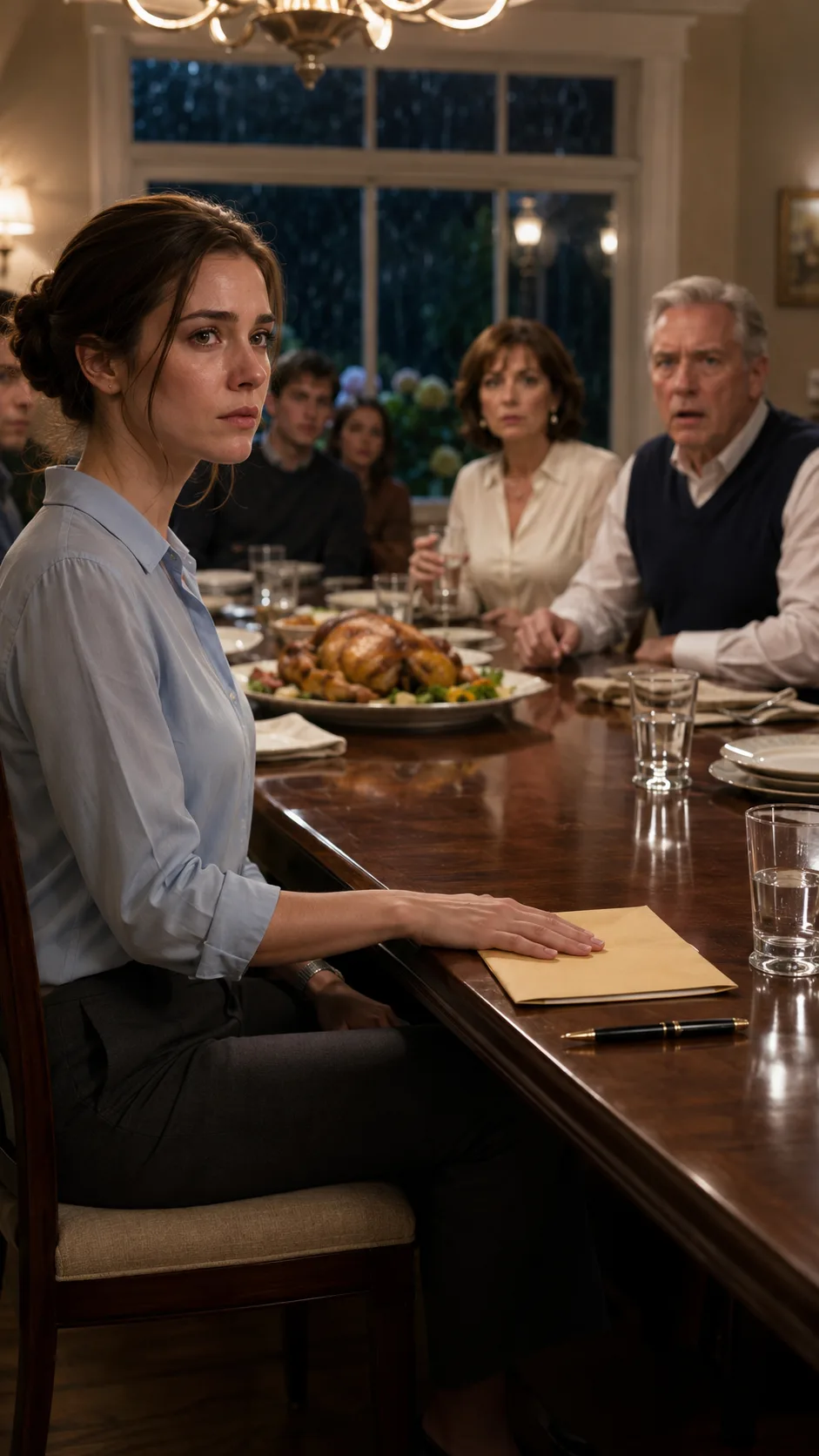
There were eight people seated at the table.
My parents. My older brother, Caleb, and his wife, Maren. My mother’s sister, Aunt Lydia. My father’s business partner, Mr. Kline. Pastor Daniel from their church. And Mrs. Haskins, my mother’s friend who had once told me I was lucky my parents cared enough to guide me.
Eight place settings. Water glasses. Linen napkins folded into stiff triangles. Roast chicken in the center, untouched.
It was not dinner.
It was a hearing.
My father sat at the head of the table with his black fountain pen beside his plate.
Tap. Tap.
He did not notice me noticing.
“Sit,” he said.
There was one empty chair at the foot of the table.
Of course there was.
I sat.
My brother Caleb would not look at me. He had always been better at benefiting from my parents than defending them. There was a difference, though not much of one.
Maren gave me a quick, apologetic glance, then lowered her eyes.
My mother took her seat beside my father.
“We invited a few people who love you,” she said, “because private conversations have not been working.”
I looked around the table.
“Private conversations usually include the person before the audience.”
Aunt Lydia made a small disapproving sound.
My father picked up his pen.
Tap.
“We are concerned,” he said. “Your behavior today was erratic.”
“I went to the dentist and the bank.”
“Without communication.”
“I didn’t ask permission.”
The room shifted.
A tiny movement. Shoulders tightening. Forks pausing. Mrs. Haskins’s eyes sharpening with interest.
My father smiled.
“There it is.”
“What?”
“That defiance. That contempt for family structure.”
Pastor Daniel cleared his throat. He was a kind man in public and a coward in private, which made him very useful to families like mine.
“Nora,” he said, “your parents have described years of financial mentorship. Perhaps gratitude would be a healing place to begin.”
I looked at him.
“What exactly did they describe?”
My mother reached for her water glass.
“That we’ve kept you afloat,” she said. “That we’ve protected you from your impulses. That when you were too emotional to handle adult finances, your father created stability.”
“Too emotional,” I repeated.
Caleb rubbed his forehead.
Dad leaned back.
“You have rent because we taught you discipline. You have a job because we insisted you stay respectable. You have a car because we helped you budget. And today you stormed into a bank like some victim in a television movie.”
My fingers tightened around the envelope in my lap.
Not yet.
“Arthur,” Mr. Kline said mildly, “maybe let her respond.”
“She will,” my father said. “After she understands the severity.”
He slid a document across the table.
It was already printed.
My name at the top.
Financial Recommitment Agreement.
No readable legal letterhead. Just my father’s formatting. Bold headings. Neat margins. Boxes waiting for initials.
I did not touch it.
“What is this?”
“A reset,” my mother said.
“A protection,” my father corrected.
I looked down the page.
It required me to resume automatic transfers. Increase the amount to seventy percent of my net pay. Provide monthly statements. Consult them before purchases over fifty dollars. Agree not to open new accounts without notifying them.
At the bottom, there was a signature line.
My father uncapped his pen.
Tap.
“You’ll sign tonight,” he said, “and we’ll forget today happened.”
The room went quiet in the way rooms do when everyone knows something cruel has been said but nobody wants to be the first decent person.
I heard the kitchen clock ticking behind me.
I heard my mother’s bracelet slide against her wrist.
I heard my own breathing, thin and careful.
“No,” I said.
My father stared at me.
It was not anger yet.
It was disbelief that a chair had spoken.
“No?”
“No.”
My mother laughed softly, almost kindly, for the audience.
“Sweetheart, this is exactly why we’re here.”
“I’m not signing that.”
My father’s face changed by one degree.
“You will not embarrass this family in front of people who care enough to show up.”
“I didn’t invite them.”
“You forced transparency.”
“No,” I said. “You staged pressure.”
Aunt Lydia said, “Nora, don’t be ugly.”
That nearly did it.
Not my father. Not the document. That sentence.
Because ugly was what they called truth when it came from someone they expected to stay pleasant.
For a second, the dining room tilted. The cream walls, the hydrangeas outside the dark window, the polished table reflecting every face except mine. My throat closed so hard I could not swallow.
I pressed my thumb against the edge of the envelope until the paper cut into my skin.
Stay boring.
I breathed through my nose.
My father mistook the silence for surrender.
He slid the pen toward me.
The black lacquer body rolled across the table and stopped beside my water glass.
“There,” he said, voice soft with victory. “Let’s end this little episode.”
My mother smiled at Mrs. Haskins.
Caleb looked at the table.
Maren’s hand moved under the table, and Caleb flinched slightly. She had pinched him. I saw it. I do not think anyone else did.
I picked up the pen.
My father relaxed.
That was when I knew he had never imagined me doing anything else.
I turned the pen once in my fingers.
Then I set it back down.
“I brought my own paperwork.”
The words were quiet.
Not brave. Not dramatic.
Just true.
My mother’s smile froze.
I lifted the manila envelope from my lap and placed it on the polished dining table.
The sound was small.
A dry slap of cheap paper against expensive wood.
It should not have been loud enough to change a room.
It did.
My father looked at the envelope.
Then at me.
“What is that?”
I did not answer immediately.
I opened the flap slowly. It resisted because the glue had failed. The cheap paper bent under my fingers.
I removed the first page and laid it flat.
The closure record.
My father’s hand, the one near the fountain pen, went still.
I said exactly what Priya had told me not to explain past.
“The account was closed.”
Four words.
No accusation. No speech.
The silence that followed did not feel empty.
It felt physical, like someone had lowered a glass wall over the table.
Mrs. Haskins leaned forward, then stopped herself.
Pastor Daniel’s eyes moved from my father to the paper.
Mr. Kline put down his fork, though he had not picked up any food.
My father’s gaze dropped to the date.
Nine years ago.
His jaw moved once.
My mother whispered, “Arthur.”
Not angry.
Afraid.
That was new.
Dad reached for the page.
I placed my palm over it.
“No.”
His eyes lifted to mine.
For the first time that evening, he looked like a man in a room rather than the owner of it.
“You don’t understand what you’re doing,” he said.
“I do.”
“No,” he snapped, the polish cracking. “You are taking family matters and making them filthy.”
I pulled out the second page.
Bank transfer history.
Then the third.
Then the fourth.
I did not scatter them. I lined them neatly, the way my mother had taught me to line cans in a cabinet.
Household support. Family stability. Emergency fund. Parental reimbursement.
Years of labels.
Years of money.
No shared account.
No legal authority.
No stability except theirs.
Mr. Kline picked up one page before my father could stop him.
He was an insurance man, too. He knew documents. He knew what numbers did when people lied around them.
“Arthur,” he said slowly, “is this your personal account?”
My father’s face hardened.
“This is not your concern.”
“You invited me.”
My mother’s hand went to her pearls.
“They were helping her,” she said quickly. “We were helping our daughter.”
“With seventy percent of her income?” Maren said.
Everyone looked at her.
Her face flushed, but she did not look down this time.
Caleb murmured, “Maren.”
“No,” she said, voice thin but steady. “No, I’m asking.”
My father stood.
The chair legs scraped against the floor.
“There will be no cross-examination in my dining room.”
I almost smiled.
His dining room.
His table.
His witnesses.
His pen.
And my money.
I took out Priya’s letter.
“This revokes any permission you claim to manage, direct, monitor, or approve my income or personal accounts,” I said. “The automatic transfer has been canceled.”
My mother made a sound like I had slapped her.
I had not touched her.
Maybe that was the worst part for her.
“You ungrateful girl,” she said, and the room finally saw her without the polish.
There was a small noise from the doorway.
I turned.
Lena, their part-time housekeeper, stood half in the hall holding a stack of dessert plates. She was not family. Not a church elder. Not a business partner. Just a woman paid to clean up after people who forgot she had ears.
Her eyes were fixed on the papers.
Then, very carefully, she set the plates on the sideboard instead of bringing them to the table.
One plate clicked against another.
Soft.
Final.
My father noticed her.
“Lena, leave us.”
She wiped her hands on her apron.
“Yes, Mr. Whitaker.”
But before she went, she looked at me and gave the smallest nod.
I kept that nod.
Even now, I keep it.
Mr. Kline pushed his chair back.
“Arthur,” he said, “I’m going to step outside and make a call.”
“To whom?” my father asked.
“My attorney.”
The word changed the air.
Pastor Daniel stood too, looking pale.
“I think perhaps this should remain a family matter.”
“It was a family matter,” I said. “Until you came to witness me sign away my paycheck.”
He had no answer for that.
My father pointed at me.
“You think paperwork makes you adult?”
“No,” I said. “Paying for my own dentist did.”
It was not the line I had planned.
It was better.
My brother covered his mouth.
Not to hide a laugh. I think to hold something in that had been stuck for years.
My mother stood so fast her chair rocked.
“You will regret this when you need us.”
I looked at her.
I wanted to say I had needed them for years.
I wanted to say I had needed parents, not auditors. I had needed advice that did not come with a password request. I had needed someone to ask if my tooth hurt instead of whether apples were on budget.
But Priya was right.
Worth was not a debate.
“I’m requesting a full accounting,” I said. “You have thirty days.”
My father laughed.
It was too loud.
It landed wrong.
“Or what?”
I slid the final page across the table.
Priya’s business card was clipped to it.
Not dramatic. Not fancy. White card. Blue letters. Legal Aid & Financial Exploitation Unit.
My father read it.
His hand lowered.
Just half an inch.
That was all.
But I saw the defeat arrive there first, in the small drop of his hand before his face learned how to hide it.
My mother looked from the card to him.
“Arthur,” she said again.
This time it sounded like blame.
I gathered my copies back into the envelope, leaving only the revocation letter and accounting request on the table.
The fountain pen lay between us.
I did not take it.
At the door, Caleb caught up with me.
“Nora.”
I turned.
He looked older than he had at dinner. Or maybe I was finally seeing him without my parents’ lighting.
“I didn’t know it was that much,” he said.
I believed him.
That was not the same as forgiveness.
“You didn’t ask,” I said.
He nodded once, like the words had gone somewhere they could not be removed.
Maren stood behind him, arms wrapped around herself.
“She has copies,” she said quietly. “Your mom tried to put one page in her purse.”
I looked at my mother.
Across the dining room, she was very still.
Caught.
For once, not managing the room fast enough.
I walked out before anyone could make me part of another scene.
Outside, the rain had stopped.
The hydrangeas looked almost black in the porch light. My car was parked two houses down because some part of me had still arrived like a child expecting punishment. I walked to it slowly, the envelope under my arm, my repaired tooth strange and smooth when I ran my tongue over it.
Halfway down the block, my phone buzzed.
Mom.
Then Dad.
Then Mom again.
I did not answer.
At my apartment, the receipt was still on the kitchen table beside the cold mug. The edges had curled even more. I picked it up and almost threw it away.
Instead, I flattened it under the sugar jar.
Four dollars and eighty-seven cents.
Eggs. Bread. Apples.
At 11:23 p.m., an email arrived from Priya.
Subject: Next steps.
I opened it.
There were forms attached. More paperwork. More numbers. More proof that freedom was not a door you walked through once, but a hallway full of locks you had to keep turning.
Then another message appeared.
From Caleb.
I’m sorry. I want to talk when you’re ready.
I looked at it for a long time.
I did not reply.
Not because I wanted to punish him.
Because for once, nobody was getting an answer from me just because they asked.
I put my phone face down.
The apartment was quiet except for the refrigerator and, upstairs, the trumpet starting again.
Same wrong note.
Again.
Again.
Then, finally, one clean sound.
Chapter complete
You have reached the end of this chapter.
Continue reading
A few more worlds to get lost in after this chapter.




