The first time I noticed the missing money, the grocery receipt was still warm in my hand.
Chapter 1
The first time I noticed the missing money, the grocery receipt was still warm in my hand.
It was a Tuesday evening in late October, the kind where the sky turned dark before six and the kitchen window reflected my own face back at me like I was someone standing outside, looking in. I had bought eggs, chicken thighs, coffee, dish soap, and a bag of those tiny oranges Daniel liked to eat standing over the sink.
The cashier had smiled when my card declined.
Not a pity smile. Worse. A patient one.
I tried it again.
Declined.
Behind me, a man in a work jacket shifted his basket from one hand to the other. A child asked her mother why the line had stopped. I stood there with my scarf damp from the rain, my fingers still cold around the plastic handle of the cart, and said, “There must be a mistake.”
The cashier lowered her voice. “Do you have another card?”
I did.
Not one
Daniel knew about.
I pulled it from the zippered pocket inside my wallet, the one hidden behind old loyalty cards and a folded receipt from a pharmacy in Pittsburgh. The card was plain gray, almost ugly, with my name printed small in the bottom corner.
Claire Bennett.
Not Mrs. Daniel Bennett. Not Daniel’s wife. Just me.
It went through.
The machine made its cheerful little beep. I hated that sound.
At home, Daniel was in the living room with the television turned too loud, one socked foot resting on the coffee table, his phone tilted away from the doorway. He had that look he got when he was losing and pretending he was not checking anything important. His jaw moved slightly, like he was chewing a thought he did not want to swallow.
“You’re late,” he said without looking up.
“The card declined at Miller’s.”
That got his attention. His
eyes flicked to the grocery bags first, not to me.
“What card?”
“Our joint card.”
He gave a short laugh, dry and irritated. “Claire, you probably entered the wrong PIN.”
“I didn’t.”
“You do that thing where you panic at registers.”
“I don’t panic at registers.”
He leaned back and rubbed his face with both hands. His wedding ring made a soft scrape against the stubble on his cheek. “Okay. Fine. I moved some money.”
“How much?”
“Enough.”
“Daniel.”
He looked at me then, and for half a second I saw the man I married. The one who used to leave coffee beside my laptop before I woke up. The one who cried quietly when his father died and said he didn’t know how to be the oldest son now. Then the other Daniel slid back over his face like a curtain.
“You don’t understand timing,” he said. “I had
an opportunity.”
The oranges rolled across the counter when I dropped the bag too hard.
“What kind of opportunity?”
He muted the television. “Sportsbook promo. Matched deposit. You put in a little, you get a bonus. It’s not complicated.”
My hands smelled like cold rain and paper grocery bags. “You took grocery money.”
“I moved household funds.”
“You emptied the grocery account.”
He stood up. He was still handsome then, in that tired, unfair way men can be when they are ruining your life but sleeping fine at night. Dark blond hair, blue eyes, shoulders still broad from when he cared about running. His shirt was wrinkled at the collar. There was a tiny smear of orange dust on his thumb from the chips he ate when he was anxious.
“Don’t start,” he said. “I’m handling it.”
That was the phrase that lived in our house longer than some of our furniture.
I’m handling it.
He said it when the electric bill went unpaid because he had “forgotten the auto-pay changed.” He said it when his credit card statement came hidden under a catalog in the mail. He said it when I found two casino parking receipts in his coat pocket, both dated on nights he claimed to be working late.
And I wanted to believe him. That was the part I hated saying out loud.
I wanted to believe him because before the gambling, Daniel had been careful with money in a way that made me feel safe. He alphabetized our tax folders. He compared gas prices. He once drove back to a restaurant because the receipt had charged us for two iced teas instead of one. When my mother got sick, he created a spreadsheet for her medication schedule without being asked.
So when the first cracks appeared, I told myself grief had made him reckless. His father had loved horse racing. After the funeral, Daniel started watching races online, then basketball lines, then poker videos with men whispering about discipline while their eyes looked dead.
At first, I covered small gaps.
Then I started documenting them.
Not because I was brave.
Because I was scared.
Five years before that grocery store, I opened the separate account during my lunch break.
It was at a small credit union beside a nail salon and a dentist’s office. The carpet was gray. The air smelled like burnt coffee and printer toner. A woman named Marisol helped me. She had silver-framed glasses and a purple cardigan buttoned wrong at the top.
“Individual account?” she asked.
“Yes.”
“Direct deposit?”
“Just a small percentage.”
She did not ask questions. I think she knew not to.
I started with eighty dollars from each paycheck. Then one hundred and twenty. Then more when I could. I told Daniel my employer had changed insurance costs. He barely listened. By then, he had begun talking about “systems” and “edges” and “recovering the month.”
Every deposit felt like hiding a match in a flood.
I did not spend from that account unless I had to. Vet bill. Emergency tire. My mother’s medication after Medicare delayed coverage. Groceries on nights when the joint card failed. Each time, I wrote it down in a blue notebook I kept inside an old flour tin on the top pantry shelf because Daniel never baked and never looked up.
The blue notebook became my witness.
Dates. Amounts. What he said. What went missing. Which bills I paid from my paycheck. Which debts he promised to fix. Screenshots printed at the library because I did not trust our home printer after he started checking the tray.
I was not planning revenge.
I was planning oxygen.
By the fifth year, our marriage had become a house with good curtains and rotten wiring.
From outside, we looked fine. We hosted Thanksgiving. We brought wine to neighbors. Daniel kissed the side of my head in front of his mother, Helen, and said, “Claire keeps me alive,” in that charming voice people loved. Helen would pat my arm and tell me I was lucky to have a man who worked so hard.
Inside, I learned to sleep lightly when he stayed up past midnight.
I learned the sound of his thumb tapping a phone screen.
I learned the difference between silence after a win and silence after a loss.
Then came the Saturday dinner at his sister’s house.
Rachel lived twenty minutes away in a new subdivision where every home had stone accents and a porch too small for actual sitting. She invited us for her husband’s promotion dinner. There were twelve people there: Daniel’s mother, his brother, two cousins, Rachel’s neighbors from church, and a retired accountant named Mr. Foley who had known Daniel’s father.
I wore a navy sweater dress with small snags near the cuff because I had not bought myself anything new in eight months. Daniel wore a charcoal blazer he had once called “lucky.” I watched him smooth the lapel twice before we walked in.
The first warning was the way he carried himself.
Too bright. Too loud. Too generous with jokes.
People who are hiding shame sometimes act like hosts in rooms that do not belong to them.
Dinner smelled like roast beef and rosemary. Rachel had used cloth napkins and tiny place cards written in gold ink. Mine said Claire. Daniel’s said Dan.
He hated being called Dan.
He drank too much red wine before the salad plates were cleared.
I felt his knee bouncing under the table.
Rachel asked about our kitchen renovation, the one we had postponed three years in a row.
Daniel smiled and lifted his glass. “Ask Claire. She’s the finance minister.”
Everyone laughed.
I kept my fork still.
He continued, “No, seriously. I make the money, she makes it disappear into throw pillows and organic chicken.”
My face warmed. Not from embarrassment exactly. From recognition. He was building toward something.
Helen gave me a soft, disapproving look. “Groceries are expensive, dear, but you do have to plan.”
“I do plan,” I said.
Daniel leaned back. “She plans emotionally.”
Another laugh. Smaller this time.
Rachel’s husband, Mark, looked down at his plate.
I pressed my thumb against the side of my water glass until the condensation broke and slid under my nail.
Then Daniel reached into his blazer pocket and pulled out a folded sheet of paper.
“Actually,” he said, “since we’re all family here, maybe this is a good time.”
My mouth went dry.
“Daniel,” I said quietly.
He ignored me.
He unfolded the paper and set it beside his plate. I saw columns. Numbers. Our names.
“I’ve been dealing with some financial stress,” he said, voice smooth now, controlled. “And I’m tired of being the bad guy when I’m the only one trying to keep us above water.”
The room changed. Forks slowed. Wine glasses paused near mouths.
Helen straightened.
Daniel looked at me with a kind of wounded patience that made me want to stand up and leave before he did whatever he had rehearsed.
“My wife has been keeping a separate account,” he said.
There it was.
Not the gambling. Not the missing mortgage payments. Not the credit cards. Not the loan against his 401(k).
My account.
A small sound came from Rachel’s throat.
Helen’s eyes sharpened. “Claire?”
Daniel lifted one hand like a man asking for fairness. “For five years.”
The room tilted slightly, not enough for anyone else to see.
I had known he might find it one day. I had not expected him to perform the discovery over roast beef and gold place cards.
“How did you get that?” I asked.
He smiled without warmth. “So it’s true.”
“That wasn’t my question.”
He tapped the paper. “You’ve been hiding money while I’ve been carrying this family.”
Something inside me almost broke loose then. Not anger. Laughter maybe. Or a sound that would have embarrassed me forever.
I saw five years in flashes: the declined card, the unpaid electric notice, the dog limping in the rain while Daniel told me the emergency fund was “temporarily tied up,” my mother crying because she thought she was a burden, me counting cash in a parking lot with my hands shaking too hard to separate the bills.
And him, sitting at this table, calling it carrying.
I excused myself before my voice could betray me.
Rachel’s downstairs bathroom had floral wallpaper and a candle that smelled like vanilla frosting. I locked the door, sat on the closed toilet lid, and pressed both palms over my mouth.
For thirty seconds, I let myself shake.
Not loudly. Not beautifully.
My shoulders jerked like I was cold. My breath came out wrong. I stared at a tiny crack in the tile near the sink and thought: I cannot do this at a dinner table. I cannot have my life turned into a joke between the salad and dessert.
Then my phone buzzed.
A text from Marisol.
Not credit union Marisol. Different Marisol. Same name. My attorney.
I had hired her six weeks earlier after Daniel opened a credit card in both our names using an electronic signature I did not recognize.
Her message was short.
All copies ready. If he escalates, do not argue. Ask for witnesses.
I looked at my face in the mirror.
My eyeliner had not moved. That seemed unfair.
I washed my hands, dried them carefully, and walked back to the dining room.
Daniel was still talking.
“She’s not stupid,” he said as I entered. “That’s the thing. She’s not stupid in general. She’s just stupid with money.”
Nobody laughed that time.
Helen said, “Daniel, maybe—”
“No, Mom. I’m done covering for her.”
I sat down.
Rachel looked at me like she wanted to apologize but did not know which betrayal to apologize for first.
Daniel turned the paper toward me. “I printed the deposits. You want to explain?”
I looked at the paper.
It was only partial. Of course it was. He had found transfers, not the reason behind them. He had circled amounts in red pen like a schoolteacher correcting a child.
“What do you want?” I asked.
He looked satisfied, as if I had stepped exactly where he wanted me.
“I want accountability.”
“For what?”
“For hiding marital assets.”
Mr. Foley shifted in his chair.
Daniel heard it and grew bolder.
“And I want us to sign something tonight. A written agreement. Full financial transparency. Every account. Every password. Every card. No more secret money.”
“You brought an agreement?”
He reached into his pocket again and pulled out a second folded document.
Rachel whispered, “Dan.”
He shot her a look. “This affects the whole family. Mom loaned us money last year.”
Helen looked at me sharply.
I had not known that.
Daniel’s mouth tightened. He had not meant to reveal it that way.
“How much?” I asked Helen.
She looked between us. “Ten thousand.”
“For what?”
Daniel said, “The mortgage.”
The mortgage had been paid from my paycheck for eleven months.
I felt something go quiet inside me.
Not calm. Quiet.
There is a difference.
I looked at Daniel’s agreement. “You want me to sign this tonight, in front of everyone.”
“Yes.”
“Why?”
“Because private conversations haven’t worked.”
I almost admired the sentence. It was polished enough to sound reasonable and cruel enough to do damage.
He slid a pen across the table.
It rolled over the white tablecloth and stopped against my bread plate.
A cheap black pen. Hotel logo. I remembered putting it in my purse months earlier after Daniel forgot one at the bank. He must have taken it from the kitchen drawer.
The tiny ordinary theft of it made me tired.
“Sign,” he said.
The room waited.
The humiliation sat there with us, served hot.
I looked at the pen. Then at him. “No.”
His smile thinned. “Then I’ll file tomorrow.”
“Do that.”
His eyes flashed. “And I’ll make sure everyone knows you’ve been stealing from your own marriage.”
That was the sentence he could not take back.
Rachel’s neighbor looked down into her lap. Mark’s jaw tightened. Helen’s face had gone pale but hard.
Daniel stood up.
He liked height when he was losing control.
“You know what?” he said, louder now. “Let’s stop pretending. Claire has always acted like she’s the responsible one. But she’s been sitting on a pile of cash while bills fell behind. While I had to borrow from my mother. While I had to figure out how to keep this family together.”
He picked up the agreement and held it for the table to see.
“I am asking my wife, in front of witnesses, to stop hiding money and behave like a partner.”
The room was so quiet I could hear the dishwasher humming behind Rachel’s kitchen wall.
I reached into my purse.
Slowly.
Daniel watched my hand like he expected me to pull out my secret card and surrender it.
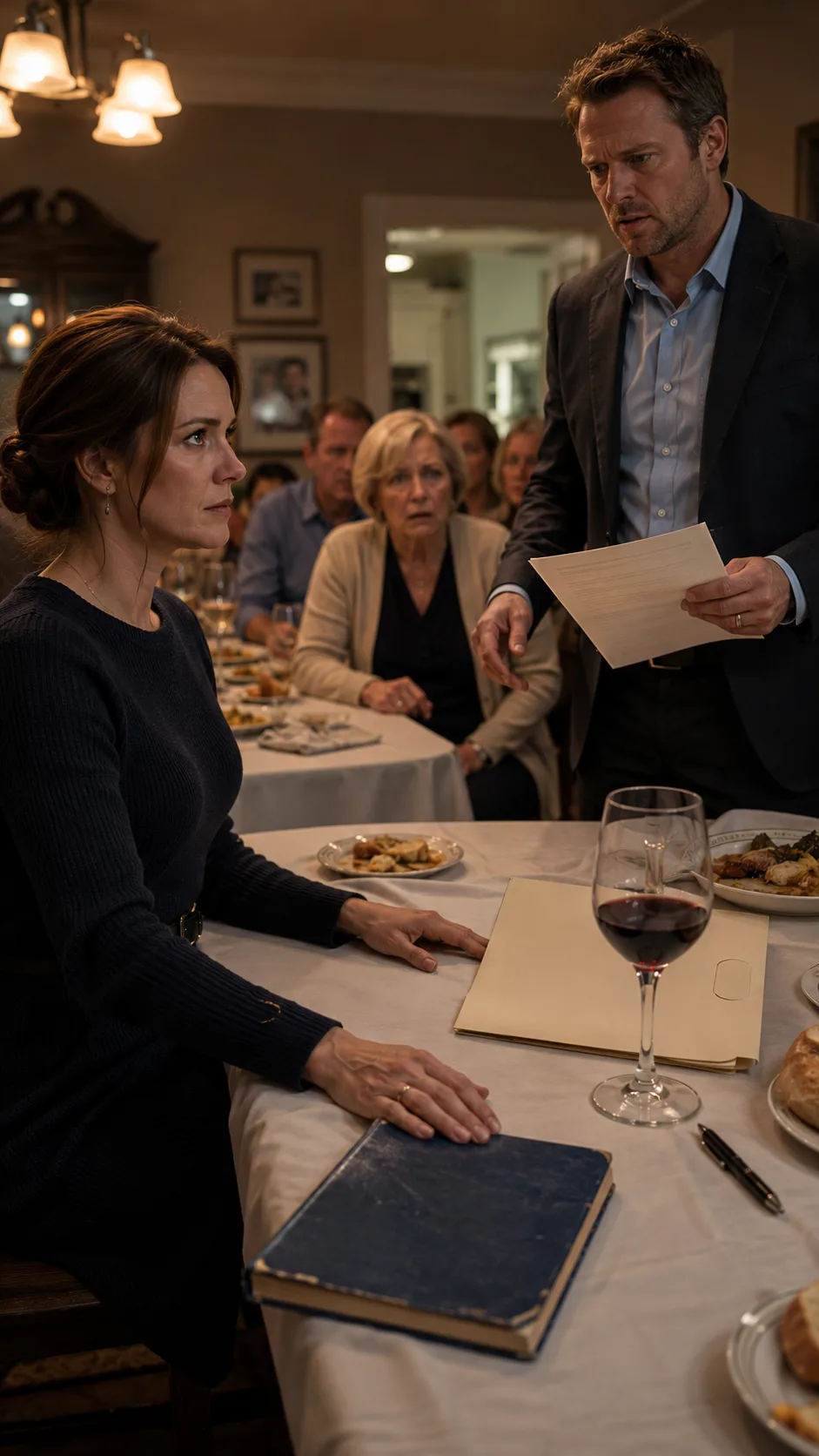
Instead, I took out the blue notebook.
Its cover was soft at the corners. The elastic band had lost its stretch. There was a faint flour mark on the back from the tin where it had lived for years.
I placed it on the table.
The sound was small.
A dull tap against wood under cloth.
No one moved.
Daniel frowned. “What is that?”
I did not answer.
I opened the notebook to the first marked page and turned it toward Mr. Foley.
Then I took out a cream folder from my purse and set it beside the notebook. This sound was sharper, paper against plate, final enough that Helen’s eyes dropped to it.
Daniel gave a short laugh. “You brought props?”
I looked at him.
“Read page three.”
Four words.
That was all I gave him.
The room held still around them.
Daniel’s hand hovered over the folder. He did not touch it at first. Mr. Foley reached instead, with the careful authority of a man who had spent forty years reading numbers people hoped he would ignore.
He opened the folder.
The first page was a summary of joint account withdrawals. The second was a list of gambling transactions flagged from bank statements and credit card records. The third was the signed affidavit from the bank’s fraud department stating that the electronic signature on the new credit card application did not match prior verified signatures and was under investigation.
Mr. Foley’s glasses slid down his nose.
“Daniel,” he said.
That one word changed the room more than any speech could have.
Daniel grabbed the folder.
His face did not collapse. It tightened in pieces.
First his mouth. Then the skin beneath his eyes. Then his shoulders, which lost a small amount of height he could not recover.
“This is private,” he said.
“So was my account,” I replied.
Rachel pushed back from the table. Her chair legs scraped the floor.
Helen whispered, “What credit card?”
Daniel did not look at her.
Mr. Foley turned another page. “There are casino withdrawals here. Online betting deposits. Cash advances.”
“That’s not—” Daniel started.
“Twenty-eight thousand dollars in eighteen months,” Mr. Foley said.
A server could not have entered that room, but Rachel’s teenage daughter, Emma, stood in the hallway holding a stack of dessert plates. She had frozen there, eyes wide, plates trembling slightly in her hands.
Rachel saw her and stood. “Emma, honey, go upstairs.”
Emma did not move at first. Then she lowered the plates carefully onto the sideboard and left without a word.
That small act hurt more than the shouting would have. A child had understood the room was unsafe before the adults admitted it.
Daniel pointed at me. “You planned this.”
“No,” I said. “I prepared for it.”
Mark looked at the agreement Daniel had wanted me to sign. He picked it up, read the first paragraph, and let out a breath through his nose.
“Dan,” he said quietly, “this gives you access to everything of hers.”
“It’s marriage,” Daniel snapped.
“No,” Mark said. “It’s control.”
Helen stood, one hand on the tablecloth. For the first time all night, she looked old.
“You told me Claire overspent,” she said.
“She did,” Daniel said too quickly.
I opened the blue notebook to a page marked with a yellow sticky tab and slid it to Helen.
“Your ten thousand went into his personal account on March fourth,” I said. “The mortgage was paid from mine on March seventh.”
Helen stared at the page.
Her lips parted once, then closed.
Daniel reached for the notebook.
I put my palm flat on it.
Not hard. Just enough.
He stopped.
Nobody at that table missed it.
“You don’t get to touch this,” I said.
His eyes met mine, and I saw him searching for the old Claire. The one who would soften because his voice shook. The one who would protect him from embarrassment even while he fed her to it.
I was still in there.
That was the painful part.
I still knew the exact sound of him laughing in our first apartment when the radiator clanged at night. I still remembered him standing barefoot in the kitchen, teaching me how his father made pancakes with too much vanilla. I still had a voicemail from him saved on an old phone because he had said my name like it mattered.
But loving the memory of someone is not the same as handing them your future.
Daniel lowered his voice. “Claire, don’t do this here.”
I almost smiled.
“Here was your idea.”
Rachel covered her mouth.
Mr. Foley closed the folder and looked at me. “Do you have legal counsel?”
“Yes.”
Daniel’s head snapped toward me.
I took one more paper from my purse. Not dramatic. Not fast.
A clean white envelope.
I placed it beside his wine glass.
This time the sound was barely anything.
But he flinched.
“Temporary separation agreement,” I said. “Filed yesterday. My attorney served your office this afternoon.”
He looked at the envelope as if it had heat.
“You filed?”
“You told me to stop being stupid with money.”
The room breathed around us.
Daniel sat down without meaning to. His knees touched the chair first, then the rest of him followed. The pen he had pushed toward me lay near my plate, useless now.
Helen lowered herself back into her chair.
Rachel began crying silently, which annoyed me for half a second before I understood she was not crying for Daniel. She was crying because some families teach women to recognize pain only after it becomes paperwork.
Daniel opened the envelope with clumsy fingers.
He read the first page. Then the second.
His eyes stopped halfway down.
“What is this account balance?” he asked.
“My separate account.”
His voice dropped. “That’s not possible.”
“It is.”
“How?”
“Five years.”
The phrase moved through the room like a match being struck.
Five years.
Five years of eighty dollars. Five years of skipped haircuts and store-brand cereal and telling coworkers I had brought lunch because I was trying to eat better. Five years of saving gift cards, returning sweaters, taking extra freelance bookkeeping clients after midnight while Daniel slept off losses he called stress.
He looked up at me then. Not angry.
Afraid.
Because the account was not just money.
It was proof I could leave.
“I want half,” he said.
Mr. Foley made a sound then. Not a laugh. Something harder.
My attorney had prepared me for this.
“The funds are traceable,” I said. “My wages. My emergency savings. Used repeatedly to cover joint obligations after your withdrawals. The court can decide what is marital and what was financial dissipation.”
Daniel stared.
He hated words he could not charm his way around.
“Financial dissipation,” Mark repeated quietly.
Helen looked at her son as if someone had turned on a kitchen light and shown her the mess she had been stepping over for years.
Daniel’s voice cracked at the edge. “Mom.”
She did not answer.
That may have been the cruelest thing he experienced that night.
Not my folder. Not the notebook. Not the separation papers.
His mother’s silence.
The dinner ended without dessert.
People stood in strange pieces, one chair at a time. Rachel’s neighbor murmured something about getting home. Mr. Foley gave me his card, though I already had an attorney, and said, “For the records. I’ll confirm what I saw.”
Emma came back downstairs after everyone else had moved toward the foyer. She did not look at Daniel. She picked up the dessert plates from the sideboard and carried them into the kitchen with both hands steady this time.
At the door, Helen touched my sleeve.
“I didn’t know,” she said.
I wanted to give her absolution because women are trained to clean rooms even when we did not make the mess.
Instead, I said, “You didn’t ask me.”
Her hand fell away.
Daniel followed me outside into the cold.
Rain had started again, thin and mean under the porch light. The street smelled like wet leaves and car exhaust. Our car sat at the curb, and for a second I thought of all the times I had sat in the passenger seat counting the seconds between his apologies.
“Claire,” he said.
I kept walking.
“Claire, stop.”
I unlocked the car but did not get in.
He stood on the sidewalk, blazer darkening at the shoulders. He looked smaller without a table and an audience.
“You humiliated me,” he said.
I looked at him across the roof of the car.
The porch light caught the rain between us, each drop visible for a second before it disappeared.
“You called me stupid with money in front of your family.”
“I was angry.”
“You brought papers.”
“You brought a whole damn case file.”
“I brought the truth.”
He rubbed both hands over his face. His ring scraped his skin again. Same sound as the night of the grocery receipt. Same small metal scrape, only now it sounded less like marriage and more like a lock turning.
“I can fix this,” he said.
I believed that he believed it.
That was the tragedy.
He could fix a spreadsheet. A late fee. A lie if it was small enough and caught early. But he could not fix the five years he had turned me into a woman who hid survival money in a separate account and a blue notebook in a flour tin.
“My attorney will contact you,” I said.
His mouth twisted. “So that’s it.”
“No.”
He blinked.
“That’s the first honest thing that’s happened.”
I got into the car.
My hands shook so badly I missed the ignition button the first time.
I sat there while Daniel stood in the rain, and I let the shaking happen where no one could turn it into weakness. The dashboard glowed blue. The grocery receipt from Tuesday was still tucked in the cup holder, soft and curled from moisture.
Eggs. Chicken thighs. Coffee. Dish soap. Tiny oranges.
I picked it up and folded it once, then once again.
Not because I needed it.
Because I had learned to keep receipts.
When I pulled away from the curb, Daniel did not follow.
Two weeks later, I moved into a one-bedroom apartment above a bakery that started work at four every morning. The first night, the mixer woke me before sunrise, heavy and rhythmic through the floorboards. I lay there on an air mattress with no curtains, no sofa, and three boxes labeled KITCHEN even though I only owned two pans.
I should have felt empty.
Mostly I felt awake.
The legal process did not unfold cleanly. Nothing does. Daniel contested everything at first. He accused me of hiding assets. Then his attorney saw the notebook, the statements, the fraud investigation, the printed screenshots, the timeline Marisol had built so carefully she could have framed it.
His position changed after that.
Not into remorse.
Into strategy.
He offered apologies through lawyers. He offered settlement terms that sounded generous until you read the footnotes. He asked for the dog even though he had forgotten her medication twice. He sent one text at 1:13 a.m. that said, I miss who we were.
I did not answer it.
Some nights, I almost did.
That is the part people do not like in revenge stories. They want the clean door slam. They want the woman to walk away without looking back, hair perfect, account full, pain converted neatly into power.
I looked back plenty.
I looked back at the grocery store when the cashier recognized me and said, “Different card today?” too kindly.
I looked back when I found Daniel’s old running shoes in a box and remembered him tying mine before my first 5K because my fingers were numb.
I looked back when Helen mailed me a check for ten thousand dollars with a note that said, I should have asked.
I did not cash it for three days.
Then I did.
The divorce hearing happened in a courthouse with beige walls and vending machines that hummed louder than the people waiting beside them. Daniel wore a navy suit. I wore the same navy sweater dress from Rachel’s dinner, repaired at the cuff with thread that did not quite match.
Marisol sat beside me with a yellow legal pad.
Daniel did not look at me until the judge asked about financial disclosures.
Then his eyes moved to my bag.
He knew.
The blue notebook was inside.
I did not need to take it out that day. The evidence had already done its work.
The judge approved temporary support adjustments, debt responsibility review, and protection of my individual account pending final classification. The fraud investigation remained open. The gambling losses were documented. Daniel’s lawyer spoke carefully. Daniel stayed quiet.
When it ended, Marisol touched my elbow.
“You did well,” she said.
I almost laughed because I had done well by sitting still and not falling apart in public.
Outside, the courthouse steps were wet from morning rain.
Daniel came out behind me.
For a second, neither of us moved.
Then he said, “Do you hate me?”
I looked at him.
He was thinner. His face had that gray look people get when consequences start sleeping in the room with them.
“No,” I said.
He looked almost relieved.
“That would take too much of me.”
His relief disappeared.
I walked down the steps before he could find a way to make even that answer about him.
At the bakery apartment, I made coffee in a chipped mug and opened the separate account on my laptop. The balance stared back at me, ordinary black numbers on a white screen.
Not freedom exactly.
A beginning with rent due on the first.
My phone buzzed.
A new message from Daniel.
Can we talk without lawyers?
I turned the phone face down.
The bakery mixer started beneath my floor, steady as weather.
On the counter beside my laptop sat the folded grocery receipt from Miller’s. I had kept it through the move, tucked into the blue notebook, then set it out that morning without deciding why.
I smoothed it flat with two fingers.
The ink had started to fade.
I opened a new document on my laptop and typed the first line of a budget that belonged only to me.
Rent.
Then I stopped and listened to the mixer below, to the rain against the window, to my own breathing in a room where nothing was missing because someone else had taken it.
My phone buzzed again.
I did not turn it over.
Not yet.
Chapter complete
You have reached the end of this chapter.
Continue reading
A few more worlds to get lost in after this chapter.




