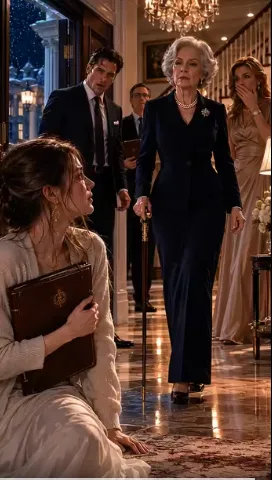
The first thing Mr.
Chapter 2
The first thing Mr.
Henderson did when he stepped inside was set his briefcase
on the narrow console table by the front door. Sarah had found that table at an
estate sale three years ago and refinished it herself — sanded it by hand on the
back porch on a Saturday while James played golf — because he had said a real
decorator would cost too much. The table was the nicest piece of furniture in
the entryway. Nobody had ever commented on it.
Henderson set his briefcase on it without looking down, the way people set things
on surfaces they don't notice.
Sarah noticed.
Behind her, James and Patricia had gone very quiet — the specific quiet of people
reassessing a situation they thought they had already won. Margaret stood near the
hallway arch, her cane still in her right hand, and watched them the way a person
watches a weather pattern they
have been tracking for years.
"Shall we sit?" Henderson asked. Not a question.
—
They sat in the living room Sarah had furnished and maintained and cleaned and
rearranged twice when James said the flow was wrong. Patricia took the armchair.
James stood near the fireplace, one hand on the mantle, like a man who needed
to feel structural support.
Henderson opened the briefcase.
He removed a document about twelve pages thick and placed it on the coffee table.
Same cream-colored paper as the deed. Same notary stamps. The top page carried
the header of a law firm Sarah had never seen, and below it, in clean serif type:
Vance Family Trust — Amendment and Protective Codicil. Executed March 14.
"Six months ago," Henderson said, "Mrs. Margaret Vance executed an amendment
to her family trust. It accomplishes two things." He turned to the first marked
tab. "The first is the
hotel transfer, which Sarah has already seen."
He turned to the second tab.
"The second is a coercion clause."
Patricia's eyes moved to Margaret.
"The clause is simple," Henderson continued. "If at any point, within five years
of the trust's activation, any individual attempts — through legal action, marital
pressure, financial coercion, or verbal threat — to compel the transfer of trust
assets away from the primary beneficiary, the trust becomes irrevocable. Entirely.
Permanently. Without exception."
James said: "That's not—"
"You told your wife," Henderson said, turning one page, "and I'm quoting from
the timestamp on her phone log from forty-seven minutes ago, 'If you don't sign
control over to me and Mom by tomorrow, we're getting divorced. And when I'm
done, you'll have nothing.'"
The room held it.
James's hand tightened on the mantle.
"That statement," Henderson said, "constitutes coercion under the clause's
definition. The trust is now irrevocable.
As of tonight."
Patricia turned to Margaret. "You planned this."
"I prepared for it," Margaret said. "There's a difference."
—
Henderson turned to the third tab.
This part Sarah hadn't seen yet.
"The second document," he said, "is a financial audit of the marital estate.
Commissioned by Mrs. Vance eighteen months ago through a third party." He slid
a copy across the coffee table toward James. "Page four is the relevant section."
James didn't pick it up. So Sarah did.
Page four was a table. Two columns: Payment Source and Amount.
The house down payment: $87,000. Source — Sarah Bennett Vance Trust Account,
disbursement dated March 2020.
Mortgage payments, sixty-one months: $214,000 combined. Source — same account.
Sarah had been told this was James's income. He had shown her pay stubs. She
had believed him because she had no reason not to.
Then the third line.
*Miller & Co. Consulting — Seed Capital and Operating Expenses, 2020–2024:
$340,000. Source — Vance Trust.*
James had come home in October of 2020 and told her a friend from business
school had believed in him enough to invest. He had been proud of it. He had
taken her to dinner. He had ordered champagne.
She put the paper down very carefully.
"Your firm," she said.
James looked at the document instead of her.
"The friend," she said. "From business school."
Silence.
Margaret said: "As the trust's primary beneficiary and the source of seventy
percent of Miller and Company's capitalization, Sarah holds majority stakeholder
rights to the firm's assets. Mr. Henderson has the paperwork."
Patricia stood up.
"This is fabricated," she said, her voice tight and high. "This is a setup.
You've been planning this since—"
"Three years ago," Margaret said. "I offered James two million dollars to walk
away from this marriage cleanly. We were having coffee after golf, at the Union
League Club. He laughed." She paused. "He thought I was joking."
Patricia turned to James.
James said nothing.
It was the nothing that confirmed it. He hadn't told his mother. Whatever she
had believed about this marriage — that it was real, that Sarah was simply lucky,
that her son had chosen well — was recalibrating behind her eyes in real time.
Sarah watched her mother-in-law's face do something she had never seen it do
before. Not regret. Not quite. But the particular look of a woman who has been
defending a story she did not have the full text of.
—
James turned to her then. The anger was still in his posture but something else
had moved under it. Something older and less organized.
"Sarah." His voice dropped. "Seven years. You're going to let them end seven
years because of a document? We can negotiate. We can structure something fair—"
"You said I try," Sarah said.
He blinked.
"At dinner. Tonight." She kept her voice even. "The waiter was two feet away.
Your mother was right there. And you looked up from your phone and said I try."
"I didn't mean—"
"I know you didn't mean it to matter," she said. "That's the whole point."
James opened his mouth. Closed it.
The two security guards Margaret had brought stepped forward without being asked.
James looked at them. Then at Henderson. Then at the document still open on the
coffee table.
He had built his professional identity on her money and he had not known that
she knew.
He picked up his jacket from the back of the sofa. Patricia was already moving
toward the door — the fast, clipped walk of a woman retreating with what dignity
she can carry. At the threshold, James stopped.
He didn't look at Margaret. He looked at Sarah.
"I did love you," he said. "At some point. Before all of this."
She didn't say anything. It might have been true. She didn't know what to do
with something that might have been true once and wasn't anymore.
The door closed.
—
She sat down on the floor of her own hallway.
Not dramatically. Her legs just made the decision and she went with it. The
portfolio was in her lap, leather warm from being held. The house was silent in
a way it had never been — not the quiet of someone being careful not to make
noise, but the quiet of a space finally empty of performance.
Henderson offered to stay. She shook her head. He left his card on the console
table, beside the lamp, and let himself out.
Margaret sat down on the hall bench — the one Sarah had reupholstered in navy
velvet the previous spring — and said nothing. She didn't ask if Sarah was
alright. She just stayed.
After a while, the clock in the kitchen marked the half hour.
Margaret said: "Do you want to see it?"
Sarah looked up.
"The hotel," Margaret said. "Tonight, if you want."
—
The night doorman wore a navy uniform with brass buttons and held the door
open the way people do when they have been doing something with care for years.
He looked at Sarah and said: "Ms. Miller?"
She stopped on the threshold. Behind her, the Chicago night was cold and bright
and enormous.
"Ms. Vance," she said. "Just for tonight."
Chapter complete
You have reached the end of this chapter.
Continue reading
A few more worlds to get lost in after this chapter.




