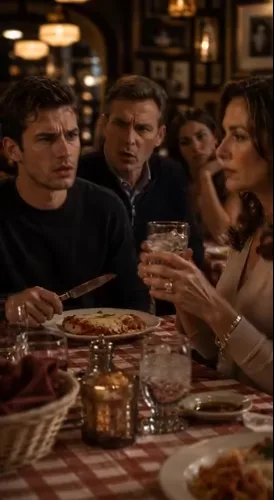
Patricia Vang arrived at 9:45 and arranged herself at my grandmother's dining table with the efficiency of someone who had been in this exact room — different houses, same furniture arrangement — many times before.
Chapter 3
Patricia Vang arrived at 9:45 and arranged herself at my grandmother's dining table with the efficiency of someone who had been in this exact room — different houses, same furniture arrangement — many times before.
Yellow legal pad. A pen she kept clicking without noticing. A leather folder with printed documents inside. She shook my hand and said, "Your father speaks highly of you," in a way that was factual rather than warm.
Dad sat at the head. Mom and Kennedy across from me. My grandmother at the far end with her coffee, which she'd been working on since before I arrived. She'd worn her good cardigan, the navy one she kept for church and difficult occasions.
My folder was already in front of me. I'd placed it there when I helped set the table.
Patricia opened with numbers. She didn't editorialize — just account names, original balances, withdrawal dates, current totals. Her voice had the particular flatness of a professional who had learned not to react to family ugliness because reacting prolonged the appointment.
Mom interrupted twice. Both times Patricia let her finish, nodded
once, and continued from where she'd stopped.
"The secondary savings account," Patricia said, "was opened in 2019 with an original balance of forty-two thousand, three hundred dollars. Over nineteen months, thirty-three thousand dollars were withdrawn. Current balance: nine thousand, three hundred."
Kennedy said: "That can't be right."
Patricia turned her legal pad so the numbers faced the table.
Kennedy went quiet.
"The account," Patricia continued, "was designated for both children equally, per the verbal agreement your husband established at account opening, which is documented in correspondence with the branch manager." She tapped the folder. "Not exclusively for one."
Mom said: "We were supporting family in a time of crisis. Any parent would make the same—"
"Mom." My father's voice was very low. "Let her finish."
—
I opened my folder.
Not a dramatic gesture. The way you open something you've reviewed six times and already know. I set the bank
statements on the table first. Then the spreadsheet — printed in a clean twelve-point font because I knew it would be passed around. Then I put my phone down, face-up, open to Kennedy's Instagram, scrolled to October 17.
I slid it across the table until it sat alongside the spreadsheet.
Kennedy looked at it.
The photo: her own face. The red rocks of Sedona behind her. A clay cup in both hands. The caption in her own words. And next to it, in yellow highlight on the spreadsheet: October 14. Withdrawal. $2,400.
I didn't say anything.
Patricia didn't say anything.
My grandmother set her coffee cup down. A small ceramic sound.
The room held it.
Kennedy said: "Those were personal photos. You can't just pull those and use them like—"
"They're public," I said. Not angry. A correction. The way you correct a math error.
"Hunter." Mom's voice. The tone
she used when she wanted me to understand that I was making something worse by being accurate.
Kennedy looked at the phone again. Then at the spreadsheet. Then at me.
"I was going through the worst year of my life," she said.
"I know," I said. "I saw the posts."
Something crossed her face. Not the argument she'd been ready to make — something quieter than that. She was looking at her own image on my phone, herself smiling in the sun above a canyon, and I don't know what it felt like to see it from the outside. I didn't know if she'd ever looked at it that way before.
She looked away first.
—
Mom started then.
A version of a story I'd heard constructed differently for twenty-six years but built from the same materials: Kennedy's anxiety, the brutal breakup, the judgment calls a parent makes based on need rather than fairness. The part where surely a son who had always managed so well could understand that sometimes one child simply requires more.
I'd heard it so many times it had stopped sounding like an explanation. It sounded like infrastructure. Like the load-bearing argument that held up the whole structure of how our family had been arranged.
My father said: "You reallocated his inheritance."
My mother's word. From the restaurant, two weeks ago. He'd remembered it exactly.
She heard it too. I saw her face register it — the word returning in his voice instead of hers, stripped of the administrative neutrality she'd given it.
"Raymond—"
"He worked every day since he was twenty years old," Dad said. The volume never rose. "He never asked us for one thing. And you took his grandfather's money and spent it on hotel rooms."
Kennedy said: "Dad, that's not fair—"
"Kennedy."
She closed her mouth.
Patricia outlined the options with the tone of someone closing a meeting: a personal repayment agreement, structured and signed, with a schedule of installments. Or a civil process, which was formal, and slower, and would become a matter of record.
Mom started asking about flexibility in the terms. Kennedy was looking at the table.
"I'll take the agreement," I said.
Everyone turned.
"Two years is fine." I looked at Mom. "I don't need it all at once. I just need it written down."
—
I excused myself during the discussion of terms.
The kitchen was small and warm, still carrying the smell of the morning's eggs. I ran the tap cold and filled a glass and stood at the window. My grandmother's garden was directly below — a stubborn rosebush along the back fence that had been there since I was nine. She fought it every spring. It always came back thicker.
I stood there long enough to drink the water and then stayed a little longer.
I was twenty-two when I called my mother from my first apartment in the new city, the night after I started the job, and she'd said: I knew you'd be fine. At the time I'd been so proud she said it. Took it as confidence in me. Carried it for years.
Some sentences take a long time to hear correctly.
The voices from the dining room were lower now. The heat had settled into logistics. I let it.
I put the glass down and went back.
—
Patricia had them both sign before noon.
Kennedy's signature was smaller than I expected. Careful, almost.
After Patricia left, my grandmother walked everyone to the door. She held my mother's hand for a long moment at the threshold — not warmth exactly, but something older than judgment. She just held it.
My mother didn't say anything to me before she left. Neither did Kennedy. The door closed and the house was very quiet.
My grandmother went back to the dining table and collected the coffee cups without asking. I followed her to the kitchen. She washed them by hand, even though the dishwasher was right there, the same way she'd always done it. I found a dish towel and dried.
We didn't talk. The water ran and stopped. The cups went into the cabinet.
At some point she said, still looking at the shelf:
"Your grandfather would've liked you."
Not you did the right thing. Not I'm sorry for what your mother did.
Just that.
I put the last cup away in the spot where it always lived and didn't say anything.
—
I drove home in the early afternoon.
Made eggs again. My kitchen was quiet the way rooms get after too much has happened in them for too long. I ate at the counter without turning on the TV because I didn't want the noise.
My phone had notifications I didn't open until the plate was in the drying rack. Kennedy, twice. Mom once. The family group chat — Family ❤️, named seven years ago when Dad got his first smartphone, added me with the enthusiasm of a man discovering group texts — showed six new messages. I read the preview of the first one and put the phone down.
Dad texted at 6:12pm. Call me when you're ready. No rush.
I set the phone face-down on the counter.
Not tonight.
The dish towel was still in my hand. I folded it over the oven handle, the way my grandmother did it, and stood there looking at the window above the sink. The evening light was flat and noncommittal. The kind that doesn't decide anything.
I thought about the restaurant. The red-checkered tablecloth and the warm neon light. The smell of garlic bread when the waiter passed. My mother's fork, suspended in the yellow light above the marinara, and that fraction of a second I'd felt something close over like a door.
She had known then.
She had known for nineteen months before then.
Patricia's repayment agreement was still in my folder on the counter. First installment due in thirty days. Two-year schedule, signed and witnessed.
I opened the folder and read the first line. Then I closed it.
I'd call Patricia on Monday about next steps. There were questions I still hadn't asked.
Tonight I folded the dish towel again, even though it was already straight, and went to bed.
Chapter complete
You have reached the end of this chapter.
Continue reading
A few more worlds to get lost in after this chapter.




