I did not call David Kessler that night.
Chapter 3
I did not call David Kessler that night.
I sat with his number in my hand for a long time, then I made chamomile tea I didn't want and I walked out to the dock in my bare feet and I stood there in the dark listening to the water.
My grandmother had bought me my first savings account.
Not with money. With a blank register, a pink pen, and an afternoon at her kitchen table when I was nine years old. She had written the columns herself, neat and precise: Date. In. Out. Balance. She had explained each one. Then she had slid a ten-dollar bill across the table and said, Your first deposit. Now you are a person who keeps track.
I had kept track ever since.
I had receipts for every dollar I had ever earned. I had folders organized by year going back to my first freelance invoice. I had photographs of every check
before I deposited it, a habit my first accountant called excessive and my second accountant called exactly right.
I was the person my grandmother had made me into.
And now her other grandchild was standing in a lawyer's office calling it theft.
I went inside and I opened the document folder I kept in the fireproof box under my bed and I spread everything across the dining room table. Business formation documents. Five years of tax returns. Bank statements, page by page. The purchase offer. The inspection report. The closing documents. The wire transfer confirmation. The keys, still on the paper tag from the title company, which said only: Mandy — welcome home.
I looked at it all for a while.
Then I photographed every page, uploaded it to a secure folder, and sent the link to David Kessler with a message that said only: Ashley and Brent Harlow are
claiming I used the inheritance to purchase my home. I wanted you to have the documentation before you heard from anyone else. I hope you're well.
He replied at eleven-forty-seven PM, which surprised me because I had not expected him to read it until morning.
I'm sorry you're dealing with this. I'll pull the estate records tomorrow. Don't speak to them again without counsel. And Mandy — I knew your grandmother for forty years. She would not be surprised, and she would not be pleased.
I read it twice.
Then I folded my arms on the table and put my head down on them, just for a moment, the way I used to do at my desk in the bad years when exhaustion was a room I lived in — and I let myself feel the full unfair weight of it. The intrusion into the home I had earned. The
mother who called it complicated. The father who named his reason, and in naming it, had maybe, slightly, told me the truth.
Because your sister cried.
Ashley had always known how to cry at the right moment.
I had always been better at not crying at all.
It occurred to me, in the dark of my dining room with the lake outside and the documents spread across the table, that our whole lives we had been rewarded for opposite things. She had been rewarded for falling apart beautifully. I had been rewarded for not falling apart at all. And somewhere along the way the family had drawn a map of us based on those rewards, and had stopped checking whether the map still matched the territory.
I was not a thief.
I was just the one who didn't cry.
Three weeks later, Brent's lawyer sent a formal letter.
I sent back forty-seven pages.
David called me afterward, and I could hear in his voice the particular satisfaction of an old man who has seen this shape of story before and knows exactly where it ends.
"Their attorney was thorough," he said. "In the sense that he asked good questions. Unfortunately for them, you had good answers."
"What happens now?"
"They can pursue it. They won't. The filing fees alone would cost them more than their theoretical claim, and Brent Harlow is not a man who spends money to lose publicly."
I sat at my kitchen table with my coffee.
Outside, the lake was bright this morning, sharp with autumn light.
"And my parents?"
A pause.
David Kessler had been handling family estates for forty-three years. I imagined there was very little he had not seen spill out of a will reading.
"That," he said, "is a different conversation. Not a legal one."
"I know."
"Give it time."
"Does time fix it?"
He was quiet for a beat. "Sometimes. Depends on whether the people involved are more committed to the story or the truth."
I thought about my mother and the word complicated. My father and the word cried.
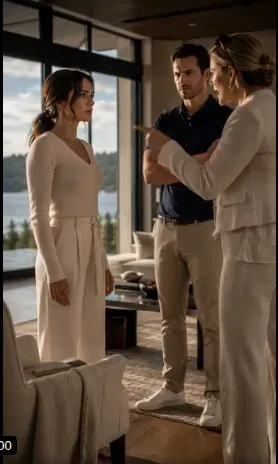
I thought about Ashley in my living room, heels on my floor, pointing at my ceiling.
I thought about my grandmother at her kitchen table, sliding a ten-dollar bill toward a nine-year-old girl, teaching her to keep track.
"I'll let you know," I said.
Ashley called on a Sunday in November.
I was on the dock with coffee and a book and the last of the warm weather, which had been lasting longer than it should and which I was choosing not to question.
I let it ring.
She called again.
I let it ring again.
The third time, I answered, because the third time always means something different from the first two.
She didn't speak immediately.
I waited.
Outside, a heron stood motionless at the edge of the water thirty feet down the dock, watching the surface with the patience of something that has learned exactly how still it needs to be.
"I looked at the documents," Ashley said. Her voice was flat. Not apologetic. Not soft. Just stripped of the performance.
"Okay."
"David sent them to Mom and Dad."
"I know."
Another silence.
"The numbers don't — they don't add up the way I thought they did."
I watched the heron.
I had a choice here. I had been offered a small door. Behind it was the version of this conversation where I was gracious and she was contrite and we found our way back to something that looked like sisters, and perhaps we held that shape for a while, long enough for the holidays, long enough for the parents.
I knew how to walk through that door.
I had walked through it before.
Every time one of her hurricanes had passed through something I had built, I had cleaned up quietly and held the door open and smiled at the ceiling until the warmth came back into the room.
"Ashley," I said.
"Yeah."
"What did you think was going to happen when you walked into my home and said that to me?"
Silence.
Not the loaded silence of before. Something smaller.
"I don't know," she said.
And the thing was — I believed her.
That was the worst part. Not the malice. The absence of it. The way she had walked into my living room with her designer sunglasses and her borrowed certainty and her husband's hand at her back, and she had simply not thought about me at all.
I had been a problem to solve.
A story that made things make sense.
People like you, she had said. Like you was a category. Like you was a distance she had installed between us so long ago that she had forgotten she'd built it.
"I think," I said slowly, "that we need some time before we have the rest of this conversation."
"Mandy—"
"I'm not hanging up angry. I'm not cutting you off. I'm saying I need some time." I shifted the phone to my other ear. "And I need you to understand something. This house is mine. It was always mine. And the next time you feel certain about something that serious — about me specifically — I need you to ask me first."
She was quiet.
"Can you do that?"
A long pause.
"I don't know," she said again.
It was the most honest thing she had said to me in years.
The heron lifted from the dock without warning, sudden and enormous and grey, and crossed the length of the lake in a low, silent arc before disappearing into the tree line on the far shore.
I watched it go.
"That's a start," I said.
Chapter complete
You have reached the end of this chapter.
Continue reading
A few more worlds to get lost in after this chapter.




