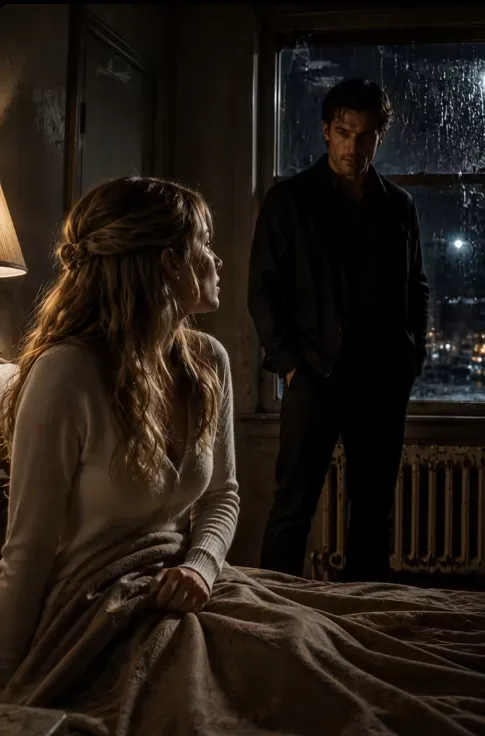
“Married to whom?” I had asked.
Chapter 2
“Married to whom?” I had asked.
My father did not answer right away.
He walked deeper into the room, his shoes silent on the thick carpet, and closed the book in my lap with two fingers.
Not roughly.
That would have been too honest.
Cyrus Whitcomb never needed to be rough when ownership would do.
“A man who is willing to take you,” he said.
There were sentences a daughter remembered forever.
Not because they were shouted.
Because they were spoken calmly enough to become law.
I kept my hand on the closed book.
“Willing?”
His breath moved through his nose, impatient.
“Nora, do not perform innocence with me.”
I turned my face toward his voice.
“I do not know what that means.”
“It means you are twenty-six years old, blind, unmarried, and still living in my house.”
My house.
Not our house.
Never home.
I had grown up inside the Whitcomb mansion like an expensive
inconvenience. Nurses came and went. Tutors arrived. Stylists dressed me for photographs. My father allowed me at charity galas when he needed donors to see his “devotion” to disability causes, then sent me back upstairs before dinner turned serious.
To the public, I was his brave daughter.
In private, I was a problem with soft hands and no exit.
“You told people I was focusing on philanthropic work,” I said.
“I told people what they needed to hear.”
“And what do I need to hear?”
His voice hardened.
“That I am tired of pretending you have a future here.”
The room had gone very still.
Even now, seven nights later, sitting in that motel room with Ethan Vale across from me in the dark, I could feel the old sentence press against my chest.
I had not cried when my father said it.
That seemed to annoy him most.
“Tomorrow
morning,” he continued, “you will marry him. The agreement is arranged. After that, you will no longer be my responsibility.”
“Does Mother know?”
A pause.
Too small for most people.
Large enough for me.
“Your mother knows what is necessary.”
That meant no.
Or worse.
It meant my mother had chosen not to ask.
Ethan’s voice brought me back to the motel.
“He told you I was willing to take you?”
I did not know why the shame came then.
Not when my father said it.
Not at the courthouse.
Not in the car.
But there, in front of the man who had heard the price of my life spoken like a business term.
“Yes.”
Ethan was quiet.
The rain scratched at the window.
Then he said, “I’m sorry.”
I almost laughed.
“People say that when they do not know what else to say.”
“I know exactly what to say.
Most of it would frighten you.”
That stopped me.
Not because of the threat.
Because he did not pretend there was no threat inside him.
I pulled the blanket higher.
“Why tell me now?”
“Because tomorrow your father will announce your disappearance as voluntary.”
My heart missed once.
“What?”
“The story is already drafted. He will claim you rejected your family, married a con artist, emptied several accounts, and ran away out of emotional instability.”
The words did not make sense at first.
Then they made too much sense.
My father had always believed truth was whatever reached the press release first.
“No,” I whispered.
“Yes.”
“I have no access to his accounts.”
“You won’t need to. He created documents.”
My mouth went dry.
“He forged my signature?”
“Several times.”
I closed my eyes, though darkness was not something I could close out.
My father had sold me, abandoned me, and now planned to turn me into the thief.
Not because he needed the money.
Because he needed the story.
A blind daughter was useful when she made him look generous.
A discarded daughter needed to become ungrateful.
“Tomorrow,” Ethan said, “you’re going to hear the original deal.”
“The confession?”
“Yes.”
“What did he confess to?”
Ethan did not answer quickly.
In the silence, I heard him shift.
Not closer.
Just enough that the old mattress creaked under his weight.
“My father’s death. The Vale collapse. Your mother’s inheritance. And the trust your father kept hidden from you.”
The last part struck hardest.
“My trust?”
“Yes.”
“I don’t have a trust.”
“You do.”
“No.” My voice sharpened. “I would know.”
“Would you?”
The question cut through the room.
Not cruelly.
Worse.
Accurately.
I wanted to say yes.
I wanted to say I knew my own life. My own finances. My own name.
But I had never read my own bank statements without someone else choosing which pages became Braille. I had never signed documents without my father’s attorney guiding my hand. I had never been allowed private meetings with accountants, estate managers, board members, doctors, or anyone who might speak to me as if I were a person instead of a liability.
I had lived in luxury.
But luxury was not freedom.
Sometimes it was only a velvet-lined cage.
Ethan’s voice softened again.
“Nora, your grandmother left you a trust when you were six. It matured when you turned twenty-five.”
My hands went numb.
“My grandmother died when I was eight.”
“I know.”
“She left everything to my father.”
“No. That is what he told you.”
I pressed one hand against my chest.
The motel room felt too small. The air too warm. The rain too loud.
“How much?”
Ethan exhaled.
“Enough that Cyrus needed legal control over you to keep moving it.”
The meaning unfolded slowly.
Marriage.
Guardianship conversations.
Doctors.
My father’s sudden interest in declaring me “incapable of independent financial judgment” last year after I refused to sign a foundation transfer.
I had thought he was angry.
He had been preparing.
“Why marry me to you?” I asked.
“Because he thought I was nobody.”
“But you paid him.”
“Yes.”
“Then why would he think that?”
“Because I made sure he did.”
For the first time, I heard the shape of Ethan Vale clearly.
Not the beggar.
Not the husband.
Not the victim.
The strategist.
“You tricked him.”
“He tricked himself. I only wore the costume he wanted to believe.”
Something in my chest tightened.
“He thought no one would value me.”
Ethan said nothing.
He did not need to.
That had been the foundation of the whole transaction.
No one wants a blind heiress.
My father had said it once, years ago, to a senator at a fundraiser after too much bourbon, believing I was too far across the room to hear.
No one wants a blind heiress, but donors adore a tragedy.
I had been eighteen.
That night, I learned that some fathers did not need to hate their daughters to destroy them.
They only needed to find them useful.
“Do you have the recording here?” I asked.
“Yes.”
“Play it.”
“No.”
My head lifted sharply.
“Why not?”
“Because once you hear it, you cannot unhear it.”
“I already cannot unlive him.”
Silence.
Then footsteps crossed the motel room.
A drawer opened.
Metal clicked.
A chair scraped closer, but still stopped far enough away that I did not feel trapped.
Ethan placed something on the small table between the beds.
A device.
I heard the soft tap of his finger against a screen.
Then my father’s voice filled the room.
Not the polished voice from interviews.
Not the warm voice from charity galas.
His real voice.
Impatient.
Amused.
Alive with contempt.
“How much are you offering for the girl?”
My stomach turned.
A second voice answered.
Rougher than Ethan’s true voice. The performance voice he had used in front of Cyrus.
“Five million.”
My father laughed.
“For Nora?”
A rustle of paper.
“Cash transfer upon signature.”
My father’s chair creaked.
“She is blind, stubborn, and more expensive than she is worth.”
The recording crackled faintly.
Ethan’s false voice said, “Then sell me the problem.”
My father hummed.
Sell me the problem.
I gripped the blanket until my fingers hurt.
Then came the sentence that changed the room forever.
“All right,” Cyrus Whitcomb said. “But you take her name, her needs, her moods, her blindness, and whatever remains of her mother’s bloodline. I want nothing left attached to me.”
I stopped breathing.
My mother’s bloodline.
Ethan paused the recording.
“No,” I said immediately. “Keep going.”
“Nora—”
“Keep going.”
He did.
My father spoke again.
“There is one complication. Her grandmother’s trust is still technically hers, but I control its administration through medical incapacity recommendations. Once she is married and out of state, I can argue abandonment if necessary. My attorneys will handle it.”
Ethan’s false voice asked, “And if she contests?”
Cyrus laughed.
“My daughter cannot even cross a lobby without someone guiding her. Who would believe she understood a trust structure?”
Something inside me went very still.
Not broken.
Not frozen.
Still.
Like a blade laid carefully on a table.
Ethan stopped the recording.
This time, I did not tell him to continue.
I sat in the dark motel room listening to my own breathing, to the rain, to the low buzz of the highway beyond the walls.
My father had sold me because he thought blindness meant ignorance.
He had mistaken dependence for stupidity.
And everyone around him had let him.
Finally, I said, “Who else has heard this?”
“No one.”
“Why?”
“Because it belongs to you.”
I turned toward his voice.
That answer mattered.
More than I wanted it to.
Ethan Vale had paid five million dollars, built a disguise, trapped my father in his own arrogance, and still waited to play the recording until I could decide what it meant.
“Why would you give me the choice?” I asked.
“Because Cyrus took too many from both of us.”
My throat tightened.
“You hate him.”
“Yes.”
“You want revenge.”
“Yes.”
“Through me.”
“No.”
The answer came fast.
Too fast to be performance.
“No,” Ethan said again, quieter. “With you, if you choose. Never through you.”
I did not know what to do with that.
Kindness that did not demand obedience felt suspicious when you had been raised by people who considered care an investment.
I lowered my hand to the edge of the mattress.
“Is there more?”
“Yes.”
“How much more?”
“Enough.”
That word sat between us.
Enough to destroy Cyrus Whitcomb.
Enough to expose the Vale scandal.
Enough to return my trust.
Enough to make every person who had smiled beside my father at charity galas pretend they had never truly known him.
For the first time in my life, I imagined my father afraid of my voice.
Not my silence.
My voice.
“What happens tomorrow?” I asked.
“A lawyer comes.”
“For you?”
“For you.”
I swallowed.
“I don’t have money.”
“You do.”
“My trust.”
“Yes.”
“He controls it.”
“Not after tomorrow.”
“How?”
Ethan shifted again.
This time, I heard paper slide across the table.
“I found your grandmother’s original attorney. She was forced out of Whitcomb holdings nine years ago. She kept copies of everything.”
My pulse quickened.
“Why would she help me?”
“Because she has been waiting for you to ask.”
The words hurt.
All the people I never knew were waiting.
All the doors I never opened because my father told me walls were doors.
“All right,” I whispered.
Ethan went still.
“All right what?”
“I want to hear everything. I want the lawyer. I want the trust. I want my father’s voice in a room where he cannot tell everyone what it means before I do.”
For several seconds, Ethan said nothing.
Then, very softly, he said, “Good.”
I lay back against the pillow.
My shoulder ached where I had struck the headboard. The motel smelled awful. The rain was getting louder. My husband was a stranger who had bought my freedom with money and revenge.
And yet, for the first time in twenty-six years, I felt the outline of a door.
The next morning, Cyrus Whitcomb appeared on national business television at 8:05 a.m.
I heard his voice from the motel television while Ethan made coffee in the corner.
A host asked about rumors of his daughter’s sudden marriage.
My father gave a mournful sigh.
“Nora has always been fragile,” he said, voice heavy with practiced sorrow. “We are devastated by her recent choices, but we hope she finds her way back to the family when she is ready to receive help.”
Help.
I smiled.
Ethan turned toward me.
“What?”
“Nothing,” I said.
Then I picked up the burner phone Ethan had placed in my hand and dialed the number of my grandmother’s attorney.
When a woman answered, I said my name clearly.
“This is Nora Whitcomb Vale,” I said. “I’m ready to receive my inheritance.”
Across the room, Ethan went completely still.
On the television, my father was still speaking.
By noon, he would stop.
Chapter complete
You have reached the end of this chapter.
Continue reading
A few more worlds to get lost in after this chapter.




