Maya did not answer the invitation that night.
Chapter 2
Maya did not answer the invitation that night.
She let it sit on the edge of her worktable beneath the yellow glow of a desk lamp while rain blurred Brooklyn into silver streaks beyond the windows.
Rosa kept looking at it.
Not directly. Rosa had too much dignity for that. But every few minutes her eyes drifted toward the cream card, the gold lettering, the Whitmore seal pressed into the thick paper like an old-money thumbprint.
Finally, she said, “You are not going.”
Maya threaded a needle.
“I didn’t say that.”
Rosa stopped moving.
“Maya.”
There were many ways a person could say your name.
Rosa said hers like a warning and a prayer at the same time.
Maya looked up.
Across the studio, three mannequins stood beneath muslin covers. Half-finished gowns waited on dress forms. Rolls of silk, tulle, velvet, and organza leaned against the wall like sleeping ghosts. The studio was small, overworked, underfunded, and full
of dreams that still smelled faintly of coffee and steam.
It was hers.
Not Preston’s.
Not Evelyn Hale’s.
Not anyone’s gift.
Hers.
“I know what she wants,” Maya said.
Rosa folded her arms. “Then why give it to her?”
Maya looked at the invitation again.
Because some rooms only remembered you one way unless you entered them again and changed the memory yourself.
Because she had spent three years letting Preston’s world decide the shape of her humiliation.
Because Sloane Whitmore had not invited Maya to a party.
She had invited a ghost.
And Maya was tired of haunting places that once hurt her.
“She thinks I’m broke,” Maya said.
“You are broke.”
Maya smiled faintly.
“Temporarily.”
Rosa sighed. “That is not the comforting distinction you think it is.”
Maya laughed then.
A real laugh.
Small, tired, but alive.
Her business was not failing, exactly. Failing was dramatic. Failing suggested
movement.
Maya Ellis Atelier was surviving in the exhausting way women survived when they had talent, bills, pride, and no one wealthy enough to call their struggle charming.
She had clients. Real ones. Brides who found her through word of mouth. Singers who needed stage gowns. A senator’s wife who quietly preferred Maya’s fittings to Paris couture but still paid late because rich people loved pretending invoices were suggestions.
The rent was due in nine days.
Two suppliers were waiting.
Her assistants deserved raises she could not afford.
And yet, in the center of the studio stood a locked garment bag containing the one piece that could change everything.
Rosa followed her gaze.
“No,” she said immediately.
Maya did not move.
“No,” Rosa repeated. “Absolutely not.”
“You don’t even know what I was thinking.”
“I know your face. That is the face you make before doing something expensive and emotionally
irresponsible.”
Maya walked to the back wall and unlocked the cabinet.
Inside hung a gown wrapped in layers of black silk paper.
Not white.
Not gold.
Not red.
Black.
Deep black silk velvet at the bodice, cut with architectural precision. A sheer illusion neckline hand-embroidered with jet beads that caught light like midnight rain. The skirt fell in liquid layers of dark silk and hidden silver thread, each panel stitched to move like shadow opening around the body. At the back, a long cape of translucent organza swept from the shoulders, embroidered with thousands of tiny glass crystals in the shape of broken constellations.
It had taken six months.
Every spare hour.
Every abandoned night.
Every humiliation she had not answered.
Maya had named it Aftermath.
Rosa stared at it as if it were a person.
“You made that for the Milan buyer.”
“I made it for myself.”
“You made it to sell.”
“I made it to be seen.”
Rosa’s mouth tightened.
“Maya, if you wear that into Whitmore House, every woman in that room will know exactly what it is.”
“Good.”
“And every man will pretend not to know while wanting to know who owns it.”
“Better.”
“And Sloane will try to destroy you.”
Maya touched the edge of the cape.
“Sloane already tried. She just used Preston’s hands.”
Rosa said nothing.
Because that was the truth, and truth was difficult to argue with in a room full of pins.
Saturday arrived colder than expected.
New York had turned sharp overnight. The sky was a hard gray, the kind that made glass buildings look like knives. Maya spent the morning working as if nothing unusual were coming. She fitted a bride at ten, adjusted a sleeve at noon, approved beadwork at two, and pretended not to notice how often her assistants whispered near the back table.
At five, Rosa closed the studio blinds.
At six, Maya stepped into the gown.
The room went silent.
Not because the dress was beautiful.
Maya already knew it was beautiful.
Silence came because the dress did not make her look decorated.
It made her look inevitable.
Rosa stood behind her, hands hovering near the final clasp.
“You look like a warning,” she said.
Maya met her own eyes in the mirror.
For years, she had let Preston’s world make her feel too much.
Too bold.
Too brown.
Too loud.
Too proud.
Too hungry.
Too unfamiliar.
Tonight, she looked at herself and saw exactly enough.
Rosa fastened the clasp.
“Do not let them make you explain yourself,” she said.
Maya smiled.
“I’m done explaining art to people who collect it for tax reasons.”
Rosa almost smiled back.
Then she handed Maya a black envelope.
“What is this?”
“Insurance.”
Maya raised an eyebrow.
Rosa shrugged. “You learned from rich women. I learned from watching rich women lie.”
Inside the envelope were printed screenshots.
Sloane’s invitation.
A few messages Sloane had sent to mutual acquaintances.
One in particular made Maya’s smile disappear.
I invited Preston’s ex. Poor thing. It’ll be good for her to see what real success looks like.
Maya read it once.
Then folded it neatly.
“Thank you.”
Rosa touched her arm.
“Remember, you are not going there to bleed.”
Maya looked at the dress in the mirror.
“No,” she said. “I already did that part.”
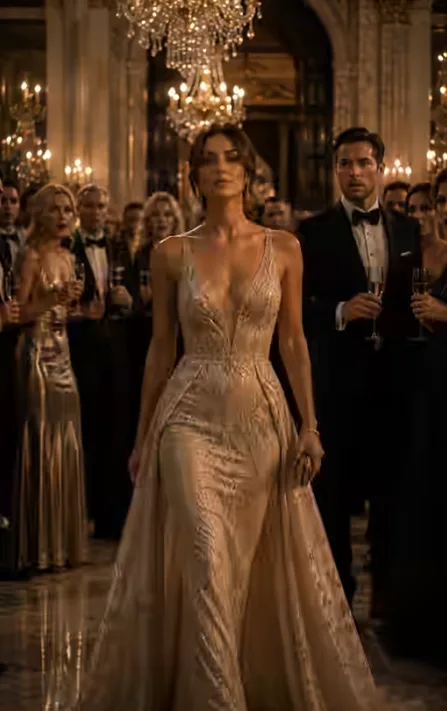
Whitmore House rose from Fifth Avenue like a building that had never been asked to apologize.
The limestone façade glowed beneath soft exterior lights. Black cars lined the curb. Men in tuxedos stepped out with women in diamonds. Cameras flashed near the entrance, though the event was technically private. Rich people loved privacy until attention became useful.
Maya stepped from the car at 8:17.
For half a second, nobody noticed her.
Then the cape caught the wind.
The crystals along her shoulders flashed under the lights like a night sky breaking open.
A photographer turned first.
Then another.
Then the doorman.
Then the woman checking names at the entrance.
“Maya Ellis,” Maya said.
The woman looked down at the list.
Then up at Maya.
Her expression changed.
Not recognition.
Recalculation.
“Yes, Ms. Ellis,” she said quickly. “Welcome.”
Inside, Whitmore House smelled of white roses, polished wood, money, and champagne poured too early.
The ballroom was everything Maya remembered and worse.
Gold ceilings. Marble fireplace. Portraits of dead men who had probably been called visionaries because nobody wrote down who they stepped on. A string quartet played near the far wall. Waiters moved like shadows carrying silver trays. People laughed softly in clusters designed to exclude without appearing rude.
Maya paused at the top of the short staircase leading into the room.
Conversation thinned.
Then stopped.
It moved through the ballroom like weather.
First one head turned.
Then another.
Then nearly all of them.
Maya descended the steps slowly.
Not because she wanted drama.
Because the dress required respect from the body wearing it.
At the bottom, she saw Preston.
He stood beside Sloane near the fireplace, holding a glass of champagne he had not yet lifted to his mouth.
For a moment, he did not recognize her.
That hurt less than it should have.
Then his eyes widened.
Maya watched him see the woman he had once corrected at dinner.
The wife he had told to dress “less emotionally.”
The ex he had assumed would arrive small, wounded, grateful to be invited.
His mouth parted slightly.
Sloane noticed his expression before she saw Maya.
Then she turned.
Her smile remained fixed for one impressive second.
Then it cracked.
Just a hairline.
Tiny.
Perfect.
Priceless.
“Maya,” Sloane said, floating forward in a pale ivory gown that probably cost more than Maya’s rent and somehow looked less expensive than silence.
Maya smiled.
“Sloane.”
Sloane’s eyes moved down the dress.
Then up again.
Slowly.
A woman like Sloane knew fabric.
She knew handwork.
She knew what could be rented and what could not.
Most importantly, she knew when another woman had walked into a room wearing something no stylist could buy by tomorrow morning.
“You came,” Sloane said.
“You invited me.”
Preston appeared behind her.
“Maya.”
His voice was softer than it had any right to be.
Maya looked at him.
“Preston.”
There was a time when saying his name felt like touching a memory.
Tonight, it felt like reading a label on something expired.
His gaze kept slipping to the dress.
“What are you wearing?”
Sloane’s smile sharpened.
An opening.
Maya saw it.
So did every woman nearby.
There were only two answers that world expected from someone like her.
A designer’s name she could not afford.
Or a nervous confession that she made it herself, allowing them to call it charming.
Maya gave them neither.
“A consequence,” she said.
The women closest to them went very still.
Preston blinked.
Sloane laughed lightly. “How poetic.”
“Thank you.”
“Who dressed you?”
Maya tilted her head.
“Do you ask every designer that?”
Sloane’s smile thinned.
Preston’s eyes snapped to Maya’s face.
“You designed this?”
Before Maya could answer, an older man near the bar stepped closer.
Julian Mercer.
Luxury investor.
Owner of three fashion houses, two magazines, and a reputation for buying talent before talent knew its own price.
Maya recognized him immediately.
Everyone in fashion did.
Julian was looking at the dress the way men like him looked at buildings, paintings, and companies they were deciding whether to possess.
“Excuse me,” he said. “Did you say you designed this gown?”
Maya turned.
“Yes.”
He moved closer, studying the beadwork without touching it.
Good man.
Or at least trained man.
“This is hand-embroidered?”
“Yes.”
“By whom?”
“My studio.”
“Which studio?”
“Maya Ellis Atelier.”
A silence followed.
Not empty.
Interested.
Sloane looked suddenly less amused.
Preston looked stunned.
Julian Mercer’s eyes lifted to Maya’s.
“I’ve heard your name.”
That stopped her.
“You have?”
“A singer wore one of your pieces last month at the Met after-party. Copper silk, asymmetric shoulder, hand-painted lining.”
Maya kept her expression calm.
Inside, something lit.
“That was mine.”
Julian nodded.
“I thought so.”
Sloane stepped in smoothly.
“Maya has always been creative. Preston used to encourage her little projects.”
There it was.
Little.
A small word thrown like a pin.
Maya smiled at Sloane.
“Preston did enjoy making things smaller.”
Several guests looked away to hide their reactions.
Preston’s face flushed.
Sloane’s eyes cooled.
Julian Mercer did not smile, but something in his expression sharpened with interest.
“Ms. Ellis,” he said, “are you showing this season?”
“Not yet.”
“Why not?”
“Capital.”
Honesty was a risk.
But Maya had learned something since leaving Preston.
Shame only worked if you agreed to hold it.
Julian took a card from his jacket.
“I would like to visit your studio.”
The room around them seemed to tighten.
Maya accepted the card.
“Then you should.”
Sloane’s fingers tightened around her champagne glass.
Preston noticed.
Good.
Maya hoped he did.
Before anyone could speak, Evelyn Hale arrived.
Preston’s mother moved through the ballroom in silver satin, diamonds at her throat, every inch the kind of woman who believed bloodlines were résumés.
She stopped when she saw Maya.
Her eyes traveled over the gown.
A mistake.
Because for once, Maya let her look.
Let her measure.
Let her understand that nothing on Maya’s body had been borrowed from the Hale world.
“Maya,” Evelyn said.
“Evelyn.”
“How unexpected.”
“Sloane invited me.”
Evelyn’s mouth tightened.
Sloane’s smile flickered.
Preston took a sip of champagne.
Coward.
Still.
Evelyn looked at the dress again.
“Well,” she said. “You’ve certainly made an entrance.”
Maya smiled politely.
“I learned from this family that presentation matters.”
A few guests nearby inhaled.
Evelyn’s eyes sharpened.
“You look… improved.”
Maya’s smile did not change.
“No,” she said. “Just unedited.”
The silence after that was delicious.
Sloane recovered first.
“Let’s not make the evening tense. We’re here to celebrate new beginnings.”
“Of course,” Maya said. “What are we celebrating?”
Preston and Sloane exchanged a look.
Small.
Quick.
Not romantic.
Strategic.
Evelyn lifted her chin.
“Preston and Sloane are announcing their engagement tonight.”
Maya nodded.
“How efficient.”
Preston flinched.
Sloane laughed too brightly.
“We hoped you would be happy for us.”
Maya looked at her.
There were many cruel things she could say.
She said none of them.
Because the room was already beginning to understand that the cruelty had not come from her.
“I hope you receive exactly what you worked for,” Maya said.
Sloane’s smile froze.
Julian Mercer’s assistant, a woman in black glasses, whispered something into his ear. He glanced at his phone.
Then at Maya.
Then at Sloane.
Interesting.
Sloane saw it too.
Her voice grew sharper.
“Preston told me you struggled after the divorce. I do hope things are more stable now.”
There it was.
The reason for the invitation.
The room leaned in without moving.
Maya could feel it.
The hunger.
Rich people called it concern when they wanted to taste someone else’s pain politely.
She reached into her clutch and removed Rosa’s black envelope.
Preston’s face changed immediately.
He recognized envelopes.
Men who built wealth on paperwork often feared paper more than knives.
Maya did not hand it to him.
She held it lightly.
“I did struggle,” she said. “Divorce is difficult when the man who leaves you also delays settlement payments, freezes shared accounts, and tells mutual friends you are unstable when you ask for what the court ordered.”
The ballroom went silent.
Sloane’s mouth parted.
Preston’s jaw tightened.
“Maya,” he said quietly. “This is not the place.”
She looked around at the marble, the champagne, the billionaires, the white roses.
“No? I thought this room enjoyed public lessons.”
Evelyn stepped closer. “Be careful.”
Maya turned to her.
“I was careful for three years. It did not make any of you kind.”
Julian Mercer’s eyes moved from Maya to Preston.
That mattered.
Not because Maya needed a rich man’s approval.
Because Preston did.
Sloane’s voice turned cold.
“You were invited as a courtesy.”
“No,” Maya said. “I was invited as a joke.”
She opened the black envelope and removed the printed screenshot.
Then she held it out.
Not to Sloane.
To Preston.
He did not take it.
So Julian Mercer’s assistant did.
She read it.
Her eyebrows lifted.
Then she handed it to Julian.
He read Sloane’s message aloud, voice flat.
“Poor thing. It’ll be good for her to see what real success looks like.”
Sloane went white.
Preston whispered, “Sloane.”
Maya looked at him.
His disappointment almost made her laugh.
Not because Sloane had been cruel.
Because she had been indiscreet.
That was the sin in their world.
Not cruelty.
Carelessness.
Maya stepped back.
“I should thank you, actually.”
Sloane stared at her.
“If you had not invited me, Mr. Mercer might not have seen the gown.”
Julian looked at Maya.
“I would have found it eventually.”
Maya met his eyes.
“Good.”
Preston’s glass lowered.
“Maya, can we talk privately?”
She smiled.
There it was.
The sentence men used when public truth became inconvenient.
“No.”
His face tightened.
“I think we owe each other—”
“You owe me money.”
Someone near the fireplace coughed.
Maya continued, calm as silk.
“And an apology. But I no longer need either badly enough to beg.”
Evelyn stepped in, voice low. “You are embarrassing yourself.”
Maya turned toward her one last time.
“No, Evelyn. I am wearing a million-dollar dress in a room that once laughed at me. I think, for the first time, I understand refinement perfectly.”
Evelyn had no answer.
Not one.
Sloane looked around the room, searching for allies.
But something had shifted.
People still watched her.
But not with admiration.
With curiosity.
The dangerous kind.
The kind rich people reserved for someone who might become socially expensive.
Maya placed Julian’s card into her clutch.
Then she looked at Preston.
“I hope she makes you very happy.”
His eyes held hers.
For the first time since their divorce, he looked like he wanted to say something real.
Maybe regret.
Maybe apology.
Maybe only fear of losing control of the story.
Maya did not stay to find out.
She turned and walked toward the exit.
Behind her, whispers bloomed.
Not cruel this time.
Hungry.
“Who designed that dress?”
“Maya Ellis Atelier.”
“Is she showing?”
“Julian Mercer gave her his card.”
“Did Sloane really invite her as a joke?”
The room that once made Maya feel small now said her name like a discovery.
At the staircase, Preston called after her.
“Maya.”
She paused, but did not turn.
He said, softer, “I didn’t know she sent that message.”
Maya looked over her shoulder.
“No, Preston. You just taught her I was someone she could send it about.”
His face fell.
Good.
Some lessons should arrive late and still hurt.
Maya walked out into the cold night.
Rosa was waiting in a hired car across the street, because of course she was. The passenger window rolled down.
“Well?” Rosa asked.
Maya climbed inside and closed the door.
For a moment, she said nothing.
Then she pulled Julian Mercer’s card from her clutch and placed it between them.
Rosa stared.
Then she laughed.
Not softly.
Not politely.
Fully.
Maya leaned back against the seat as the car pulled away from Whitmore House.
Behind them, the lights of Fifth Avenue blurred through the window.
For the first time in three years, Maya did not feel like Preston Hale’s ex-wife.
She felt like the woman he had been too small to keep.
Chapter complete
You have reached the end of this chapter.
Continue reading
A few more worlds to get lost in after this chapter.




