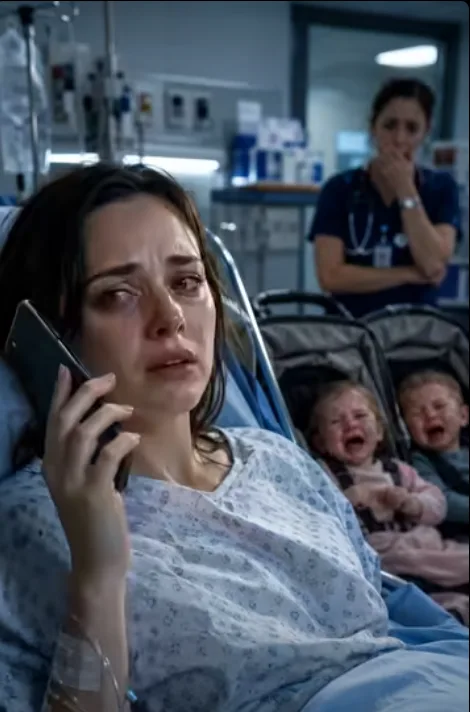
For one second, I did not understand what I was looking at.
Chapter 2
For one second, I did not understand what I was looking at.
My father stood on my front porch in the same navy windbreaker he wore when he wanted people to think he was harmless. His hair was damp with sweat despite the cold morning air. His face looked pale, strained, almost sick.
Behind him stood two police officers.
And in his hands was Lily’s pink blanket.
The one with the little white rabbits stitched along the edge.
The one she could not sleep without.
The one I knew had been in her crib that morning.
My arms tightened around Lily automatically.
She pressed her face into my neck, sleepy and warm, unaware that the entire world had just tilted.
“Claire,” my father said, voice trembling. “We need to talk.”
I looked at the blanket.
Then at the officers.
Then back at him.
“How did you get that?”
He swallowed.
Not fast enough.
Not cleanly enough.
One of the officers, a woman
with kind eyes and a careful expression, stepped slightly forward.
“Ma’am, are you Claire Bennett?”
“Yes.”
“We received a welfare concern regarding two minor children in this residence.”
I almost laughed.
The sound caught in my throat and died there.
“A welfare concern?”
My father lifted the blanket like proof.
“We found this outside,” he said quickly. “Near the driveway. Lily’s blanket. Your mother has been worried sick. We’ve been calling and calling, and you refuse to answer.”
Because I blocked you, I thought.
Because I was healing from emergency surgery.
Because the last time I asked for help, you chose concert seats over my children.
But I did not say any of that yet.
I looked at the officer.
“My children are safe.”
The second officer, a man with a notepad in one hand, glanced past me into the house. “May we come in and confirm that?”
Every protective
instinct in my body screamed no.
But I had nothing to hide.
And my father knew it.
That was the part that scared me.
This was not about what they would find.
It was about making me look unstable for refusing.
I stepped back.
“You may come in. He may not.”
My father’s mouth opened.
“Claire—”
“No.”
The word came out sharp enough that Lily lifted her head.
I kissed her hair.
The female officer looked at my father. “Sir, please wait outside.”
His face changed.
For the first time since I opened the door, I saw irritation cut through the performance.
“But I’m her father.”
“And this is my house,” I said.
The officer repeated, firmer this time, “Please wait outside.”
He did.
Slowly.
Like a man already calculating how to use it against me later.
I closed the door in his face.
The moment the latch clicked, I
nearly lost my balance.
Pain pulled across my stomach, hot and warning. I shifted Lily higher on my hip and forced myself to breathe.
The female officer noticed.
“Ma’am, are you recovering from surgery?”
“Yes. Two weeks ago.”
Her expression changed slightly.
Not sympathy exactly.
Awareness.
The male officer looked around the living room.
There were toys on the rug, a basket of folded laundry on the sofa, sippy cups on the coffee table, and Noah sitting in his playpen stacking blocks with the serious concentration of a tiny engineer.
It was not spotless.
It was a home with toddlers.
But it was safe.
Warm.
Alive.
“Hi, buddy,” the female officer said gently.
Noah looked up, considered her, then went back to his blocks.
Lily squirmed in my arms.
“Blankie?” she mumbled.
My throat tightened.
“Yes, baby. I know.”
The officer’s eyes moved to the door.
“Your father said he found it outside.”
“He shouldn’t have been near my driveway.”
“Is he not welcome here?”
“Why?”
I looked at both officers.
Then I walked slowly to the kitchen counter, picked up my phone, and opened the message thread from two weeks ago.
The one I had not deleted.
The one I had read at 3 a.m. more times than I should have.
I handed it to the female officer.
“This is why.”
She read the message I had sent.
You chose a concert over my children. The money stops today. Do not contact me again.
Then she scrolled up.
Her face hardened.
Not much.
Enough.
Because above my message were missed calls, then the final call log from the hospital, then my mother’s text sent hours later.
Hope your little emergency was worth ruining our night. Vanessa cried because of you.
The officer looked at me.
I said, “I was going into surgery. My appendix had ruptured. My parents were my emergency contacts. They refused to watch my children because they had concert tickets.”
The male officer stopped writing.
The female officer handed my phone back carefully.
“And you have childcare now?”
Before I could answer, a calm voice came from the hallway.
“Yes.”
Marisol stepped into the living room with Noah’s clean blanket in her hands. She was in her early forties, hair tied back, face composed, eyes alert in the way only truly competent people are. She had arrived that first night like an answer I did not know I was allowed to pray for.
“I’m Marisol Vega,” she said. “Licensed childcare provider. I’ve been assisting Ms. Bennett since her discharge.”
She handed the officers her ID badge, references, and the emergency service card without being asked.
I could have hugged her.
I almost did.
The male officer reviewed everything.
The female officer looked at the kitchen, then the baby gate, then the medicine bottles placed high on a shelf, then the printed post-surgery instructions taped to the fridge.
My father had expected chaos.
Instead, he had delivered two police officers into the most documented two weeks of my life.
Marisol glanced at me once.
A small look.
Steady.
You’re okay.
The female officer nodded.
“Everything appears safe here.”
Relief hit so hard my knees weakened.
But the male officer was still looking at the door.
“Your father also stated that you may be preventing the grandparents from seeing the children due to emotional distress.”
I laughed then.
I couldn’t help it.
It came out small and sharp and tired.
“My emotional distress?”
The female officer’s tone softened. “We understand family situations can be complicated.”
“No,” I said. “This one is simple.”
I looked toward the door.
“They refused to help when my children needed care during a medical emergency. Then they got angry because I stopped paying their bills.”
The male officer looked up.
“Paying their bills?”
“Yes.”
And there it was.
The real reason behind the knock.
Not concern.
Not love.
Not Lily’s blanket.
Money.
Always money, when people who call you a burden suddenly need access again.
“My parents’ mortgage shortfall. Their car insurance. Vanessa’s credit card payments twice last year. My father’s medication copays. My mother’s salon account that she pretended was a medical expense. I paid all of it.”
Marisol’s face did not change, but I saw her eyes sharpen.
The female officer said, “Do you have documentation?”
“Yes.”
My father had taught me one useful thing in life: never trust someone who gets angry when you ask for receipts.
So I kept every receipt.
Every transfer.
Every text.
Every “just this once, Claire.”
Every “you know Vanessa has anxiety about money.”
Every “don’t be selfish.”
I opened a folder on my phone and showed them.
The male officer’s expression shifted from formal to uncomfortable.
The female officer handed back the phone.
“Ms. Bennett, based on what we’ve seen, there is no immediate welfare concern.”
My breath loosened.
Then she added, “But given the family conflict, you may want to consider documenting future contact.”
“I already am.”
A pounding sound came from the front door.
“Claire!” my father shouted from outside. “Don’t lie to them!”
Lily startled and began to cry.
Something in me changed.
Not broke.
Changed.
For two weeks, I had been healing. Quiet. Careful. Trying not to lift too much, not to cry too hard, not to wonder why my own mother never once texted to ask whether I survived surgery.
But now my daughter was crying because my father was shouting outside my door with a blanket he had no right to hold.
That was enough.
I handed Lily to Marisol.
Then I opened the door.
My father stood there red-faced, breathing hard.
The moment he saw the officers behind me, he rearranged his face into wounded concern.
“Claire, sweetheart, we are just worried.”
“No, you’re not.”
His eyes flicked toward the officers.
“Your mother has been crying for two weeks.”
“She cried because the money stopped.”
His jaw tightened.
“Don’t do this in front of strangers.”
I smiled faintly.
That sentence was my childhood in six words.
Hide the truth so the family looks clean.
“No,” I said. “I think strangers are exactly who should hear this.”
The female officer stepped closer, alert now.
My father lowered his voice. “You are making a mistake.”
“I made the mistake when I believed you would show up if things got bad enough.”
His nostrils flared.
“We had plans.”
“I had surgery.”
“You always make everything about you.”
I looked at him.
Really looked.
At the man who had taught me to change tires, file taxes, and apologize first even when I was the one hurt.
At the man who had once carried me into the house after I fell off my bike.
At the man who had held my daughter’s blanket and used it like a weapon.
“I almost died,” I said quietly.
For a second, something moved across his face.
Not remorse.
Annoyance.
Because my pain had become inconvenient again.
“You didn’t die.”
The words landed in the doorway with the weight of a slammed coffin.
Even the male officer looked up.
My father seemed to realize too late what he had said.
“Claire, I didn’t mean—”
“Yes,” I said. “You did.”
Behind him, a car door slammed.
My mother came rushing up the walkway in a beige coat, Vanessa behind her wearing sunglasses too large for her face despite the cloudy sky.
Of course Vanessa came.
She always arrived for the performance after someone else set the stage.
“Claire!” Mom cried. “What are you doing to this family?”
I stared at her.
Not “How are you feeling?”
Not “Can I see the babies?”
Not “I’m sorry.”
What are you doing to this family?
Vanessa pointed at the officers.
“See? This is exactly why we were worried. She’s acting unstable.”
Marisol stepped closer behind me.
My mother saw her and froze.
“Who is that?”
“The nanny you forced me to hire.”
Mom’s mouth tightened. “A stranger is watching our grandchildren?”
“A qualified stranger showed up when their grandparents chose a concert.”
Vanessa rolled her eyes. “Oh my God, are you still on that?”
Still.
As if it were a spilled drink.
As if it were a late birthday card.
As if I had not been lying on a hospital bed terrified my babies would be left with hospital staff while I was unconscious.
My father snapped, “Enough. We are taking the twins for the afternoon.”
The world went silent.
There it was.
Not asking.
Not apologizing.
Taking.
The female officer stepped forward. “Sir, that is not happening today.”
My father turned to her. “They are our grandchildren.”
“And Ms. Bennett is their mother.”
Vanessa laughed bitterly. “A mother who cuts off everyone and hires strangers while she’s on painkillers.”
I felt my hands curl.
The accusation was not careless.
It was planned.
They had come to paint me as unstable.
Recovering from surgery. On medication. Isolating the children. Refusing family contact.
And Lily’s blanket was their opening scene.
My mother took one step toward me.
“Claire, just give us the babies for a little while. You need rest. We’ll talk about the money later.”
There it was.
The money.
Again.
I looked at the officers.
“Do I have to let them in?”
“No,” the female officer said.
“Do I have to let them take my children?”
“No.”
“Can I ask them to leave my property?”
“Yes.”
I turned back to my family.
“Leave.”
Mom’s face crumpled instantly.
Not from pain.
From insult.
“After everything we’ve done for you?”
I laughed once.
It was not a happy sound.
“You mean after everything I paid for?”
Dad’s face darkened. “You ungrateful little—”
The male officer stepped in. “Sir.”
Dad stopped.
Vanessa crossed her arms. “This is insane. You know what? Fine. Keep your little victims. But don’t come crawling back when you realize you can’t do this alone.”
I looked over my shoulder.
Marisol was holding Lily, who had calmed down and was playing with the necklace around Marisol’s neck. Noah was standing in his playpen, watching everything with wide eyes.
I was not alone.
That was the part my family had failed to calculate.
They thought if they withdrew love, I would have nothing left.
They forgot I could hire help.
They forgot I could build safety.
They forgot money was never love, but it could buy distance from people who confused access with entitlement.
“I won’t,” I said.
Mom’s eyes filled with tears.
Real ones, maybe.
Too late.
“Claire,” she whispered. “Please. We’re family.”
I looked at her for a long moment.
Then I said the sentence I had been too afraid to say my entire life.
“No. You’re relatives.”
Her face collapsed.
But I felt nothing.
Not because I was cruel.
Because I was finally empty of the part of me that kept trying to earn softness from people who rationed it like charity.
The officers escorted them down the walkway.
My mother cried.
Vanessa cursed under her breath.
My father looked back once with a face so cold it sent a warning through me.
This was not over.
Not for him.
At the end of the driveway, before getting into the car, he lifted his phone and made a call.
Marisol noticed too.
When I closed the door, she turned the lock immediately.
“Claire,” she said gently, “you should call a lawyer.”
“I know.”
My voice was steady.
Too steady.
I took Lily back into my arms and pressed my cheek to her hair.
She smelled like baby shampoo and crackers.
Safe.
For now.
My phone buzzed.
A text from an unknown number appeared.
Ms. Bennett, this is Attorney Rachel Coleman. Your father just contacted my office asking about grandparent custody rights. I declined representation due to conflict concerns, but you need counsel immediately.
I stared at the screen.
My father had not waited five minutes.
My family had chosen a concert over my life, called my children a nuisance, used my daughter’s blanket to bring police to my door, and now wanted legal access to the babies they had abandoned when I needed them most.
Marisol read the text over my shoulder.
Her face hardened.
“I know someone,” she said.
“A lawyer?”
She nodded. “A very good one.”
Outside, my father’s car pulled away.
Inside, Noah began stacking blocks again like the world had not just tried to reach through our front door and take him.
I held Lily tighter.
Two weeks ago, I had cut off their money.
Today, they had shown me what they really wanted back.
Not love.
Not forgiveness.
Control.
I looked at Marisol.
“Call them,” I said.
She took out her phone.
And for the first time since the hospital, I was not just surviving what my family had done.
I was preparing to make sure they could never do it again.
Chapter complete
You have reached the end of this chapter.
Continue reading
A few more worlds to get lost in after this chapter.




