PART 2 — THEY TRIED TO BREAK ME FOR MY HOUSE
Tiffany did not even pretend to be grieving.
Chapter 2
PART 2 — THEY TRIED TO BREAK ME FOR MY HOUSE
Tiffany did not even pretend to be grieving.
She wore a completely inappropriate fitted black dress and spent the ceremony checking her phone. After the burial, when everyone left, I stayed alone in my house for the first time in fifty years.
The silence was deafening.
Every corner reminded me of Louie. His laughter, his voice, his presence. I cried for entire days, barely eating, barely sleeping. Michael called twice that first week. Brief and uncomfortable conversations where he did not know what to say.
A month passed before he came to visit me again, but this time he did not come alone. Tiffany accompanied him, and for the first time in years, she entered my house.
They sat in the living room, and Michael awkwardly cleared his throat before speaking.
“Mom, we need to talk about your situation. This house is too much for you alone. The expenses, the maintenance, everything. Tiffany and I have been thinking.
Maybe it would be better for you to move in with us. We could sell this house, and you would have financial security for your later years.”
My later years.
I was seventy. I was not dead. But what hurt me the most was the way they said it, as if I were a burden, a problem to solve.
I looked Michael directly in the eyes, searching for the boy I had raised. But I only found a calculating stranger.
“Michael, this house was your father’s dream. All our memories are here. Your childhood, our lives. I am not going to sell it,” I replied, my voice trembling but firm.
Tiffany let out an exaggerated sigh of frustration and looked at Michael with that expression that clearly said, I told you so.
“Mom, be realistic,” Michael insisted. “You are an older woman alone in a big house. What if you
fall? What if you get sick? We live forty minutes from here. We cannot be coming every time you need something. It is for your own good.”
But I heard Tiffany’s words coming out of his mouth.
“I appreciate your concern, but I am perfectly fine. I have my neighbors, my friends from church. I am not alone,” I said, trying to stay calm.
Tiffany abruptly stood up, clearly irritated by my refusal.
“Michael, we have wasted enough time. Your mother is stubborn. She is not going to listen to reason. Let us go,” she said, grabbing her designer purse, which probably cost more than my expenses for three months.
Michael looked at me with disappointment, as if I were the unreasonable one, and they left without even saying a proper goodbye.
That was the first of many uncomfortable conversations.
Michael began to visit me more frequently, but they were
no longer visits from a concerned son. They were negotiations, constant pressure for me to sell the house.
Every time he came, he inspected everything with critical eyes, pointing out defects, maintenance problems, expenses that, according to him, I could not sustain.
“Mom, the plumbing is old. The roof needs repair. The paint is peeling. How much do you think all those repairs will cost? Thousands of dollars you do not have. If you sell now, you could get good money. Any later, it will be too late, and the value will drop,” he constantly told me, like a persistent salesperson.
I resisted, but I must admit that I was beginning to feel the pressure. Louie had left the house completely paid for, but living on the Social Security checks I received was increasingly difficult. Utilities were going up. Food cost more. The medication for my blood pressure was not cheap.
I started taking sewing jobs to earn extra money, mending neighbors’ clothes until late at night.
Michael discovered I was working and flew into a rage.
“See, Mom, this is exactly what I am talking about. A seventy-year-old woman sewing until midnight because she cannot afford to keep this house. It is ridiculous. It is dangerous for your health. Sell the house and stop suffering.”
But I was not suffering. Working made me feel useful. It kept me busy. It prevented me from sinking into loneliness.
The house was the only thing I had left of Louie, of our life together. Selling it would be betraying everything he worked to give us.
So I kept refusing.
Then the strategy changed.
Michael and Tiffany started coming without warning, always criticizing, always pointing out problems. Tiffany complained about the smell of dampness that, according to her, pervaded the house, even though I cleaned obsessively every day. She complained about the old furniture, the worn curtains, everything.
“I do not know how you can live like this, Rose. This is depressing. Michael grew up in this darkness, poor boy. Thank goodness I got him out of here,” she told me one day as she ran her finger over a shelf looking for dust.
She called me by my first name. She no longer even called me mother-in-law or Mrs. Rose. Just Rose, as if we were friends, or worse, as if she had authority over me.
I swallowed the insult and did not respond. Confronting Tiffany meant confronting Michael, and I still had hope that my son would return to who he was.
How naive I was.
Things got worse when Michael suggested that I move in with them temporarily while I decided what to do with the house.
“Just a few weeks, Mom, so you can see what it is like to live without worries, without having to maintain this huge house. We have a perfect guest room for you,” he said with a smile that should have seemed comforting, but I found unsettling.
I finally accepted, exhausted by the constant pressure, thinking that perhaps a change of scenery would help me clear my mind.
I packed a small suitcase with clothes for two weeks and left my house with a heavy heart, looking back as if I had a premonition that something terrible was about to happen.
Michael and Tiffany’s house was the opposite of mine. Modern, minimalist, cold like a soulless luxury hotel. Everything was white, gray, and gleaming chrome. There were no family photographs, no memories, just expensive, empty magazine decor.
The guest room was small and austere, with a single bed and a tiny closet.
The first few days were tolerable. Tiffany practically ignored me, locked in her home office, working on I did not know what. Michael left early and came home late. I spent the days watching television in the living room, feeling like an intruder in a house that was not mine.
I cooked occasionally, trying to be helpful, but Tiffany complained about the smells, saying her kitchen was not for preparing heavy food.
After a week, Michael came to my room with papers in his hand.
“Mom, I have been thinking. Since you are here and you are comfortable, why do we not rent out your house? We could easily get one thousand dollars a month for it. That money would help you a lot, and the house would not be sitting empty, deteriorating.”
Rent out my house.
Let strangers live where Louie and I built our life.
The idea horrified me.
“No, Michael. That house is not for rent. I am going back soon. I just needed this break.”
His expression changed instantly. The mask of the concerned son dropped, and I saw genuine irritation.
“Mom, you are being irrational. That house is falling apart, empty. It is a waste. Dad would have wanted you to be practical.”
“Do not speak for your father. Louie wanted me to keep that house. He made me promise before he died,” I replied with more firmness than I had shown in months.
Michael left my room, slamming the door, and I heard raised voices from his bedroom. Tiffany was shouting something about the stubborn old woman and wasting time.
That night, I decided I would return to my house the next day. It had been a mistake to come. A mistake to believe that Michael really cared about my well-being.
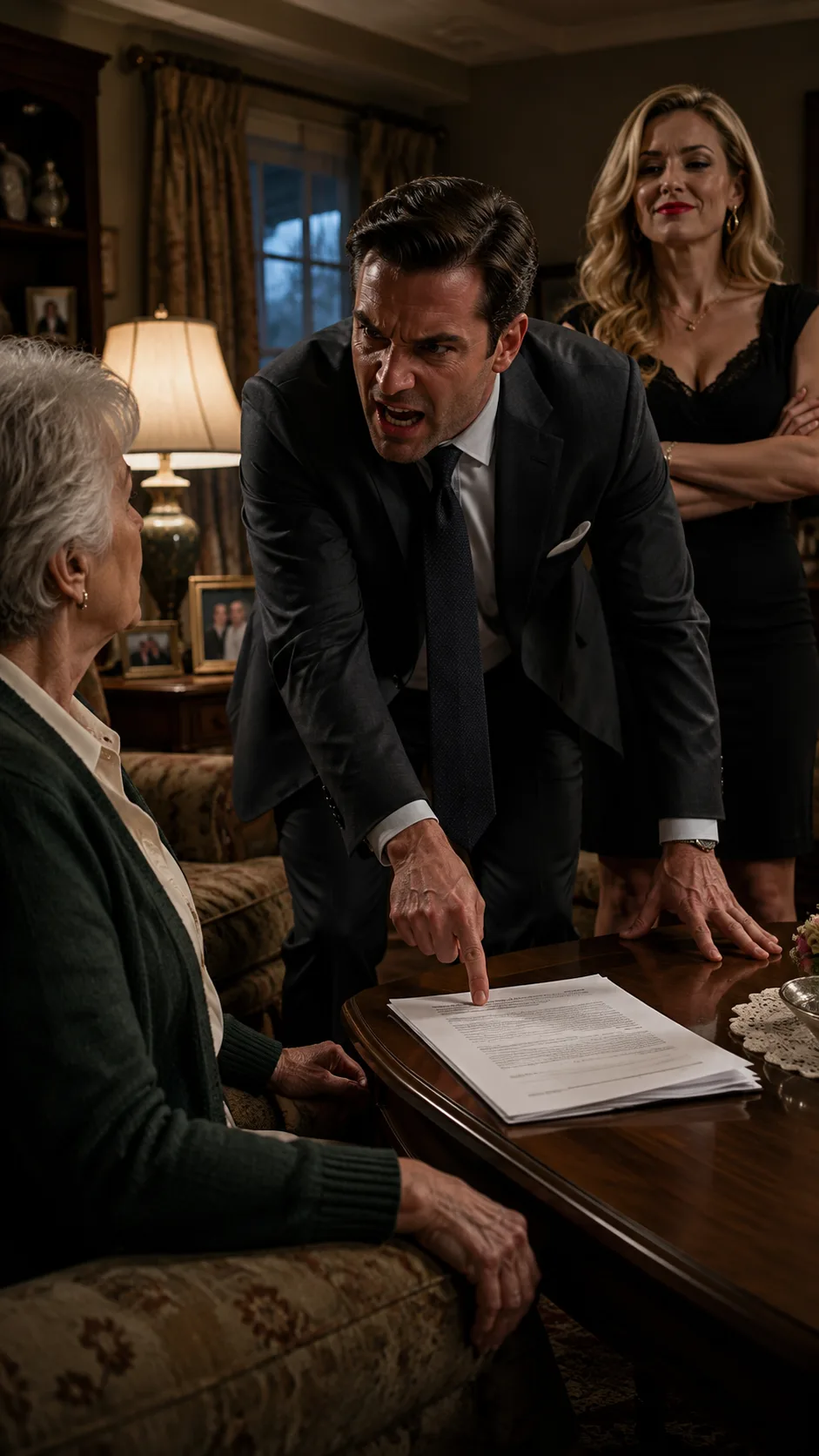
But when I went downstairs the next morning with my suitcase, I found Michael and Tiffany waiting for me in the living room with serious expressions.
“Mom, sit down. We need to have an adult conversation,” Michael said with a tone I had never heard from him before.
Authoritative and cold.
Tiffany stood with her arms crossed, a satisfied smile on her intensely red painted lips.
I sat down slowly, my suitcase still in my hand, sensing that something very bad was about to happen.
Michael cleared his throat and looked me directly in the eyes without a hint of warmth.
“We have been very patient with you, Mom. Too patient. But enough is enough. That house is a burden for you and for us. Dad died more than one year ago, and you are still clinging to the past as if he were going to come back. He is not coming back. It is time for you to accept reality and sell that property.”
Michael said it with a coldness that chilled my blood.
“Michael, we have talked about this. I am not going to sell your father’s house. It is my home. It is where I plan to die when my time comes,” I replied, trying to keep my voice steady, but I felt my hands trembling.
Tiffany let out a sarcastic laugh that echoed in the room like a whip.
“Your home, Rose? Let us be honest. That house is worth at least three hundred thousand dollars on the current market. Three hundred thousand dollars wasted on an old woman who cannot even maintain it properly. It is selfish of you.”
Selfish.
I was selfish?
I stood up abruptly, my indignation overcoming my fear.
“I spent fifty years sacrificing for this family. I cleaned other people’s houses so Michael could have an education. I wore old clothes so he could dress well. Louie and I worked ourselves to exhaustion to give him everything. And now it turns out that I am selfish for wanting to keep the only thing I have left?”
“The only thing you have left is us, Mom. Your family. And your family is telling you that house is too much for you,” Michael interrupted, also standing up, approaching me with measured steps. “You can sell it voluntarily and live your last years in peace, or you can continue to be stubborn and complicate your life. You decide.”
“I have already decided. I am going home right now,” I said, taking my suitcase with trembling hands.
I walked toward the door, but Tiffany stepped in my path with her arms crossed and that cruel smile I had come to hate so much.
“I do not think you understand the situation, Rose. It is not a request. Michael is your only son, your only heir. That house will eventually belong to him. So why not make things easier for him now? Think of it as your last gift to the son you love so much.”
Tiffany said it with a sickly sweet tone that concealed pure poison.
“Get out of my way,” I demanded with all the dignity I could muster.
Tiffany looked at Michael for instructions, and he nodded slightly. She stepped aside, but as I passed her, I heard her venomous whisper.
“This is not over, old woman.”
I took a taxi back to my house, using the few dollars I had saved in my purse. Throughout the ride, I cried in silence. The taxi driver had the decency not to ask questions.
When I arrived home, the house felt different, as if it, too, had been betrayed.
I locked myself in and did not answer Michael’s calls for three days. But on the fourth day, he showed up without warning. He knocked insistently until I opened, tired of hearing the doorbell.
He entered without waiting for an invitation, looking around as if evaluating a property for sale, which I suppose was exactly what he was doing.
“Mom, I am sorry if Tiffany was hard on you. You know how she is. Direct. But she is right. This house is falling apart, and you cannot maintain it. Look at this,” he said, pointing to a damp stain on the ceiling that had appeared after the last rains. “This is going to cost thousands of dollars to repair. Where are you going to get that money? Are you going to sew dresses until you are eighty years old?”
“If necessary, yes,” I replied with a stubbornness I did not know I still possessed.
Michael sighed dramatically, as if I were a difficult child who would not listen to reason.
“All right, Mom. If you want to live like this, go ahead. But do not expect me to come every time something breaks or you need help. I have enough responsibilities as it is,” he said, heading toward the door.
Before leaving, he turned around with an expression I could not decipher.
“Dad would be disappointed to see you like this, clinging to material things when you could be enjoying life.”
Using Louie against me was the lowest blow.
When Michael left, I collapsed on the sofa and cried until I had no more tears left.
My son, the boy I had raised with so much love, had turned into a cruel stranger who only saw my house as a bank account.
But I would resist for Louie. For myself. For the dignity I still had left.
The following weeks were the loneliest of my life. Michael did not call or visit again. It was as if he had erased me from his life for not doing what he wanted.
My neighbors invited me for coffee. The ladies from church included me in their activities, but nothing filled the void left by my son’s absence.
Two months after our last fight, Michael showed up again.
This time, he did not come alone. Tiffany accompanied him, and both had serious expressions that immediately put me on alert. They sat down in my living room without being invited, Tiffany wrinkling her nose at the old furniture as she always did.
“Mom, we have come to make you a final offer. A very generous offer considering your situation,” Michael began, taking some papers out of his briefcase. “Tiffany and I have decided to buy your house. We will give you two hundred thousand dollars, which is a fair price considering the condition it is in. With that money, you can buy a small, comfortable apartment, and you will have money left over to live your final years peacefully.”
Two hundred thousand dollars, when he himself had said it was worth three hundred thousand.
They wanted to cheat me and make it look like a favor.
“It is not for sale, Michael. And I definitely would not sell it to you for one hundred thousand dollars less than it is worth.”
Tiffany stood up abruptly, her patience clearly exhausted.
“You know what, Rose? I am tired of this. You are a stubborn, selfish, ungrateful old woman. Michael has offered you help again and again, and you reject him as if he were the enemy. That house is going to be ours, one way or another. We can do this the easy way or the hard way.”
“Are you threatening me in my own house?” I asked incredulously, looking at Michael, expecting him to defend his mother.
But he just looked at the floor.
Cowardly until the end.
“It is not a threat. It is a promise,” Tiffany said. “Michael is your only heir. When you die, which could be tomorrow considering your age, this house will be his anyway. Why do we not save everyone the drama, and you hand it over now? That way, at least you will see some money before you die.”
She said it with a malicious smile that made me understand this woman was truly evil.
“Get out of my house now. Both of you,” I ordered with a voice I did not recognize, full of fury and pain.
Michael finally looked up, and for a second, I saw something like shame in his eyes. But it was only a second.
“All right, Mom. We are leaving. But think carefully. This is your last chance to do this civilly,” Michael said as Tiffany was already walking toward the door, her heels clicking loudly against the hardwood floor as if to make her contempt clear.
When they left, I locked the door and slid down to the floor, my back against the wood, crying uncontrollably.
My son had threatened me. My own son wished I would die soon so he could take my house.
The pain was unbearable, physical, as if my heart had been ripped from my chest.
That night, I could not sleep. Every noise scared me. Every shadow seemed threatening. Tiffany’s words echoed in my mind.
One way or another.
What did that mean? How far were they capable of going?
I did not have to wait long to find out.
A week later, the strange problems began.
First, it was the water. I arrived home after church and discovered there was no pressure, barely a thin trickle coming out of the faucets. I called the water company, and they informed me that someone had reported a leak and had temporarily shut off the supply.
But I had not reported any leak. Nor was there such a problem.
“It must be a mistake, ma’am. Someone called from this address two days ago. We will have to send an inspector, and that will take at least a week,” they told me with bureaucratic indifference.
A week without proper water, having to carry buckets from my neighbor’s house.
At seventy years old, going up and down stairs with heavy buckets.
Then it was the electricity. An astronomical bill arrived, four times more than normal. Five hundred dollars I definitely did not have. When I called to complain, they told me the meter showed a very high consumption, as if I had all the appliances on day and night.
Impossible.
I turned everything off religiously to save.
“If you do not pay in three days, we will proceed to cut off the service,” they warned me with a mechanical tone.
I had to use the savings I had hidden for emergencies, money I had been saving penny by penny for years. It vanished in an instant to pay a bill I did not understand.
Then I understood they were not coincidences.
Someone was sabotaging my life, making living in my own house a nightmare. And there were only two people with a motive to do so.
Michael knew all the details of my house. He had grown up here. He knew where the meter was. He knew my routines. He had a copy of the keys that I had never asked him to return.
I changed the locks immediately, spending more money I did not have.
The locksmith looked at me with pity when he saw my trembling hands as I paid him.
“Is everything all right, ma’am? Is someone bothering you?” he asked with genuine concern.
I shook my head, too ashamed to admit that the person harassing me was my own son.
But changing the locks did not stop the problems.
One morning, I found the backyard fence broken as if someone had kicked it during the night. Another time, the plants I cared for so diligently appeared uprooted and thrown around the yard.
Small cruelties designed to break me, to make me feel unsafe in my own home.
I finally called Michael. My last hope was that maybe he did not know what Tiffany was doing.
“Michael, strange things are happening at the house. I think someone is breaking in when I am not here. Could you come and check?”
There was a long silence on the other end of the line.
Too long.
“Mom, maybe you are imagining things. At your age, it is normal for the mind to play tricks. Have you considered that perhaps it is not safe for you to live alone? These episodes of paranoia are common in older adults.”
He was calling me crazy.
My own son was invalidating my reality, making me doubt myself.
“I am not imagining anything, Michael. The fence is broken. The bills are altered. Someone reported false problems to the water service. This is real.”
“Or maybe you are so stressed about maintaining that house that you are starting to see problems where there are none. This only confirms what I have been telling you. Mom, that house is too much for you. Sell it before something really bad happens.”
He said it with a tone that sounded almost satisfied, as if my problems validated his argument.
I hung up, feeling more alone than ever.
I had no one to turn to, no one who would believe me. My neighbors were kind, but old like me, unable to truly help. The police would laugh if I told them my son was psychologically harassing me to steal my house.
I had no proof, just a series of incidents that could seem like simple coincidences.
The nights became terrifying. Every creak of the house made me jump. Every shadow seemed like a threat. I slept with a chair wedged against my bedroom door.
This was no way to live, but I preferred it to giving up.
A month after changing the locks, Michael and Tiffany appeared again.
This time, they did not knock. They were simply on my porch when I opened the door to pick up the newspaper. I was so scared I almost screamed.
“Good morning, Mom. I see you changed the locks. Interesting decision considering I am your son,” Michael said with an accusatory tone, as if I had committed some unforgivable offense.
“I have the right to change the locks on my own house,” I replied, trying to sound braver than I felt.
Tiffany looked at me with those calculating eyes, evaluating me like a predator evaluates its prey.
“Of course you do. It is your house for now,” Tiffany said, emphasizing the last two words. “But we have come to inform you of something important. We have hired an appraiser. This house needs urgent structural repairs, or it could be considered uninhabitable. The roof, the plumbing, the electricity, everything is in dangerous condition.”
“That is a lie. This house is perfectly fine,” I protested.
But my voice sounded weak, even to my own ears.
Michael pulled more papers from his eternal briefcase.
“We have the report here. The inspector found multiple code violations. You could be fined or even forced to abandon the property if you do not make the repairs. We are talking about at least fifty thousand dollars in repairs.”
Fifty thousand dollars.
He might as well have said a million. I did not have that amount. Not even a fraction. And they knew it perfectly well.
“You hired an inspector without my permission. How did you get onto my property?”
“We did not need to enter, Mom. The problems are visible from the outside. The inspector did his work from the street. All completely legal.”
Michael lied without batting an eye.
But I knew it was a lie. No one could see the condition of the plumbing or the electricity from the street.
Tiffany approached, her expensive perfume mixing with my fear.
“Look, Rose, enough with the games. You know you cannot fix this house. You know you cannot maintain it. You know it will eventually be ours. Why prolong the inevitable? Sign the sales papers, take the money, and end this torture for everyone.”
“Never,” I whispered.
But my determination was beginning to break under the constant weight of their harassment. I was exhausted, scared, completely alone against two people who clearly had no moral limits.
Michael sighed dramatically.
“All right, Mom, if that is what you want. But when the fines from the city come, when they force you to leave the house because it is uninhabitable, do not say we did not warn you. And by then, the price we offer will be much lower. Every day that passes, this property is worth less.”
They left, leaving me trembling on the porch.
I went inside and locked the door, sliding down to the floor again. They were winning. I could feel it. Little by little, they were breaking me, stealing my peace, my safety, my sanity. It was only a matter of time before I completely surrendered.
That night, sitting in the darkness of my living room to save electricity, I touched the photograph of Louie that I kept on the end table.
“Forgive me, my love. I do not know if I can continue to keep my promise. I am so tired, so alone. What do I do?”
As if Louie had heard me from wherever he was, something made me remember.
There was a box in the attic. Louie’s things that I had never checked after his death. Documents, papers, memories that were too painful for me to face.
But now, desperate, I decided to search.
I went up to the attic with difficulty. Every step was a challenge for my arthritic knees. The flickering light barely illuminated the dusty space full of old boxes and abandoned memories.
I searched through the shadows until I found the wooden box that Louie had guarded jealously for years. He always told me it contained important papers, but he never let me see them.
“Someday you will need them, Rose. When I am gone, open this box,” he had told me months before he died.
I carefully carried the heavy box downstairs, almost stumbling on the stairs. I placed it on the dining table and opened it with trembling hands.
Inside were meticulously organized folders, typical of Louie, who was always orderly with documents. I started checking the house deed, old receipts, birth certificates.
Nothing seemed relevant until I found a yellowed envelope with my name written in Louie’s handwriting. I opened it with a racing heart and took out a letter.
I immediately recognized his careful calligraphy, each letter formed with the precision of a man who left everything in order before leaving.
My dearest Rose, it began.
Tears blurred my vision. But I kept reading.
If you are reading this, it means I am no longer with you, and you are probably facing problems with our house. I know our son better than he thinks. I have seen how he has changed since he married that woman. I have noticed how he looks at our property with greedy eyes. That is why I took precautions that I never mentioned to you, because I did not want to worry you while I was still alive.
My breathing quickened as I continued reading.
Louie explained that two years before he died, he had transferred the house to an irrevocable trust. The property was no longer directly in my name or his. It was protected in a legal structure that Michael could not touch, manipulate, or automatically inherit.
I was the lifetime beneficiary with the right to live there until my death, but no one could force me to sell.
The letter continued.
Also, I have been saving money in accounts that Michael does not know about. It is not a fortune, but it is enough for you to live with dignity. I also have two small properties that I rented out for years without telling you because I wanted to surprise you on our fiftieth wedding anniversary. That day never came. But now those properties are yours. Everything is documented in this box.
I continued reading through my tears, discovering secret after secret that my humble Louie had kept.
He had been more astute than anyone imagined.
If Michael is causing you problems, contact the lawyer, Francis Herrera. He is an old friend of mine who knows the whole situation. His number is at the end of this letter. He has specific instructions to protect you and ensure that no one abuses you. Trust him as you trusted me.
The name Francis Herrera was clearly written next to a phone number.
There was also an additional note.
I have prepaid his services for ten years. It will not cost you a penny. Just call him, and he will know what to do.
I frantically checked the rest of the box. There were the trust documents, the deeds to two small apartments in popular areas of the city, bank statements showing savings of almost eighty thousand dollars distributed in different accounts, and rental contracts that generated fifteen hundred dollars a month.
Louie had left me protected.
He had anticipated exactly this situation.
“Why did you not tell me, Louie? Why did you keep all this a secret?” I whispered to my husband’s photograph, although deep down I understood.
Louie knew me. He knew I would have insisted on sharing this information with Michael, trusting in the goodness of our son. Louie saw what I did not want to see.
Our son had become someone capable of betraying his own mother.
With trembling hands, I dialed Francis Herrera’s number. It was almost eight o’clock, but Louie had written that I could call any time.
The phone rang three times before a professional but friendly voice answered.
“Herrera and Associates. Francis Herrera speaking.”
“Mr. Herrera, my name is Rose. I am Louie’s widow. I found your number in a letter my husband left me,” I said, my voice broken with emotion.
There was a brief silence. Then I heard a deep sigh.
“Mrs. Rose, finally. I have been waiting for your call for over a year. Louie warned me that it would probably take time before you checked that box. Are you having problems with your son, Michael?”
The direct way he asked took my breath away.
Louie had told him everything.
“Yes. He and his wife are pressuring me to sell the house. They have been sabotaging my life, scaring me, threatening me. I do not know what else to do.”
“Do not do anything else, Mrs. Rose. I will come to your house first thing tomorrow morning. Bring all the documents you found. We are going to solve this once and for all. Michael and his wife are going to discover that messing with you was the biggest mistake of their lives.”
Francis said it with a firmness that made me feel protected for the first time in months.
That night, I slept better than I had slept in a year. I knew that Louie, even after death, was still looking out for me. He had been my guardian angel, anticipating the danger and leaving me the tools to defend myself.
Michael and Tiffany thought they were harassing a defenseless old woman.
They were very wrong.
At nine o’clock the next morning, Francis Herrera knocked on my door. He was a man of about sixty years old, with impeccably groomed gray hair, an immaculate dark suit, and a professional leather briefcase. His eyes conveyed competence and something else: indignation at injustice.
“Mrs. Rose, it is an honor to finally meet you. Louie spoke of you constantly. I am very sorry that we are meeting under these circumstances,” he said, shaking my hand with genuine warmth.
I invited him in and prepared coffee while he meticulously reviewed every document in the box.
“This is pure gold,” he murmured as he read. “Louie was brilliant. This trust is completely airtight. Your son has absolutely no claim on this property as long as you live. And even after your death, the trust has specific instructions that Michael will have to comply with if he wants to see a single cent.”
“What kind of instructions?” I asked, curious.
Francis smiled in a way that made me feel like Louie had left one last surprise.
“If Michael behaves, respects his memory, and treats you with dignity until the end of your days, then he will receive a modest inheritance. But if there is any evidence of mistreatment, manipulation, or abuse toward you, everything is donated to charity organizations. Louie made it very clear that he would prefer his money to help strangers rather than reward a cruel son.”
I burst out laughing for the first time in months.
My Louie had thought of everything.
“But there is more,” Francis continued. “The threats, the harassment, the problems you have been experiencing, all of that constitutes elder abuse. It is a serious crime. With your testimony and any evidence you can gather, we could file criminal charges against your son and your daughter-in-law.”
Criminal charges against Michael.
The idea terrified and relieved me simultaneously. Part of me was still the mother who wanted to protect her son, but another part, the wounded and betrayed part, wanted justice.
“You do not have to decide now,” Francis said. “First, we are going to confront them with the legal reality of the situation. We are going to make it very clear to them that you are not alone or defenseless. I have full authorization from Louie to represent you and protect your interests. Believe me, when they understand that a lawyer is involved and that their whole strategy has been useless, they will back down quickly.”
We spent the next two hours going over every detail. Francis documented every incident of harassment I recounted, took photographs of the broken fence and the destroyed plants, copied the altered bills. He explained my rights and the legal options available.
For the first time since Louie’s death, I did not feel alone.
“Now, Mrs. Rose, I suggest we call your son and invite him to come over. It is time for Michael and Tiffany to know the truth,” Francis said, closing his notebook with satisfaction.
I picked up the phone with hands that no longer trembled. I dialed Michael’s number, and he answered on the third ring with an impatient voice.
“Mom, what is it now? I am busy.”
“Michael, I need you to come to the house. It is urgent. Bring Tiffany, too,” I said with a calm that surprised even myself.
Francis nodded in approval from his seat.
“Urgent? Did you finally decide to be reasonable about the house?” Michael asked with a hopeful tone that turned my stomach.
He still thought he had won. That he had completely broken me.
“Come and you will find out. I will expect you in an hour,” I replied, and hung up before he could ask more questions.
Francis smiled contentedly.
“Perfect. Now prepare yourself, Mrs. Rose. What is about to happen will be emotionally difficult, but it is necessary. Your son needs to understand that his actions have consequences.”
To be continued… Click “PART 3” to read the final part: 👉 PART 3 👈
Chapter complete
You have reached the end of this chapter.
Continue reading
A few more worlds to get lost in after this chapter.




