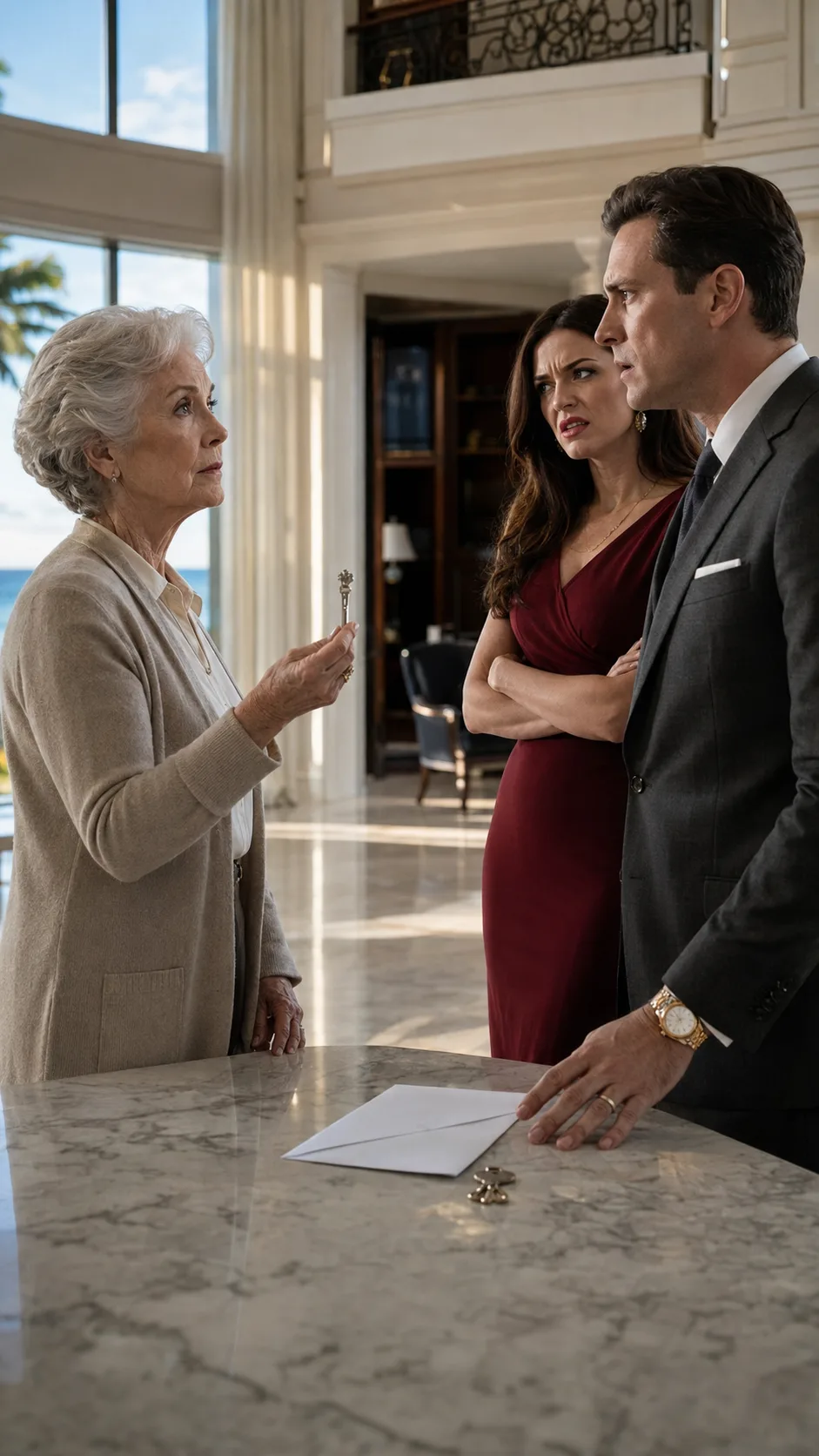
Margaret walked toward the glass doors overlooking the ocean.
Chapter 3
Margaret walked toward the glass doors overlooking the ocean.
Preston remained on his knees, the white envelope resting across his legs. Vanessa stood behind him, pale and rigid, as though the room itself had betrayed her.
“Tomorrow morning at nine,” Margaret said, “my attorney will serve you with a formal restructuring plan.”
Preston looked up.
“What kind of plan?”
“You will surrender the Bellevue house.”
Vanessa gasped.
“You can’t take our home!”
Margaret turned at the terrace doors. The fading afternoon light sharpened the lines of her face.
“I am not taking your home, Vanessa. I am taking my house. My trust purchased the mortgage when Preston could no longer qualify for refinancing. You have lived there for seven years without paying a dollar toward the principal.”
“That was family money!”
“It was my money.”
Vanessa looked at Preston.
“Tell her no.”
He did not move.
Margaret continued.
“You will have forty-eight hours to arrange a move into a
modest rental. If the house is not vacant by Wednesday at noon, my attorneys will execute the demand notes and the sheriff will supervise possession.”
“You are treating us like criminals,” Vanessa said.
“No. Criminals are punished. You are being required to repay what you owe.”
Preston’s hands tightened around the envelope.
“If you take the house, Vanessa will leave me.”
Vanessa stared at him, shocked that he had said it aloud.
Margaret’s expression did not change.
“If your marriage survives only while you appear wealthy, then the house is not the greatest thing you are about to lose.”
Vanessa’s face hardened.
“This family has always looked down on me.”
Margaret almost laughed.
“You entered my villa today, measured my bedroom with your eyes, and told a seventy-one-year-old widow she belonged in a cottage. Do not ask me to comfort you because the theft failed.”
“Fight her,” Vanessa demanded, turning
to Preston. “Call your lawyers. File the competency petition.”
Preston slowly looked at the blue binder on the rug.
“My lawyers drafted the documents based on what I told them.”
“And what did you tell them?”
“That Dad’s estate was mine.”
Vanessa stepped back as if he had struck her.
Margaret walked to the front door and opened it.
“Get out of my house.”
She did not shout. She did not need to.
Preston rose unsteadily. He placed the white envelope under one arm and bent to retrieve the binder, but Margaret stopped him.
“That stays here.”
He released it.
Vanessa crossed the room first, her heels striking the porcelain like a series of small accusations. Preston followed more slowly. At the threshold, he removed his father’s gold watch.
He held it out.
“Do you want this too?”
Margaret looked at the watch Charles had worn through years of rain,
sawdust, victories, and hidden failures.
“No. Keep it until my attorney tells you otherwise. Perhaps by then you will understand that wearing another man’s watch does not give you his life.”
Preston closed his fist around it and left.
Ten minutes later, Margaret stood alone on the terrace and listened to his car disappear down the gravel drive.
The wind carried salt, cedar, and approaching rain.
She pulled a worn gold locket from her cardigan pocket. Inside was a photograph of Charles in 1978, standing in front of their first lumber yard with his sleeves rolled up and a pencil behind his ear.
“I tried, Charles,” she whispered. “I tried to let him remain the son you imagined. But now he has to learn to become a man.”
She returned inside, lifted the binder from the rug, and placed it beside Charles’s photograph.
Then she went to the kitchen.
The gravy had formed a skin. The vegetables were cold. The roast, however, was perfect.
Margaret warmed one plate and sat at the table alone.
For the first time in forty years, the silence did not feel like abandonment.
It felt like ownership.
At nine the next morning, Preston received the restructuring documents.
The Bellevue house went on the market three weeks later.
Preston and Vanessa moved into a two-bedroom apartment near the highway in Renton. The building had no ocean view, no private entrance, and no dining room large enough for Vanessa’s twelve-seat table.
Vanessa spent the first month insisting Preston should challenge Margaret. She contacted three law firms. Each reached the same conclusion: the debt agreements were valid, the liens were recorded, and Margaret’s trust held enforceable control over the assets.
Once Vanessa realized there was no hidden inheritance and no court battle likely to restore the lifestyle she had married, her anger shifted entirely toward Preston.
Four months later, she filed for divorce.
Preston lost the house, his luxury car, his country club membership, and most of the polished friends who had admired his surname more than his character. The logistics firm survived, but only under strict financial oversight. Half his distributions went directly into the grandchildren’s trust, exactly as Margaret required.
For the first time in his life, he needed a salary.
He accepted a mid-level management job at a regional timber supply company.
On his first morning, he arrived wearing a work jacket instead of a tailored suit. His supervisor handed him a hard hat, a clipboard, and a schedule beginning before sunrise.
The work was not glamorous.
The expensive softness vanished from his hands.
Calluses replaced it.
He did not contact Margaret for six months.
One rainy Saturday, the doorbell rang at the villa.
Margaret opened the door and found Preston on the porch.
He wore plain jeans, worn boots, and a dark work jacket. His face was leaner. The gold watch was gone. In his hands was a small box from the bakery near the docks.
He did not try to step inside.
“May I come in, Mother?”
Margaret looked at him carefully.
There was no envelope under his arm. No lawyer waiting in the car. No speech prepared behind his eyes.
She noticed the calluses on his palms.
“What is in the box?”
“Lemon pastries. The kind Dad used to bring home.”
“Your father always ate two before dinner.”
“I remember.”
Margaret opened the door wider.
“The tea is nearly ready.”
Preston wiped his boots on the mat before entering. When he reached the marble table, he paused.
Six months earlier, he had placed his keys there as if the house were already his.
This time, he kept them in his pocket.
They sat in the kitchen while rain streaked the windows.
For several minutes, Preston said nothing. Then he placed both hands around his teacup.
“I blamed Dad,” he said. “Then I blamed you. Then Vanessa. Then the lawyers.”
Margaret waited.
“Eventually there was nobody left.”
“And what did you find?”
“Myself.”
His answer was quiet.
“I thought being Charles Hale’s son made me important. I thought wealth was proof that I deserved more than other people. When you took it away, I believed you had taken my identity.”
“I did not take it.”
“No. You showed me it had never been mine.”
Margaret’s eyes softened, but she did not rescue him from the truth.
“I was cruel to you,” he continued. “Not only that Sunday. For years. I treated everything you gave me as evidence that I was entitled to more.”
“Yes.”
“I am sorry.”
The apology did not repair everything. It did not erase the cottage, the papers, or the competency threat.
But it was the first honest thing Preston had offered her without asking for something in return.
Margaret poured more tea.
“An apology is a foundation,” she said. “Not a finished house.”
He nodded.
“Then teach me how to build.”
Outside, the storm moved east over the cove. Golden light broke through the clouds and spread across the marble floor.
Margaret looked toward Charles’s photograph, then back at her son.
She began with the truth about the company, the mistakes she and Charles had made, and the cost of protecting a child from every consequence. Preston listened without interrupting.
He did not inherit an empire that afternoon.
He received something harder and far more valuable: the chance to construct a life that belonged to him.
Not from appearances.
Not from borrowed money.
Not from a father’s lie.
From work, humility, and truth.
Sometimes the greatest gift a mother can give her child is not a fortune.
Sometimes it is the refusal to let that fortune destroy him.
THE END
Chapter complete
You have reached the end of this chapter.
Continue reading
A few more worlds to get lost in after this chapter.




