Brandon’s sobs came through the phone in broken waves.
Chapter 3
Brandon’s sobs came through the phone in broken waves.
“Mom, Megan took everything. She took Oliver, the money, even the furniture. I can’t pay the rent. I need somewhere to stay.”
I closed my eyes.
For a moment, I saw him at six years old, running toward me with a scraped knee. A mother does not stop loving her child simply because the child becomes cruel.
But love was not the same as surrender.
“Brandon,” I said quietly, “I am sorry you are hurting.”
“Then help me. Please. You have more than enough.”
There it was again. Not remorse. Need.
“You had a mother who would have given you almost anything,” I said. “Then you watched your wife slap her and chose to protect your comfort.”
“I made a mistake.”
“You made hundreds of choices. The wedding was only the moment they became impossible to ignore.”
His breathing grew harsh. “What about Oliver? Is your pride more important than
your grandson?”
“My dignity is not pride,” I replied. “And Oliver already has an education fund that neither you nor Megan can access. I will protect him without allowing you to use him against me.”
“Mom—”
“I am not your safety net anymore.”
I ended the call.
My hands shook afterward, and I cried. Boundaries do not always feel powerful when you set them. Sometimes they feel like grief. But when the tears stopped, I realized I was sitting straighter than before.
The foundation grew into three cities, and Sophie became our lead advocate because she understood how manipulation entered families disguised as concern.
She taught our staff to recognize gentle-sounding phrases—“You’re too old to understand” or “Let me handle the money”—that often concealed control.
A year after the wedding, Sophie lost the apartment she had shared with a cousin after Megan pressured the family to cut her off. She
called me from her car, trying not to cry.
“I knew telling the truth would cost me,” she said. “I just didn’t know it would cost everyone.”
“Then you will build a new family,” I told her. “One that does not require silence as the price of belonging.”
The apartment beside mine became available, and Sophie moved in with three boxes, a lamp, and a nervous expression. No one asked her to leave.
Over time, she became the daughter I never had. We cooked together on Sundays, planted herbs on the balcony, and spent long evenings reviewing foundation cases. She never asked what I could give her. She only asked what work needed to be done.
Two years after the wedding, our foundation had helped more than two thousand families and recovered over eight million dollars in stolen assets. We supported legislation that increased penalties for relatives who exploited elderly
family members. When the governor signed the Elder Dignity Protection Act, I stood at the podium beside survivors whose children had tried to erase them.
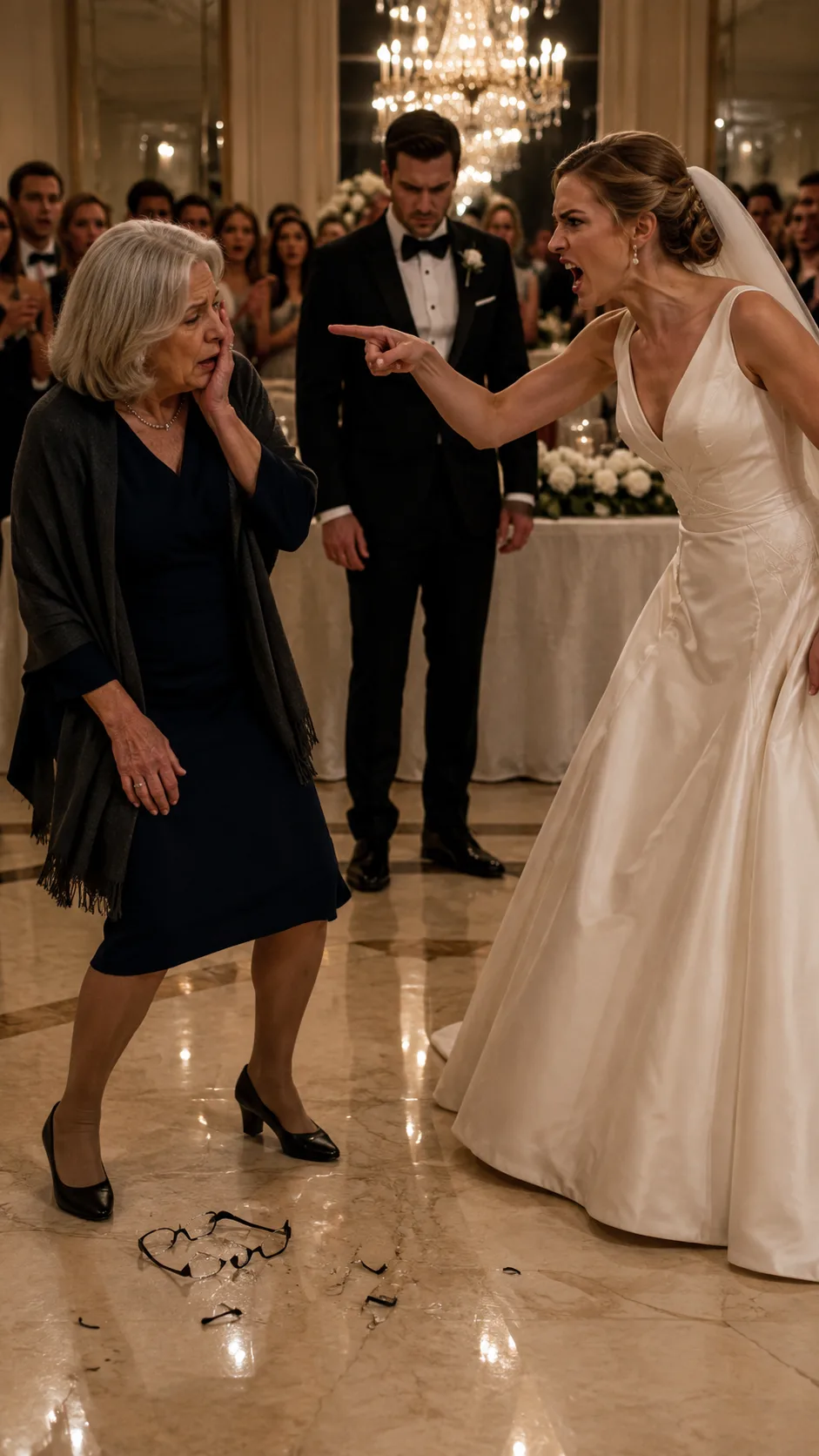
The cameras flashed, but I was thinking about the shattered glasses on the ballroom floor.
Megan had believed that slap would reduce me to silence.
Instead, it gave thousands of people a microphone.
My health changed as my life changed. The headaches stopped. I began sleeping through the night. My blood pressure fell. Dr. Martinez smiled during one appointment and told me I carried the stress levels of a woman ten years younger.
“The body knows when danger has left the room,” she said.
She was right.
When the flower shop closed, I created a community garden and taught seniors to grow herbs and flowers. The earth reminded me that pruning was not cruelty; sometimes it allowed the rest of the plant to survive.
Brandon contacted me only a few times.
The first call came after his coworkers saw a news report about the foundation. He complained that people were judging him.
“You told the whole world our private business,” he said.
“No,” I answered. “Your wife made it public when she hit me before 130 witnesses. I simply stopped hiding what followed.”
The second message arrived on Oliver’s birthday. It contained another photograph. The boy had Brandon’s dark eyes and a small dimple near his mouth. I saved the picture, then added money to his trust.
I would not punish my grandson for the choices of his parents.
The third contact came almost three years after the wedding. Brandon mailed a birthday card.
Inside, he had written:
“Mom, I am sorry. I know I cannot undo what happened. I think about you every day, and I hope you can forgive me.”
I read the message several times.
Once, those words would have shattered me. Now they brought a quiet sadness—and peace.
I wrote back:
“Brandon, I forgave you long ago because I refused to carry anger for the rest of my life. But forgiveness does not mean restoration. Trust is not rebuilt by asking for it. Some bridges cannot be crossed again simply because the person who burned them becomes lonely. I wish you healing, but I cannot return to the mother you expected to use whenever life became difficult.”
I mailed the card and did not wait for a response.
A week later, another letter arrived from an unexpected person: Oliver’s daycare teacher.
Years earlier, Megan had listed me as an emergency contact and forgotten to remove my name. The teacher explained that Oliver had found an old photograph of me in Brandon’s drawer and begun asking about his other grandmother.
“He is curious, bright, and kind,” she wrote. “I thought you might want to know.”
I cried when I finished reading, but they were not hopeless tears.
Maybe one day Oliver would come looking for the truth. If he did, I would not poison him against his parents. I would tell him that people can regret terrible choices, but regret does not erase consequences.
I would tell him boundaries are not revenge.
They are doors we close so violence cannot keep walking in.
Life gave me another beautiful surprise when Sophie became engaged to Michael, a social worker she met through the foundation. He was patient, thoughtful, and never mistook her kindness for weakness.
They planned a spring wedding in our community garden, surrounded by flowers we had planted ourselves.
One evening, Sophie sat across from me at dinner, tears shining in her eyes.
“You are the closest thing to a mother I have,” she said. “Will you officiate our wedding?”
I reached across the table and held her hands.
“Yes,” I answered. “Of course I will.”
On the wedding day, I stood beneath an arch covered in white roses and lavender. There were no chandeliers or crowds measuring anyone’s worth—only people who had chosen one another honestly.
As Sophie and Michael exchanged vows, I felt William close to me.
My husband believed money mattered only when it protected freedom. I once wondered whether hiding our wealth had been a mistake. Now I knew secrecy had revealed character: Megan saw a poor widow and chose greed; Sophie saw a wounded stranger and chose truth.
The difference had never been money.
It was love.
After the ceremony, Sophie kissed my cheek—the same cheek Megan had struck years earlier.
“I love you, Aunt Ellaner,” she whispered.
“I love you too.”
That evening, I returned to my balcony and watched the sky turn orange over the city. The apartment keys rested on the table beside me. They were the same keys Megan had demanded, but they no longer represented fear or possession.
They represented choice.
I had chosen to keep my home.
I had chosen to protect my dignity.
I had chosen to transform pain into shelter for people who had nowhere else to go.
At seventy-one, my life was fuller than at sixty-eight. The foundation operated in twelve states, Sophie had built an honest family, and Oliver had a future his parents could not steal.
And I was finally free from the belief that being a good mother meant accepting anything from my child.
Family is not permission to humiliate, exploit, or assault someone. Love that demands your silence is not love. Forgiveness that requires you to reopen the door to abuse is not healing.
The slap that was meant to break me became the sound of my old life ending.
Megan lost the fortune she thought she could take. Brandon lost the mother he assumed would always rescue him. But I gained something no inheritance could purchase.
I gained myself.
My name is Ellaner Hughes. I am seventy-one years old. I still drive a modest car, grow flowers, and wear clothes that make me comfortable. But I no longer make myself small so other people can feel powerful.
And whenever someone asks whether I regret walking away from my only son, I give them the truth.
I did not walk away from love.
I walked away from abuse.
There is a difference—and learning it saved my life.
THE END
Chapter complete
You have reached the end of this chapter.
Continue reading
A few more worlds to get lost in after this chapter.




