PART 2 — FROM A PARK BENCH TO MENDOZA ENTERPRISES
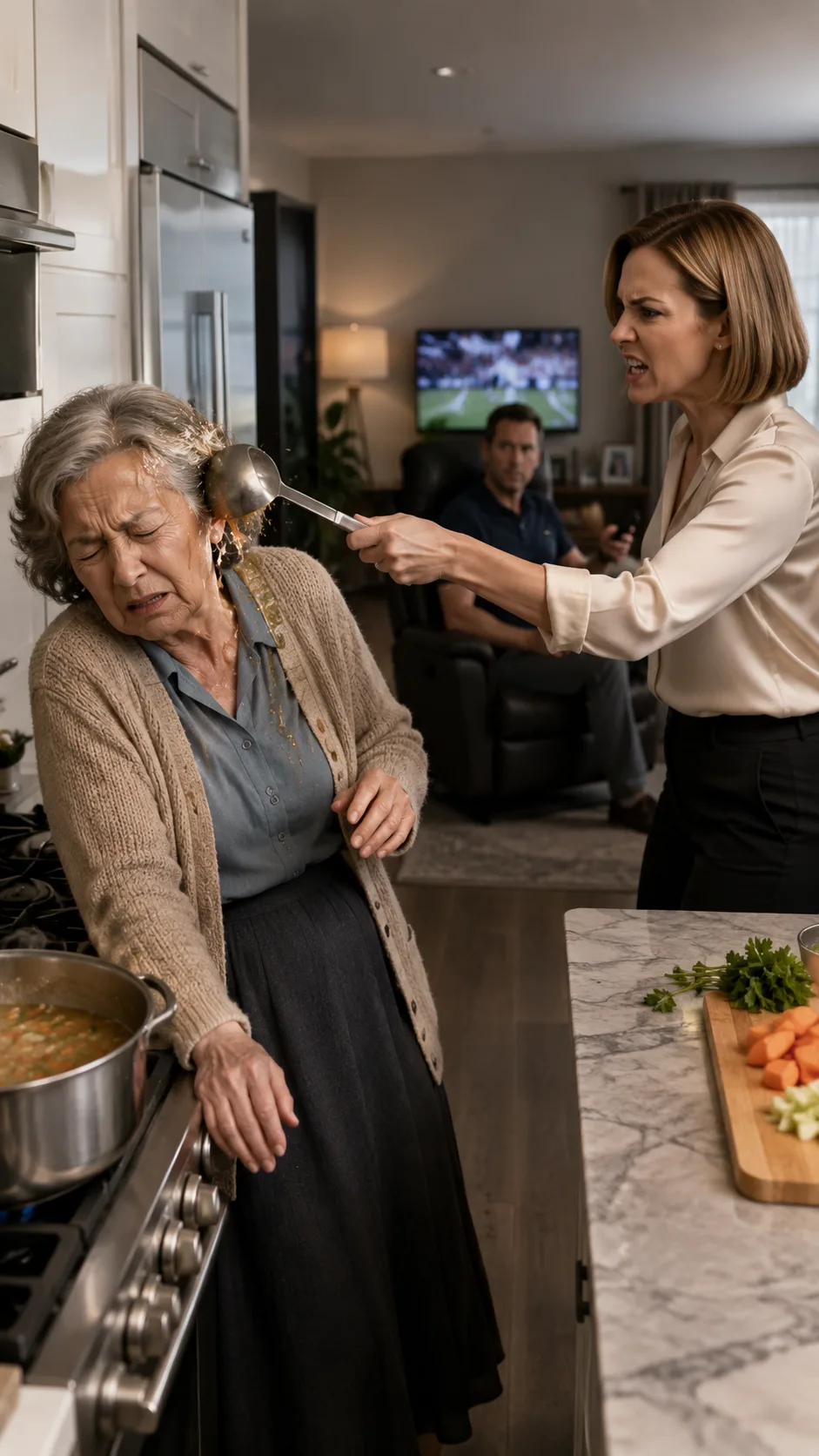
I was chopping carrots at the kitchen island, trying to make every slice even, trying to make the broth taste the way it had tasted in our old house, when Dawn burst into the kitchen like a storm.
Chapter 2
PART 2 — FROM A PARK BENCH TO MENDOZA ENTERPRISES
I was chopping carrots at the kitchen island, trying to make every slice even, trying to make the broth taste the way it had tasted in our old house, when Dawn burst into the kitchen like a storm.
“What are you doing?” she asked in that sharp voice I knew too well.
“Soup for dinner,” I replied softly, without turning around. “Robert’s favorite recipe.”
She came closer and leaned over the pot. Her face twisted in disgust.
“This looks like pig slop. How much salt did you put in? Are you trying to poison us?”
Her words landed like little knives. I tried to explain, but she would not listen. She grabbed the ladle from the pot, and before I could move, she slammed it against the side of my head.
The blow stunned me.
For a second, I could not breathe. I felt the heat of the metal, the wet burn of soup running into my hair, the sharp pain in my temple.
“Who cooks like that, you useless woman?” Dawn screamed, her voice echoing through the apartment.
I stumbled and caught the edge of the stove.
From the living room, I heard the television. Robert was there. He could hear everything. And then, like a door closing inside my chest, I heard him turn up the volume.
That was the moment something inside me went out.
The physical pain was nothing compared to the betrayal of that silence.
My son, the boy I had carried inside my body, the child I had raised with every ounce of love I had, chose the sound of a television show over his mother’s suffering.
I stood there leaning against the stove, the ladle dripping soup at my feet. Dawn looked at me with eyes full of contempt, waiting for me to apologize, to kneel, to beg forgiveness for existing.
But I could only think of Robert.
Of how the television volume had risen just as she screamed.
Of how he knew exactly what was happening and chose not to
see it.
“You’re pathetic,” Dawn spat, crossing her arms. “Look at this mess. You can’t even make soup. I don’t know why Robert insisted on bringing you here. You’re a burden. A useless person taking up space.”
Every word was another slap.
I wanted to answer. I wanted to defend myself. But my voice was trapped somewhere deep inside my throat.
I tried to clean up the drops of soup from the floor, but my hands trembled. My head throbbed where the ladle had struck. Dawn stormed out of the kitchen, leaving me alone among the steam, the spilled soup, and the terrible silence.
Five minutes.
That was all it took for me to make a decision.
I looked at the pots lined up on the stove. I looked at the dishes stacked in the drainer. I looked at that kitchen I had cleaned every day for months, trying to
earn a place in a home that had never been mine.
And something inside me simply exploded.
It was not planned. It was not calculated. It was pure survival.
I grabbed the largest pot, the one holding the soup she had insulted so much, and emptied it into the sink. The hot liquid rushed down the drain with an almost violent sound. Then I grabbed another pot, and another. I let them fall, some onto the floor, others against the counter. Plates slipped from my hands. Cups shattered. Forks and spoons scattered across the tile.
It was chaotic, loud, necessary.
For the first time in months, the house heard me.
I heard Robert’s hurried footsteps.
“What was that?” he shouted from the hallway.
When he reached the kitchen, he stopped dead. His face went pale as he saw me surrounded by overturned pots, spilled soup, and broken dishes.
There was a thin line of blood on my temple where the ladle had hit me.
“Mom,” he whispered. “What did you do?”
But he did not come closer. He did not touch me. He just looked at me as if I were the problem.
Dawn appeared behind him, and her look of horror quickly became fury.
“She’s crazy,” she shrieked, pointing at me as if I were dangerous. “Your mother is completely insane. Look at this mess. She destroyed my entire kitchen. Call someone, Robert. This woman needs to be locked up.”
Robert looked at me.
I looked back at him, still hoping he might say something. That he might defend me. That he might at least ask why I had done it.
But he only shook his head, disappointed and ashamed.
“Mom,” he said, “why? Why do you do these things?”
“Why?” I repeated, my voice hoarse and broken. “Your wife hit me with a boiling ladle, Robert. She hit me. And you turned up the television.”
The words came out like knives.
He blinked, confused, or pretending to be confused.
“I didn’t hear it, Mom. I didn’t. I didn’t know—”
“Liar.”
The word hung between us like poison.
“You were there,” I said. “You heard everything, and you chose to do nothing.”
Dawn stepped between us, her face red with rage.
“I won’t tolerate this,” she snapped. “I will not live under the same roof as this ungrateful old woman. Robert, you have to choose. Either she leaves, or I do.”
The silence that followed was worse than any scream.
I looked at my son, begging him with my eyes to choose me, to remember who raised him, who sat beside him through childhood fevers, who worked long shifts to help pay for his college, who packed his lunches, ironed his shirts, prayed for him, believed in him.
But Robert looked at the floor with his hands in his pockets.
“I’m sorry, Mom,” he finally mumbled. “But I think it’s better if you look for somewhere else. This isn’t working. You’re causing problems. You need to leave.”
The world stopped.
My heart stopped.
Everything stopped.
“You’re kicking me out?” I asked, though I already knew the answer. “Your wife hits me, and you kick me out?”
“It’s not like that, Mom. Dawn and I need our space. You need your independence. It’ll be better for everyone.”
He spoke in rehearsed phrases, empty words someone else had put in his mouth. My son was not there anymore. Only a stranger with his face remained.
“When?” I asked, feeling tears burn behind my eyes.
“Tomorrow morning. I’ll call you a taxi. You can stay in a hotel while you find something permanent. I’ll help you with some expenses.”
He was dismissing me like an employee.
He did not even have the courage to look me in the eye.
That night, I did not sleep. I sat on the edge of the bed and looked at Henry’s photographs, wondering what he would say if he could see me now. I packed slowly, folding each item carefully, as if order on the outside could contain the chaos inside me.
At dawn, I heard the taxi horn.
Robert waited by the front door with two hundred dollars in his hand.
“For you to settle in,” he said, still unable to meet my eyes.
I did not hug him. I did not say goodbye. I took the money, gripped my suitcases, and left that apartment without looking back.
The taxi driver asked where I wanted to go.
I had no answer.
“Any cheap motel,” I finally told him.
He took me to a place on the outskirts of Los Angeles, one of those roadside motels with flickering neon signs, cracked pavement, and carpets that smelled faintly of dampness and cigarettes no amount of cleaning could remove. The room cost thirty dollars a night. I did the math in my head.
With two hundred dollars, I could survive less than a week.
The room was small, with stained beige walls and a bed that creaked every time I moved. There was a window overlooking the parking lot, where cars came and went at all hours. The neon sign outside flickered every few seconds, bathing everything in a sick reddish glow.
I sat on that bed and, for the first time in months, cried without restraint.
They were not silent tears. They were deep sobs pulled from some dark place in my chest. Years of swallowed humiliation, accumulated pain, and unspoken words broke loose all at once.
I cried for Henry, who had left me alone in a world I no longer recognized.
I cried for Robert, the child who once hugged me and called me his hero.
I cried for myself, for the woman I had been and the woman I no longer knew how to be.
When the tears dried, only emptiness remained.
I looked at myself in the bathroom mirror beneath the cruel fluorescent light. A seventy-one-year-old woman stared back at me. Deep wrinkles. Swollen eyes. Messy gray hair. A purple mark on my temple where the ladle had struck.
I touched the bruise gently and realized the physical pain was almost a relief compared to the other pain, the one without a name.
The days began to blur.
I stayed in the room, watching television without really seeing it, eating only what I had to. I went out only to buy something from the vending machine in the hallway. Salty chips. Instant coffee. Granola bars. Once, the machine swallowed my last two dollars without giving me anything. I stood there watching the money disappear and thought it was the perfect metaphor for my life.
I sent messages to Robert.
At first, I tried to be dignified.
Son, I need to talk to you.
Nothing.
Then I tried to be more direct.
Robert, I’m running out of money.
Silence.
Finally, I stopped trying. The messages showed as read, but there was never a response. It was like shouting into a bottomless pit.
A week later, the money ran out.
The motel receptionist, a man in his forties with tired eyes and a round belly, knocked on my door.
“Ma’am, I need you to pay or vacate the room.”
His voice was not cruel. It was worse than cruel. It was professional.
I explained my situation. I begged for one more day. He shook his head.
“I’m sorry, ma’am. Those are the rules.”
I packed my suitcases again. Four suitcases that now weighed like coffins. I dragged them across the parking lot under a scorching California sun, not knowing where to go. I walked for hours. My feet hurt. My hands blistered from carrying so much weight. But I kept going because stopping meant accepting that I had nowhere to go.
I ended up in a park near downtown Los Angeles. There were metal benches under jacaranda trees, pigeons pecking at crumbs, children playing on the swings while their mothers watched from shaded picnic tables.
I sat on a secluded bench and watched life continue as if I did not exist.
A woman passed with her young daughter. The girl looked at me curiously, but her mother pulled her hand and quickened her pace, as if poverty were contagious.
That was my first night sleeping outside.
I did not really sleep. I sat upright, clutching my purse, startled by every noise. There were other homeless people in the park, mostly men huddled beneath cardboard or old blankets. One of them approached and offered me a piece of stale bread.
“Eat it, Grandma,” he said. “You gotta be careful out here.”
I took the bread with trembling hands and thanked him. He nodded and walked away, dragging a bag full of empty cans.
The days turned into a survival routine.
I searched for food in dumpsters behind restaurants. At first, I was disgusted. I was ashamed. But hunger is stronger than pride. I found day-old bread, bruised fruit, leftovers people had abandoned in takeout containers. I ate hidden in alleys where no one could see me.
There was a church a few blocks away that served soup on Tuesdays and Thursdays. I lined up with dozens of other people, all with broken stories written on their faces. A young volunteer handed me a bowl with a compassionate smile that somehow made me feel even smaller.
“God bless you,” she said.
I only nodded, unable to form words.
Nights were the worst. Cold, long, full of fear. I lay on the bench with my suitcases around me, using my sweater as a blanket. I heard distant sirens, occasional shouting, and the constant hum of a city that never truly slept.
I thought about Robert lying in his comfortable bed in his heated apartment while I shivered under the stars. I wondered if he thought about me. If he cared. If he knew his mother was sleeping on a park bench.
One morning, a police officer woke me with his flashlight.
“Ma’am, you can’t stay here. You have to move.”
“I have nowhere to go,” I told him.
He sighed, tired from hearing stories like mine.
“There’s a shelter six blocks away. Go there.”
He gave me the address and left.
I tried to go, but the shelter was full.
“Come back early tomorrow,” they told me.
Always tomorrow. Always wait. Never now.
Two weeks passed like that. Maybe three. I lost count. The days blurred into exhaustion and hopelessness. My clothes were dirty. My hair was greasy. My skin felt covered in the dust of the city. I had become one of those invisible people everyone avoids looking at.
A statistic.
A shadow.
But in the middle of all that suffering, something strange happened. I started remembering things I had forgotten.
I remembered that before I married Henry, I wanted to study literature.
I remembered winning a poetry contest in high school.
I remembered there had been a time when I had dreams of my own before becoming a wife, a mother, a grandmother, a shadow in other people’s homes.
One afternoon, while searching through my suitcases for a clean blouse, I found an envelope I did not remember packing. It was old, yellowed, and had my name written across the front in Henry’s unmistakable handwriting.
My heart leaped.
I opened it with trembling hands.
Inside was a letter and several folded documents. The letter began, My dearest Helen.
I recognized immediately when he must have written it. Two years earlier, Henry had been hospitalized with pneumonia. I thought it had only been a scare. Now I understood that he had faced his own mortality and prepared for a future I had refused to imagine.
If you are reading this, it means I am no longer with you, the letter said. Forgive me for not telling you everything while I was alive. I always wanted to shield you from worries about money, business, and legal matters. Now I see it was a mistake to keep you in the dark.
My eyes filled with tears as I read. Henry’s voice lived in every word.
For the last thirty years, I made investments. Small at first, then larger. I bought properties when no one wanted them, in neighborhoods that later became valuable. I saved every extra cent. I did it all thinking about our future, about your security. I never told you because I did not want you to worry. I wanted to surprise you in our old age with peace of mind, knowing you would be taken care of.
My breathing quickened.
I unfolded the documents that accompanied the letter.
They were deeds. Property titles. Investment certificates.
My eyes scanned the pages, unable to believe what they were seeing. An apartment building downtown. Another in North Hollywood. Commercial units near a shopping corridor. Company stocks. Bank accounts with numbers that looked impossible.
My hands trembled so badly the papers nearly fell.
There were thirteen properties in my name.
Thirteen.
Entire buildings, apartments, commercial spaces.
And one address was painfully familiar.
Magnolia Street, number 452.
It was the building where Robert and Dawn lived. The building where I had been humiliated, struck, discarded, and thrown away like trash.
That building was mine.
It had been mine all along.
Something turned in my stomach. It was not only surprise. It was disbelief, pain, and something darker that began slowly growing.
Henry’s letter continued on a second page.
Contact the lawyer, Roger Mendes. He has all the original documents and will help you with everything. His number is at the end of this letter.
Helen, my love, never let anyone make you feel less than you are. You are a strong, capable, valuable woman. If someone treats you badly, remember that you have the power to defend yourself. I loved you every day of my life. Take care. Your Henry.
I sat on that park bench, surrounded by my suitcases, holding proof that I was not the destitute woman everyone saw when they passed by.
I was the owner of an estate worth millions of dollars.
Millions.
And I had been sleeping on the street, eating from dumpsters, begging for crumbs.
The irony was so brutal that I did not know whether to laugh or cry. I did both. I laughed like a madwoman as tears streamed down my dirty cheeks. People passing through the park looked at me with pity or fear and moved away from the crazy old woman on the bench.
But I was not that woman anymore.
Or maybe I still was.
But now I knew something they did not.
I searched through my things until I found enough change and then found a pay phone that still worked near a liquor store on the corner. My fingers trembled as I dialed the number for Roger Mendes.
It rang three times before a professional voice answered.
“Mendes and Associates Law Firm. How may I help you?”
“I need to speak with Mr. Roger Mendes. It’s about Henry Salazar.”
My voice sounded hoarse, broken from weeks of barely using it.
There was a pause.
“Who is speaking, please?”
“I am Helen Salazar. Henry’s widow.”
Another pause, longer this time.
“Mrs. Salazar. We have been trying to contact you for months. Where are you? Mr. Mendes urgently needs to see you.”
I gave them the park’s address. They told me they would send a car in less than thirty minutes.
I returned to my bench and waited, clutching those documents as if they were the only real things left in the world.
Maybe they were.
The car that arrived was black and elegant, with tinted windows. The driver got out and looked at me with a neutral, professional expression, as if picking up homeless women from city parks were part of his ordinary routine.
“Mrs. Salazar?”
I nodded.
He loaded my suitcases into the trunk and opened the back door for me. The interior smelled of leather and expensive air freshener. I felt dirty and out of place, but I did not care anymore.
The law firm was in the financial district, in one of those glass buildings that reflected the sky. We rode a silent elevator to the fifteenth floor. The receptionist looked me up and down but said nothing.
“Mr. Mendes is waiting for you in his office.”
Roger Mendes was a man in his fifties with perfectly combed gray hair and thin-rimmed glasses. He stood when I entered. For one second, surprise crossed his face at the sight of me, but he quickly replaced it with professional calm.
“Mrs. Salazar, please sit down. May I offer you water or coffee?”
“Water, please.”
My voice was barely a whisper.
He poured a glass from a crystal carafe and handed it to me. I drank as if I had not had water in days, which, in some ways, felt true.
“Mrs. Salazar,” he said gently, “we have been trying to locate you since Mr. Henry passed away. We left messages at your old house. We sent letters. Your son told us you had moved, but he did not provide a contact address.”
“My son,” I said, the words bitter on my tongue. “My son kicked me out of his home three weeks ago. I have been living on the street.”
The lawyer’s expression tightened.
“I am very sorry to hear that. But I want you to know your financial situation is very solid. Your husband was an extremely foresighted man. Have you reviewed the documents he left you?”
I took the wrinkled envelope from my purse and placed it on his desk.
“I found them yesterday. I don’t understand everything they say.”
Roger reviewed them carefully.
“These are duplicates. I have the certified originals here. Allow me to explain your current situation, Mrs. Salazar. You are the owner of thirteen properties in the city, valued at approximately eight million dollars total. Additionally, you have investments in funds and stocks worth roughly two million dollars. Your husband also left you three bank accounts with readily available cash of approximately five hundred thousand dollars.”
The numbers floated in the air like something unreal.
Ten million dollars.
And I had been searching for food in dumpsters.
“It can’t be real,” I whispered.
“It is completely real, Mrs. Salazar. And there is something else you should know. One of the buildings you own is on Magnolia Street, number 452. According to our records, your son, Robert Salazar, and his wife, Dawn, occupy apartment 301 in that building.”
“That’s correct,” I said slowly.
“Then you should know they have been living there under a reduced-rent contract your husband granted them five years ago. They pay barely four hundred dollars a month for an apartment that would be worth around twenty-five hundred on the market. It was a family favor Mr. Henry granted them.”
Four hundred dollars.
Robert was paying four hundred dollars to live in a luxury apartment because of his father’s generosity.
And he had thrown me onto the street.
He had left me with nothing.
Roger continued explaining details about taxes and property management, but I barely heard him. My mind was working on something else.
“Can I cancel that contract?” I asked suddenly.
Roger stopped and looked at me carefully.
“You are the owner, Mrs. Salazar. You can do what you wish with your properties, but there are legal procedures we must follow. You cannot simply remove them without notice.”
“I don’t want to remove them yet,” I said. My voice was colder than I expected. “I want their rent adjusted to the market price. Twenty-five hundred dollars. Have them pay that.”
The lawyer nodded slowly.
“That is within your rights. We would need to notify them thirty days in advance of the change in terms. Are you sure you want to proceed?”
“Completely sure.”
Roger typed notes into his computer.
“Very well. I will prepare the documents. Now, Mrs. Salazar, there are more immediate matters. Your housing situation, for example. You have several options. You can move into any of your unoccupied properties, or I can help arrange temporary lodging while you decide.”
“I want to see the buildings,” I said. “All of them. I want to know exactly what I own.”
“Of course. We can organize visits beginning tomorrow. In the meantime, allow me to arrange a hotel room for you, somewhere appropriate where you can rest and recover.”
He stood and made a call. Within minutes, everything was arranged. A five-star hotel downtown. An executive suite. Paid for from my own account.
Before I left, Roger handed me a bank card.
“This gives you access to one of your checking accounts. There are fifty thousand dollars available for immediate expenses. Use what you need. And Mrs. Salazar, one more thing.”
He opened a drawer and took out a sealed envelope.
“Your husband asked me to give you this if you ever came to see me under difficult circumstances. He made me promise. His exact words were, ‘If my Helen comes to you beaten down by life, give her this and tell her I always knew she was stronger than she thought.’”
I took the envelope with hands that no longer trembled quite as much.
I opened it right there in front of Roger.
It was another letter from Henry, shorter this time, written in black ink on thick paper.
My love, if you are reading this, it means someone hurt you enough that you finally sought help. I know your pride. I know how hard it is for you to ask for anything. But I want you to know one thing. I built all this for you. Every property, every investment, every penny saved was meant for the day when I would be gone and you would need to defend yourself. Don’t let anyone, not even our own blood, make you feel small.
You’re a giant, Helen. You always were.
Now prove it.
Tears streamed down my cheeks as I read.
Roger had the delicacy to look away, pretending to review papers.
I folded the letter carefully and placed it with the first one. Henry had known. Somehow, he had known that one day I would need this. A shield. Armor. A castle of my own.
The hotel was everything my life had stopped being.
Soft carpets. Sheets that smelled faintly of lavender. A bathroom with a marble tub. I stood in the middle of the suite for several minutes, just looking. It seemed unreal. Twenty-four hours earlier, I had slept on a park bench. Now I stood in a room that cost more per night than Robert had handed me when he threw me away.
The first thing I did was take a bath.
I filled the tub with hot water to the brim and lowered myself into it. The water darkened with weeks of grime. I scrubbed my skin until it hurt. I washed my hair three times, removing every trace of the street from my body. When I stepped out, I wrapped myself in a white robe hanging behind the door. It was so soft it almost made me cry again.
I ordered room service.
Soup. Fresh bread. Roast chicken. Salad. Dessert.
When the food arrived on a cart with a white tablecloth, I sat down and ate slowly, savoring every bite.
It was not just food.
It was dignity.
It was power.
It was proof that I still existed as something more than a shadow.
That night, I slept twelve hours straight. I slept without fear, without cold, without being startled awake by voices in the dark. When I woke, sunlight was slipping through the curtains, and for a moment I did not remember where I was.
Then everything returned.
The documents. The money. The properties. My new reality.
For the next few days, Roger took me to see each of my properties. Apartment buildings. Commercial spaces. Even a small shopping center in South Los Angeles. Each place represented years of Henry’s silent work, investments made with patience and vision. Roger explained the rental contracts, maintenance costs, tax responsibilities, monthly income.
I listened and took notes like a diligent student.
“The net income from all your properties totals approximately forty-five thousand dollars a month,” he told me one afternoon while we reviewed reports in his office. “After taxes and maintenance, you are looking at about four hundred thousand dollars a year. That is without touching the principal capital.”
Four hundred thousand dollars a year.
And I had begged for a bowl of soup at church.
The irony was still brutal. But now there was something else too.
A plan.
Cold, patient, precise.
“Roger,” I said one afternoon, “I need us to make some changes. But they must be done discreetly. I don’t want anyone knowing I am behind them.”
He leaned back in his chair.
“What kind of changes?”
“First, the building on Magnolia Street. I want to raise my son’s rent to market price as we discussed, but I also want every contract in that building reviewed. If there are other special arrangements, reduced prices, favors being granted, I want everything returned to normal rates. Everyone. I want that building to operate as a real business, not a charity.”
Roger nodded and took notes.
“It can be done. Anything else?”
“I want new clothes. I want to change my appearance. And I want a business name, something that appears on contracts. I don’t want anyone to know Helen Salazar owns all this.”
“We can create a legal entity,” he said. “An LLC. You will remain the beneficiary, but public-facing documents can use the company name. It is perfectly legal and common in real estate.”
“Good. Call it Mendoza Enterprises.”
Over the next two weeks, I transformed.
I went to beauty salons where my hair was cut and dyed, the gray softened into an elegant brown. I went to boutiques where attentive staff helped me choose clothing that fit the woman I was becoming: pearl-gray dresses, earth-toned pantsuits, dark green silk blouses, nothing flashy, everything composed. I bought new glasses with modern frames. I got a manicure. I learned how to use a little makeup to soften the deepest lines.
I was not becoming someone else.
I was uncovering the Helen who had been buried under years of silent service.
Roger taught me how to review financial reports, read bank statements, and make business decisions. I learned quickly, discovering a part of myself that had never had the chance to develop. I had spent fifty years cooking and cleaning, but my mind was still sharp, capable, hungry.
“You have a talent for this,” Roger told me one day. “Your husband chose his investments well, but you have an instinct for seeing opportunities.”
Maybe it was natural.
Maybe it had always been there, waiting for someone to give it room.
Henry had been a good man, a loving husband, but even he had kept me in the dark about finances because he believed he was protecting me. Now I understood that real power did not come from being protected.
It came from having the tools to protect yourself.
The rent increase notices were sent to all tenants in the Magnolia Street building, signed by Mendoza Enterprises and represented by Mendes and Associates Law Firm. The increases were legal, justified, and significant, especially for those who had been paying reduced rates for years.
Roger kept me informed of the reactions.
“Some tenants called angrily. Others tried to negotiate. One apartment in particular has called seven times,” he told me one afternoon. “Apartment 301. Robert Salazar. He says he had a special contract with the former owner and that this must be a mistake.”
“It is not a mistake,” I said calmly. “Tell him the special contract expired with the death of Henry Salazar. He must now pay full rate or vacate.”
“He is asking to speak with the owner directly.”
“Tell him the owner is unavailable. All communications go through you.”
Days passed.
Roger continued updating me.
“Mr. Salazar is trying to get a loan to cover the new rent. Apparently, he and his wife are living beyond their means. Credit card debt, a financed car, personal loans. The rent increase is putting pressure on them.”
“Good,” I said.
The word came out cold, without emotion.
I did not feel satisfaction exactly, but I did not feel guilt either. I was watching the natural consequences of Robert’s decisions. He had chosen a wife who spent more than they earned. He had chosen to live in luxury he could afford only because of his father’s kindness. He had chosen to throw his mother out with two hundred dollars and a vague promise of help.
Now he was seeing the price of those choices.
But I was not finished.
There were other levers to move.
Dawn worked as an independent consultant from home. I did some investigating using resources Roger connected me with. I discovered that one of her main clients rented space in another one of my properties at South Commercial Plaza.
“Roger,” I said, “this client renting unit 203 at South Plaza. How much do they pay?”
He checked his files.
“Twenty-two hundred a month. It is a large space. Good business. Always pays on time.”
“Raise the rent to thirty-five hundred.”
“That is a significant increase, Mrs. Salazar. They may decide to move.”
“Then let them move. It is my property, and I want to charge what it is worth.”
The client in unit 203 did not move, but they reduced expenses. One of the first things they cut was contracts with outside consultants, including Dawn.
Roger informed me casually during one of our weekly meetings.
“By the way, your strategy has had side effects. The business at South Plaza canceled several vendor contracts. One of them was with Dawn Salazar.”
I said nothing. I only nodded and continued reviewing documents.
Inside, I felt something close to satisfaction.
It was not revenge yet.
It was justice.
It was the universe readjusting, removing unearned privileges, balancing the scales.
Weeks passed. I continued living in the hotel, studying, learning, transforming. I signed up for an online course in property management. I read books on personal finance I had never had time for before. I met other property owners Roger knew, listened to their stories, absorbed their experience.
One afternoon, while I was drinking coffee on the hotel terrace, Roger called.
“Mrs. Salazar, there is a situation you should know about. Your son requested a hearing with the building’s management. He is two months behind on rent. Under standard policy, we have the right to initiate eviction proceedings.”
“How much does he owe?”
“Five thousand in rent, plus late fees. Sixty-two hundred total.”
Sixty-two hundred dollars.
I could have paid it with the money in my purse.
“Proceed with the eviction,” I said. “Follow all legal protocols.”
“Of course. Are you sure? Once we start, it becomes public. It will appear on his record.”
“I am completely sure.”
To be continued… Click “PART 3” to read the final part: 👉 PART 3 👈
Chapter complete
You have reached the end of this chapter.
Continue reading
A few more worlds to get lost in after this chapter.




