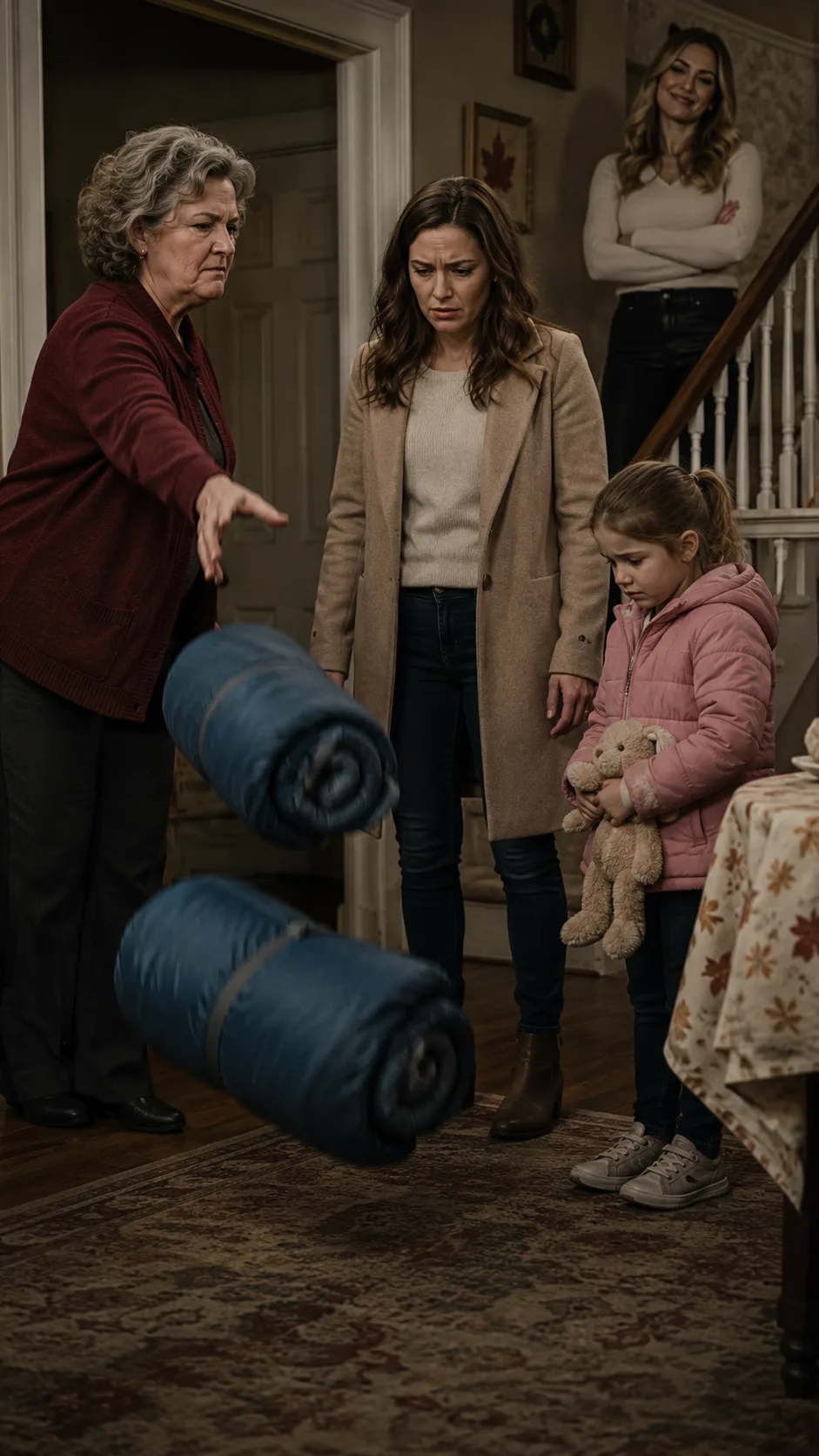
PART 3 — THE EMPTY BOX WASN’T EMPTY ANYMORE
I listened to that one twice.
Chapter 3
PART 3 — THE EMPTY BOX WASN’T EMPTY ANYMORE
I listened to that one twice.
Sitting on the edge of my bed, Marcus asleep, the house dark. That single word, please, pressed against something old and deep in me.
But then I heard it clearly. Her first three messages were about money. The house, the bill, her reputation, her comfort. The fourth was, “Please.”
In 12 years, this was the first time she’d said it to me, and it was about a payment. Not about Lily sleeping on the floor. Not about the birthday she’d never asked me to plan. Not about me.
About $800.
I put the phone down and called Aunt Colleen. She picked up on the first ring.
I was wondering when you’d call, she said.
Has mom talked to you?
Oh, honey, she’s talked to everyone. Come Sunday, she’ll be talking to the Lord himself.
Despite everything, I almost smiled.
Colleen, am I wrong?
She was quiet for exactly two seconds.
You’re 12 years late. That’s the only thing wrong about it.
Colleen Brennan is my mother’s younger sister by three years. She lives in Dayton, teaches high school English, drinks black coffee, and has never told a comfortable lie in her life. Growing up, she was the aunt who slipped me books and said, “Read this. Don’t tell your mother.”
She told me what happened when mom called her.
Your mother was furious. Said you canled everything and you’re being selfish, that you’re abandoning her.
What did you say?
I said, “Pat, that girl has been carrying this family on her back for 12 years, and you gave her a sleeping bag.”
She hung up on me.
I laughed, the short, empty kind.
Then Colleen said something I’ll carry for the rest of my life.
Gwyn, your mom doesn’t favor Denise because she loves Denise more. She favors Denise because
Denise threatens to leave. Your sister has been holding that exit door open for 40 years. I won’t come for Christmas. Don’t expect me at Thanksgiving. Your mother, widowed, scared, in that big house alone, folds every time. And me? You never threatened to leave, not once. And your mother learned that loyalty without consequences is the easiest thing in the world to exploit.
I was quiet.
So, you had to stop being easy, she said.
I had to stop being free.
Colleen told me one more thing.
Your mother’s been telling people you canled the party because of work stress. She’s editing the story, but here’s the problem. 80 invitations went out with your name on them. People are doing the math.
She also confirmed what I needed to hear. Mom’s social security covers basic expenses. She has savings. She won’t lose the house. She’ll have to budget, downsize
maybe, but she won’t be on the street.
I wasn’t pushing her off a cliff. I was letting go of the rope I’d been pulling her up with.
Mid December, I flew to Indianapolis for a two-day client meeting, the kind where you turn your phone off because a distraction could cost you the account. I turned it off Monday morning and forgot about it until Tuesday night at the hotel.
When I powered it back on, the screen filled up like a slot machine. 98 missed calls. Mom, 34. Denise, 22. Numbers from the 740 area code I didn’t recognize, 19. Ruth Meyers, four church friends, four more, Kevin, three, Aunt Colleen, two, cousin Eddie, five, others I couldn’t even place.
I sat on the hotel bed and scrolled. Colleen’s text came first.
The town knows your mom tried to throw a small potluck to replace the party. Nobody showed because they thought the big event was still on for January 4th. Now everyone’s asking questions she can’t answer.
Then mom’s latest voicemail. The voice was unrecognizable, stripped, thin, the sound of a woman whose walls had just come down around her.
Guy, I don’t know what to do. Ruth asked me point blank if you were paying for everything, and I couldn’t. I couldn’t lie anymore. She told the women’s group after the service. Everyone knows about the mortgage, the taxes, all of it. Please, please call me.
I played it again.
Ruth asked me point blank. I couldn’t lie anymore.
Not I’m sorry. Not I was wrong. I couldn’t lie anymore. As if truth were something that happened to her. Like weather.
I put the phone down and stared at the ceiling. 80 invitations with my name on the bottom. A canceled venue. A mother who told different lies to different people until the math stopped adding up.
I didn’t blow the whistle. I just stopped playing the music. And when the music stopped, everyone could hear the silence.
Colleen told me the rest.
Sunday morning, Ridgewood Community Church. Mom walked in the way she always did, navy dress, pearl earrings, Bible under her arm, third pew from the front. Ruth’s seat was next to hers. Ruth nodded, didn’t smile. Nancy Walsh sat one row back, didn’t lean over to whisper the way she usually did. Deborah Clemens looked up, then looked away.
The service was about gratitude. Mom sat through the whole thing staring at the hymnal. After the benediction, the parking lot, that’s where it happened.
Linda Henderson walked up. She’d lived next door to my parents for 30 years. She brought casseroles when dad was dying. She’d known me since I was in pigtails.
Pat, I talked to Gwyn. She told me to ask you, so I’m asking, is it true that she’s been paying your mortgage, your taxes, organizing your parties, and you put her kids on the floor at Thanksgiving?
Mom’s face went still.
Linda, it’s not that simple.
It sounds pretty simple to me. That girl drove three hours with a car full of groceries to cook your Thanksgiving dinner, and you made her children sleep on the floor so Denise could have the bed.
Other women slowed down near their cars, listening, not hiding it.
Mom said nothing.
I’ve known you 40 years, Patricia, and I never once knew your daughter was keeping the lights on.
Linda walked to her car, closed the door, pulled away. Mom stood in the parking lot alone, her Bible still under her arm.
Colleen was parked three rows back watching. She called me that afternoon.
I’m telling you this so you know the truth came out. You didn’t have to say a word, Gwyn. You never had to.
I closed my eyes.
I know. That’s the part that hurts the most.
Weekend before Christmas. Doorbell at noon. Mom on my porch. 3 hours from Ridgewood. Hair pulled back, no earrings, the old corduroy coat she wears when she’s not trying to impress anyone.
Can we talk like adults?
I let her in. Marcus took the kids to the backyard without being asked. We sat at the kitchen table. Same table, different war.
She started where she always starts.
The whole town is talking about me.
I know.
Is that what you wanted? To humiliate me?
No, I wanted you to see me.
I’ve always seen you.
You’ve always used me, mom.
She flinched.
You see my checkbook. You see my oven. You see my car pulling up with groceries. But you don’t see me. You never ask how I’m doing. You never check on Lily. You never call on a Tuesday just to talk.
That’s not fair.
Fair.
I stood up, walked to the bedroom, came back with the box. Brown leather, velvet lining, brass hinge, empty. I set it on the table between us.
You gave Denise grandma’s ring, and you gave me this. And you said, “The box is nice, too, Gwyn.” You missed Lily’s recital for Madison’s shoes. You made my children sleep on the floor. And in 12 years, you never once said thank you. Not once.
She stared at the box.
I didn’t think you needed me to, she said quiet, almost a whisper.
That’s the problem, mom. You decided I didn’t need anything, and you were wrong.
The kitchen was silent. The clock on the wall ticked. Outside, I could hear Lily laughing on the swing.
Mom reached for the box, turned it over in her hands, ran her thumb along the hinge.
I gave Denise the ring because she needed something. You always had everything together.
Having everything together is not the same as having everything.
She held the box like it weighed something now. Like she finally understood what it had always meant.
I kept it for eight years, I said. Not because I wanted the ring. Because that box is the most honest thing you’ve ever given me. Empty. And you thought it was enough.
Her chin trembled. Not the performative kind. The kind that comes before the kind of crying you can’t control.
Gwyn, I—
I held this family together with my bare hands, mom. I paid your mortgage. I paid your taxes. I cooked every holiday. I funded every emergency. I planned your birthday party. 6 months, 80 guests, $30,000. And the thank you I got was a sleeping bag on a cold floor while Denise laughed from the stairs.
She was crying now. Real crying, shoulders shaking, no sound at first, then a ragged inhale that broke the silence wide open.
I didn’t move to comfort her. Not this time. I’d spent 12 years absorbing other people’s pain. This pain was hers to sit with.
What do I do? she asked, voice cracked.
Start by looking at Lily the way you look at Madison. Start there.
She wiped her eyes with both hands. Looked at me. Really looked. Maybe for the first time in a decade.
I love you, mom. I’ve always loved you, but I can’t keep setting myself on fire to keep you warm. That’s not love. That’s just burning.
She nodded. Didn’t argue, didn’t deflect, just nodded.
Something shifted in the room. Not forgiveness. That’s not something you hand over in a kitchen on a Saturday, but acknowledgement. A crack in the wall she’d built, wide enough for light. The empty box sat between us, still empty. But the silence around it had changed.
She stood up slowly, like her body had gotten older in the last hour.
I need to go home. I need to think.
I walked her to the door. She put on her coat, buttoned it wrong, then fixed it.
At the threshold, she stopped, turned.
Gin, the sleeping bags. I knew it was wrong when I did it. I just told myself you’d be okay because you’re always okay.
I know, mom.
I don’t know how to fix this.
You can start by not asking Denise what to do about it.
Something flickered in her eyes. Surprise, maybe, that I knew her that well. Then she nodded.
No hug, no I love you. No dramatic reconciliation on the porch. She just walked to her car, got in, and sat there for a full minute before turning the key.
I watched her pull away. Tail lights fading down our street, left at the stop sign, gone.
Marcus came through the back door. He stood behind me, one hand on my shoulder.
Was I too hard?
You were 12 years too gentle.
I leaned into him, closed my eyes.
Lily’s voice from the hallway.
Mommy, was that grandma? Is she coming for Christmas?
I turned around and crouched down to her eye level, brushed the hair off her forehead.
I don’t know yet, baby, but wherever we are on Christmas, we’ll have beds. I promise you that.
She grinned.
Can I have the star nightlight?
You already have one. Daddy bought it for you, remember?
Oh, yeah.
She ran back to her room.
Marcus and I stood in the doorway, cold air coming in, the street quiet.
Mom drove 3 hours back to Ridgewood alone. I don’t know what she thought about on that drive. But I know what was waiting for her when she got home. An empty guest room and the echo of a question she couldn’t answer.
The week before Christmas, the second domino fell. But this one wasn’t mine.
Colleen called on a Thursday night.
Kevin told Denise he wants a trial separation.
I sat down my coffee.
Kevin?
He went to your mom’s house and told her first. Said he’d been unhappy for years, but didn’t have the words. Said, “Watching all this, the cancellation, the sleeping bags, the way the family treated you, ripped something open.”
That’s not because of me.
No, it’s not. Kevin told Colleen he’d been thinking about it since last summer. He said, and I’m quoting here, “I watched Denise treat her sister like an ATM for 15 years. When Gwyn stopped, Denise didn’t miss Gwyn. She missed the money. That’s when I knew who I married.”
My stomach turned. Not satisfaction. Something heavier.
How’s Denise taking it?
Exactly how you’d expect. She called your mom screaming. Said, “It’s your fault.”
Of course she did.
My phone buzzed while I was still on the line with Colleen. Denise.
You destroyed my marriage. Are you happy now? My kids are crying.
I typed back, “Your marriage is between you and Kevin. I’m not part of it.”
She didn’t respond.
Two days later, Braden called me. He’d borrowed Kevin’s phone.
Aunt Gwyn, are you okay?
I’m fine, buddy. Are you?
Mom says you’re the bad guy, but I don’t think that’s right.
I sat down on the bottom stair.
Braden, I love your mom. I just can’t carry everything anymore.
He was quiet for a second.
Then I looked up how much summer camp costs. That’s a lot of money.
14 years old. Doing the math his mother never bothered to do.
Yeah, buddy. It is.
Thanks for paying for it. Nobody ever said that, so thanks.
I couldn’t talk for a few seconds after that.
Christmas Eve, our house, just the four of us. Marcus strung lights on the porch. Lily and Owen decorated the tree. Ornaments clustered at the bottom three feet, bare branches above. Owen hung his favorite firetruck ornament upside down and refused to let anyone fix it.
I made pot roast, not turkey, not three pies and a casserole for 12. Pot roast, mashed potatoes, rolls from the bakery on Fifth Street, and a chocolate cake from a box because Lily asked, and box cake is her favorite.
We ate at our table, four chairs, four plates, no folding stools.
After dinner, the kids opened one gift each, Christmas Eve tradition Marcus started when Lily was two. Lily tore open the wrapping, a star nightlight, same shape as the one in mom’s guest room, the one she loved. Marcus had found it online two weeks ago. She clutched it to her chest.
It’s my star.
Merry Christmas, Lilybug, Marcus said.
Owen got a stuffed dinosaur. He immediately tried to feed it chocolate cake.
At 9:00, both kids were asleep. Marcus and I sat on the couch with the tree lights blinking. Quiet. The good kind.
My phone buzzed.
Mom, merry Christmas, Gwyavir.
Four words. No guilt, no ask. Just four words.
I stared at it for a long time, then typed, “Merry Christmas, mom.” Sent it. Set the phone down.
Colleen had told me that mom was alone this year. Denise went to Kevin’s parents’ house. Kevin’s terms, part of the separation. Mom sat at her dining table with six chairs and one plate.
I didn’t feel victorious. I didn’t feel vindicated. I felt sad, but it was a clean sadness. Not the kind that eats you from the inside. The kind that means something real changed. And changing things always costs something.
Lily slept in her bed that night. Star nightlight glowing.
January 4th, mom’s 65th birthday. On another timeline, today looked like this. The Ridgewood Country Club banquet room. Round tables with ivory linens. Gold centerpieces I’d picked out myself. 80 people. A three-tier vanilla cake with buttercream and sugar peonies. A slideshow I’d spent 40 hours editing, 200 photos set to Van Morrison, ending on a picture of mom and dad on their wedding day.
On this timeline, mom sat in her kitchen. Colleen brought a store-bought carrot cake. Ruth showed up with a bouquet of grocery store daisies. Three women at a table meant for one.
Ruth poured tea.
Have you talked to Gwyn? She sent me a birthday text this morning.
Pat, I’ve known you since 1985. That girl has been your backbone. You need to fix this.
I don’t know how.
Colleen set down her fork.
Start by telling her you were wrong. Not that you’re sorry it happened. That you were wrong.
Mom looked out the window.
Colleen told me later what she saw on mom’s face. Not stubbornness, not anger, but the slow realization of a woman surveying damage she caused and finally understanding the scale. The garage roof was sagging. Gwyn used to hire the repair guy. The driveway hadn’t been plowed. Gwyn paid the snow service. The front porch light was out. Gwyn replaced bulbs when she visited.
Small things, invisible things, the kind of things that only become visible when the person doing them stops.
Mom said to no one in particular:
I had two daughters. One of them held everything up, and I gave her a sleeping bag.
Ruth and Colleen exchanged a look.
That night, mom sat alone. The carrot cake was barely touched. And somewhere in Columbus, her youngest daughter was putting a six-year-old to bed in a house where nobody sleeps on the floor.
I want to check in with you because my mom is alone on her 65th birthday. And I know some of you are feeling for her right now, maybe thinking I went too far. But ask yourself this, would she have changed if I stayed? Would she have looked at Lily differently if I was still cooking her meals and writing her checks? Sometimes the kindest thing you can do for someone you love is let them feel the weight you’ve been carrying.
Stay with me.
End of January. I found it in the mailbox between a credit card offer and a water bill. A white envelope, hand-addressed, postmarked Ridgewood. My mother’s handwriting slanted shaky. The t’s crossed too high the way they always are.
Not an email, not a text, a letter on paper through the mail.
I sat on the porch and opened it. Two pages, blue ink, smudged in places where she’d pressed too hard. I could see where she’d crossed things out and started over. Lines of words hidden under thick strokes, four or five false starts on the first page alone.
She began with the sleeping bags.
I knew it was wrong when I did it. I don’t know why I did it anyway. That’s the part I’m trying to figure out.
She wrote about Denise.
I’ve spent so many years trying to keep your sister close that I forgot to hold on to you. Denise would threaten to leave and I’d panic. You never threatened anything. And I took that as permission to put you last.
She didn’t blame anyone else. Didn’t bring up dad. Didn’t ask for money.
Near the end:
I’ve been seeing a counselor. Ruth suggested it. Her name is Dr. Allison Pierce. It’s only been two sessions, but she’s already asking me questions. I’ve spent 64 years avoiding.
The last paragraph:
I don’t expect you to forgive me tomorrow, but I want you to know that for the first time, I’m not asking you to fix this. I’m trying to fix it myself.
I read the letter three times, cried on the second read, laughed once on the third. She’d misspelled counselor as counselor, and corrected it with a tiny arrow.
Marcus found me on the porch.
What does it say?
She’s trying. It’s not perfect, but she’s trying.
I didn’t call her back that night. I needed time, and for the first time, I let myself take it.
Two weeks after the letter, I texted mom on a Tuesday evening.
Lily wants to show you her new drawing. Are you free for a video call?
Her reply came in 9 seconds.
Yes, anytime.
We called at 7. Lily held the phone the way six-year-olds do, too close. Half her face, the camera pointing at the ceiling every third second.
Grandma, look.
She held up a drawing. Crayon on printer paper. A house with two windows and a triangle roof. Five stick figures standing in front. One tall with brown hair, me. One taller, Marcus. Two small ones, her and Owen. And one with curly gray hair and a purple dress.
That’s you, Grandma. That’s you next to me.
Mom’s voice through the phone came out fractured.
Where am I standing, Lily?
Next to me. Because I want you next to me.
Silence. Then a breath that sounded like it came from somewhere deep.
I want that, too, sweetheart. I want that, too.
They talked for 12 more minutes. Lily showed her the nightlight. Owen held up his dinosaur and roared into the camera. Mom laughed. A real laugh. Rusty, but real.
After the call, the screen went dark. I sat looking at it.
Marcus from the kitchen.
Progress.
Progress. Not a finish line, but progress.
I want to be clear about something. I didn’t restore the mortgage supplement. Didn’t reinstate the property tax payments. Those were gone permanently. Those weren’t gifts I’d been giving. They were crutches I’d been building. And crutches don’t help someone learn to walk.
But I opened a door. Small, just a crack. Enough to let light through. Not enough to let the storm back in.
This time when I gave something, it was because I chose to, not because I had to. That’s the difference between love and obligation. And it had taken me 38 years to learn it.
Spring, 5 months after Thanksgiving, mom sold the house. Her decision. Colleen helped her find a two-bedroom condo on the east side of Ridgewood. Smaller, newer, no sagging porch, no leaking roof. She used the equity to pay off the mortgage and put the rest in savings.
For the first time in 30 years, Patricia Yodar was living within her own means.
Denise got a full-time job, receptionist at a veterinary clinic in town, her first full-time position in 10 years. She and Kevin were in counseling, not divorced, not reunited, somewhere in the uncertain middle where people figure out if they still recognize each other.
Mom came to visit, her first time at our house since the confrontation. She drove 3 hours just like always. But this time she brought two things. A nightlight for Lily’s room. Same shape as the star, different color. Blue this time. She’d picked it out herself. And a drawing in a frame. Lily’s drawing. The one with the five stick figures. She’d had it matted and framed in a thin oak border.
“I put it next to my bed,” she said. “I see it every morning.”
She walked through the door and saw Lily. And instead of looking at me first, instead of scanning the kitchen to see what needed doing, she crouched down, arms open, and waited. Lily ran to her full speed. No hesitation, no checking the window first.
My mother is not a different person. She’s the same woman. Stubborn, proud, difficult. She still talks too much about Denise. She still forgets to ask about Marcus. She still says Gwyavir when she’s frustrated.
But she’s learning in her own slow, imperfect 65-year-old way. She’s learning, and I think that’s more than I ever dared to hope for.
A month later, a package arrived. Small padded envelope, return address, Denise Caldwell, Rididgewood, Ohio. No card, just a scrap of notebook paper folded twice, and something wrapped in tissue at the bottom.
The note in Denise’s handwriting, messy, all lowercase, like she’d written it fast before she could change her mind.
This should have been yours. I knew it then. I’m sorry it took me this long.
I peeled the tissue back. Grandma Irene’s ruby ring. Victorian setting, hand cut stone. Three generations of Yodor women had worn this ring to Sunday services.
I held it up to the window. The stone caught the light and threw a red dot on the wall.
Then I walked to the shelf in the bedroom, picked up the brown leather box, brass hinge, velvet lining. The box I’d kept for eight years as a monument to everything I wasn’t given. I set the ring inside, closed the lid. The hinge clicked. A small certain sound.
The box wasn’t empty anymore.
I texted Denise.
Thank you. This means more than you know.
Her reply took an hour.
I know exactly how much it means. That’s why I’m giving it back.
My sister and I are not best friends. We may never be. There are too many years of scar tissue, too many unspoken debts, too many versions of you’re overreacting and it’s always about you stacked between us like bricks.
But for the first time in 42 and 38 years, we’re honest. She sent the ring without excuses. I accepted it without conditions. And honest, even if it’s all we ever manage, is a place to start.
Marcus saw the box on the nightstand that evening, ring inside, lid closed.
Full circle, he said.
Full box.
He smiled, kissed my forehead, turned off the lamp.
9:30 on a Tuesday night. Nothing special about it. Just a Tuesday. I walked down the hall to check on the kids the way I do every night.
Owen first, sprawled sideways across his bed, one foot hanging off the edge, dinosaur tucked under his chin. I pulled the blanket up. He didn’t stir.
Then Lily’s room. I pushed the door open. The star nightlight glowed from the outlet beside her bed, throwing pale gold shapes across the ceiling. She was lying on her back, hair fanned out on the pillow, covers pulled up to her chin, asleep in a bed in her room, in her home.
Mommy.
Her eyes opened halfway the way they do when she’s between dreaming and waking.
Go back to sleep, baby.
Mommy.
Yeah.
I like sleeping in a bed.
I knelt beside her, smoothed her hair.
Me, too, baby. Me, too.
She closed her eyes and was gone again in seconds.
I stayed there for a minute, kneeling on the carpet, listening to her breathe. 5 months ago, this child knelt on a hardwood floor in her grandmother’s living room, trying to unroll a sleeping bag that kept sliding out from under her. She asked me if we were camping.
I left that house at 11:00 on a November night with two sleeping children and a husband who never once said, “I told you so.”
I left a version of myself who believed that love meant kneeling. I left the woman who kept an empty box on a shelf and called it enough. I left her on that cold floor and I walked out the door with the only people I needed. Two small hands in mine and a man who loved me without conditions.
If you’re out there, the one who always pays, always shows up, and never gets seen, I want you to know something. You are allowed to stop. You are allowed to rest. You are allowed to have a bed.
That’s my story. And if even one part of it felt familiar, if you’ve ever been the one holding everything together while everyone else held you last, I see you. I truly do.
Which part hit hardest? The sleeping bags, the empty box, or the 98 missed calls. Drop your answer in the comments. And if this story made you feel something real, share it with someone who needs to hear it today. There’s another story in the description I think you’ll love just as much. Thank you for staying until the end.
THE END.
Chapter complete
You have reached the end of this chapter.
Continue reading
A few more worlds to get lost in after this chapter.




