During the second week, Christopher hired a lawyer.
Chapter 3
During the second week, Christopher hired a lawyer.
The letter arrived through Sharon, full of polished phrases about tenant rights, financial hardship, unfair termination, and a family misunderstanding exaggerated by emotion.
Sharon answered in less than twenty-four hours.
She attached the signed agreement. Witness statements from Robert and Ellen. Patricia’s written account. A summary of Jessica’s visit to our porch. A reminder that we were following formal process, not emotion.
The lawyer’s next message was shorter.
Christopher and Jessica would comply with the deadline while reserving their rights.
Sharon forwarded it to me with one sentence.
They blinked.
By the third week, Christopher left May a voicemail.
She asked me to sit beside her while she listened.
His voice sounded broken.
“May, please. Please talk to Dad. Jessica can’t find a place. Our credit is bad. Every apartment wants more money than we have. Lily is four years old. I know you didn’t deserve what happened. I know.
But please don’t let him do this to us. For Lily’s sake.”
May held the phone in both hands.
She played it once.
Then again.
Then she set it down and whispered, “I feel like I broke your family.”
“You didn’t.”
“I know that here,” she said, touching her temple.
Then she touched her chest.
“But not here.”
I had no answer.
So I held her hand.
That is one of the cruelest parts of doing the right thing. It does not stop pain from blaming the wrong person.
On day twenty-eight, Christopher came into my garage without knocking.
I was sanding a board for a bookshelf, or pretending to. Mostly, I had been rubbing the same piece of wood for twenty minutes because my mind would not settle.
The side door opened.
Christopher stood there looking terrible. Unshaven. Dark circles under his eyes. Shirt wrinkled. Jeans stained. He looked
less like a man who had lost an argument and more like a man who had not slept near peace in a long time.
“Dad.”
I set down the sandpaper.
“What?”
“I’ll leave her.”
I stared at him.
“What?”
“I’ll divorce Jessica. I’ll file. I’ll fight for Lily. She’ll be gone. Just let us stay in the house.”
The words came too fast.
Too late.
“Why now?” I asked.
His throat moved.
“Because you’re right. She’s dangerous. She’s getting worse. I kept thinking she would change.”
“Why now?” I repeated. “Not three years ago when she shoved you into a counter? Not when she screamed at May? Not when she sent those messages? Not when she put her hands on my wife?”
His face twitched.
“Because I was scared.”
“Of her?”
“Of being alone. Of losing Lily. Of admitting I made a mistake.”
“And now?”
He looked down.
“Now I’m
scared of what she might do next.”
The garage seemed colder.
“Has she threatened May?”
“Not directly.”
“Christopher.”
“She talks about her,” he admitted. “A lot. Says May ruined everything. Says you chose her over blood. Says May planned all of this.”
I thought of Jessica standing on our porch.
I thought of Patricia’s call.
I thought of Christopher dropping matches and letting someone else carry the fire.
“If you divorce Jessica,” I asked, “where will she go?”
“Back to Idaho. Her parents.”
“And Lily?”
“I’ll fight for custody.”
“Will you?”
His eyes snapped up. “Yes.”
“Even if it costs money? Time? Comfort? Pride?”
He flinched.
“Even then.”
I looked at him for a long time, searching for my son inside the man in front of me. I could still see pieces of him. But I could also see the years he had survived by letting other people absorb the damage.
“Even if you divorce her,” I said, “the termination stands.”
His face fell.
“But I just said—”
“I heard you.”
“I’m leaving her.”
“Maybe. Maybe not. But you enabled her for years. You let her terrorize May. Patricia told me the rest.”
His expression changed.
Not confusion.
Caution.
“What did Patricia tell you?”
“The comments before dinners. The timing. The way you wound Jessica up and let May take the blow.”
His mouth tightened.
“I don’t know what Patricia thinks she saw.”
“I think you do.”
He did not deny it.
That hurt more than if he had shouted.
“You can stay with Patricia if she’ll have you,” I said. “You can rent an apartment. You can start over. But you are not staying in that house.”
“I don’t have first and last month.”
“Then you had better figure it out.”
He stared at me.
Then something hardened in him.
“To hell with you.”
The words came out low.
I looked at him.
He looked almost relieved to have said them.
“To hell with you,” he repeated. “You wanted this. You never liked Jessica. You wanted to play hero. One push, one time, and you destroy our life.”
“It was not one time. You know that.”
“When Lily asks why she doesn’t have grandparents anymore, you’ll regret this.”
“Maybe,” I said. “But I will regret it less than watching May get hurt again.”
He left.
That night, May woke me at 2:07.
“Lawrence,” she whispered. “I heard something.”
I went to the window.
Jessica’s car sat across the street, engine off, lights dark.
She was in the driver’s seat.
Watching our house.
I called the police.
They came, spoke to her, and told her to leave.
The next night, she came back.
Same car.
Same darkness.
Same watching.
This time, the officer filed a report. Sharon moved quickly. With witness statements, prior incidents, and two police calls, a temporary protective order was granted.
Jessica had to stay away from our house.
Away from May.
She did not come back.
On day thirty, I drove past the Westmont house at noon.
A moving truck sat in the driveway. Boxes lined the porch. Christopher carried a lamp. Jessica stood by the front steps holding Lily’s backpack, her face turned away from the street. Lily sat on the curb with a stuffed rabbit in her lap.
I did not stop.
At six that evening, Christopher called.
“We’re out,” he said.
“Where are you going?”
“Extended stay in Hillsboro.”
“And Jessica?”
“With me for now.”
“You said you were leaving her.”
“I filed. Then she said she’d take Lily and disappear. Said I’d never see her again.”
His voice was flat with exhaustion.
“I withdrew it.”
“You always have a choice, Christopher.”
“Easy for you to say.”
“No,” I said. “None of this is easy.”
He hung up.
The house sat empty for three months.
When I finally went inside with Patricia, it smelled like cardboard, dust, and anger. Lily’s nursery walls were pale green. A height chart marked the kitchen doorway. A plastic shovel lay under the back porch.
I stood in Lily’s room longer than I should have.
Patricia found me there.
“Dad.”
“I know.”
“You did the right thing.”
“I know.”
Knowing did not make the room easier to stand in.
We sold the house in February.
The market was strong. Stronger than expected. After the sale, I told May what I wanted to do with the proceeds.
All of it.
There was a women’s shelter in Portland Sharon knew, a place that provided emergency housing, counseling, legal help, and transitional apartments for people leaving unsafe homes.
May listened quietly.
“Will it help them?” she asked.
“Yes.”
“Then do it,” she said. “But Lawrence?”
“Yes?”
“Do not do it to feel better. Do it because it is right. Those are not the same thing.”
That was my wife.
Even wounded, she knew where truth belonged.
I donated the money.
A year later, Sharon called.
“Jessica was arrested in Idaho.”
I sat down.
“For what?”
“Domestic disturbance involving her new husband. Charges were dropped. He didn’t press.”
I closed my eyes.
“Some people never change,” Sharon said.
“I know.”
Christopher and Jessica lasted four months at the extended stay. Then the money ran out. Jessica took Lily to Idaho. Christopher tried to fight for custody without a lawyer because he could not afford one.
He lost.
For now, at least.
He moved into a studio apartment ten minutes from our house. Sometimes I see his car. He never stops.
Patricia says he has been drinking. Lost one job. Found another for less pay. She checks on him when he lets her.
“Dad, he is your son,” she told me last month.
“I know.”
“He is suffering.”
“I know that too.”
“So what are you waiting for?”
I had no answer that made either of us feel better.
Because here is the truth no one likes in stories about consequences: sometimes the person who deserves them is also someone you love. Sometimes accountability lands exactly where it should and still leaves wreckage you cannot celebrate.
May does not host dinners anymore.
She says she does not have the energy.
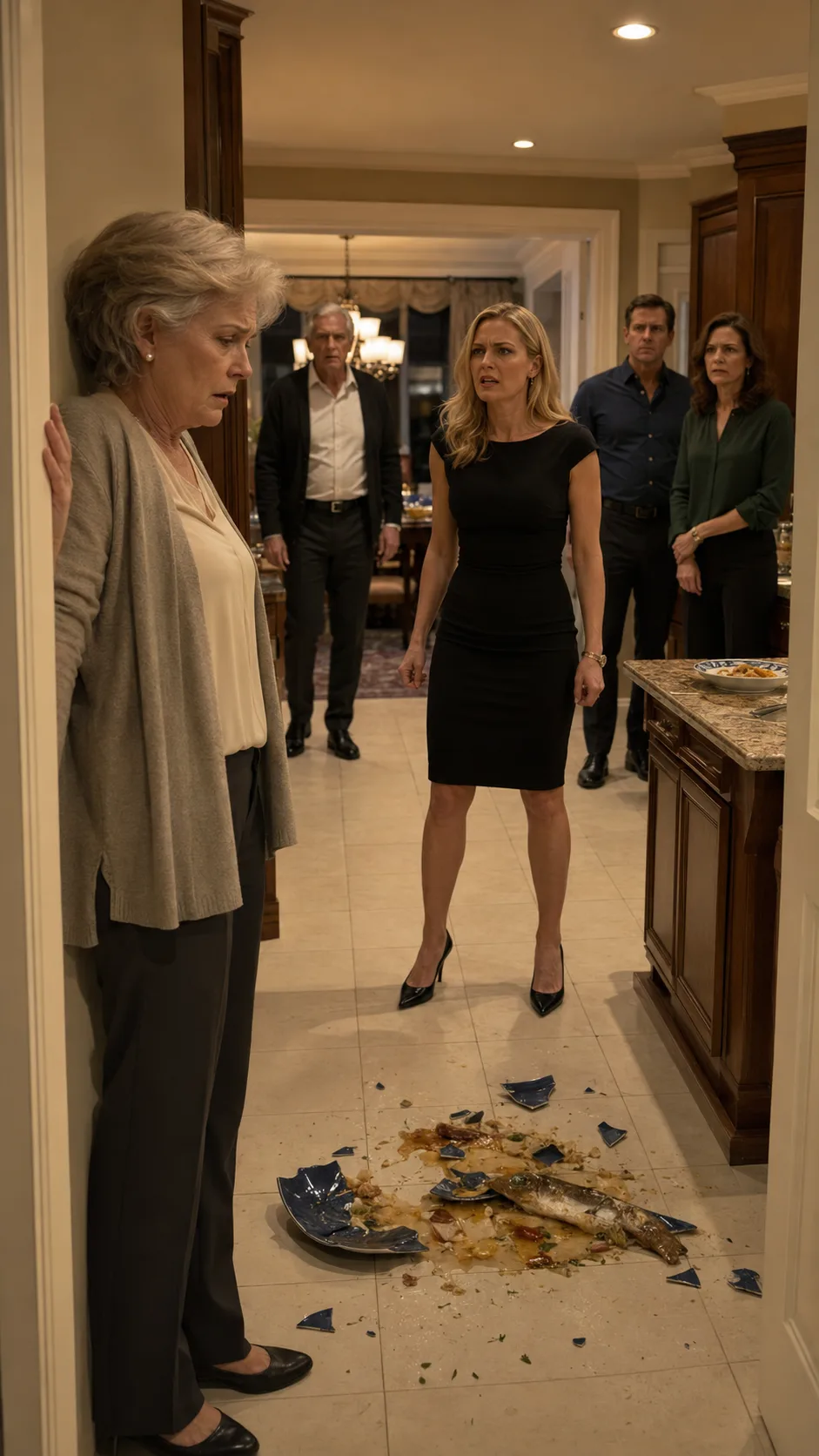
Three weeks after the eviction, I found her standing in the kitchen, staring at the counter near where the platter had broken.
“Do you think Lily will remember us?” she asked.
“She was four,” I said softly. “Maybe not much.”
May nodded.
“That is the worst part. She will not even know what she lost.”
That is what May carries now.
Not anger.
Not revenge.
Lily.
Every day, like a weight she did not choose.
Christopher sent me a birthday card this year. No message. Just his signature.
I did not respond.
It sits in my desk drawer beside the termination notice.
I do not keep the notice as a trophy. There is no trophy in any of this. I keep it as a reminder that some choices are necessary and still cost everything.
Last week, May found an old photograph of Christopher as a boy at Elaine’s funeral, standing beside me in a navy suit too big for his shoulders, holding my hand with both of his.
She brought it to me in the den.
“He needed you then,” she said.
“I know.”
“Does he need you now?”
I did not answer.
Because I did not know whether Christopher needed me, or only needed what I could give him.
There is a difference.
One I learned too late.
The house is quiet now, just May and me.
Quiet has changed its meaning over the years. When Elaine died, quiet meant absence. When I married May, quiet became peace. After Jessica, quiet sometimes feels like a locked door. Sometimes like safety. Sometimes like the space after an explosion when everyone is still checking whether they can hear.
May laughs sometimes.
Not as often as before.
But last Sunday, I heard the piano.
At first, I thought I imagined it. She had not played in months. The piano sits in the front room, a walnut upright she owned before I knew her. She used to play old songs in the morning, sometimes hymns, sometimes little pieces of Gershwin when she thought I was not listening.
Last Sunday, after lunch, I heard one note.
Then another.
Just scales.
Nothing more.
I stood in the doorway and watched her hands move slowly over the keys. Afternoon light touched her silver hair. Her shoulders were straighter than they had been in a long time.
She did not turn around.
I did not speak.
That is what I have.
She is here.
She is safe.
Sometimes she plays.
I chose her.
I would choose her again, even knowing everything that choice took from me.
Some nights, I dream of Christopher as a boy. Not the man in my garage saying cruel words. Not the husband making excuses. Not the son who hid behind his wife’s rage.
I dream of the boy with grass-stained knees. The boy who asked whether heaven had bicycles after his mother died. The boy who once stood in the kitchen and asked if I was lonely.
In the dreams, I always answer too late.
Maybe that is what haunts parents most. Not only the harm our children do as adults, but the fear that some part of it grew in silences we left unfilled when they were young.
I do not blame myself for Jessica.
But I do blame myself for teaching Christopher, in ways I did not see, that conflict could be survived by waiting it out.
After Elaine died, I avoided hard conversations because the children had already suffered enough. If Christopher lied, I gave him time. If Patricia was angry, I let her cool off. If grief sat at the table, I changed the subject.
I thought I was being gentle.
Maybe sometimes I was.
Maybe sometimes I was teaching them that discomfort was something to step around.
Christopher learned too well.
He stepped around everything until his wife put her hands on mine.
No more.
That was the moment the stepping around ended.
I have not called him yet.
I may.
Not to rescue him.
Not to offer money.
Not to undo the consequence.
If I call, it will be to say this:
I love you. I will always love you. But love is not a house you get to live in after helping someone set fire to it. Love is not silence. Love is not pretending. Love is not letting your wife become a weapon and then calling her damage an accident.
If you want to rebuild something with me, bring truth.
Bring responsibility.
Bring no excuses.
Maybe he will hang up.
Maybe he will cry.
Maybe he will ask for money.
Maybe he will surprise me.
I do not know.
At seventy-one, I have finally stopped pretending love gives me the power to predict people.
The shelter sent a letter after the donation. May made me open it.
Inside was a note from the director. The money had helped fund transitional homes for families leaving unsafe places. One mother and two children had moved in after sleeping in their car. The first night, the children slept in beds. The mother cried when she saw the kitchen.
A kitchen.
A door that locked.
May pressed the letter to her chest.
“Then something good came out of it,” she said.
Something good.
Not enough to erase the bad.
But something.
That is what we get sometimes. Not perfect justice. Not everyone apologizing. Not a family returning to the table clean and changed.
Sometimes all we get is one safe door.
One woman playing scales.
One granddaughter somewhere we hope still remembers being loved.
One son who may or may not find his way back through the wreckage he helped create.
And one old man sitting at his desk, remembering what it cost to choose rightly.
The night Jessica shoved May, I thought the decision began there.
It did not.
That night was only the moment the truth became visible.
The decision began years earlier, every time I stayed quiet because I wanted peace. Every time May swallowed an insult to keep Christopher comfortable. Every time Christopher called cruelty stress, embarrassment, tiredness, or accident.
A family is not kept together by refusing to name harm.
That only teaches harm where to live.
I wish I had learned sooner.
I wish May had not paid the price for my patience.
I wish Lily still came over and left blocks under the sofa.
I wish Christopher had chosen differently.
I wish many things.
But wishing is not a plan.
The plan now is simple.
Keep May safe.
Keep the door locked.
Keep the truth where I can see it.
And if Christopher ever knocks—not for rescue, not for a house, not for an easier consequence, but for the beginning of an honest reckoning—I hope I am strong enough to open the door without handing him the keys.
Until then, I live with what I chose.
May is upstairs now. I hear her moving around the bedroom, opening drawers, humming under her breath. The sound is small, almost nothing.
But in this quiet house, it reaches me.
She is here.
She is safe.
Sometimes she plays.
I chose her.
I would choose her again.
THE END.
Chapter complete
You have reached the end of this chapter.
Continue reading
A few more worlds to get lost in after this chapter.




