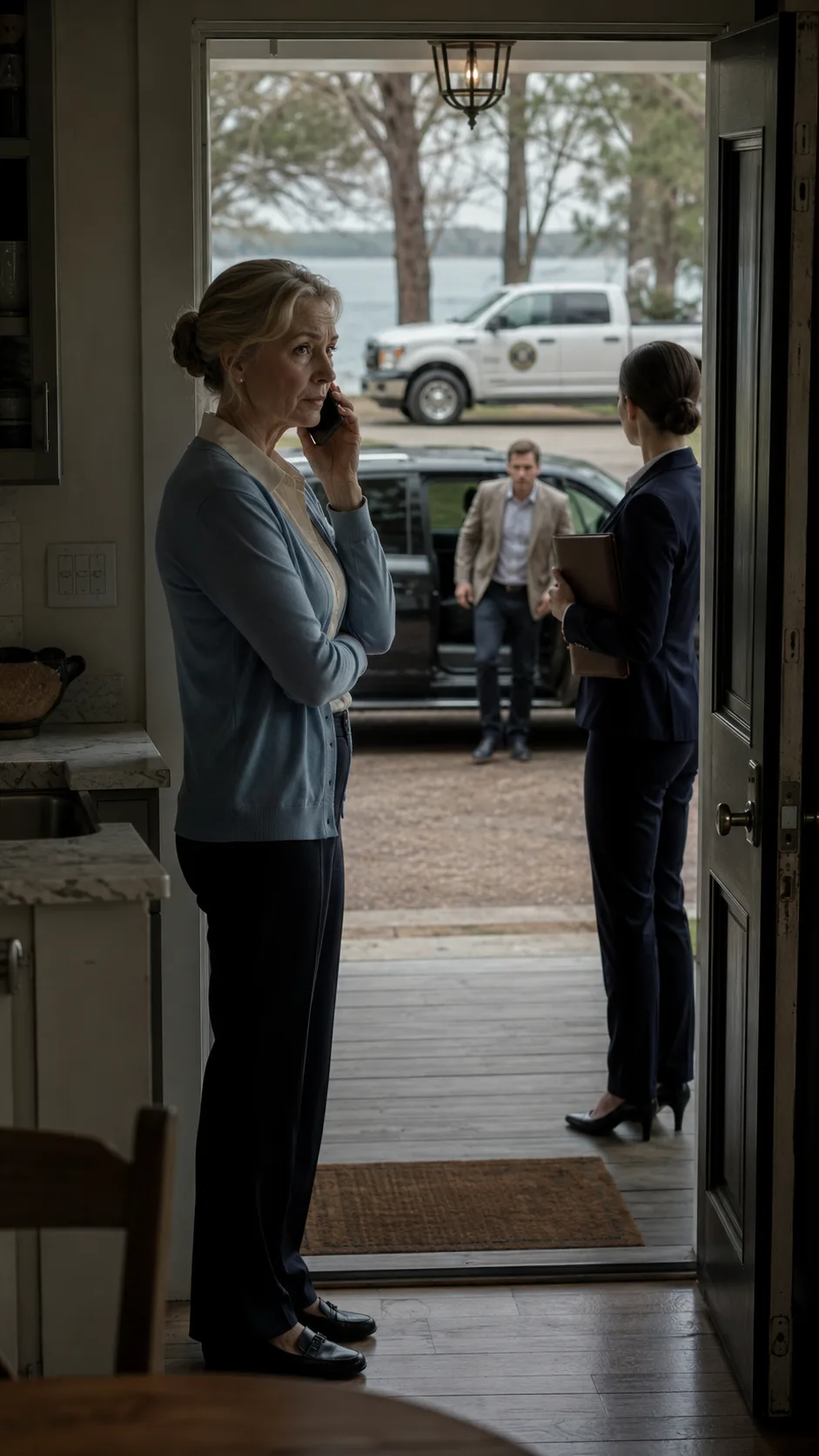
Megan saw the envelope and laughed too loudly.
Chapter 3
Megan saw the envelope and laughed too loudly.
It was the kind of laugh people use when they are not amused, only terrified.
“Oh, please,” she said. “Now there’s a secret letter? How convenient.”
Jason did not laugh.
He was staring at his father’s handwriting.
I knew that look.
He had worn it as a boy whenever Henry called his full name from the garage. Jason Whitaker could argue with me. He could dismiss me. He could dress greed up in words like market, cash, liquidity, and future.
But Henry’s handwriting still reached a part of him he had not managed to kill.
Abigail held the envelope toward me.
“Mrs. Whitaker,” she said, “this belongs to you.”
My fingers trembled when I took it.
For eight years, I had lived in this house with Henry’s absence.
His boots were gone from the mudroom. His coffee mug had been chipped, washed, and placed on the high shelf I never
used. His voice had faded from the rooms slowly, then suddenly, until sometimes I wondered if memory itself was another kind of betrayal.
But when I touched that envelope, he was there.
Right there.
Megan folded her arms. “Jason, don’t just stand there. Say something.”
Jason’s voice came out thin.
“Mom… don’t open that in front of everyone.”
I looked at him.
That was the first thing he had asked me for all day that sounded like fear instead of entitlement.
“Why?” I asked. “You sold my house in front of strangers.”
His face twisted.
“I made a mistake.”
“No,” I said. “You made a plan.”
I opened the envelope.
Inside was a single folded letter and a photocopy of another document.
The first line of Henry’s letter nearly took my knees out from under me.
Grace, if you are reading this, then our son has chosen the house over
his mother.
I closed my eyes.
Jason whispered, “Dad…”
I kept reading aloud.
I am sorry I did not teach him better. I am sorrier if I loved him in ways that made him believe love meant rescue without consequence.
Megan rolled her eyes. “This is manipulative.”
Abigail’s voice cut across the kitchen.
“Mrs. Whitaker is reading. You can remain silent or leave.”
Megan’s mouth snapped shut.
I continued.
Jason came to me three years before my diagnosis and asked for money. Not a loan, though he called it one. He said he needed help saving his business, his credit, his reputation. I gave him two hundred fifty thousand dollars.
Jason looked away.
My breath caught.
I had known Henry gave Jason money once. I did not know the number.
Two hundred fifty thousand dollars.
Henry’s letter continued.
In exchange, Jason signed the enclosed waiver acknowledging that he had received
an advance against any future interest connected to the lake house and that he would make no claim against Grace’s ownership during her lifetime or after her death.
Megan’s face changed.
Not shock.
Calculation.
She turned to Jason slowly.
“You told me your father never helped you.”
Jason rubbed both hands over his face.
“Megan, not now.”
She laughed under her breath. “Not now? You told me this house was what he owed you.”
I looked at my son.
“What did you tell her?”
Jason’s eyes were red now, but I did not know whether from shame, anger, or the collapse of a lie too heavy to hold.
“I told her Dad promised me the lake house.”
“He promised you summers,” I said. “Fishing. Family. A place to bring your children. He never promised you my eviction.”
Abigail took the photocopy from my hand.
“This waiver appears notarized and valid,” she said. “Mr. Alvarez?”
Mr. Alvarez reviewed it on the kitchen table.
“Yes,” he said after a moment. “This matches a recorded trust supplement. The descendant forfeiture clause applies.”
Paul Dreyer exhaled hard.
“So the sale is void.”
“Completely,” Abigail said. “And any funds placed in escrow must be returned.”
Paul looked at Jason.
“Then you and your agent will be hearing from my attorney.”
Jason’s shoulders dropped.
Megan stepped back as if the damage might stain her shoes.
“Jason,” she said quietly, “tell me you didn’t use the escrow expectation for the townhouse deposit.”
He did not answer.
The room seemed to tilt toward her.
“You idiot,” she whispered.
It was the first honest thing she had said all day.
Jason looked at me then, and for a second I saw the twelve-year-old boy from the photograph. The one holding a fishing pole too big for his hands. The one who once ran into the house crying because he hooked his sleeve and thought the wound would never stop bleeding.
“Mom,” he said, “I was going to fix it before closing.”
“No,” I said. “You were going to make it impossible for me to say no.”
Megan’s face hardened again.
“She’s enjoying this,” she told him. “Can’t you see that? She wants you humiliated.”
I laughed softly.
That sound surprised even me.
“Megan, if I wanted humiliation, I would have let you finish the closing.”
She turned white.
Because that was the truth.
I could have waited.
I could have let them sign every page, shake every hand, accept every congratulation, and then watch the whole beautiful fraud collapse in public.
But Henry had taught me that revenge and justice are cousins, not twins.
One destroys everything.
The other leaves enough standing for people to choose who they become next.
Abigail placed both hands on the table.
“Mrs. Whitaker, you have options. You can pursue civil claims. Depending on the power of attorney document, there may also be criminal exposure.”
Jason flinched.
Megan stepped away from him.
There it was.
The first crack in their perfect little alliance.
When the plan was profit, they were partners.
When the plan became evidence, she needed distance.
I picked up Henry’s letter and walked toward the back door.
Everyone followed in silence except Megan, who stayed in the kitchen with her phone clutched like a weapon that had run out of bullets.
I walked down the porch steps toward the dock.
The lake was gray under the late-afternoon sky. Wind moved across the surface in long silver lines. The old boathouse leaned slightly to the left, just as it had for twenty years, refusing to fall because Henry had reinforced the beams himself.
Jason stopped beside me.
For a long time, neither of us spoke.
Then he said, “I thought if I got the money, everything would calm down.”
“Money does not calm people like Megan,” I said. “It only teaches them where to dig next.”
He swallowed.
“She said you were selfish.”
“I know.”
“She said Dad would have wanted me to have it.”
“I know.”
“She said you were just holding on because you didn’t want me to be happy.”
I looked at him then.
“Jason, your wife did not make you betray me. She gave you permission to do what you already wanted.”
That hit him harder than any shout would have.
His face crumpled.
“I’m sorry,” he whispered.
I wanted to grab that apology and hold it against the years. I wanted to pretend it repaired the phone call, the forged paper, the way he had spoken about my life like a storage problem.
But motherhood teaches women to confuse pain with duty.
I was done confusing them.
“I believe you are sorry that it failed,” I said. “I do not yet believe you are sorry that you tried.”
He cried then.
Quietly.
Not enough to change what he had done.
Enough to prove some part of him was still alive.
Behind us, Megan came onto the back porch.
“Jason,” she called, “we need to go. Now.”
He turned toward her.
For the first time that day, he did not move when she spoke.
Abigail stepped onto the porch behind Megan.
“Before anyone leaves,” she said, “I need the original of that power of attorney document and the contact information for the person who prepared it.”
Megan’s jaw tightened.
“I don’t have it.”
Jason looked at her.
“You said your cousin handled it.”
Megan’s eyes flashed.
“Do not start.”
Jason stared at her for a long moment.
Then something in his face changed.
Not courage yet.
Maybe the first pale shape of it.
“Megan,” he said, “where did you get the notary stamp?”
She slapped him.
The sound cracked across the dock, across the porch, across the water.
No one moved.
Then Paul Dreyer, still standing near the kitchen door, muttered, “Well, that answers a few questions.”
Megan looked around and realized every witness she had forgotten was still present.
The county clerk.
The attorney.
The buyer.
Me.
Jason touched his cheek.
Then he stepped away from her.
That was how their empire ended.
Not with police lights.
Not with screaming sirens.
With one slap and a husband finally understanding that he had not been leading anything.
He had been useful.
Three weeks later, the sale was formally voided.
Paul Dreyer recovered his escrow. Jason signed a sworn statement admitting he had no authority to sell the lake house. Megan’s cousin, who was not a notary and barely a paralegal, disappeared from her office for exactly four days before an investigator found her.
I did not press every charge I could have pressed.
People called that mercy.
It was not mercy.
It was strategy.
Jason agreed to repay every legal fee, every county cost, and every dollar lost by the buyer because of his attempted sale. He also signed a permanent disclaimer of any future claim to the lake house.
Megan moved out of their townhouse before Thanksgiving.
Jason came to see me once in December.
He did not bring flowers.
He brought Henry’s old tackle box, which he had taken from the garage years earlier and never admitted.
“I thought it belonged to me,” he said.
I opened it.
Inside were rusted hooks, faded lures, and a photograph of Henry holding baby Jason on this very dock.
I closed the box gently.
“No,” I said. “It belonged to your father. There’s a difference.”
Jason nodded.
“I know that now.”
Maybe he did.
Maybe he was only beginning to.
On Christmas Eve, I sat alone in the kitchen with Henry’s letter beside my coffee cup.
There was one final paragraph I had not read aloud that day.
Grace, keep the house as long as it gives you peace. When you are done with it, let it become something better than an inheritance. Let it become shelter.
So I did.
The following spring, I amended the trust with Abigail Reed’s help.
After my death, the lake house would become the Henry Whitaker Memorial Retreat, a quiet place for widows, grieving parents, and families who needed one peaceful week near the water without paying a cent.
Jason found out from Abigail, not from me.
He called that night.
For once, he did not yell.
“Mom,” he said, “Dad would have liked that.”
I looked out at the lake, where the last light of evening lay across the water like a promise.
“Yes,” I said. “He would have.”
Then I hung up, poured a cup of coffee, and sat on the porch of the house my son tried to sell.
The house he thought was his future.
The house his father had turned into my protection.
And for the first time in years, the silence did not feel empty.
It felt like mine.
THE END
Chapter complete
You have reached the end of this chapter.
Continue reading
A few more worlds to get lost in after this chapter.




