Part 4 — The Inheritance She Couldn’t Throw Away
It took a few weeks to arrange, partly because the baby came in the middle of it.
Chapter 4
Part 4 — The Inheritance She Couldn’t Throw Away
It took a few weeks to arrange, partly because the baby came in the middle of it.
Hudson arrived on a rainy Thursday, seven pounds and furious about it, with — I am not making this up — his grandfather’s exact frown.
The first time they put him in my arms, that cross little face working itself up to a holler, I saw Frank so clearly I had to sit down.
“There you are,” I whispered to him. “We’ve been saving up for you a long time, little man.”
The baby changed things a little in everyone.
Even Madison was softer, exhausted and human in the way new mothers are, the labels temporarily forgotten under spit-up and no sleep.
For a few days, I let myself hope the gathering might not even be necessary. Maybe the baby would melt the whole thing.
Then I saw Madison’s first posted photo of Hudson.
Staged.
Filtered.
In a four-hundred-dollar outfit, with the brands listed.
And I knew the softness was
a phase.
The values were the structure.
Hudson was already being measured for the same little tags his mother had been raised inside.
That meant Frank’s gift, and Frank’s letter, mattered more than ever.
That baby was going to grow up in a house that taught him a thing’s worth was printed on its label.
Somewhere in his life, he would need the opposite lesson.
Sewn by hand.
Paid for in patience.
Waiting in an envelope marked eighteen.
So I sent the invitations.
Sunday dinner.
My house.
Everyone.
And I got out the blanket.
They came on a Sunday evening into a house that smelled like pot roast, because some weapons are kindness.
Kyle arrived gray and quiet, carrying the baby.
Madison was polished again, wary.
Gail came because missing it would have looked worse than attending.
Caroline arrived early to help me and to stand at my shoulder like
the sister Frank would have wanted there.
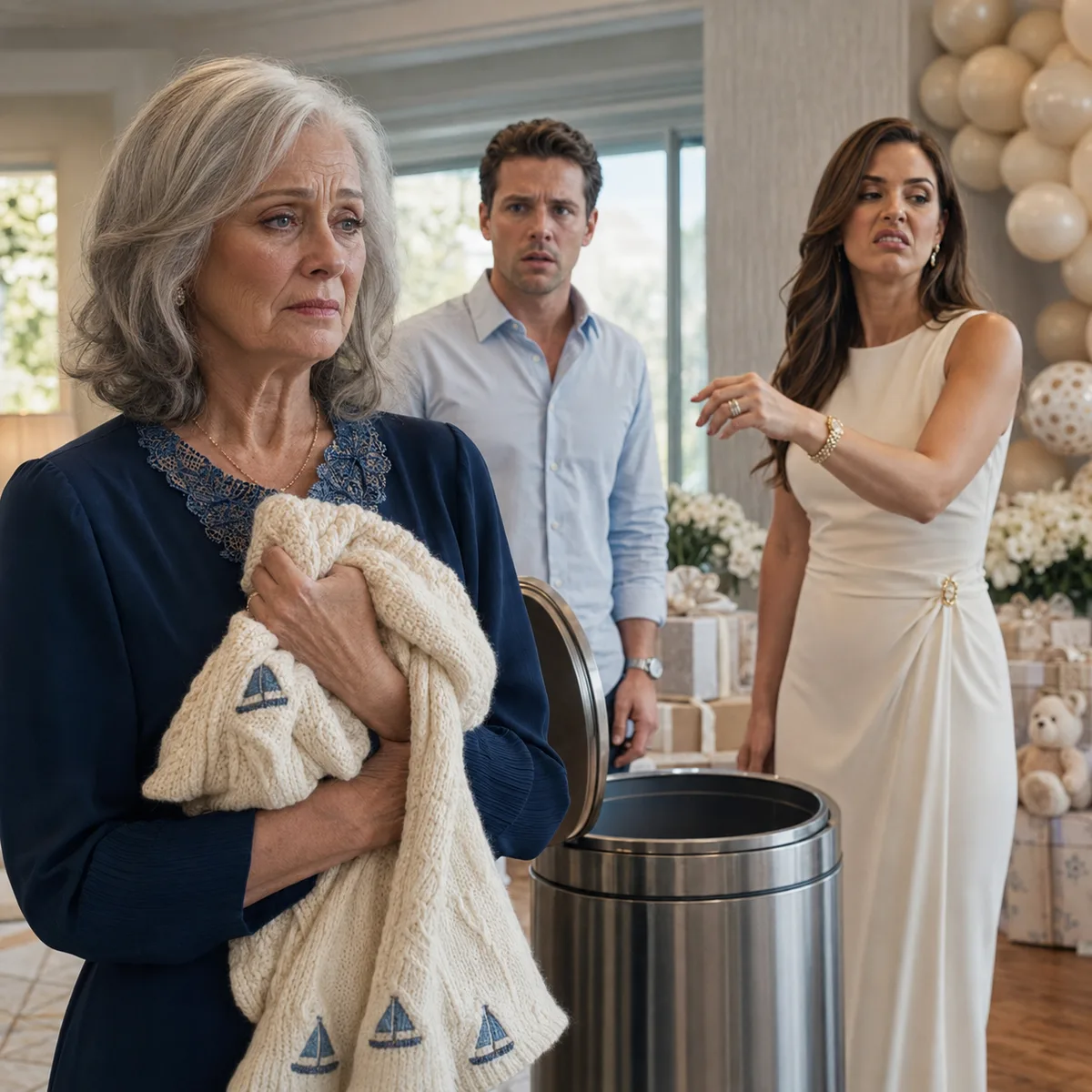
I had set the table nicely. In the center, where the centerpiece would normally go, I laid the blanket.
It had been washed.
The trash smell was gone.
The sailboats were bright.
Frank’s initials sat in the corner.
I folded it with the inner pocket facing up.
Madison’s eyes went to it the second she walked in. Her face did something complicated.
She had not expected to see it again.
I think she had hoped it would quietly disappear, the way uncomfortable things do for people used to having discomfort handled for them.
We ate first.
I insisted.
You do not do the hard thing on an empty stomach, and I wanted everyone settled, fed, and unable to claim they had been ambushed.
We talked about the baby.
It was almost pleasant.
Madison even thanked me for the roast, and seemed surprised to
mean it.
Then I cleared the plates. I sat back down and put my hand flat on the blanket.
“I’d like to give Hudson his gift from his grandfather now,” I said. “Properly this time, the way Frank asked me to before he passed.”
The table went still.
Kyle’s jaw tightened.
Gail set down her wine.
Madison went carefully blank.
“Madison,” I said, my voice warm and steady and not unkind, “you held this blanket a few weeks ago. You decided what it was worth. And you threw it away.”
Her face tightened.
“I’d like to show you, and everyone here, what you were actually holding.”
I picked up the seam ripper.
I opened the inner pocket in front of all of them, slow and deliberate. The little tool slid through the stitches I had sewn with such care.
Then I drew out the contents and laid them on the clean table one at a time, like a banker counting out a fortune.
Which is exactly what I was doing.
“These,” I said, setting down the thick rubber-banded stack, “are United States savings bonds. Your father bought them, Kyle. A few at a time, every birthday and every bonus for almost thirty years, starting the year you turned ten.”
I touched the stack.
“The envelope in his closet said, ‘For our first grandbaby.’ They came due this year. They are worth forty-seven thousand dollars.”
The number went around the table like a cold draft.
Gail’s mouth opened.
Madison went very pale.
“And this,” I said, setting down the envelope gently, like setting down a sleeping child, “is the last letter your husband ever wrote, Kyle. He dictated it to me in the hospital. It is for Hudson to open on his eighteenth birthday, so a boy who will never meet his grandfather can sit down someday and hear from him anyway.”
I touched the envelope.
“Frank’s exact words to me were, ‘Make her open the blanket. Make them find it. Make it last.’”
I looked up.
I looked directly at Madison.
And I kept my voice as gentle as I have ever kept it, which somehow made it worse for her.
“This is what you held in your hands at the shower,” I said. “Forty-seven thousand dollars and the last words of a man who loved that baby before he ever saw his face. This is what you called homemade. This is what you dropped in the trash can on camera in front of twenty people because it did not match your aesthetic.”
Nobody breathed.
Brooke’s video, I knew, was still out there in the world, and everyone at that table knew it too.
Madison did what Madison does.
She reached immediately for the version where she was the victim.
“You can’t put this on me,” she said, her voice climbing. “How was I supposed to know? Who sews that kind of money into a blanket and doesn’t tell anyone? That’s a trap. Basically, you set me up. You let me—”
“I did not let you do anything, Madison,” I said, still calm. “Your husband’s father asked, near the end of his life, that the gift be hidden in something handmade, so it would be treasured instead of spent. I honored him.”
I paused.
“I assumed, foolishly, I’ll grant you, that no one would throw a handmade blanket in the garbage. That assumption was my only mistake. The throwing was entirely yours.”
“It was a joke,” she said. “It was for the—”
“For the camera,” I finished gently. “I know. That is rather the whole problem.”
I folded my hands on the table.
“You only use designer things, Madison. You told the whole room. So you took the only priceless thing you were given that day and put it in the trash because it did not come with a logo. Because your friend was filming. Because you have been taught your entire life that worth is something printed on a tag.”
I let it land.
“There is no tag on love. There is no brand on thirty years of a man saving for a child he knew he might not live to meet. You could not see it because you have never been taught how to look. And it nearly cost your son his inheritance and his grandfather’s last words.”
Gail started to speak.
“Now, that’s not fair. Madison didn’t—”
I turned my eyes to her just once.
“Gail,” I said. “You taught her how to look. I’d sit this one out.”
Gail sat it out.
Then I told them what I had decided, because mercy and consequence can sit at the same table.
I had raised Kyle to know the difference.
“Here is what happens now,” I said. “Hudson gets every cent. Frank saved it for the baby, and the baby will have it.”
I laid my hand on the bonds.
“But not the way it was meant to be given. I cannot hand an open inheritance to a household that throws legacies in the trash for content. So this money is going into a locked education trust, administered independently, for Hudson and Hudson alone. For his schooling. His start. It cannot be spent, borrowed against, or touched by his parents. Not by Madison. Not by you, Kyle. Not by me.”
Kyle nodded slowly.
I saw, with a small ache, that he understood. The locking out included him. He did not argue, because he knew he had earned it by the wall that day.
“And the blanket,” I said, “comes home with me tonight. Hudson can have it when I see it will be honored, and not before. A thing is not safe in a house that did not know it was precious.”
Madison opened her mouth to protest the blanket, I think, which tells you she still had not understood a word.
Then Kyle, my quiet son, finally spoke.
“Madison.”
Just her name.
But in a voice I had never heard him use with her.
“Don’t. Not one more word. Not about the blanket. Not about whose fault it is. Not one more word.”
And Madison, for the first time since I had met her, closed her mouth and kept it closed.
It had taken forty-seven thousand dollars and a grandfather’s letter to give my son a spine.
But there it was.
Better late.
There was one thing left to do.
The most important thing.
The thing Frank actually wanted.
“His letter is for Hudson at eighteen,” I said. “It will wait sealed in the trust until then. But Frank wrote one part for all of us too. A little opening for the day the family first learned about the gift. He made me promise to read it out loud when that day came.”
I took a second, smaller envelope from my cardigan pocket.
“He did not know it would be a day like this,” I said. “But here we are.”
I opened it.
My hands shook, not from the arthritis this time.
And I read my husband’s words to his family in my kitchen, with his grandson asleep in his son’s arms.
“If you’re hearing this,” I read, “then the little one has finally arrived, and I’m sorry I couldn’t be there to be a nuisance about it. I’ve been saving for this baby since Kyle was ten years old, because the best thing my own grandfather ever gave me wasn’t money. It was the proof that someone was thinking of me before I existed. That’s what’s in this blanket. Proof that you were wanted, little one, by an old man who never got to meet you. Spend the money on something that lasts. And whatever you do…”
My voice broke there, and I let it.
“Be the kind of family that knows the difference between what a thing costs and what a thing is worth. Your grandmother does. Learn it from her. All my love, Frank.”
The room was silent.
Caroline was crying openly.
Kyle had his face pressed to the top of his sleeping son’s head, his shoulders shaking.
And Madison was looking at the blanket on the table, the one she had thrown away.
For the first time, I think, she was actually seeing it.
It was too late to be forgiveness.
But it might, just might, have been the beginning of learning how to look.
I folded the letter back into its envelope.
The hard part was done, and I am not a cruel woman, so I softened the way you let a room breathe after a hard truth.
“I did not do this to humiliate you, Madison,” I said. “Though I understand it feels that way. I did it because that baby is going to grow up in your house, learning your values. Someday he is going to need to know there was another way to measure things.”
I touched the bonds.
“The bonds are for his future. The letter is for his heart.”
Then I rested my hand on the blanket.
“And the blanket is to remind everyone, including me, that the most precious thing in a room is almost never the most expensive one.”
I looked at my son.
“Kyle,” I said, “you stayed quiet at that shower because quiet was easier. You have stayed quiet your whole life because it was easier. I am not angry at you, but I need you to hear me as your mother. The blanket survived because I refused to be quiet about what it was worth, even when being quiet would have been so much more comfortable. That is the inheritance, son. Not the bonds. That.”
He nodded.
He could not speak.
He did not need to.
Then I looked at the whole table.
“I am Hudson’s grandmother. Not optional. Not a thrift-store relative you tolerate at holidays. I made that baby a blanket with hands that do not work the way they used to, and I will be in his life fully, or this family and I will have a much harder conversation than this one. Those are the terms.”
Nobody argued with the terms.
Here is how it shook out in the months after, because I know you want the ledger and not just the feeling.
The trust is locked and growing.
Forty-seven thousand dollars sitting quietly, doing for Hudson exactly what Frank intended, waiting patiently the way Frank himself would have.
Hudson cannot touch it until he is grown, and neither can anyone else.
That is the point.
Frank thought in decades.
Now so does his grandson’s future.
Brooke’s video, the one of Madison dropping the blanket and saying, “We only use designer things here,” turned out to have been seen by more of the family than Madison realized.
She had posted it as a cute moment before any of us knew what was inside.
She took it down, of course, the day Kyle told her the truth.
But the internet keeps what it is given, and enough people had seen it that Madison spent a long, quiet season being known in her own circle as the woman who threw away her child’s inheritance for a laugh.
I did not do that to her.
She filmed it herself.
There is a lesson in that too, about living for a camera.
Gail and I are not close.
We never will be.
But she has stopped saying “bless her heart” to me, which I count as a diplomatic victory.
Madison and I are careful.
She has never fully apologized. She is not built for it.
But a few weeks later, she asked me in a small voice if I would teach her to knit.
I said yes.
Together, we made a lopsided, ugly, wonderful little hat for Hudson.
Her first handmade thing.
She kept it.
She did not throw it away.
It is a start.
Kyle changed the most.
Grief and shame did to him what years of comfort never could.
They grew him a backbone.
He came to me about a month after the dinner, alone, and sat at my kitchen table where the blanket had been.
“I’ve been replaying it,” he said. “The shower. I keep landing on the same thing. I didn’t fail Dad when I let the blanket go into the trash. I failed him a hundred times before that. Every time I stayed quiet to keep Madison happy. The blanket was just the one I couldn’t unsee.”
That is a hard thing to know about yourself.
“You knew it about me for years,” he said. “Why didn’t you ever say?”
“Because some things a person has to find for himself,” I told him. “I could have told you a thousand times. It took a blanket in a bin to make you believe it.”
He is different now.
He speaks up.
He and Madison are in counseling, which I never thought I would see.
He still keeps Frank’s fishing hat on the hook by the door, but now he has told Hudson he will teach him to fish himself, the way Grandpa would have.
“I’m still learning how not to choose easier,” he told me. “But I’m choosing on purpose now. That’s new.”
It is new.
And I am proud of him.
Better late.
The blanket lives on Hudson’s crib now.
It took a few months. Long enough for me to be sure the house it was going into had learned, even a little, what it was holding.
When I finally brought it over, Madison had cleared a place of honor for it. She had put away the designer throw that used to be there, and she did not say a word about aesthetics.
She just watched me lay Frank’s sailboats over her son.
Then she touched the corner with his initials.
“FM,” she said quietly. “I never even noticed that was there.”
“Most people don’t,” I said. “You have to know to look.”
My hands are worse this winter.
Some mornings, the needles win, and I cannot knit at all.
But I am making Hudson a sweater slowly, a few rows on the good days, with his grandfather’s initials hidden in the cuff where he will find them someday if he knows to look.
Because that is what we do, the homemade grandmothers.
We sew ourselves into things quietly.
And we wait.
Frank taught me that.
Time pays interest on patience.
If there is one thing I would hand you from all of this, it is this:
The world will tell you louder every year that worth is a thing you can read off a label. That the expensive gift is the real one, and the homemade one is sweet but lesser.
Do not believe it.
The most valuable things in any room are almost always the quiet ones.
Made by hand.
Given without logos.
Easy to throw away if you have never been taught how to look.
Learn how to look.
And whatever you love, sew it into something that lasts.
Never let anyone tell you it belongs in the trash.
That is my story.
One homemade blanket.
One trash can.
And a love worth more than the whole designer room.
THE END.
Chapter complete
You have reached the end of this chapter.
Continue reading
A few more worlds to get lost in after this chapter.




