Part 2 — Frank’s Secret Inside the Blanket
About a week before Frank passed, when we both knew the truth without saying it too loudly, he asked me to bring him the old cigar box from the top shelf of his closet.
Chapter 2
Part 2 — Frank’s Secret Inside the Blanket
About a week before Frank passed, when we both knew the truth without saying it too loudly, he asked me to bring him the old cigar box from the top shelf of his closet.
I had seen that box for thirty years and never once opened it.
I assumed it held receipts, or his father’s war medals, or the kind of nothing a man keeps because throwing it away feels like a small loss.
It was full of savings bonds.
Stacks of them, rubber-banded by year, going back to before Kyle was even grown. United States savings bonds, bought a little at a time. Fifty dollars here. A hundred there. Every birthday, every bonus, every good month for almost thirty years.
On the envelope, in Frank’s blocky pencil, it said:
For our first grandbaby. I started the year Kyle turned ten.
Frank told me, his voice thin but his eyes clear, “Figured someday there’d be a little one. Wanted to hand them a head start nobody could take away.”
He squeezed my hand.
“They’ve all come due now, Dar. Thirty years. They’re worth real
money.”
I asked him how much.
He told me.
I will not make you wait for it the way the family had to.
It was just under fifty thousand dollars.
Then Frank told me the part that mattered more than the money. The part I think about every single day.
“Don’t just hand them an envelope,” he said. “Money in an envelope, they’ll spend it on a stroller and forget where it came from.”
He smiled.
The old Frank smile.
“Put them somewhere they’ll keep. Sew them into something. Make her open the blanket, Dar. Make them find it. Make it last.”
Make her open the blanket.
It was nearly the last clear instruction my husband ever gave me, and I intended to honor it perfectly.
So I knitted a blanket.
I started the month after the funeral, partly for the baby, and partly, I admit, to give my hands
something to do besides shake.
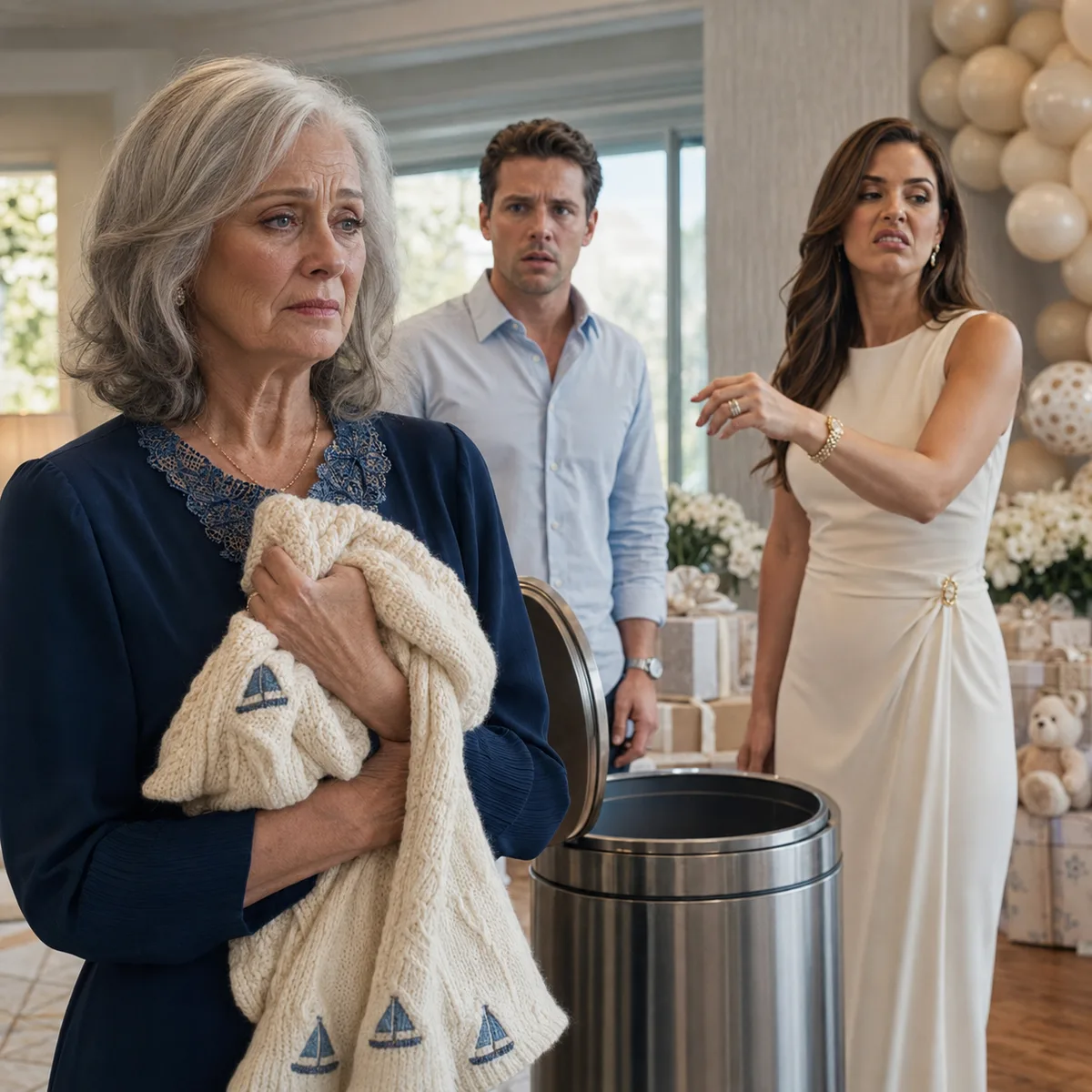
Cream-colored wool, soft as a cloud, with a border of tiny blue sailboats. Frank loved the water. He had promised that baby fishing trips he would never take.
In one corner, small enough that you had to look closely, I knitted his initials.
FM.
So a piece of him would be in the room for every nap, every fever, every bad dream, forever.
It took four months.
My hands made me pay for every row. There were nights I cried over it, not from the pain, but from the missing.
But I finished it.
And I will say, without false modesty, that it was the most beautiful thing I had ever made.
Then I did the real work.
On the underside, I sewed a flat inner pocket, the kind I used to hide in coat linings for travelers who did not trust their money to
a suitcase.
Into that pocket, I folded Frank’s bonds, all thirty years of them, and one more thing.
A letter.
Frank had dictated it to me in the hospital, in his own halting words, and made me write it down and read it back twice.
It was a letter to the grandchild he would never meet. A letter about who he was, where the child came from, and what he hoped for them.
I sealed it in an envelope that said:
To be opened when you’re eighteen. Love, Grandpa Frank.
I folded the bonds and the letter into the blanket’s lining and stitched it shut.
Neat.
Invisible.
Nearly fifty thousand dollars and a grandfather’s last words, sewn with love into something a young woman would later call cheap.
I wrapped it in plain cream paper and went to the baby shower.
I should tell you about Madison, because I do not want her to be a cartoon villain. She is more than that, and the “more” is the sad part.
My daughter-in-law grew up the only child of a woman named Gail, who measures the whole world in labels.
I met Gail exactly twice before the wedding, and both times she found a way to mention what her handbag cost.
Madison was raised to believe that the worth of a thing — a coat, a car, a person — is printed on a little tag. She was taught that the worst fate that can befall a woman is to be seen as common.
So Madison curates everything.
The apartment looks like a magazine.
The clothes are deliberate.
And ever since the pregnancy, the baby had become the ultimate accessory. A designer nursery. A registry full of brands I had never heard of and could not pronounce. A whole aesthetic of a perfect little life, documented and posted and admired.
I tried to like her.
I did.
She was not cruel to me exactly in the early days. She just looked at me the way she looked at a thrift store, with polite, faint distaste, as if she might catch something.
I think, underneath all the labels, Madison is frightened.
Frightened the way her mother taught her to be.
Frightened that if the wrong person looks too closely, they will see something cheap.
The cruel joke of people like that is they cannot recognize the genuinely precious when it is right in front of them, because it does not come with a logo.
She was about to prove that in front of twenty people with a camera running.
She just had no idea what she was holding when she did it.
And I should tell you about my son Kyle, because the part of this story that still aches is not Madison.
It is him.
Kyle is a good man who has spent his whole life avoiding conflict the way some people avoid heights.
He is gentle.
He is funny.
He loved his father fiercely.
And he fell hard for Madison.
Somewhere in the falling, he started going quiet. Agreeing. Smoothing things over. Keeping the peace.
When Madison’s mother redecorated their life in labels, Kyle just went along.
It was easier.
Kyle has always chosen easier.
After Frank passed, Kyle came apart in the way quiet men do: privately, where it does not inconvenience anyone. He would call me late sometimes just to talk about his dad. He kept Frank’s old fishing hat on a hook by his door.
He, of all people, knew exactly who his father was.
That is why, when the truth finally came out, it did not break Madison.
Madison deflected.
It broke Kyle.
Because Kyle was sitting right there at that shower.
Kyle watched his wife call his father’s final gift homemade and drop it in the trash. And Kyle, keeping the peace, choosing easier, said nothing.
He even laughed a little.
A nervous laugh.
He did not know what was inside. I want to be fair to him about that. He did not know.
But he knew the blanket was from me.
He knew his grieving mother had made it with hands that barely worked anymore.
And he let it go into the bin to avoid a scene.
That is the thing he is going to carry.
Not Madison’s cruelty.
His own silence.
Remember that when we get to the phone call.
Remember that the voice breaking on the line that night was a son who had just learned what his quiet had cost.
The shower invitation came on heavy card stock with gold edges.
Madison’s Garden Soiree, it said.
There was a dress code for a baby shower.
I did not mind.
I was, God help me, excited.
I had the most important gift in the world sitting wrapped on my dresser, and I had practiced in my head how it would go.
Madison would open it and find a soft cream blanket. Then I would say gently, “There’s something inside it, sweetheart. From Frank. Feel along the bottom seam.”
She would find the pocket, the bonds, and the letter. The whole room would understand that the quiet old man who could not be there had been planning for this baby for thirty years.
Make her open the blanket, Frank had said.
I was going to make sure she opened the blanket.
I bought a new blouse for the occasion, navy with a little lace collar. I wrapped the gift in plain cream paper because the blanket did not need gold edges to be precious. I tied it with a bit of blue ribbon the color of the sailboats.
I drove over with the box on the passenger seat where Frank used to sit, and I talked to him a little on the way, the way I do.
“Big day, Frank,” I said. “We’re giving them your bonds. Can you believe it? We’re going to be grandparents after all.”
I had no idea I was about to watch a stranger drop my husband into a garbage can.
Gail’s house was done up like a boutique hotel.
White peonies everywhere. A balloon arch in three shades of greige. A table of tiny catered things that cost more than they fed. A backdrop with the baby’s name in gold script.
They had chosen Hudson, after no one in particular, a name Madison said “tested well,” whatever that means.
I felt like a wren that had flown in through an open window.
Everyone was younger, glossier, dressed in clothes that knew they were being photographed.
I clutched my plain cream box and smiled. I found a chair near the edge, where the old aunt is meant to sit.
But I was not unhappy.
I had my secret, and secrets keep you warm.
Every time a young woman in a dress that cost more than my car looked at my box with that little flicker of pity, I thought about the pocket sewn into the lining and smiled to myself.
I want you to understand that, because of everything that happened that day, it is the part I grieve most.
I walked in happy.
I walked in carrying my husband’s love for a baby he would never hold, ready to give it away with both hands.
I had no armor on.
Why would I?
You do not wear armor to a baby shower.
You bring a blanket and a full heart, and you assume the people there will at least be kind.
I was about to learn that some rooms will throw your whole heart in the trash and call it a vibe.
There was a woman by the gift table with her phone out, filming. Madison’s friend Brooke, capturing content for Madison’s page.
I did not think anything of it then.
I would think a great deal of it later.
The whole event was built around the gift opening, which Madison ran like a product launch. She sat in a throne-like white chair under the balloon arch. Brooke filmed. Gail narrated for the room.
“Oh, that’s the Italian one. Isn’t it gorgeous?”
Madison held each gift up to the camera, named the brand, and thanked the giver by tagging them in the air, as if the whole point of the present was the label it announced.
A cashmere onesie.
A designer diaper bag that cost what I used to take home in a month.
A stroller with a name like a sports car.
Each one was held up, admired, photographed, cooed over.
The currency of the room was visible, and I did not have any of it.
I watched my son across the room.
Kyle stood near the wall with a drink he was not drinking, smiling the smile of a man who would rather be anywhere else. He caught my eye once and gave me a small helpless shrug, like a boy apologizing for weather.
I should have read that shrug better than I did.
It was the shrug of a man who already knew his wife was going to do something unkind, and had already decided not to stop her.
Aunt Caroline was there too. Frank’s younger sister. Sixty-five, sharp and warm, and the one person in that room besides me who had loved Frank.
She squeezed in beside me.
“Designer diaper bag,” she muttered. “In my day, we used a tote and the baby survived.”
I laughed.
She patted my box.
“Is that the famous blanket?”
I nodded.
“Frank told me what you were putting in it,” she whispered. “The old softy. That baby is one lucky little fish.”
I had no idea that Caroline knowing, and assuming everyone else knew too, would become the fuse on the whole thing.
“You should tell her before she opens it,” Caroline whispered. “About the bonds. So she’s careful with it.”
I shook my head, smiling.
“Frank’s orders. Make her open the blanket. Find it herself. I’ll point her to the seam after.”
Caroline chuckled.
“He always did love a bit of theater, my brother.”
I think about that exchange a lot.
If I had listened to Caroline, if I had stood up and announced before Madison touched it that there was nearly fifty thousand dollars and Frank’s last letter sewn inside, none of what followed would have happened.
Madison would have handled it like the Hope Diamond.
There would have been no story.
But I did not.
I was honoring a man’s final wish. And honestly, it never occurred to me in a thousand years that anyone would simply throw a handmade blanket away.
Refold it badly, maybe. Set it aside politely. Regift it someday.
But throw it in the trash in front of everyone, with a camera running?
That was a failure of imagination on my part.
I had lived sixty-eight years and never met cruelty quite that casual.
The gifts dwindled.
The designer pile grew into a little mountain beside Madison’s throne.
Then there were only two presents left on the table: a gift card in an envelope, and my plain cream box with its blue ribbon.
Gail picked up my box and read the little tag.
“From Grandma Darlene,” she announced, with the gentle condescension you would use for a child’s macaroni art.
A few people went, “Aw.”
Someone’s phone came up.
Madison took the box, gave the plain wrapping a quick assessing look, and the corner of her mouth did something I did not like.
“Let’s see what Grandma made,” she said.
She pulled off the paper.
For a moment, one moment, I let myself hope.
The cream paper fell away, and there it was.
Four months of my hands.
The softest wool I could afford.
The tiny blue sailboats marching along the border.
Frank’s initials hidden in the corner like a held breath.
In that glossy room full of things made by machines in factories, my blanket looked, to my eyes, like the only real thing there.
Madison held it up by two corners, the way you would hold something to check it for stains.
I watched her face.
I watched her register that it was handmade. The slight unevenness that means a human being did this. The very thing magazines now say makes an item precious.
I watched her decide what it meant.
Her nose wrinkled just slightly.
The tiny expression of a woman taught that homemade is another word for poor.
“Oh,” she said. “Did you make this?”
“I did, sweetheart,” I said.
My voice was warm. I started to lean forward to tell her about the seam, about Frank, about feeling along the bottom.
“There’s something special about it if you—”
But Madison was already talking over me. To the room. To the camera.
“That’s so sweet,” she said in the voice people use to end a conversation. “It’s very homemade.”
Gail laughed, that little tinkling laugh, and said, “Bless her heart.”
I felt the room tilt just slightly, the old familiar feeling of being made small.
But I still did not understand what was about to happen.
I thought the worst of it was the word homemade and the bless her heart. I thought I would smile through it, point Madison to the seam in private, and let the bonds redeem the whole afternoon.
I was wrong about how far she would take it.
What happened next happened fast, and I have replayed it in slow motion ten thousand times since.
Madison folded the blanket over her arm with a kind of finality. She looked around at her perfect greige party, her registry mountain, her watching friends, her filming Brooke.
I watched her make a calculation.
The social math of a woman who lives for an audience.
A homemade blanket did not fit the picture.
It clashed with the brand.
Madison had a camera running and a room to perform for. Somewhere in her label-measured heart, she decided that the funny, on-brand, content-worthy thing to do was make a little joke of it.
There was a tall steel trash can at the end of the gift table, the nice kind, lined with a crisp white bag for wrapping paper.
Madison stood up, blanket over her arm, and crossed to it.
“Okay, so,” she said, laughing, playing to Brooke’s phone, “I love Grandma, but we have a whole aesthetic for the nursery.”
She held the blanket out over the open can like a magician about to drop a scarf.
“We only use designer things here.”
And she let go.
My blanket.
Frank’s sailboats.
Frank’s initials.
Frank’s bonds.
Frank’s last letter to the grandson he would never meet.
It dropped into the trash can on top of torn wrapping paper.
The room laughed.
Not everyone.
But enough.
The nervous, follow-the-leader laugh of people who have decided the powerful person in the room is the one being funny.
Brooke’s phone caught all of it.
Gail clapped, delighted.
And my son, my Kyle, stood against the wall, went pale, opened his mouth, and closed it again.
He said nothing.
That was the worst second of the whole day.
Not the blanket in the bin.
My son’s mouth closing.
Click the blue “PART 3” below to read the next part: 👉 PART 3 👈
Chapter complete
You have reached the end of this chapter.
Continue reading
A few more worlds to get lost in after this chapter.




